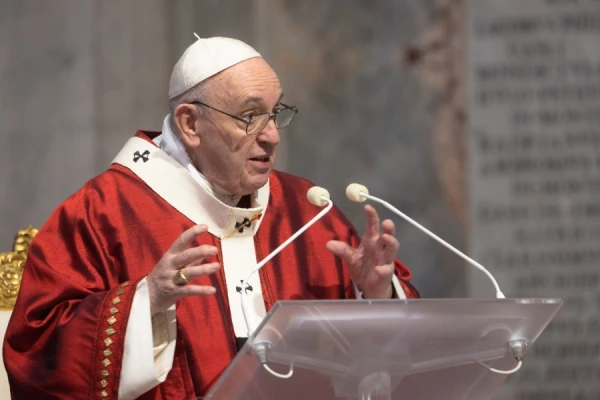
Vatican City, May 31, 2020 / 05:15 am (CNA).- Here is the full text of Pope Francis’ Pentecost Sunday homily, delivered May 31, 2020, at the Basilica of St. Peter, and checked against delivery.
“There are different kinds of spiritual gifts, but the same Spirit” (1 Corinthians 12:4), as the Apostle Paul writes to the Corinthians. He continues: “There are different forms of service, but the same Lord; there are different workings but the same God who produces all of them in everyone” (vv. 5- 6). Diversity and unity: St. Paul puts together two words that seem contradictory. He wants to tell us that the Holy Spirit is the one who brings together the many; and that the Church was born this way: we are all different, yet united by the same Holy Spirit.
Let us go back to the origin of the Church, to the day of Pentecost. Let us look at the Apostles: some of them were fishermen, simple people accustomed to living by the work of their hands, but there were also others, like Matthew, who was an educated tax collector. They were from different backgrounds and social contexts, and they had Hebrew and Greek names. In terms of character, some were meek and others were excitable; they all had different ideas and sensibilities. They were all different. Jesus did not change them; he did not make them into a set of pre-packaged models. He left their differences and now he unites them by anointing them with the Holy Spirit. The union comes with the anointing. At Pentecost, the Apostles understand the unifying power of the Spirit. They see it with their own eyes when everyone, though speaking in different languages, comes together as one people: the people of God, shaped by the Spirit, who weaves unity from diversity and bestows harmony because there is harmony in the Spirit. He himself is harmony.
Let us now focus on ourselves, the Church of today. We can ask ourselves: “What is it that unites us, what is the basis of our unity?” We too have our differences, for example: of opinions, choices, sensibilities. But the temptation is always fiercely to defend our ideas, believing them to be good for everybody and agreeing only with those who think as we do. And that’s a bad temptation that divides. But this is a faith created in our own image; it is not what the Spirit wants. We might think that what unite us are our beliefs and our morality. But there is much more: our principle of unity is the Holy Spirit. He reminds us that first of all we are God’s beloved children, all the same, in this, and all different. The Spirit comes to us, in our differences and difficulties, to tell us that we have one Lord — Jesus — and one Father, and that for this reason we are brothers and sisters! Let us begin anew from here; let us look at the Church with the eyes of the Spirit and not as the world does. The world sees us only as on the right or left, with this ideology, with that one; the Spirit sees us as sons and daughters of the Father and brothers and sisters of Jesus. The world sees conservatives and progressives; the Spirit sees children of God. A worldly gaze sees structures to be made more efficient; a spiritual gaze sees brothers and sisters pleading for mercy. The Spirit loves us and knows everyone’s place in the grand scheme of things: for him, we are not bits of confetti blown about by the wind, rather we are irreplaceable fragments in his mosaic.
If we go back to the day of Pentecost, we discover that the first task of the Church is proclamation. Yet we see that the Apostles do not prepare a strategy; when they were shut in there, in the Upper Room, they did not make a strategy, no, they do not prepare a pastoral plan. They could have divided people into groups according to their roots, speaking first to those close by and then to those far away… They could have also waited a while before beginning their preaching in order to understand more deeply the teachings of Jesus, so as to avoid risks… No. The Spirit does not want the memory of the Master to be cultivated in small groups locked in upper rooms where it is easy to “nest.” And this is a bad disease that can come to the Church: the Church not as a community, not as a family, not as a mother, but as a nest. He opens doors and pushes us to press beyond what has already been said and done, beyond the precincts of a timid and wary faith. In the world, unless there is tight organization and a clear strategy, things fall apart. In the Church, however, the Spirit guarantees unity to those who proclaim the message. The Apostles set off: unprepared, yet putting their lives on the line. One thing kept them going: the desire to give what they received. The beginning of the First Letter of John is beautiful: “What we have seen and heard we proclaim now to you” (1 John 1:3).
Here we come to understand what the secret of unity is, the secret of the Spirit. It is gift. For the Spirit himself is gift: he lives by giving himself and in this way he keeps us together, making us sharers in the same gift. It is important to believe that God is gift, that he acts not by taking away, but by giving. Why is this important? Because our way of being believers depends on how we understand God. If we have in mind a God who takes away and imposes himself, we too will want to take away and impose ourselves: occupying spaces, demanding recognition, seeking power. But if we have in our hearts a God who is gift, everything changes. If we realize that what we are is his gift, free and unmerited, then we too will want to make our lives a gift. By loving humbly, serving freely and joyfully, we will offer to the world the true image of God. The Spirit, the living memory of the Church, reminds us that we are born from a gift and that we grow by giving: not by holding on but by giving of ourselves.
Dear brothers and sisters, let us look within and ask ourselves what prevents us from giving ourselves. There are, let us say, three enemies of the gift — the main ones, three — always lurking at the door of our hearts: narcissism, victimhood and pessimism. Narcissism makes us idolize ourselves, to be concerned only with what is good for us. The narcissist thinks: “Life is good if I profit from it.” So he or she ends up saying: “Why should I give myself to others?” In this time of pandemic, how wrong narcissism is: the tendency to think only of our own needs, to be indifferent to those of others, and not to admit our own frailties and mistakes. But the second enemy, victimhood, is equally dangerous. Victims complain every day about their neighbour: “No one understands me, no one helps me, no one loves me, everyone has it in for me!” The victim’s heart is closed, as he or she asks, “Why aren’t others concerned about me?” In the crisis we are experiencing, how ugly victimhood is! Thinking that no one understands us and experiences what we experience. Finally, there is pessimism. Here the unending complaint is: “Nothing is going well, society, politics, the Church…” The pessimist gets angry with the world, but sits back and does nothing, thinking: “What good is giving? That is useless.” At this moment, in the great effort of beginning anew, how damaging is pessimism, the tendency to see everything in the worst light and to keep saying that nothing will return as before! When someone thinks this way, the one thing that certainly does not return is hope. In these three — the narcissistic idol of the mirror, the ‘mirror-god;’ ‘I feel like a person with grievances;’ and the ‘god-negativity,’ ‘everything is black, everything is dark’ — we find ourselves in the famine of hope and we need to appreciate the gift of life, the gift that each of us is. Therefore we need the Holy Spirit, God’s gift that heals us from narcissism, victimhood and pessimism, heals us from the mirror, from grievances and darkness.
Brothers and sister, let us pray to him: Holy Spirit, memory of God, revive in us the memory of the gift received. Free us from the paralysis of selfishness and awaken in us the desire to serve, to do good. Even worse than this crisis is the tragedy of squandering it by closing in on ourselves. Come, Holy Spirit: you are harmony; make us builders of unity. You always give yourself; grant us the courage to go out of ourselves, to love and help each other, in order to become one family. Amen.
 […]
[…]



Did you know that McCarrick had a thick dossier on him and you then appointed him to power? Answering no…would protect the flock from the feeling that you can dish out resignations but can’t take one for yourself nor can you let go of the attachment to the papacy and its ego thrills. So what is stopping you from answering…no. Has nothing to do with Christ’s use of silence.
Lk 4:16-30. Our Lord says quite a few things (understatement) in this Gospel before “he passed through the midst of them and went away.”
Is there no end to the manipulation of even the words of the Holy Gospel by Bergoglio (on the Memorial of St. Gregory the Great, Pope and Doctor of the Church) for the sake of himself and the “pack” he so readily defends?
So we should speak out against injustice, but not at this time, not regarding the scandal in the Church? Is the current “division” in the Church the actual scandal and not the history of sexual abuse, exploitation and cover up that may go “straight to the top?” Is the real or even worse “scandal” our speaking about it and wanting answers? Did the fact that many did not accept Bergoglio’s profound “silence”(not really “silence”)in response to Vigano’s letter/accusations demonstrate who was a member of “a pack of wild dogs,” not like Our Lord Himself and not “using reason?” Were these Catholics (who did not accept Bergoglio’s “answer” regarding Vigano) being led by the Devil and not Christ who expressed views on “scandal” Himself? Were they not being taught by St. Paul or the Saints? Not following the teachings of the Church? Not being led by reason?
His attempt to connect this Gospel with “disagreements” regarding “politics, sports or money” is also manipulative (an attempt at attenuation of the current “disagreement” in the Church) but somewhat laughable. He is though, getting warmer, as they say, with his reference to “the father of lies, the accuser, the devil.” But is all “unity” a good thing? Socrates would ask: is the “unity” of criminals a good thing or only a unity of those who seek the good and justice?
At what point does Bergoglio realize that Christ was being “led to the brow of hill” for stating the Truth and not because of an evasive, manipulative “silence” he imagines is like his own?
The Holy Father raises an important point with respect to silence and prayer, albeit one could argue that he uses it in the wrong context with respect to the current sexual crisis facing the Church. The report states that Pope Francis’ homily stated that ‘the people “rose up, drove [Jesus] out of the town, and led him to the brow of the hill… to hurl him down headlong. But he passed through the midst of them and went away.”’ These verses (referenced in the article by the Pope it appears) are found in Lk 4:29-30).
It is important to note that one cannot read scripture in isolation as the previous verses Lk 4:23-27, (apparently not cited in the report or the homily) speak to the reasons why they “rose up” to drive Jesus out of town. Jesus told the Jews that God’s salvation was not limited to them alone, but that Gentiles too would be saved (see Lk 4:23-27). Our Lord goes on to cite the death that ravaged the land during the drought prophesized by Elijah, (1 Kings 17), which killed Jew and Gentile alike. Christ further states that Elijah had been sent to the aid of a Gentile woman (see 1 Kings 17:9-24) and not a Jew when he says “It was to none of these that Elijah was sent, but only to a widow in Zarephath in the land of Sidon” (Lk 4:26). Similarly, Christ states that Elisha the prophet did not cleanse the Jewish lepers, “but only Naaman the Syrian” (Lk 4:27). The footnotes of the USCCB New American Bible state the following regarding these verses: A widow in Zarephath in the land of Sidon: like Naaman the Syrian in Lk 4:27, a non-Israelite becomes the object of the prophet’s ministry.
Thus, Christ was targeted by the mob not because he spoke falsehoods or refused to acknowledge the truth, but precisely because He was speaking the truth and the truth made high-minded Jews most uncomfortable, just as now those voices speaking for truth in the Church are making high-minded members of the hierarchy most uncomfortable.
By all means, prayer and silence are important and there is a time for such things. Equally, however, prayer must be accompanied with action or it is of little service to the Kingdom of God. Consider St. James who wrote that:
“What good is it, my brothers, if someone says he has faith but does not have works? Can that faith save him?
If a brother or sister has nothing to wear and has no food for the day,
and one of you says to them, “Go in peace, keep warm, and eat well,” but you do not give them the necessities of the body, what good is it?
So also faith of itself, if it does not have works, is dead” (James 2:14-17).
Similarly, one cannot remain silent and simply pray that the evil in the Church will be routed out. Without concrete steps taken to feed, clothe, and care for the body of Christ by way of demanding a full, transparent, comprehensive, and independent investigation into the evil that has found its way to high-placed positions (McCarrick, etc.) within the Church, then the Church will further become a place for resident evil. We must remember the words of Christ “whatever you did for one of these least brothers of mine, you did for me” (Mt 25:40), and, “what you did not do for one of these least ones, you did not do for me” (Mt 25:45). To stand by and simply pray and be silent is to stand by and watch the “least of these brothers of [Christ]” to be sexually, physically, emotionally, psychologically, and spiritually abused and those of us who stand by “will go off to eternal punishment” (Mt. 25:46).
Consider as well the parable of the Good Samaritan:
Jesus replied, “A man fell victim to robbers as he went down from Jerusalem to Jericho. They stripped and beat him and went off leaving him half-dead.
A priest happened to be going down that road, but when he saw him, he passed by on the opposite side.
Likewise a Levite came to the place, and when he saw him, he passed by on the opposite side.
But a Samaritan traveler who came upon him was moved with compassion at the sight.
He approached the victim, poured oil and wine over his wounds and bandaged them. Then he lifted him up on his own animal, took him to an inn and cared for him.
The next day he took out two silver coins and gave them to the innkeeper with the instruction, ‘Take care of him. If you spend more than what I have given you, I shall repay you on my way back.’
Which of these three, in your opinion, was neighbor to the robbers’ victim?”
He answered, “The one who treated him with mercy.” Jesus said to him, “Go and do likewise.” (Lk 10:30-37).
To simply pray and be silent, is simply to cross the road on the opposite side and that is not what Christ asks of His people.
Write letters to your Bishops, start signature campaigns within your parish, participate in the “white ribbon campaign” wearing a white ribbon to demonstrate your support of those abused by clergy and let your voice be heard for a full, comprehensive, transparent, and independent investigation. Find out what programs and measures are in place in your parish, hold a group meeting to discuss these measures with your pastor and let it be known that you care about the safety of every single child in your parish, whether you have children or not.
Christ is asking each of us right now, “who do you say that I am” (Mt. 16:15), and if we truly believe and answer that “[He] is the Messiah, the Son of the Living God” (Mt. 16:16), then we have no choice but to help save His Church.
Thank you for your reasoned fast ball. If only he had ears to hear. Since he does not, it is up to us. This is the time for great saints. Let us not be afraid.
Excuse me? Did my Pope, in response to credible allegations of multiple incidents of criminal behavior, and moral turpitude of Priests, Bishops, and Cardinals, actually tell me, and the rest of the faithful, to sit down and shut up? Is that what has just happened? NO sir! That ship sailed 16 years ago! Here’s what I’m going to do my Dear Pope Francis. Since you refuse to hear the tortured voices of the faithful crying out for justice and a full accounting of the obvious cancer in the hierarchy of the Roman Catholic Church, perhaps you’ll hear this…( ). That’s the sound of not one more penny of donation. I don’t know how long it will take for you, and the miscreants you’re protecting, to feel the financial pain, but when you do, perhaps then you can tell us in our prayerful silence what you are going to do about the aforementioned criminal behavior, and moral decay in the shepherds of the Catholic Church. I know that my paltry $20.00+ per day doesn’t mean much to royalty, but I do hope, that if there are enough like minded faithful who are as angry as I am, maybe the sum will be great enough to get your attention. By the by, I’m withholding my donations to the Church because the scope of sinful behavior which has been revealed has convinced me that, at least, some of my donations have been used for the commission of grave sin and if I continue to fund that sin, then I become accessory to that sin.
Shine SWF,
That is EXACTLY what I am going to do. I have supported seminarians, helped put a roof on my parish church, put a bucket into Catholic Charities, and steward my parish above 5%. Then there are all sorts of incidental expenses here and there which I erase, expel, repel, and pay. Absolutely no more. I informed my Archbishop and my parish priest. Until they write to PF, demanding answers and asking for reversals of his unjust tinkering with doctrine and resultant confusion, until then I give nothing. My church does not consist of my bishop and my priest. It does consist of the sacraments, and those can be provided through itinerants clothed in sack-cloth and knocking on doors for a cup of water. To such as those I shall give of my munificence.
It looks like Pope Francis is reverting to pay, pray, and obey.
“Pope Francis said Monday that to division and scandal the answer should be silence and prayer.”
Seems to me that was the protocol for decades when dealing with the wayward clergy. How did that work out?
Excuse me your Holiness, but we just want the TRUTH, we are already humiliated enough and don’t want to spread gossip …. FOR CRYING OUT LOUD!!!!! ENOUGH IS ENOUGH!!!!!
Would that the Pope followed his own advice and remained silent when he spoke. Now is the time for speaking and he chooses silence.
This tells us how upside down his idea of spirituality and right conduct is.
Wherever pervs and coverups throb, the spirit (& tactics) of Marcial Maciel continues to animate them.
*
Likely into the corners of eternity itself.
So the Pope is comparing his silence to that of Christ???
Does this confirm working as an anti-Christ? Christ spoke out against those who abused his sheep. Pope Francis sits in silence and protects those who abuse Christ’s sheep. Christ spoke plainly. Pope Francis speaks in ambiguities. Yet he compares his response with being Christlike? Please…not even close.
I pray for your soul that you will have a conversion so your final judgement may be merciful.
The Pope cannot compare himself to Jesus or Padre Pio on remaining silence as he is not subordonate to anybody who could inflict a penalty on him. It comes like Jesus being in the court and Pontius Pirate is not there to place any sentence on Him and Jesus stating what His sentence on himself will be. Secondly when somebody have true silence they do not accuse the one who is accusing them of wantingredients to commit scandal and decision. If Pope Francis said that people are trying to commit scandal then he should show the evidence, how they are trying to. He cannot have it both ways staying silence and hinting insults at the person
I do agree with all of the ideas you’ve introduced in your post.
They’re very convincing and will definitely work.
Nonetheless, the posts are very quick for newbies. May
you please prolong them a bit from next time? Thanks for the post.