No Picture
News Briefs

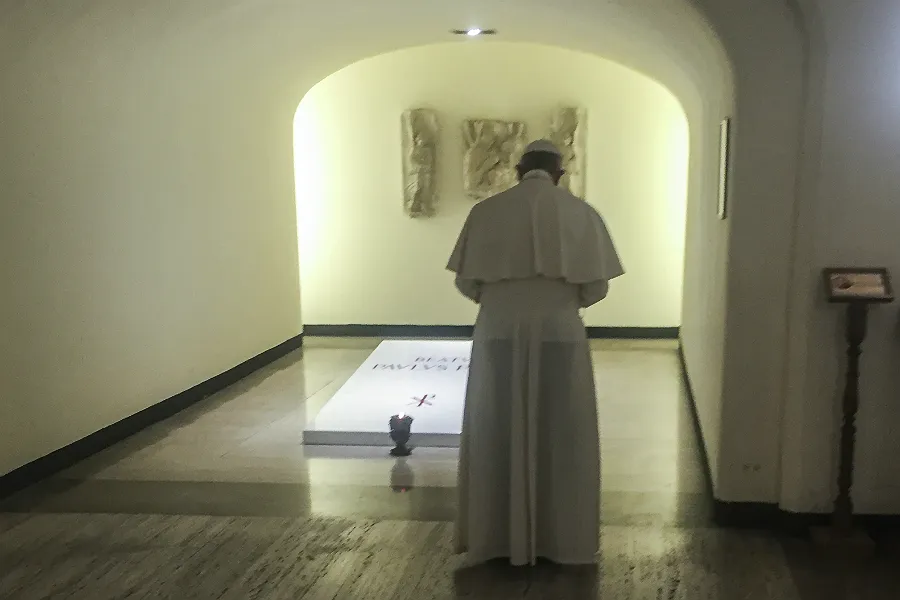
Francis again visits Blessed Paul VI’s tomb on anniversary of his death

August 6, 2018 CNA Daily News 0

Vatican City, Aug 6, 2018 / 10:04 am (CNA/EWTN News).- Pope Francis made a private visit Monday morning to pray at the tomb of Bl. Paul VI, on the 40th anniversary of his death.

Francis made a similar visit to Bl. Paul VI’s tomb last year.

Pope Francis’ visit to the tomb took place in an absolutely private manner, said vice-director of the Holy See press office, Paloma Garcia.

She told EWTN Aug. 6 that Pope Francis prayed for about 10 minutes at the tomb, which is located in the Vatican Grottos, the crypt beneath St. Peter’s Basilica.

Bl. Paul VI, to whom Francis referred Sunday as a “pope of modernity,” was the author of the 1968 encyclical Humanae vitae, which reaffirmed Church teaching against contraception.

Bl. Paul VI will be canonized with Bl. Oscar Romero Oct. 14, during the synod on young people, faith, and vocational discernment.

At the end of his Angelus address Aug. 5, Francis recalled the blessed, calling him a “great pope of modernity,” and remembering him “with much veneration and gratitude.”

“From heaven may he intercede for the Church and for peace in the world,” the pope said.

Pope Francis unofficially confirmed the news of Paul VI’s canonization during his annual meeting with the priests of Rome Feb. 17. “Paul VI will be a saint this year,” he said Feb. 15.

After a long question and answer session, the pope gave texts containing meditations by Bl. Paul VI as a gift to each of the priests. “I saw it and I loved it,” Francis said about the book.

[…]

No Picture
News Briefs

Efforts to broaden abortion legalization continue in Chile

August 5, 2018 CNA Daily News 0

Santiago, Chile, Aug 5, 2018 / 04:42 pm (ACI Prensa).- Pro-life groups in Chile are criticizing efforts to legalize abortion for any reason up to 14 weeks of pregnancy.

Guido Guirardi, president of the Senate Committee on Health, has pushed for the introduction of a bill to broaden the legalization of abortion, according to La Tercera news.

Guirardi said that there is no comparison between the value of “a complete person, a human being, a woman, who has consciousness, a life history, and a germ of life, which is not a person, which is the union of an ovum and a sperm, that has no consciousness, brain, feeling or life history.”

Chilean president Sebastián Piñera has promised to oppose efforts to expand abortion in the country, saying he will do “everything that is necessary to defend life.”

Last year, Chile approved the legalization of abortion on the grounds of rape, fetal non-viability, or risk to the life of the mother.

Elizabeth Bunster, director of Project Hope, told CNA’s Spanish language sister agency ACI Prensa that the new bill “makes obvious what we were saying: that approving abortion on three grounds opened the door for abortion to be [completely] legalized.”

Bunster emphasized that pro-life groups in the country continue their work by “accompanying women in crisis pregnancies and those who suffer from the consequences of abortion.”

Rosario Vidal, president of the Women Reclaim Movement, warned that “the pro-abortion position has strong media backing and a lot of foreign funding.”

It is important to address the roots of the problem, and various pressures that women face to abort, she said.

“You have to understand that abortion is not a freely made decision, nor does a woman have an abortion to make a decision about her body.”


This article was originally published by our sister agency, ACI Prensa. It has been translated and adapted by CNA.

[…]

No Picture
News Briefs

Seek Jesus before material things, pope says

August 5, 2018 CNA Daily News 0

Vatican City, Aug 5, 2018 / 05:04 am (CNA/EWTN News).- It is not wrong to be concerned with the daily necessities of life, but strengthening one’s relationship with Jesus is of far greater importance, Pope Francis said in his Sunday Angelus addre… […]

No Picture
News Briefs

Argentine province declares itself pro-life ahead of abortion vote

August 5, 2018 CNA Daily News 0

Buenos Aires, Argentina, Aug 5, 2018 / 04:23 am (ACI Prensa).- Shortly before next week’s vote on the abortion bill in the Argentine National Senate, the Tucumán provincial legislature declared the province to be pro-life.

Of 43 provincial legislators, 39 voted in favor of the resolution Aug. 2. The resolution joins other decrees that have declared “pro-life” cities, including Concordia, San Salvador de Jujuy, Presidencia Roque Sáenz Peña and San Fernando del Valle de Catamarca, among others.

The declaration comes just days ahead of the Aug. 8 Senate vote on a bill to broaden legalization of abortion in the country.

The abortion bill was passed 129-125 by the nation’s lower house on June 14 and must be approved by the Senate before it can become law.

Current law in Argentina prohibits abortion, except when the mother’s life or health is determined to be in danger, or in cases of rape.

The bill pending in the Senate would allow abortion on demand up to the 14th week of gestation. Minors under 16 could get an abortion without having to inform their parents.

Health care workers under the bill could be eligible for conscience-based objections to participating in an abortion if they make such a request in advance “individually and in writing” to the director of their medical center. Institutions and health care facilities as a whole would not be allowed to conscientiously object to abortion.

The pro-life declarations in Tucumán and other provinces are symbolic, as abortion will be legal nationwide if the bill is confirmed by the Senate.

However, lawmaker Sandra Mendoza, who helped introduce the initiative, stressed that the resolution reflects the beliefs of the majority of people in Tucumán, according to the Argentine Catholic Information Agency.

Mendoza said the pro-life position is not denominational or religious alone, but scientific, rational and ethical.

“The argument in favor of abortion, called ‘the right to choose,’ is false. It says nothing of the right to life of the one developing in the womb. The ideology in favor of abortion is trying to plant the idea that only one person exists, when science affirms there are two,” she said.

She added that “as people or human beings we’re not the ones to decide who ought to live or die. Only the supreme being, who is our God, has that decision.”

Tucumán is one of the 23 provinces of Argentina, located in the country’s northeast. It is comprised of 17 departments, 112 municipalities and rural districts, encompassing more than 1.5 million inhabitants.


This article was originally published by our sister agency, ACI Prensa. It has been translated and adapted by CNA.


[…]

No Picture
News Briefs

Survey: Religious superiors support possibility of women deacons

August 4, 2018 CNA Daily News 6

Washington D.C., Aug 4, 2018 / 06:41 pm (CNA).- A survey of both male and female religious superiors in the U.S. found that most believe that the Church can and should ordain women as deacons.

Almost three-quarters of responding superiors said they think it is possible to sacramentally ordain women deacons, and that the Church should do so. Only 45 percent, however, believe the Church will do so.

The survey, released this week by The Center for Applied Research in the Apostolate at Georgetown University (CARA), reached out to all 777 U.S. religious institutes and societies of apostolic life. These included members of the Conference of Major Superiors of Men (CMSM), the Council of Major Superiors of Women Religious (CMSWR), and the Leadership Conference of Women Religious (LCWR), as well as 137 contemplative women’s groups.

Only men may be ordained priests under Catholic teaching. Pope Francis has reiterated on numerous occasions that this doctrine is definitive and cannot be changed. However, non-ordained female deacons were part of the early Church, although it is not entirely clear what their role was.

The question of female deacons has recently resurfaced amid Pope Francis appointing a commission to look into the historical role of female deacons in the ancient Church.

Of religious superiors surveyed, 76 percent had known about the commission. Most – 84 percent – believed that ordaining women as deacons would create at least some greater call for women priests.

Among respondents, 78 percent of superiors said sacramental ordination of women deacons would be somewhat or very important for the Church, but only 45 percent said it would be somewhat or very important for their religious communities. Sixty-one percent said they did not think the ordination of women as deacons would increase candidates seeking to join their communities.

Nearly 60 percent of major superiors of women who provided a response said they would consider allowing members to be ordained if the diaconate were opened to women as an ordained ministry. Half said they do not think any of their current members are interested in becoming a deacon.

In addition, open-ended questions were presented to female superiors about benefits and challenges of ordaining women to the diaconate.

“The most common benefits cited include a greater capacity to perform liturgical and sacramental duties, a greater acceptance of women and their gifts in the Church, and the continuation of current ministries but with a higher status,” CARA said.

“Challenges and concerns frequently noted include confusion over who the deacon would be accountable to, the acceptance of female deacons by clergy and other religious, concerns that it would create a two-tiered membership within religious communities, the issue of balance between community life and a deacon’s ministry to the external community, and that this step would reinforce the hierarchal structure of the Catholic Church.”

In August 2016, Pope Francis instituted a commission for the study of women deacons, after the topic was raised at a papal audience with a group of religious sisters in May.

At the audience, one sister asked why the Church does not include women in the permanent diaconate and suggested that a commission be established to study the possibility.

Pope Francis expressed his openness to establishing such a commission. Several weeks later, he told a group of journalists that he was upset by media reports suggesting that he had endorsed the idea of female deacons.  

“They said: ‘The Church opens the door to deaconesses.’ Really? I am a bit angry because this is not telling the truth of things,” the pope said.

“We had heard that in the first centuries there were deaconesses,” he continued. “One could study this and one could make a commission. Nothing more has been requested.”

Francis acknowledged that the subject of women deacons has already been studied by the Church, including a 2002 document from the International Theological Commission, and advisory body to the Congregation for the Doctrine of the Faith.

The document, which gave a thorough historical context of the role of the deaconess in the ancient Church, overwhelmingly concluded that female deacons in the early Church had not been equivalent to male deacons, and had neither a liturgical nor a sacramental function.

Heading Francis’ commission on the study of women deacons is Prefect of the Congregation for the Doctrine of the Faith, Cardinal Luis Ladaria.

In June 2018, Ladaria clarified that “the Holy Father did not ask us to study whether or not women can be deaconesses…but rather, [he asked us] to try to say in a clear way what the problems are and what the situation was in the ancient Church on this point of the women’s diaconate.”

“We know that in the ancient Church there were so-called deaconesses: what does this mean? Was it the same as deacons, or was it something different? Was it a large, or rather local reality?


[…]