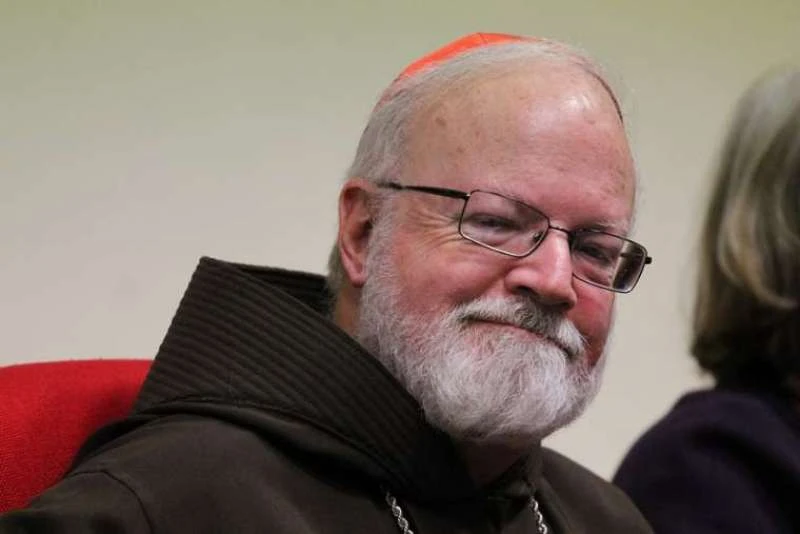
Boston, Mass., Aug 21, 2018 / 12:48 pm (CNA).- Cardinal Sean O’Malley of Boston has issued an apology for not seeing a 2015 letter to his office, which detailed accusations of former Cardinal Theodore McCarrick’s sexual misconduct and abuse of diocesan seminarians.
The apology came after media reports revealed that New York priest Father Boniface Ramsey had tried to warn church officials about McCarrick multiple times, including in the 2015 letter, which he sent to O’Malley because of his role as President of the Pontifical Commission for the Protection of Minors.
O’Malley said his secretary Father Robert Kickham received the letter and responded to Ramsey himself, saying that the accusations fell outside of the jurisdiction of O’Malley’s office, as they did not involve minors. O’Malley said he only found out about Ramsey’s letter after the recent media reports.
“In retrospect it is now clear to Fr. Kickham and to me that I should have seen that letter precisely because it made assertions about the behavior of an Archbishop in the Church,” O’Malley said in his apology, posted on the Archdiocese of Boston’s website.
“I take responsibility for the procedures followed in my office and I also am prepared to modify those procedures in light of this experience.”
O’Malley’s lack of knowledge of the 2015 letter comes as a surprise from someone widely considered to be a “zero-tolerance” bishop on matters of sexual abuse.
As numerous McCarrick allegations continued to surface in late July, O’Malley issued a statement saying that the Church needed “more than apologies” to sexual misconduct cases.
He proposed that future allegations against bishops needed to be handled as a matter of highest priority; that a new system be put in place to handle complaints against bishops; and that these reforms be clearly announced, so there can be no doubt about how such cases should be handled in the future.
Ramsey told CBS News that accusations of sexual misconduct and abuse against McCarrick first came to his attention in 1986, and he was under the impression that “virtually everyone knew” about them, including many bishops.
“Archbishop McCarrick was inviting seminarians to his beach house…There were five beds…and there were six people. Archbishop McCarrick arranged it in such a way that somebody would join him in his bed,” Ramsey told CBS.
He said that the 2015 letter contained not just rumors about McCarrick, but first-hand accounts of abuse from seminarians who had encountered McCarrick.
“I apologize to Fr. Ramsey for not having responded to him in an appropriate way and appreciate the effort that he undertook in seeking to bring his concerns about Archbishop McCarrick’s behavior to my attention,” O’Malley noted. “I also apologize to anyone whose concerns were reflected in Fr. Ramsey’s letter.”
O’Malley said that he recognized that his apology and lack of knowledge of the 2015 letter was probably still insufficient “given the way the Church has eroded the trust of our people.”
However, he said his hope is “that we can repair the trust and faith of all Catholics and the wider community by virtue of our actions and accountability in how we respond to this crisis.”
He added that the U.S. bishops are all “anxious to understand” how McCarrick became a bishop, archbishop, and cardinal if there were known allegations against him, given the vetting process that bishops have to go through before they are appointed to such positions.
“That is why the Bishops Conference are requesting an investigation by the Holy See with the participation of lay people,” O’Malley said.
O’Malley closed his apology by quoting an Aug. 20 his own letter of apology to sex abuse victims from Pope Francis: “Let us beg forgiveness for our own sins and the sins of others. An awareness of sins helps us to acknowledge the errors, the crimes and the wounds caused in the past and allows us, in the present, to be more open and committed along a journey of renewed conversion.”
If you value the news and views Catholic World Report provides, please consider donating to support our efforts. Your contribution will help us continue to make CWR available to all readers worldwide for free, without a subscription. Thank you for your generosity!
Click here for more information on donating to CWR. Click here to sign up for our newsletter.

This photo of Father Allan Travers was featured in the local newspaper after his pitching “performance” for the Detroit Tigers against the Philadelphia A’s on May 18, 1912. The photo featured the caption “strikebreaker,” which worried Travers’ mother, since there was a street trolley strike in Philadelphia earlier in the month, and she didn’t want her son caught in the confusion. / Photo credit: Public domain
Detroit, Mich., Jul 23, 2023 / 08:00 am (CNA).
The worst pitcher ever to take the mound for the Detroit Tigers became a Catholic priest.
Granted, Allan Travers was already on the path to the priesthood before suiting up for Detroit on May 18, 1912. But his story — and place in baseball history — is the prime example of being in the right place at the right time (or the wrong place at the wrong time).
Travers played in only one game, but one was enough to show that God had plans for him that didn’t involve the big leagues.
The story begins, as most stories of Tigers lore do, with Ty Cobb.
The Tigers were in New York on May 15 to play the Highlanders (the precursor to the Yankees). Cobb was playing in the outfield when he was verbally abused by a New York fan who was using profanity and racial slurs to describe Cobb’s play.
Cobb — never known for keeping his cool — stormed into the stands and unleashed a volley of punches on the fan. Tigers players rushed to the scene of the chaos, yelling at Cobb to lay off the man, who was missing one hand and three fingers on his other hand after suffering an industrial accident.
Cobb didn’t care and continued the barrage.
Ban Johnson, president of the American League, happened to be at the game, checking on the family-friendly excitement of what was turning into America’s pastime.
Having one of the league’s star players beat up a disabled spectator didn’t jibe well with Johnson’s vision for baseball, so Cobb was suspended indefinitely.
The Tigers felt Cobb’s punishment was unfair, so the players voted to strike until Cobb was reinstated for the club’s next game in three days against the two-time defending World Series champion Philadelphia Athletics.
Detroit Tigers legend Ty Cobb is pictured in 1911. Not one to keep his cool, Cobb launched himself into the stands to attack a fan who insulted him in 1912, resulting in a league suspension and sparking his teammates to strike in protest. Credit: Public domain
Johnson called the Tigers’ bluff, informing then Tigers owner Frank Navin the team would face a $5,000 fine for every game Detroit forfeited.
Navin needed to field a team, and quick, so he and Tigers manager Hughie Jennings collaborated with Athletics owner/manager Connie Mack to field a team of players to take the field.
This was well before the age of expansive minor league rosters — or commercial airlines, for that matter — so it wasn’t as though the Tigers could call up the farm team in Toledo and get them to Philadelphia in time to play the A’s. Instead, scouting was done the old-fashioned way, spreading word throughout town, asking who wanted to play baseball.
And this is where Aloysius Joseph “Allan” Travers, the student manager on the St. Joseph’s College baseball team, comes into the story.
Jennings worked with a friend of his, Joe Nolan, a sportswriter for The Philadelphia Bulletin,to field a team. Nolan knew Travers, a junior at St. Joseph’s who lived in Philadelphia, from the time the A’s fielded a second-stringer team to play St. Joseph’s College.
Nolan asked Travers to find 10-12 amateur players in the area who could suit up for the Tigers in case the Tiger players followed through on their strike threats. The idea was that the amateurs would never actually take the field; rather, it was just a tactic to get Jennings’ “real” players on the field.
Father Allan Travers, SJ, was a priest who taught at St. Joseph’s College (now St. Joseph’s University) in Philadelphia. But in 1913, while a student at St. Joseph, he was the improbable pitcher for the Detroit Tigers, where he secured a bizarre spot in baseball history. Credit: Public domain
Travers rounded up eight players who were free that day and enticed by the $25 Navin offered to each player.
Jennings had his team of strike-breakers, as requested by Navin.
When the umpire called “play ball,” the Tiger regulars took the field, but when the umpire spotted Cobb and told him to take a seat, the rest of the team walked out and took off their uniforms.
The strike-breakers would have to play after all. They were ushered into the locker room and donned the Tigers’ gray uniforms (this was in the days before names were on the back of uniforms). Two bench coaches joined the group to offer the squad some big league experience.
The question was, who would pitch?
There were no takers at first, so Navin offered an extra $25. Travers volunteered; $50 was good money for a college kid in 1912. There was one small problem — Travers had never played organized ball.
He was the assistant manager on the college baseball team, tasked with keeping stats and writing game summaries.
But there he was, the college student with plans to join the seminary after graduation, pitching before 20,000 fans at Shibe Park against the two-time defending World Series champions. A modern David versus Goliath, a plucky underdog story.
This time Goliath won.
Travers did as well as one would expect the assistant manager of a college baseball team to do against professionals. He pitched a complete game, surrendering 24 runs on 26 hits (both American League records), walking seven and striking out one. He got an MLB strikeout — they can’t take that away from him.
But the 15.75 ERA leaves a mark. He also batted 0-for-3 at the plate.
Travers’ time in the major leagues was abrupt. After the 24-2 shellacking the A’s put on the strikebreaking Tigers, Cobb persuaded his teammates to end the strike before the team’s upcoming series against the Washington Senators.
Travers’ calling was the priesthood, not pitching.
After graduating from St. Joseph’s College in 1913, he joined the Society of Jesus, studying at St. Andrew on the Hudson in New York and Woodstock College in Maryland. He was ordained a priest in 1926, making him the only priest ever to play in a Major League game.
His ministry took him to teaching positions at St. Francis Xavier High School in Manhattan and St. Joseph’s Prep and St. Joseph’s College in Philadelphia.
Father Travers didn’t speak about his baseball exploits, but he did give an interview about his bizarre start for the Tigers.
“About noon when Nolan told me about the strike of Detroit, he told me the club would be fined and might lose its franchise if 12 players didn’t show up,” Travers told sportswriter Red Smith. “He told me to round up as many fellows as I could. We never thought we’d play a game.”
The replacement Detroit Tigers are pictured in the dugout against the Philadelphia A’s on May 18, 1912. Photo credit: Public domain
The priest said Jennings told him to avoid throwing fastballs to “avoid getting killed out there,” but the A’s didn’t hold back, even resorting to bunting when they found out the third baseman had never played baseball before.
“I fed ‘em nothing but slow stuff after Frank Baker almost hit one out of the park on me, which fortunately went foul,” Travers said. “I was doing fine until they started bunting. The guy playing third base had never played baseball before. I just didn’t get any support. I threw a beautiful slow ball and the A’s were just hitting easy flies. Trouble was, no one could catch them.”
Curious enough, the only “fame” Travers got from his start was his picture in the newspaper with the word “Strikebreaker” printed above. There was a trolley strike in Philadelphia that month, and Travers’ mother was worried for her son’s safety because people might suspect he was a scab.
Travers didn’t like talking about his baseball “career” with his students, and his story is not well known, save for a few baseball history blogs.
He did sign a ball from that fateful day that wound up in the collection of Ada, Michigan, resident Steve Nagengast, who claims to have the largest collection of Tigers autographs. Nagengast was featured in the Detroit News, and the anecdote about Travers piqued Detroit Catholic’s interest.
Travers didn’t have the greatest impact on Tigers history. But the $5,000-per-game fine the Tigers faced for each game the club forfeited would have been devastating, especially in an era when professional teams folded and changed towns all the time.
So who knows.
Father Travers’ one-game career might have just saved the Tigers.
Cardinal Robert Sarah offers Mass in St. Peter’s Basilica for his 50th anniversary of priesthood in 2019. / Credit: Evandro Inetti/CNA.
Washington, D.C. Newsroom, Dec 29, 2021 / 12:00 pm (CNA).
The past year had no shortage of news in the Catholic realm, both in the Vatican and beyond. Read on for a recap of some of the most important – and interesting – figures who made headlines this year.
President Joe Biden
On Jan. 20, 2021, President Joe Biden (D) was sworn in as the second Catholic president of the United States. Born in Scranton, PA and raised in Delaware, Biden attended Catholic grammar and high school before matriculating at the University of Delaware.
Since becoming president, Biden has faced criticism from both the left and the right over his various positions, as well as his continued reception of the Eucharist at Mass. As president, Biden eliminated many pro-life policies from the Trump era. He met with Pope Francis in late October, where the two purportedly discussed the Eucharist.
Cardinal Robert Sarah
Cardinal Robert Sarah, a native of Guinea, resigned as prefect of the Congregation for Divine Worship and the Discipline of the Sacraments in February 2021. Sarah, who had reached the retirement age of 75 in June 2020, was the most senior African prelate at the Vatican. He had been appointed head of the liturgy department by Pope Francis in November 2014.
Sarah had previously served as the president of the Pontifical Council Cor Unum and as secretary of the Congregation for the Evangelization of Peoples.
“Today, the Pope accepted the resignation of my office as Prefect of the Congregation for Divine Worship after my seventy-fifth birthday. I am in God’s hands. The only rock is Christ. We will meet again very soon in Rome and elsewhere,” said Sarah on Twitter following his resignation.
Jonathan Goodall and Fr. Michael Nazir-Ali
Each year, many people cross the proverbial Tiber and are received into the Catholic Church. This fall, however, the Tiber Swim Team landed two big-name recruits: two former Church of England bishops. Jonathan Goodall, the former Anglican bishop of Ebbsfleet, announced on Sept. 3, the feast of St. Gregory the Great, that he was stepping down from his position and entering into full communion with the Catholic Church. The date was a nice touch, as St. Gregory the Great launched a mission to convert the then-pagan England to Christianity.
Goodall was formally received into the Church on Sept. 8. He said his decision came after “only after a long period of prayer, which has been among the most testing periods of my life.” He said he was “abidingly grateful to all who have so generously supported Sarah and me in these years, especially the laity and clergy of the See of Ebbsfleet — who have been the focus and joy of my ministry and devotion since becoming bishop in 2013,” and that it was “an immense privilege” to have been bishop.
Not to be outdone, a few weeks later the now-Fr. Michael Nazir-Ali announced that he, too, would be entering into full communion with the Catholic Church. Nazir-Ali, the former Anglican bishop of Rochester, entered into full communion with Rome within the Personal Ordinariate of Our Lady of Walsingham on Sept. 29. He was ordained a deacon on Oct. 28, and then a priest on Oct. 30.
Unlike Goodall, who came from a more conservative Anglican background, Nazir-Ali described himself as being part of the “Evangelical” wing of Anglicanism. At one point, he was considered to be a possible future Archbishop of Canterbury, the spiritual leader of the world’s 85 million Anglicans.
Archbishop Salvatore Cordileone and House Speaker Nancy Pelosi
Archbishop Salvatore Cordileone of San Francisco is Speaker of the House Nancy Pelosi (D-CA)’s bishop. Cordileone and Pelosi are both Catholic. And that’s about where their similarities end.
Pelosi, a committed Democrat, lamented that the support of pro-life voters for former President Donald Trump was an issue that “gives me great grief as a Catholic.” Pelosi made the comment on a Jan. 18 podcast with former senator and presidential candidate Hillary Clinton.
“I think that Donald Trump is president because of the issue of a woman’s right to choose,” said Pelosi, implying that pro-life voters boosted Trump to victory in 2016. She added that these voters “were willing to sell the whole democracy down the river for that one issue.”
Cordileone rebuked Pelosi in a statement issued days later, saying, “No Catholic in good conscience can favor abortion” and that “Our land is soaked with the blood of the innocent, and it must stop,” he said.
The archbishop also promoted a “Rose and a Rosary for Nancy Pelosi” campaign, which saw more than 16,000 people commit to praying for Pelosi’s change of heart on life issues.
Archbishop Joseph Naumann
Archbishop Joseph Naumann of Kansas City in Kansas wrapped up a three-year stint as the head of the USCCB’s pro-life committee in 2021. The outspoken defender of life unleashed on Biden in a Feb. 13 interview with Catholic World Report.
“The president should stop defining himself as a devout Catholic, and acknowledge that his view on abortion is contrary to Catholic moral teaching. It would be a more honest approach from him to say he disagreed with his Church on this important issue and that he was acting contrary to Church teaching,” said Naumann.
“When he says he is a devout Catholic, we bishops have the responsibility to correct him. Although people have given this president power and authority, he cannot define what it is to be a Catholic and what Catholic moral teaching is,” the archbishop added. He further called for the bishops to “correct” the president, “as the president is acting contrary to the Catholic faith.”
Sr. Lucile Andre Randon
The coronavirus pandemic continued throughout the world in 2021, killing hundreds of thousands of people. One person who beat it, however, was the world’s second-oldest person: a French nun named Sr. Lucile Andre Randon.
Right before Randon’s 117th birthday, coronavirus swept through the Sainte Catherine Labouré retirement home in Toulon, southern France. Eighty-one of the 88 residents of the facility tested positive in January of this year, and 10 died.
Fortunately, Randon did not display any symptoms of the disease and recovered in time to celebrate her birthday on Feb. 11.
Asked if she was scared of COVID, she told France’s BFM television, “No, I wasn’t scared because I wasn’t scared to die… I’m happy to be with you, but I would wish to be somewhere else – join my big brother and my grandfather and my grandmother.”
Hidilyn Diaz
The covid-postponed Tokyo 2020 Olympics finally were staged in the Summer of 2021, and Catholic athletes shined on the world stage.
On the third full day of the games, Hidilyn Diaz won the first gold medal for the Philippines, inspiring an entire nation with her faith, grit, and perseverance. Diaz’s triumph came in the women’s 55-kilogram weightlifting event, and she won gold with an Olympic record lift of a combined weight of 224 kilograms.
After completing her final lift in a very close competition, Diaz held her hands to her face, burst into tears and clutched at her Miraculous Medal of the Blessed Virgin Mary hanging from her neck. Later, on the podium at the medal ceremony, Diaz pointed skyward after singing the Philippine national anthem, then made the Sign of the Cross before stepping down and shouting “Mabuhay ang Pilipinas!” (“Long live the Philippines!”)
““In retrospect it is now clear to Fr. Kickham and to me that I should have seen that letter precisely because it made assertions about the behavior of an Archbishop in the Church,””
How in billy blue blazes could it not have been clear at the time? Seriously? An Archbishop is reported to be committing sins that cry out to heaven for vengeance, and somebody thought, “Well, yeah, but that’s not something we’re focusing on right now?”
““In retrospect it is now clear to Fr. Kickham and to me that I should have seen that letter precisely because it made assertions about the behavior of an Archbishop in the Church,””
How in billy blue blazes could it not have been clear at the time? Seriously? An Archbishop is reported to be committing sins that cry out to heaven for vengeance, and somebody thought, “Well, yeah, but that’s not something we’re focusing on right now?”