

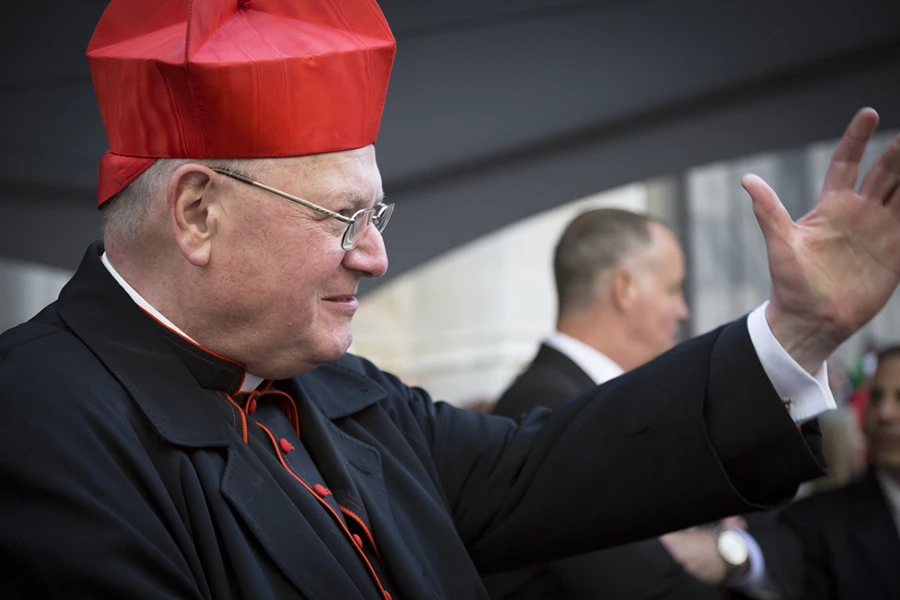
New York City, N.Y., May 22, 2018 / 08:30 pm (CNA/EWTN News).- The Archbishop of New York said Tuesday that while some recent comments about homosexuality attributed to Pope Francis are “orthodox teaching,” the pope’s reported remarks could require clarification.
Cardinal Timothy Dolan affirmed the pope’s recent affirmation of God’s love for a gay man with whom the pontiff visited in Rome, saying: “Jesus would have said that, and so would I. That’s conservative, traditional, Catholic, orthodox teaching. The ‘Catechism’ insists on that.”
“While any sexual expression outside of a man and woman in marriage is contrary to God’s purpose, so is not treating anyone, including a gay person, with anything less than dignity and respect,” Dolan added, speaking May 22 during his weekly radio show on Sirius XM’s The Catholic Channel.
“What he says is beautiful, don’t you think?” Dolan asked.
The remarks were a response to questions about Juan Carlos Cruz, a Chilean victim of sexual abuser Fr. Fernando Karadima, who told the Spanish newspaper El Pais on Friday that Pope Francis told him that it did not matter that he was gay.
“He told me ‘Juan Carlos, that you are gay does not matter. God made you like that and he loves you like that and I do not care. The Pope loves you as you are, you have to be happy with who you are,’” Cruz recalled.
Asked about the most controversial aspect of the Holy Father’s remarks, regarding whether God wills that someone experience same sex attraction, Dolan was circumspect, citing “ongoing debate” among “professional circles.”
“Is one born that way, or is it – is it nature or nurture?… I don’t think the Holy Father would feel competent to speak on that.”
Dolan noted that while he had no reason to doubt Cruz’s account, the pope’s reported remarks were “third hand: what the pope said to him, he said to the press, so one would want to get a clarification.”
He said his remarks were qualified by “a little bit of ‘wait and see’” adding “let’s find out exactly what the Holy Father said.”
If you value the news and views Catholic World Report provides, please consider donating to support our efforts. Your contribution will help us continue to make CWR available to all readers worldwide for free, without a subscription. Thank you for your generosity!
Click here for more information on donating to CWR. Click here to sign up for our newsletter.

Archbishop Dolan of “good for him” fame needs to read Aquinas who distinguished between God willing all men to be saved, willing perfection of health, perfection of beauty….as God’s antecedent willing… while His damning some men, sickness, ugliness, gay orientation refers to his consequent willing post Adam’s or man’s sin. Romans one…God…asserts about active gays…” receiving in themselves the fit recompense of their perversity”….ie He does not love what it does to their characteristics.
– “let’s find out exactly what the Holy Father said.” –
That is hilarious. You never will because the Pope speaks from both sides of the mouth – one moment saying and another quite the contray. To expect to find out exactly what the master of doublespeak said is essentially to say : He said it’s black and white at the same time.
Why would he clarify? Would that not defeat the purpose of obfuscation?
The lack of clarification is the clarification…
And a few years back, after discovering that Obamacare did not include a functional conscience clause after all, Cardinal Dolan looked back on the reassurances he had been given(and believed!) before the bill was adopted: “They lied to me.”
Why are some clerics so innocent as not to notice? Perhaps they live in a lost world where some residual degree of common humanity and trust, in politicized matters, still existed. Time to wake up. In this world we are to be both “wise as serpents and innocent as doves” (Matt 10:16), both at the same time, always, never just one or the other.
‘Dignity and respect.’ Like ‘dialog,’ all blather words now.