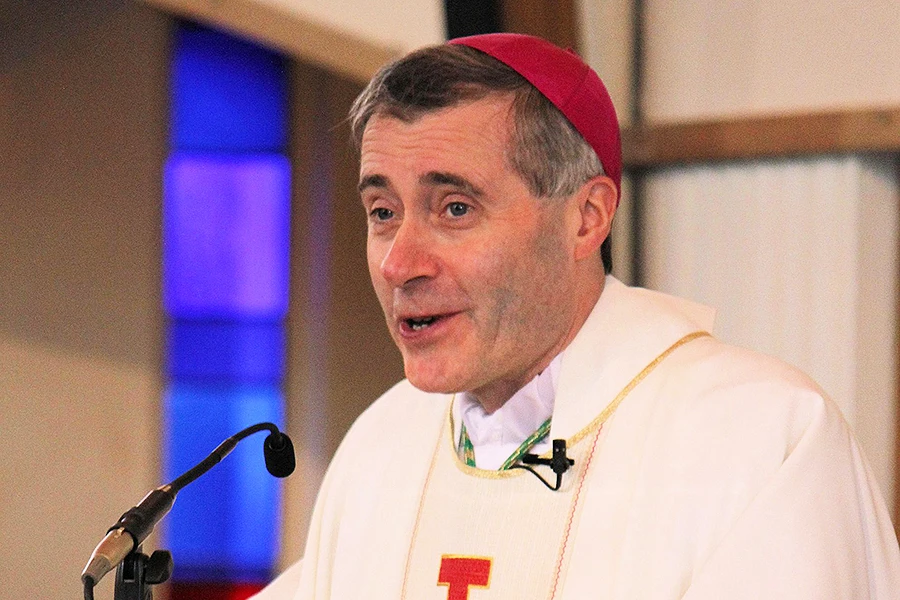
Shrewsbury, England, Feb 27, 2018 / 01:00 pm (CNA/EWTN News).- In a recent pastoral letter, a British bishop has encouraged Catholics to make the “awesome reality” of the Eucharist a central focus of their life and prayer during Lent.
“In this Eucharistic Year for the Diocese I am inviting us all to reflect more deeply on the mystery and reality of the Eucharist,” wrote Bishop Mark Davies of the Diocese of Shrewsbury.
“At the beginning of Lent, I want to draw your gaze especially towards the Altar where Christ’s Sacrifice, by which He loved us to the end, is made present anew,” Davies continued, drawing attention to the sacrifice of the Mass.
Davies cited Vatican II’s Sacrosanctum Concilium, explaining that the sacrifice of the Mass was instituted by Christ on the night before he died to “perpetuate the sacrifice of the Cross throughout the ages until he should come again.”
Davies said that Christ makes himself “wholly and entirely present” in the Eucharist during the Mass, evoking “the very words of institution, ‘This is my Body given for you,’ and ‘this chalice which is poured out for you is the New Covenant in my Blood.”
While during the Mass the “central event of salvation becomes really present,” Davies asked whether Catholics “have allowed the Mass to become reduced in our minds to merely a communal meal and celebration rather than the paschal banquet, the supper of the Lamb of God sacrificed for us?”
“Have we thereby allowed new generations to become bored and uninterested in the Mass, by not allowing them to glimpse the awesome reality of this Sacrifice and Sacrament?” Davies asked.
The UK bishop evoked the words of Pope St. John Paul II, who said that the Eucharist displays a love which “knows no measure.”
“How, then, could our hearts ever remain unmoved by this love beyond all others?” Davies questioned.
“At the Altar, we learn love and sacrifice not only by imitation, but we receive the grace and power to live sacrificial lives in the service of Christ and one another in all of the spiritual and corporal works of mercy,” he continued.
Davies encouraged the faithful in his diocese to spend time meditating on the mystery of the Eucharist, especially during the sacrificial season of Lent, so as to grow in wonder at its beauty.
“In Lent, we think of the many sacrifices we are called to make,” Davies said.
“In turning our gaze towards the Altar and the Cross, let us pray that we may recognize with faith and ever growing wonder the Holy Sacrifice of the Mass.”
If you value the news and views Catholic World Report provides, please consider donating to support our efforts. Your contribution will help us continue to make CWR available to all readers worldwide for free, without a subscription. Thank you for your generosity!
Click here for more information on donating to CWR. Click here to sign up for our newsletter.

Cardinal Lazzaro You Heung-sik, prefect of Dicastery for the Clergy, and Vatican Secretary of State Cardinal Pietro Parolin celebrate Mass on Dec. 11, 2023, to mark the 60th anniversary of diplomatic relations between the Holy See and the Republ… […]
Rome, Italy, Feb 9, 2021 / 05:01 pm (CNA).- Archbishop Ettore Balestrero, the apostolic nuncio to the Democratic Republic of Congo, announced last week that he will enter a plea bargain with an Italian court after he and his brother Guido were accused of money laundering, but will not admit guilt.
The prosecutor was investigating the alleged smuggling of Argentine meat into Italy managed by the archbishop’s father, Gerolamo.
The legal issue, which does not involve the Holy See, was a family business in which Archbishop Balestrero “acted in full good faith,” according to investigators.
The prosecutor focused on money transferred by the archbishop to his brother Guido as a donation. According to the investigators, the process in which the money was transferred (some $4.8 million) constituted at the end a scheme to launder the money.
According to Archbishop Balestrero, who was Nuncio in Colombia when Pope Frances visited the country in 2017, he accepted an anticipated bequest by his father and transferred his brother’s share to his brother’s bank account.
In a note sent to CNA, Archbishop Balestrero said that this is “exclusively a family issue” dealing with his father’s entrepreneurial activity in the early 1990s. At that time, Balestrero was a young priest serving in the nunciature in Korea. He was not involved in his father’s activity. His family deemed that those issues had been completely settled.
Some years later, in consideration of his father’s poor health condition, Archbishop Balestrero accepted the anticipation of the inheritance and gave the half of the inheritance to his brother with “a public and transparent act, in the conviction not to have done anything illicit. Otherwise I would not have done it.”
Archbishop Balestrero stressed that he and his brother always collaborated with the prosecutor, “considering that we had nothing to hide and always acted in good faith.”
The decision to negotiate a plea bargain, according to Balestrero, came “painfully” since “we deem we have no criminal responsibility.” However, he added, “it is difficult to recover, after about 25 years, part of the documentation” necessary for a successful acquittal.
Banks and other institutions involved have already destroyed the documents after so many years.
According to the Italian judicial system, a plea bargain does not constitute an admission of guilt.
“The decision to negotiate a plea bargain,” Archbishop Balestrero said, “seemed to be the best choice to preserve the serenity of my brother’s family and my old parents. Furthermore, it will save me time and energy for my spiritual mission and as a priest I feel obliged to devote my mind and interests to my mission and not money.”
As a consequence of the plea, the prosecutor will keep nearly $8 million confiscated from the Balestrero family. The prosecutor will also file a case of tax evasion.
Daniel O’Connell, lithograph attributed to R. Evan Sly (EP OCON-DA (17) II) from the National Library of Ireland. / Credit: National Library of Ireland
Dublin, Ireland, Aug 9, 2025 / 07:00 am (CNA).
Daniel O’Connell, known as “The Liberator,” was a pivotal figure in 19th-century Ireland, championing the cause of Catholic emancipation.
Opposed to violence, he advocated for Catholic rights through peaceful means, emphasizing dialogue and legal reform, and organizing mass demonstrations to rally public support and raise awareness about the injustices faced by Catholics.
“Daniel O’Connell’s achievement in forcing the British government to concede Catholic emancipation in 1829 was immense,” Bishop Niall Coll of Ossory told CNA. “The penal laws, a series of oppressive statutes enacted in the 17th and early 18th centuries that targeted the Catholic majority in Ireland, restricting their rights to own land, hold public office, and practice their religion were set aside.”
O’Connell’s efforts culminated in the passage of the Catholic Relief Act of 1829, which allowed Catholics to sit in Parliament and hold public office and significantly transformed Irish politics.
O’Connell was born in 1775 in Caherciveen in rural Kerry. His parents had managed to maintain their land despite the penal laws, thanks to their remoteness, business sense, and help from Protestant neighbors. O’Connell’s earliest years, until he was 4, were spent with an Irish-speaking family that instilled in him an inherent understanding of Irish peasant life.
After studying in France at the English Colleges in St. Omer and Douai during the French Revolution, he returned to Ireland, completed his studies, and was called to the bar. In 1802, then a successful barrister, he married a distant cousin, Mary O’Connell, and they had 12 children — seven of whom survived to adulthood. In 1823 he founded the Catholic Association with the express aim of securing emancipation.
O’Connell’s early experiences were critical to his political and social formation, according to Jesuit historian Father Fergus O’Donoghue, who told CNA that O’Connell’s exposure to European influences undoubtedly shaped his character, his opposition to violence, and his deep-seated opposition to tyranny.
“He witnessed the French Revolution, which appalled him and set his heart completely against violence,” O’Donoghue told CNA. “What Daniel O’Connell really did was produce a political sense in Ireland that was never previously generated. Irish Catholics lived in appalling poverty and were neglected. He energized them. He brought Church and laity together into politics and constitutionalism.”
Bishop Fintan Monahan at Daniel O’Connell’s memorial in Rome. Credit: Bishop Fintan Monahan
O’Donoghue explained how O’Connell’s arousal of a nationwide Irish Catholic consciousness impacted politics and society but also had far-reaching consequences beyond Irish shores.
“When Irish Catholics emigrated, which of course many were forced to do, many of them were already politically aware. That’s why Irish people got so rapidly into American politics and into Australian politics later.”
“He was part of the enormous revival of Irish Catholicism in the 19th century. Before the Act of Union, various relief acts had been passed so Catholics officially could become things like judges or sheriffs, but none really were appointed in numbers. He was blistering in highlighting the difference between the law and reality. He was liberal, which amazed people; he believed strongly in parliamentary democracy. Many Catholics were monarchists and tending to be absolutists and he was having none of that. Under no circumstances would he approve of violence.”
Coll told CNA how O’Connell’s personal reputation extended his influence worldwide: “The fact that he could remain a devoted and practicing Catholic — while supporting the separation of church and state, the ending of Anglican privileges and discrimination based on religious affiliation, and the extension of individual liberties, including those in the sphere of politics — made him a hero and inspiration to Catholic liberals in many European countries.”
Coll continued: “The fact that his political movement was based upon popular support and the mobilization of the mass of the people, while yet being nonviolent and orderly, gave proof that political agitation did not necessarily have to be anticlerical or bloody. The attention his movement and opinions received in the continental European press was remarkable, as were the number and distinction of European writers and political figures who visited Ireland with the express purpose of securing an audience with O’Connell.”
Coll agreed firmly with historians who believe no other Irish political figure of the 19th or early 20th century enjoyed such an international reputation as did O’Connell throughout his later public career.
Among those whom O’Connell also influenced were Eamon de Valera, president of Ireland; Frederick Douglass, social reformer and slavery abolitionist in the United States; and Gen. Charles de Gaulle. Indeed, de Gaulle, when on an extended visit to Ireland, insisted on visiting Derrynane House in Kerry, the home of Daniel O’Connell.
When asked how he knew about O’Connell, de Gaulle replied: “My grandmother wrote a book about O’Connell.” The grandmother in question was Joséphine de Gaulle (née Maillot), a descendant of the McCartans of County Down and his paternal grandmother, who wrote “Daniel O’Connell, Le Libérateur de l’Irlande” in 1887. De Gaulle’s father, Henri, was also a historian interested in O’Connell.
In The Tablet,Dermot McCarthy, former secretary to the Office of the Irish Prime Minister, wrote that O’Connell’s primary legacy was “lifting a demoralized and impoverished Catholic people off their knees to recognize their inherent dignity and realize their capacity to be protagonists of their own destiny.”
Minister for Culture, Communications, and Sport Patrick O’Donovan said last month: “Daniel O’Connell was one of the most important figures in Irish political history, not just for what he achieved, but for how he achieved it. He believed in peaceful reform, in democracy, and in civil rights; ideas and concepts to which we should still aspire today.”
However, in its official communiques praising O’Connell, the Irish government minister failed to mention the word “Catholic” even once.
For O’Donoghue, the absence of any Catholic context is unsurprising given the prevailing secular attitudes among many of the country’s politicians.
Bishop Fintan Monahan, bishop of Killaloe, visited O’Connell’s grave in Rome during the Jubilee for Youth, telling CNA: “In 1847, the Great Famine was at its most severe and O’Connell’s final speech in the House of Commons was an appeal for help for its victims. Due to his physical weakness, this final speech was barely audible.”
O’Connell died in Genoa on May 15, 1847, on the 17th anniversary of the first time he presented himself at the House of Commons.
It was hoped that his heart might be interred in St. Peter’s Basilica in the Vatican. However, Pope Pius IX feared offending the British government on whose goodwill Catholic missionaries depended in many parts of the world. A requiem Mass was offered for O’Connell in the Roman baroque basilica of Sant’Andrea della Valle. The attendance included the future cardinal, now canonized saint, John Henry Newman.
O’Connell had said he wished to bequeath “his soul to God, his body to Ireland, and his heart to Rome.”
Actually, Latin bishops have been complicit in desacralizing the Mass and jettisoning the treasury of Latin sacred music and good liturgical praxis. They have no one but themselves to blame.
If the 5 year olds aren’t taught what the mass is, in depth, and if their parents don’t impress upon them the solemnity, holiness and wonder of it by their own behavior, which the children should naturally want to imitate, of course they are bored!
Actually, Latin bishops have been complicit in desacralizing the Mass and jettisoning the treasury of Latin sacred music and good liturgical praxis. They have no one but themselves to blame.
If the 5 year olds aren’t taught what the mass is, in depth, and if their parents don’t impress upon them the solemnity, holiness and wonder of it by their own behavior, which the children should naturally want to imitate, of course they are bored!