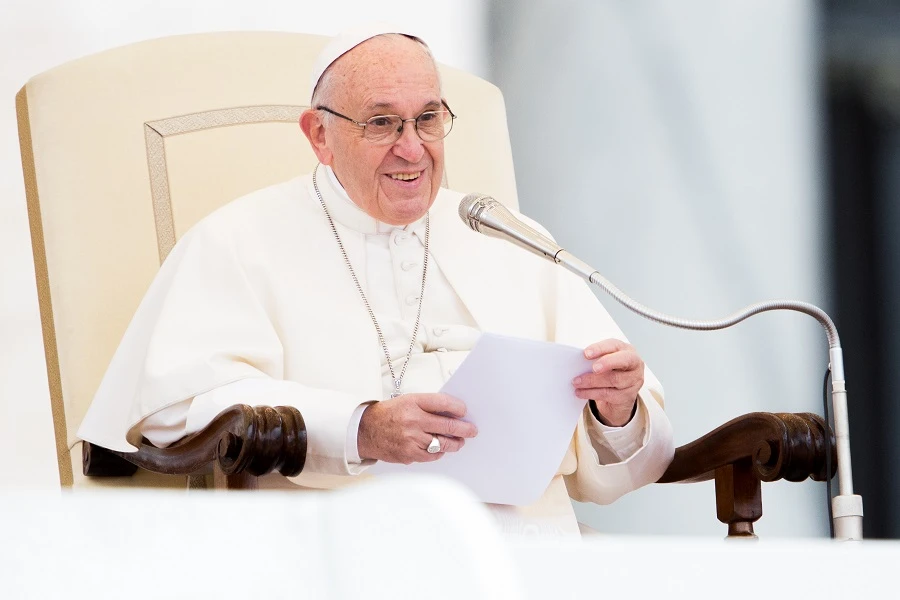
Vatican City, Jan 31, 2018 / 05:36 am (CNA/EWTN News).- On Wednesday Pope Francis spoke about the importance of the Liturgy of the Word, and therefore, also the importance of having lectors who can proclaim the readings and the Responsorial Psalm well.
“We must look for good readers!” he said Jan. 31, in off-the-cuff comments during the general audience.
Good readers and psalmists understand what they are reading and can convey it well, he continued, explaining that they need to be prepared by reading over the text before Mass.
When someone reads well, not “distorting the words,” this helps to create “a climate of receptive silence,” he said, which is important, because “it is not enough to hear with the ears, without receiving in the heart the seed of the divine Word, allowing it to bear fruit.”
On this note, Francis emphasized that it is also important that we are staying focused and listening to the readings with an open heart, not looking around at different things or making chit-chat.
“When they read the words of the Bible – the first reading, the second, the responsorial psalm, the Gospel – we must listen and open our heart,” he said. “Because it is God himself who speaks to us. Do not think about other things or talk about other things.”
Other things which are not appropriate during the Liturgy of the Word is the substitution of a non-Biblical text, or omitting a reading, he said.
Liturgically, when the same readings are proclaimed in each church, it is a way of fostering “ecclesial communion,” he said, and for this reason, it is wrong to make “subjective choices” in this case.
“Replacing that Word with other things impoverishes and compromises the dialogue between God and his people in prayer.”
The Pope recounted hearing of someone who would read the newspaper at Mass, “because it is the news of the day.” This is not okay, he said. “The Word of God is the Word of God! We can read the newspaper later. But there we read the Word of God.”
Every part of the Mass is significant, including the Liturgy of the Word, which is when “God speaks, and we listen to him, and then put into practice what we have heard.”
And “we need to listen to him!” he emphasized. “It is in fact a matter of life,” just as it says in the Gospel of Matthew: “one does not live by bread alone, but by every word that comes forth from the mouth of God.”
Just like in the Parable of the Sower, where we hear about the different results of the seeds that fall on different terrain, “the action of the Spirit, which makes the response effective, needs hearts that allow themselves to worked and cultivated, so that what is heard at Mass passes into daily life,” he said.
In fact, we must listen to the admonition of James the Apostle, the Pope continued, who tells us to “be doers of the word and not hearers only, deluding yourselves.”
Francis explained that the Word of God, especially as we hear it at Mass, is important nourishment for our daily lives. “How could we face our earthly pilgrimage, with its labors and its trials, without being regularly nourished and enlightened by the Word of God that resounds in the liturgy?” he asked.
If you value the news and views Catholic World Report provides, please consider donating to support our efforts. Your contribution will help us continue to make CWR available to all readers worldwide for free, without a subscription. Thank you for your generosity!
Click here for more information on donating to CWR. Click here to sign up for our newsletter.
Vatican City, Nov 22, 2017 / 03:00 pm (CNA/EWTN News).- Seminarians studying at the Pontifical North American College in Rome have a lot to be thankful for come Thanksgiving Day. Among them is their community, and also for home-baked pumpkin pie, made by their fellow students, the fifth-year student priests of the college.
Fr. Kevin Ewing, a newly-ordained priest of the Archdiocese of Baltimore, is the leader of this year’s seven intrepid volunteers, who during two afternoons before Thanksgiving will assemble and bake 90 pumpkin pies, to be eaten at the NAC’s annual Thanksgiving dinner on Thursday.
Situated atop Janiculum hill overlooking the Vatican, the campus is home to roughly 250 seminarians and priests studying in Rome for the Church in the U.S., Canada and Australia, as well as numerous faculty members and graduate students.
Since the students aren’t able to return home for the holiday, they try to make it a big community event, especially for seminarians who may be experiencing their first time away from home for a holiday.
Fr. Daniel Hanley, a priest of the Diocese of Arlington, VA and the director of admissions for the college, told CNA that his favorite part of the festivities “is the spirit that’s engendered here among the men.”
During a time usually associated with family, it can be difficult for some students to be away from home, he said, but “the whole spirit of the house is a desire to make the day good for each other.”
And the fifth-year students baking the pies? That’s gone on a long time, something Hanley remembers as already a part of long-established tradition when he was a student in Rome in the early 2000s.
This year’s seven priests have limited baking acumen, but “as long as there’s enough people there willing to lend a hand and follow the recipe and watch the oven it’ll come out alright,” Ewing said.
Part of the tradition also includes the fifth-year priests, and transitional deacons not returning to Rome the following year, serving the dinner, Ewing explained: “It’s a way of giving back to the community in a way that we’ve received now for four or five years.”
On Thanksgiving, the day’s festivities will begin around 6 am with a newer development, the NAC’s very own 5k “Turkey Trot,” which starts at the college, and winds around the outside of the Vatican, before returning, uphill, to the seminary.
“Its claim to fame is it’s the only Turkey Trot to go around a sovereign nation,” joked third-year seminarian Michael Buck.
An Australian, studying for the Archdiocese of Melbourne, Buck will be celebrating only his third Thanksgiving this year. He said that “discovering the tradition” has definitely been one of the great joys of being at the seminary.
Following the run, seminarians will meet back in their halls to enjoy a leisurely breakfast together before preparing for the noon Mass, which is “the center of our day,” stated Hanley.
The big meal will follow, including guests and friends from around Rome, especially American expats. Another tradition is for seating to be arranged according to home state, tables adorned with state-themed décor, such as sports jerseys or a papier-mâché cactus.
The Australian students – there are five – usually sit at a table together, but have decided this year to spread themselves out among the Americans, Buck said, as a way of more fully integrating into the holiday.
The dinner, which “captures most the festive atmosphere of the day,” according to Buck, will be a traditional American dinner in most ways – complete with turkey and mashed potatoes with gravy. But because they’re still in Rome, a dish of ravioli will provide an Italian twist.
After dinner there will be some free-time, and students often use that opportunity to make video calls home to their families.
Fr. Hanley noted that one of his favorite memories of Thanksgiving Day was walking into the chapel after dinner one year to offer a personal prayer of thanksgiving, and finding more than 100 seminarians praying before the Blessed Sacrament.
“It wasn’t an event, it was just that all these other men decided to go in and pray… and give thanks on Thanksgiving,” he said.
The final event of the holiday weekend will be the “Spaghetti Bowl,” an annual flag football match between a team of “new men” of the seminary, first-year and new transfer students, and a team of upperclassmen, nicknamed the “old men.”
A lot of the weekend is designed, Hanley said, to strengthen “the bond of the new men class – with each other – and then to strengthen their bond as members of this community.” Though most people would want to be home for Thanksgiving if they could, he noted that most seminarians seem to look forward to the weekend.
“There is certainly an atmosphere of thanksgiving and an atmosphere of taking stock” over the day’s celebrations, Buck explained, as well as joy for getting to spend the day together.
As an Aussie, Buck also wanted to offer his own gratitude for the holiday and getting to participate, saying he shares his own “thanksgiving for being able to share in Thanksgiving.”
Altar of the Chair in St. Peter’s Basilica, where Bernini’s gorgeous bronze monument to the Chair of Peter acts as a massive
bronze reliquary for the historic wooden chair. / Credit: Vatican Media
Vatican City, Nov 9, 2024 / 06:00 am (CNA).
For the first time in over a century, the historic Chair of St. Peter, a wooden throne symbolizing the pope’s magisterial authority, has been removed from its gilded bronze reliquary in St. Peter’s Basilica to be displayed for public veneration.
Pilgrims and visitors can now behold this storied relic directly in front of the basilica’s main altar, just above the tomb of St. Peter, where it will remain on display until Dec. 8, the solemnity of the Immaculate Conception.
The last major public viewing of the chair occurred in 1867, when Pope Pius IX exposed the Chair of Peter for the veneration of the faithful for 12 days on the 1,800th anniversary of the martyrdoms of St. Peter and St. Paul, according to Pietro Zander, head of the Necropolis and Artistic Heritage Section of the Vatican.
It was the first time that the centuries-old wooden throne had been exhibited to the public since 1666 when it was first encased within Gian Lorenzo Bernini’s monumental bronze sculpture under the stained-glass Dove of the Holy Spirit window at the basilica’s apse.
The historic wooden Chair of St. Peter as it is currently on display in St. Peter’s Basilica. Credit: Courtney Mares/CNA
Formally known as the Cathedra Sancti Petri Apostoli, or more simply as Cathedra Petri, the chair has held a revered place in Catholic tradition over the centuries, representing papal authority from St. Peter to the present.
“The chair is meant to be understood as the teacher’s ‘cathedra,’” art historian Elizabeth Lev told CNA. “It symbolizes the pope’s duty to hand down the teaching of Christ from generation to generation.”
“It’s antiquity [ninth century] speaks to a papacy that has endured through the ages — from St. Peter who governed a church on the run trying to evangelize with the might of the Roman Empire trying to shut him down, to the establishment of the Catholic Church and its setting down of roots in the Eternal City, to our 266th successor of St. Peter, Pope Francis,” she explained.
Pope Francis venerates the Chair of St. Peter at the end of the closing Mass of the Synod on Synodality on Oct. 27, 2024, the first day the chair was displayed for public veneration. Credit: Vatican Media
A storied history
The wooden chair itself is steeped in history. According to the Vatican, the wooden seat was likely given by the Holy Roman Emperor Charles the Bald to Pope John VIII in A.D. 875 for the emperor’s Christmas coronation in the old St. Peter’s Basilica. A depiction of the emperor appears on the crossbeam of the chair, and its ivory panels illustrate the labors of Hercules along with other scenes from Greek mythology.
The informational sign near the chair in St. Peter’s Basilica informs visitors that “shortly after the year 1000, the Cathedra Petri began to be venerated as a relic of the seat used by the apostle Peter when he preached the Gospel first in Antioch and then in Rome.”
The Fabric of St. Peter, the organization responsible for the basilica’s upkeep, maintains that “it cannot be ruled out that this ninth-century imperial seat may have later incorporated the panel depicting the labors of Hercules, which perhaps originally belonged to an earlier and more ancient papal seat.”
Before returning the chair to its place within Bernini’s monumental reliquary, Vatican experts will conduct a series of diagnostic tests with the Vatican Museums’ Cabinet of Scientific Research. The ancient seat was last removed and studied from 1969 to 1974 under Pope Paul VI but was not shown to the public.
Closer details can be seen of the historic relic of the Chair of St. Peter. For the first time in over a century, the wooden throne symbolizing the pope’s magisterial authority has been removed from its gilded bronze reliquary in St. Peter’s Basilica to be displayed for public veneration. Credit: Daniel Ibanez
The recent restoration of Bernini’s works in the basilica, funded by the Knights of Columbus in preparation for the Catholic Church’s 2025 Jubilee Year, made it possible for the chair to be moved from the bronze sculpture in August.
Pope Francis got a sneak peak of the relic in early October and a photo of the moment — showing him sitting in a wheelchair before the Chair of St. Peter — quickly went viral. Afterward, the pope requested that the relic be displayed for public veneration.
Francis ultimately decided that the Chair of St. Peter — a symbol of the Church’s unity under the instruction of Christ — would be unveiled for the public at the closing Mass for the Synod on Synodality.
“Pope Francis has been exceptionally generous to the faithful about displaying relics,” Lev said. “He brought out the bones of St. Peter shortly after his election, he had the Shroud of Turin on view in 2015, and now he has taken the Chair of Peter out for veneration in the basilica.”
“In our virtual age, where much confusion reigns between what is real and what is not, Pope Francis has encouraged us to come face to face with these ancient witnesses of our faith and our traditions.”
Pope Francis venerates the Chair of St. Peter at the end of the closing Mass of the Synod on Synodality on Oct. 27, 2024, in Rome. Credit: Vatican Media
Feast of the Chair of St. Peter
The Feast of the Chair of St. Peter, celebrated each year on Feb. 22, dates back to the fourth century. St. Jerome (A.D. 347–420) spoke of his respect for the “Chair of Peter,” writing in a letter: “I follow no leader save Christ, so I enter into communion with … the Chair of Peter, for this I know is the rock upon which the Church is built.”
As Pope Benedict XVI explained in a 2006 catechesis: “‘Cathedra’ literally means the established seat of the bishop, placed in the mother church of a diocese, which for this reason is known as a ‘cathedral.”
“It is the symbol of the bishop’s authority and in particular, of his ‘magisterium,’ that is, the evangelical teaching which, as a successor of the apostles, he is called to safeguard and to transmit to the Christian community,” he said.
When a bishop takes possession of the particular Church that has been entrusted to him, he sits on the cathedra, Benedict explained: “From this seat, as teacher and pastor, he will guide the journey of the faithful in faith, hope, and charity.”
“The Church’s first ‘seat’ was the upper room, and it is likely that a special place was reserved for Simon Peter in that room where Mary, mother of Jesus, also prayed with the disciples,” he added.
Benedict XVI described Peter’s ministry as a journey from Jerusalem to Antioch, where he served as bishop, and ultimately to Rome. He noted that the See of Rome, where Peter ultimately “ended his race at the service of the Gospel with martyrdom,” became recognized as the seat of his successors, with the cathedra representing the mission entrusted to Peter by Christ.
“So it is that the See of Rome, which had received the greatest of honors, also has the honor that Christ entrusted to Peter of being at the service of all the particular Churches for the edification and unity of the entire people of God,” he said.
The Altar of the Chair in St. Peter’s Basilica, where Bernini’s bronze monument to the Chair of Peter acts as a massive bronze reliquary for the historic wooden chair. Credit: Vatican Media
Bernini’s Baroque masterpiece
Bernini’s monumental reliquary for the chair, commissioned by Pope Alexander VII and completed in 1666, is one of the most iconic artworks in St. Peter’s Basilica. Bernini encased the wooden relic within a bronze-gilded throne, dramatically raised and crowned by a stained-glass depiction of the Holy Spirit, symbolized as a dove, surrounded by sculpted angels.
The bronze throne is supported by massive statues of four doctors of the Church — two from the West, St. Augustine and St. Ambrose, and two from the East, St. John Chrysostom and St. Athanasius — symbolizing the unity of the Church through the ages, bringing together the teachings of both the Latin and Greek Church Fathers. And at the top of the throne, cherubs hold up a papal tiara and keys symbolizing papal authority.
On the chair itself, there are three gold bas-reliefs representing the Gospel episodes of the consignment of the keys (Matthew 16:19), “feed my sheep” (John 21:17), and the washing of the feet (John 13:1-17).
The ongoing restoration of Bernini’s monument at the Altar of the Chair, along with the recently finished restoration of the baldacchino, is significant not only in light of the 2025 Jubilee Year but also the upcoming 400th anniversary of the consecration of the current St. Peter’s Basilica in 2026.
“Celebrating the ‘Chair’ of Peter,” Benedict XVI said, “means attributing a strong spiritual significance to it and recognizing it as a privileged sign of the love of God, the eternal Good Shepherd, who wanted to gather his whole Church and lead her on the path of salvation.”
Pilgrims gather in St. Peter’s Square for a Mass and canonization of 14 new saints on Sunday, Oct. 20, 2024. / Credit: Daniel Ibáñez/CNA
CNA Staff, Feb 26, 2025 / 11:10 am (CNA).
Pope Francis entered the hospital for treatment of bronchitis on Feb. 14. Almost two weeks later, doctors say the pope — who contracted a case of double pneumonia while at Rome’s Gemelli Hospital and experienced a “respiratory crisis” on Saturday — will remain in the facility while recovering due to his “complex” medical situation.
An extended hospital stay for one of the most important international figures in the world may raise the question: Who exactly runs the Vatican when a pope is hospitalized or unable to perform his normal duties?
Matthew Bunson, vice president and editorial director of EWTN News and the author of numerous books on Catholicism including “Encyclopedia of Catholic History,” told CNA that although Pope Francis has been in the hospital for almost two weeks, he has continued at least some oversight of Vatican affairs.
Bunson pointed to coverage by ACI Stampa, CNA’s Italian-language news partner, which reported that the pope earlier this week met with his secretaries at Gemelli while recovering from his illness.
“So he’s clearly still in touch with the Vatican and is still making decisions,” Bunson said.
In such cases, he said, “the machinery of state tends to keep functioning until such time as we enter into an interregnum” — the period in between popes.
Andreas Widmer, an associate professor of practice in entrepreneurship at The Catholic University of America’s Busch School of Business and former Swiss Guard at the Vatican, likewise said much of the Vatican’s administration continues even when the pope is sick.
“Things keep going. He is kept appraised by [Vatican officials],” said Widmer, who served as a Swiss Guard under Pope John Paul II in the 1980s and who regularly returns to the Vatican to work with the guard.
“From what I understand, the pope is still lucid and working,” Widmer said of Francis’ current hospitalization. “Maybe he doesn’t put in his 12-hour days, but he’s putting in work and meeting with people.”
In some cases, popes have addressed the possible need for resignations ahead of time. Pope Paul VI in 1965 wrote a letter to the dean of the College of Cardinals stating that, in the event of his incapacitation while in office, he should be considered resigned. (Pope Paul ultimately lived another 13 years and died while in office.)
In 2022, Pope Francis revealed that in the first year of his pontificate he signed his resignation and gave it to then-Vatican Secretary of State Cardinal Tarcisio Bertone to be invoked if he was medically incapacitated and unable to carry out his duties. (“I don’t know who Cardinal Bertone gave it to, but I gave it to him when he was secretary of state,” the pope joked at the time.)
However, in his biography last year, the pope said he considers the Petrine ministry to be “for life” and saw no conditions for resignation, barring serious physical impairment.
Widmer argued that popes are not given to leaving such matters unresolved one way or the other. “A pope is not going to leave this to chance. They take their responsibility very seriously,” he said.
Bunson noted the recent similar scenario in which St. John Paul II declined in health toward the end of his pontificate; during that period, he said, it was clear that preparations were being made for a possible interregnum.
“Clearly we’re not in that position yet, so the Roman Curia continues to function” as normal, he said.
In the event of a pope’s death, Bunson said, much of the immediate administration of the Vatican falls to the camerlengo of the Holy Roman Church — one of the few officials of the Vatican who does not immediately lose his job upon a pope’s death. His roles include certifying the pope’s death and overseeing the functions of the interregnum.
“It’s his job to certify the death of the reigning pope and to make sure the wishes of the pope are respected,” Bunson explained. “Then the cardinals are summoned to Rome,” after which a new pope is eventually elected.
Also retaining his title in the event of a pope’s death is the head of the Apostolic Penitentiary, the dicastery for which the chief role is the forgiveness of sins.
That official “always keeps his job,” Bunson said, “because there must always be the opportunity for God’s loving mercy.”
A second key official is the almoner of his holiness, the cardinal in charge of papal charity and care for the poor. It was Pope Francis who decreed that the almoner should keep his post, a reflection of the Holy Father’s concern for the forgotten and most vulnerable.
Though Catholics may be curious as to how the Vatican is run during a pope’s hospitalization, Widmer signalled out one rumor that he said was “complete nonsense”: The claim that the Swiss Guards are “rehearsing” for the Holy Father’s funeral.
Reports of such rehearsals have circulated in international media in recent days, with the Swiss Guard itself denying the claims.
It’s “complete garbage,” Widmer said of the rumors, arguing that the Swiss Guard is already prepared for such occurrences as a normal part of their employment.
“Nobody has to practice anything. It’s what they do for a living,” he said.
I agree with Pope Francis’ remarks here and frequently he’s correct on issues such as fake news. Anyone who loves Mass and the spiritual power of the Word likely has suffered the layperson who reads scripture as if they were reading off a laundry list and couldn’t wait until done. Worse [perhaps] are the children’s Masses when we must suffer thru the incomprehensible prattle of kids standing on a foot bench. We [at least I] can agree fully with the Pontiff on this one.
He is quite correct. At the 2016 Vatican Easter Vigil, his third lector was the young woman Tiffany. She didn’t just read the words, she spoke them, and the reaction by those listening was electric. I know, I was there. Even back in the United States, people cried after she finished. We need more lectors like her who will put their heart and soul into the readings.
I agree with Pope Francis’ remarks here and frequently he’s correct on issues such as fake news. Anyone who loves Mass and the spiritual power of the Word likely has suffered the layperson who reads scripture as if they were reading off a laundry list and couldn’t wait until done. Worse [perhaps] are the children’s Masses when we must suffer thru the incomprehensible prattle of kids standing on a foot bench. We [at least I] can agree fully with the Pontiff on this one.
He is quite correct. At the 2016 Vatican Easter Vigil, his third lector was the young woman Tiffany. She didn’t just read the words, she spoke them, and the reaction by those listening was electric. I know, I was there. Even back in the United States, people cried after she finished. We need more lectors like her who will put their heart and soul into the readings.
