No Picture
News Briefs

There’s a generation that didn’t know John Paul II – this film is for them

April 3, 2017 CNA Daily News 0

Denver, Colo., Apr 3, 2017 / 04:42 pm (CNA/EWTN News).- Thousands of people gathered in St. Peter’s Square and around their television sets to pray for Pope John Paul II as he passed away on April 2, 2005. They remembered the more than 26 years he served as the Holy Father; the courage he had in fighting communism; his immense love; and his adventurous spirit.

But that was 12 years ago.

The generation of young people who grew up during the papacies of Benedict XVI and Pope Francis might only know St. John Paul II for his canonization, which took place April 27, 2014.

The recent documentary Liberating a Continent: John Paul II and the Fall of Communism hopes to educate this younger generation on the heroic life of the Roman Pontiff – telling the stories they cannot find in their textbooks.

“One of the reasons we set out to make this film is to kind of cement the legacy of Pope John Paul II,” David Naglieri, the film’s writer and director, told CNA.

“There’s a generation now that’s graduating college, entering the workforce, that didn’t necessarily live through all these events with the fall of Communism. Perhaps they didn’t … have the chance to see Pope John Paul II in person.”

Like a real life super-hero movie, the 90-minute film focuses on the saint’s role as an integral part in the fall of communism in central and eastern Europe – except St. John Paul II did not use destructive weapons to take down some of the world’s toughest leaders.

Rather, he used prayer and solidarity to encourage those oppressed by communism in Poland to keep their hope and will alive.

According to Naglieri, this documentary is unlike any other John Paul II film.

“What helps separate our film from past works is that we looked at the entire span of central and eastern Europe and how his message not just impacted Poland, but other countries as well,” he said.

“And then we tried to connect it to the modern day and to see how John Paul’s legacy continues to impact those who are striving for freedom in Europe.”

The film reveals the events in St. John Paul II’s life through a timeline, which helps show how God’s providence guided the saint his entire life.

The late Pope grew up in Krakow, and became its archbishop in 1964. The documentary explains how he returned to the city for nine days in 1979, the year after his election as Bishop of Rome, instead of his intended two.

An interview in the documentary with Dr. Norman Davies, a historian of Poland, explains how the government’s distribution of antennas during the 1980 Olympic games led to the spreading of St. John Paul II’s message behind the Iron Curtain.

The film even tells the story of how President Reagan and the Pope met six days before the president’s famous ‘tear down this wall’ speech in 1987.

Filled with striking stories and interviews such as these, the documentary shows who truly held the power during this difficult time in the world’s history.

Naglieri said the film was an 18-month project from beginning to end, and that “we traveled to Poland and other central European countries several times during the making of it. ”

The documentary features interviews with Reagan’s National Security Advisor from 1981-82, the Prime Minister of Poland, the Archbishop of Lviv, a former Director of the Holy See Press Office, as well as journalists, historians, authors, and professors.

Narrating the documentary is Jim Caviezel, who portrayed Christ in Mel Gibson’s ‘The Passion of the Christ’. Joe Kraemer, known for his work on multiple ‘Mission Impossible’ movies, composed the documentary’s original music.


This article was originally published on CNA June 15, 2016.
[…]

No Picture
News Briefs

ISIS captive among new refugees welcomed by Pope Francis

April 3, 2017 CNA Daily News 0

Vatican City, Apr 3, 2017 / 11:23 am (CNA/EWTN News).- The Vatican has taken in three new Syrian families, some members of which were ISIS prisoners before gaining freedom and fleeing the country.

According to an April 3 Vatican communique, the families – two of whom are Christian – took the place of the families welcomed by the Vatican last year, who with the help of various organizations have now become independent, and have moved out of their Vatican apartments.

The decision to welcome them was made in response to the Pope’s Sept. 6, 2015, appeal for all European parishes, religious communities, monasteries and shrines to house one refugee family. At the time, the Pope said the two Vatican parishes – St. Peter’s Basilica and St. Anne’s parish – would also be hosting one family each.

St. Peter’s Basilica provided an apartment for an Eritrean family, consisting of a mother and her five children.

The family hosted by St. Anne’s parish was a Christian Syrian family, consisting of the parents and two children, who fled from the Syrian capital of Damascus and arrived in Italy the same day Pope Francis made his appeal.

Both families had made their way to Greece, their homes having been bombed, and made it to Italy with the help of the “Humanitarian Corridors” project run by the Sant’Egidio Community and the Federation of Evangelical Churches in Italy to provide refugees safe passage without risking their lives in the Mediterranean.

Numbering 13 people in total, the new families taking their place arrived at different times: one in February 2016 and two in March of this year.

Of the two families who arrived in March, both suffered “kidnapping and other types of discrimination” because of their Christian faith.

The first family is composed of a mother and her two adolescent children, their grandmother, an aunt and another Syrian woman who lives with them.

The second family consists of a young couple and their newborn daughter, Stella, who was born two weeks ago in the apartment they are now living in.

According to the communique, the mother had been a prisoner of ISIS for “several months,” but now, after arriving in Italy, “has again found peace.”

The third family, who arrived to Italy in February 2016, is Muslim and consists of parents and their two daughters, the eldest of whom is ill.

However, the family has begun a process of integration in which both children attend school and their mother is enrolled in a graduate course for Intercultural Mediators,entering just a few days ago a program for career training.

To date some 70 families, including those hosted by the Vatican, have arrived to Rome with the help of the Humanitarian Corridors project, totaling 145 people between them.

Apart from the assurance of a warm welcome through various parishes, communities and associations, the families are accompanied after arriving by volunteers, who help them in the integration process, beginning with learning the Italian language.

In addition to the families hosted by the Vatican, an additional 21 Syrian refugees – who came back with the Pope after his 2016 trip to Lesbos – receive economic assistance from the Holy See, and in some cases are hosted by religious or private families.

[…]

No Picture
News Briefs

This Chilean home offers hope for children with HIV

April 3, 2017 CNA Daily News 0

Santiago, Chile, Apr 3, 2017 / 02:02 am (CNA/EWTN News).- Fighting the scourge of discrimination that often accompanies HIV, the Santa Clara Foundation in Santiago de Chile has worked since 1994 to ensure that children with the virus experience God’s love and have a better quality of life.

“When you see a child it’s very easy to see the face of Christ in him,” said Sister Nora Valencia of the Franciscan Missionary Sisters of Jesus, director of the home since 2008. “The child just by himself inspires a lot of tenderness, inspires you to protect him, to love him.”

It is a face “with hope, because we’re…working so that the children live, and live well,” she told CNA.

The children at the home suffer from HIV – or human immunodeficiency virus. Despite common misconceptions, not all people with HIV will go on to develop AIDS – or acquired immunodeficiency syndrome, Sister Nora stressed.

Therefore, she clarified, it is incorrect to say that the children at their home have AIDS. “We are always making every effort so they don’t develop AIDS” and if they ever do develop it, that it remains under control.

While there is no cure for HIV, there are treatments that can help “make the lives of these children normal” and slow the progression of the disease, greatly increasing life expectancies, she explained.

The Santa Clara Home is currently caring for 60 families and has three levels of care. The internal system offers care for up to 17 children living at the facility. The intermediate system offers follow up care, as well as psychological and sociological evaluations, for children living at home. The external system offers workshops and food baskets for families who need them.

Thanks to a system of sponsors and volunteers, five legal adoptions of children with HIV have taken place since 2008.

Sister Nora said that working with these children, “your maternal instinct develops 200 percent” and “if the Lord sent him here, it’s so we first instill love and then all the rest.”

She hopes that the children “will be happy” and “tomorrow when they reach adulthood they won’t have to lie about their illness.” She further has hope that society may “accept them the way they are and give them the opportunity that at times wasn’t given to their parents. That no one be discriminated against because of ignorance.”

The Santa Clara Home obtained their own plot of land in Santiago after submitting a project to the Regional Government. They now must raise funds for the construction of a house designed for the children, since the place they are in currently is a former Franciscan convent from 1870 which will likely not withstand another earthquake like the one that occurred in 2010.


[…]

No Picture
News Briefs

Pope: Don’t dwell on suffering, let Jesus heal you

April 2, 2017 CNA Daily News 0

Vatican City, Apr 2, 2017 / 04:42 am (CNA/EWTN News).- Sunday, Pope Francis said that each of us carries some kind of tomb inside our heart, whether from sin or suffering, and we can either stay bogged down in misery, focusing only on ourselves, or we can allow Jesus to come into that place and heal it. 

“In front of the big ‘why’ of life we have two paths,” the Pope said April 2, “to stay to watch gloomily the tombs of yesterday and of today, or to bring Jesus to our tombs.”

“Yes, because each of us has a small tomb, some area that is a little bit dead inside the heart: a wound, an injury suffered or done (to us), a bitterness that does not let up, remorse that returns, a sin that you cannot overcome.”

“We identify these today, our little tombs we have inside and invite Jesus there,” he said.

Francis presided over Mass Sunday in the northern Italian town of Carpi, where he was making a day trip.

Often, the Pope said, we can be tempted to hide our weaknesses and sins from God, dwelling on them. “It’s strange, but often we prefer to be alone in the dark caves that we have inside,” he said.

“Instead, invite Jesus; we are tempted to always look to ourselves, brooding and sinking in anguish, licking our wounds, rather than going to him, who says, ‘Come to me you who are weary and burdened, and I will give you rest.’”

Pope Francis reflected on the day’s Gospel which tells the story of Lazarus’ death, the sorrow of Jesus, and the miracle of Lazarus’ raising.

“Even Jesus is shaken by the dramatic mystery of the loss of a loved one,” he said. But in the midst of this suffering, he also shows us how to act. “Despite suffering himself, Jesus was not carried away by anxiety.”

Jesus didn’t try to escape the suffering, but he also didn’t get bogged down in pessimism or gloom, Francis said. Instead, he brings hope, proclaiming: “I am the resurrection and the life; he that believes in me, though he die, shall live.”

“So he says: ‘Take away the stone’ and to Lazarus shouts loudly: ‘Come out!’” This is what Jesus also says to us: “Get up, get up!” the Pope said.

“In following Jesus we learn not to tie our lives close to the problems that tangle: there will always be problems always, and, when we solve one, promptly another one arrives,” he pointed out.

What we can do, however, is tie ourselves to the one thing that is stable and unchanging – Jesus, he continued. “With him joy dwells in the heart, hope is reborn, pain is transformed into peace, fear into confidence, proof of the gift of love.”

We have to decide which path to take, he said: “the side of the tomb or the side of Jesus.” It doesn’t matter how heavy our past sins, shame or hurt may be, with Christ’s grace, we can roll away the stone that is keeping him from our hearts.

“This is a favorable time to remove our sin, our attachment to worldly vanity, the pride that stops us the soul,” he said.

“Visited and freed by Jesus, we ask for the grace to be witnesses of life in this world that is thirsty, witnesses that arouse and raise the hope of God in hearts weary and weighed down by sadness.”

He concluded: “Our announcement is the joy of the living Lord, who still says, as in Ezekiel: ‘Behold, I will open your graves, I will make you get up out of your graves, O my people.’”

Immediately following Mass, Pope Francis led pilgrims in the Angelus, praying for people in the region of Kasai in the Democratic Republic of Congo, where he said there continue to be reports of deadly armed clashes.

The violence has also caused displacement and affected people and property, he said, including causing damage to schools, hospitals and churches.

“I assure you of my closeness to this nation and urge you all to pray for peace so that the hearts of the architects of such crimes do not remain slaves of hatred and violence, which always…destroys.”

The Pope also said he is following what is happening in the countries of Venezuela and Paraguay. “I pray for those people, so dear to me, and I urge everyone to persevere tirelessly, avoiding any violence and in the search for political solutions.”

Francis concluded by thanking everyone for being there at Mass, especially the sick and the suffering who were present, as well as those who helped with the Mass. He also blessed four stones which will be used to form cornerstones of four new diocesan buildings being erected.

[…]

No Picture
News Briefs

Pope Francis says Catholic shrines are a key place for evangelization

April 2, 2017 CNA Daily News 0

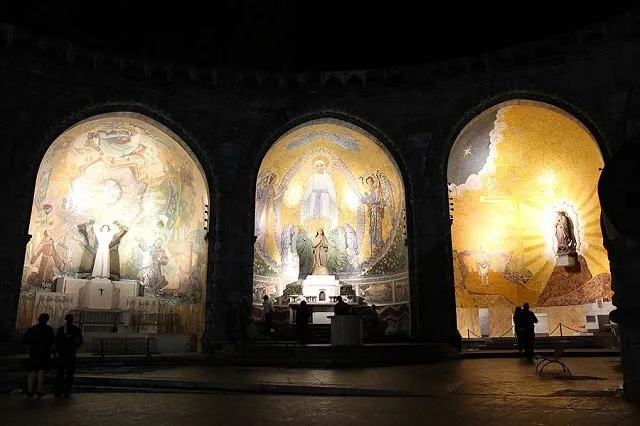
Vatican City, Apr 2, 2017 / 01:24 am (CNA/EWTN News).- On Saturday, Pope Francis moved the responsibility for Catholic shrines to be under the Congregation for the Promotion of the New Evangelization, stating that shrines, as sacred places, are especially suitable to conversion and the strengthening of faith.

April 1 the Pope issued the edict – called a motu proprio – formally moving the competency of shrines from the Congregation for Clergy to the Vatican department on the New Evangelization.

“The large influx of pilgrims, the humble and simple prayer of God’s people alternating in the liturgical celebrations, the fulfillment of so many graces that many believers certify that they have received and the natural beauty of these places allow you to see how the shrines…express an irreplaceable opportunity for evangelization in our time,” Francis states in the letter.

According to the document, titled “Ecclesia in Sanctuarium,” the tasks of the congregation will include: the establishment of new national and international shrines, studying and implementing measures for promoting their role in evangelization, and promoting systematic pastoral care of the shrines and specific training for those who operate them.

They will also be in charge of the promotion of national and international meetings to promote communal pastoral renewal and pilgrimages to various shrines, spiritual guidance for pilgrims, and “cultural and artistic enhancement of the Shrines according to the via pulchritudinis (way of beauty) as a particular mode of evangelization of the Church,” Pope Francis said.

Shrines and other places of pilgrimage “despite the crisis of faith that invests the contemporary world, are still perceived as sacred spaces to which pilgrims go to find a moment of rest, silence and contemplation in the often hectic life of today,” the letter continues.

“A hidden desire creates for many a nostalgia for God; and shrines can be a real refuge to rediscover themselves and regain the necessary strength for their conversion.”

People have made pilgrimages to holy sites since the first century, the Pope said, and even today, in every part of the world, they remain “a distinctive sign of the simple and humble faith of believers.”

The shrine is a “sacred place,” where the celebration of the sacraments, especially Reconciliation and the Eucharist, as well as the witness of charity, “express the great commitment of the Church for evangelization; and therefore it stands as a genuine place of evangelization…” he stated.

The proclamation, which was signed by Pope Francis on Feb. 11, the Feast of Our Lady of Lourdes, goes into effect 15 days from its publication.

Also April 1, the Vatican announced the Pope’s appointment of 11 new members to the Congregation for Clergy, including Fr. Hans Zollner SJ, who heads the Center for Child Protection (CCP) at the Pontifical Gregorian University in Rome and is also a member of the Vatican’s Pontifical Commission for the Protection of Minors.

Francis’ appointment of Fr. Zollner to the Congregation for Clergy reinforces his strong commitment to fight abuse, especially at the level of priestly formation.

The other nominations to the department include seven priests, one archbishop and two lay professors.

Their names are: Archbishop Erio Castellucci, Arcchbishop of Modena-Nonantola; Fr. Maurice Monier, Pro-Dean of the Roman Rota; Msgr. Vito Angelo Todisco, Prelate Auditor of the Roman Rota; Fr. Bruno Esposito, O.P., professor at the Pontifical University of St. Thomas Aquinas; Fr. George Augustin, S.A.C., dogmatic theologian; Fr. Ennio Apeciti, Rector of the Pontifical Lombard Seminary; Fr. Janusz Kowal, S.I., professor at the Pontifical Gregorian University; Fr. Marko Ivan Rupnik, S.I., consultor of the Pontifical Council for the Promotion of the New Evangelization; Professor Luigi Janiri, specializing in psychiatry and psychopathology at the University of the Sacred Heart; Professor Paolo Papanti-Pelletier, judge of the Court of Vatican City State.

[…]