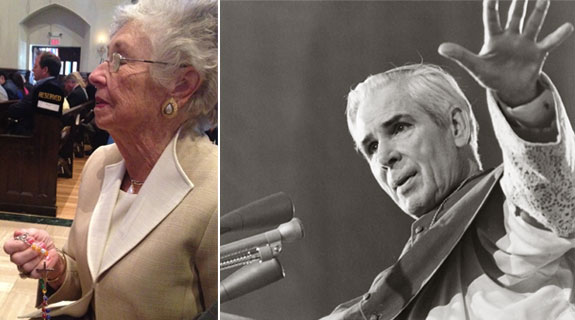
Pope Benedict XVI declared Archbishop Fulton Sheen (1895-1979) “venerable” on June 28, and the Illinois-native could soon become the first male American-born saint. A few generations back he was the face of the Catholic Church in America for many, employing his strong speaking ability, personal piety and learning, and modern media to win many converts to the Catholic faith.
Sheen was born in El Paso, Illinois, and grew up in nearby Peoria. He was ordained a priest for the Diocese of Peoria in 1919, and was made auxiliary bishop for the Archdiocese of New York in 1951 and bishop of Rochester in 1966. But Sheen is best known for his evangelization work through the media. He hosted The Catholic Hour radio program from 1930 to 1950, and Life is Worth Living, a television program for which he won an Emmy Award, from 1951 to 1957. He also authored more than 70 books on theology, philosophy, spirituality, marriage, the priesthood, and current events, and he helped convert a number of notable personalities to the Faith.
Someone who knew Sheen well and hopes to live to see his beatification is his niece Joan Sheen Cunningham of Yonkers, New York, age 85. Seventy-five years ago Joan left her midwestern family and came to New York to attend school under the guardianship of her uncle. She recently shared her memories of Archbishop Sheen with Catholic World Report.
CWR: What was your relationship to Archbishop Fulton Sheen?
Joan Sheen Cunningham: My father, Joseph Sheen (1899-1956), was the younger brother of Fulton Sheen. There were four Sheen brothers; Fulton was the oldest, and my father the second oldest. The two other brothers were Thomas and Al. My father was the closest to Fulton.
I was born into a family of eight in Peoria, Illinois. My father was a lawyer. When I was age 10, he sent me to New York to go to school, under the care of my uncle, Fulton Sheen. He was like a second father to me.
CWR: So, you were close to him?
Cunningham: Oh, yes. He took an interest in everything in my life. He took me to do things on the weekends. Sometimes, he took me ice skating at Rockefeller Center. He’d buy me pastries. Sometimes we’d visit his priest-friends at church rectories.
He’d take me to the store and pick out dresses for me. When I was older, he’d ask, “Who are you dating?” When I got married, he set up my apartment. He bought my furniture. He even went to the supermarket and bought food for my refrigerator.
He baptized my three children and gave them their first Communion. In fact, he gave me my first Communion.
CWR: Since he was a celebrity, did people come up to him frequently on the street?
Cunningham: People would stop him all the time. They’d want to shake his hand. He’d always take an interest in whoever walked up, taking the time to greet them. He always welcomed them, and was never short with anyone. He was just my uncle back then, it didn’t dawn on me until later that he was a celebrity.
Since he was known for his generosity, people would often come up to ask him for money, telling him how they were down on their luck. He’d hand them $20. I’d ask him, “How do you know that they’re not putting you on; that they really need help?”
He’d answer, “I can’t take the chance.”
He had a great love for the poor. When he served as national director for the Society for the Propagation of the Faith (1950-66), he visited the missions in Africa, and was distressed by the poverty he saw. He’d say, “Oh, if you could see the poor souls there.” As much as he loved teaching, I think the highlight of his career was being director of the Society, so he could help those people and the missionaries who served them.
When he was made bishop of Rochester, he would regularly go to the homes of poor people to celebrate Mass. He was criticized because if a school there had low enrollment, he’d want to close it, sell the property, and give the money to the poor. He saw how the poor in Rochester were in need of medical care, so he wanted to supply a medical van, staff it with doctors and nurses, and drive it to parts of town where the poor needed help. He went to a local hospital with the idea, but they wouldn’t help him.
Attitudes were different back then. There was not the stress on helping the poor like there is today. My uncle always worried about the poor.
He was also kind to outcasts. I remember one man that was disfigured by leprosy who always came to his radio broadcasts. People in the audience would see the man, cringe at his appearance and move away from him. My uncle would say to me, “Joan, go over and talk to that man, he’s very nice.”
CWR: What was his personality like? He referred to himself as a serious man.
Cunningham: He was serious, but he also had a terrific sense of humor, and managed to see the humor in things. He knew how to have a belly laugh. In fact, two of his friends were comedians Jackie Gleason and Milton Berle. When my uncle visited California, they’d arrange to get together.
Two of his best friends were Bishop Toolen of Mobile, Alabama, and his brother, who was also a priest. They’d always play gags on one another. On Bishop Toolen’s birthday, for example, my uncle sent him a St. Bernard dog with a keg around his neck.
At home, he loved to introduce people to his dog Chumley. I don’t remember the breed, but it was a big dog. He trained Chumley himself. He’d say, “Come here, Chumley, and sit. It’s Lent, time to sacrifice.” And he’d balance a piece of meat on the dog’s nose. The dog wouldn’t move until he said, “Now, it’s Easter.” And the dog would eat the meat.
He also taught Chumley to pray: he’d put his paws together and growl.
CWR: He was known for playing a role in the conversions of many people, including celebrities.
Cunningham: Yes. I remember meeting Clare Booth Luce. She’d come for breakfast at his house.
CWR: And what was his physical appearance like?
Cunningham: He was short, maybe 5’7”. None of the Sheens are tall. Often the way he was photographed would make him look tall, but he wasn’t.
He’d shave twice daily, and always dressed nicely. He’d say, “I’m an ambassador of Christ.” People were always giving him things; the tailor who did his suits, for example, wouldn’t charge him full price.
He drove a new Cadillac. A dealer in Washington, DC would give him a new one every two years. My uncle had helped him years before. The dealer told him, “I’m having a terrible time with my employees.” My uncle responded, “Why not share the wealth with them? Give them some of the profits you’re making.” The man did, and his business improved. The new Cadillacs were his way of saying thanks.
CWR: And Archbishop Sheen was known for being a pious man.
Cunningham: No question. He was always faithful to his daily Holy Hour, even when he was traveling in Africa. His whole attitude and outlook had a spiritual tone. I remember, for example, him telling me to “hold material things with a detached spirit. That way, if you lose them, it doesn’t matter.”
But besides being a religious man, he was also down-to-earth. He understood people. Many came to him with their problems. Everyone admired him and liked him as a person. He sought perfection in his life; he believed everyone should produce something with their lives.
CWR: Archbishop Sheen was known for his preaching. Did you observe how he prepared?
Cunningham: He didn’t use notes when he spoke. He’d keep an eye on the clock, and when it was time to close, he’d have a particular ending he’d prepared. I was always amazed how he always spoke the right amount of time and ended so well.
CWR: What did he enjoy eating?
Cunningham: Hardly anything. He suffered from stomach problems since he was a boy. It runs in our family.
I’d come over and cook for him sometimes. He’d have a tiny hamburger, canned peas (the small ones) and figs for dessert. He loved candy, but doctors told him he shouldn’t eat it because it was bad for his stomach. People would send him candy and cookies all the time; he’d eat one piece of candy or one cookie just so he could tell people he’d had some.
He’d go to nice dinners all the time and they’d serve him chicken. He told me he hated chicken, as they always used to give it to him on the farm when he was growing up. He’d tell me he’d push it around on his plate so that it would look like he’d eaten some.
CWR: What were his hobbies?
Cunningham: He loved tennis. He played until the doctors told him he shouldn’t play anymore. He also played the organ. He liked music, even though he couldn’t carry a tune.
CWR: Did he have problems with anyone?
Cunningham: He had a terrible time with Cardinal Spellman. That’s well known. My uncle was very successful with the mission appeal, and Cardinal Spellman’s collections were not as successful. He asked my uncle to give him some money, but he refused. He told the cardinal, “People donated to the missions, and the money has to go to the missions.”
Their dispute went all the way to Rome, and my uncle won. The cardinal didn’t want him speaking in New York, and told his priests not to have him come to their parishes. I’m sure that being sent to Rochester was the cardinal’s doing. It was a heartache for my uncle.
He was buried under the main altar of St. Patrick’s Cathedral in New York. My uncle had bought a plot in Queens and had intended to be buried there, but Cardinal Terence Cooke called and offered to bury him in St. Patrick’s. He said, “I want to make up for the way New York treated him.”
CWR: What were his final days like?
Cunningham: At the end of his life he had heart trouble. After he retired at age 75, the doctors thought he might die. He accepted it, even though he had to spend many days in the hospital. A priest friend would come every day to help him celebrate Mass.
I helped him pick out an apartment for his retirement. Two days before he died he called me and said, “Come over and help me, my books are a mess.” I came over and saw him sitting on a stool, going through his things. I thought, at last he’s getting back to his old self.
But, two days later he was dead. Apparently he died while walking to a chapel he had in his home.
I miss him. He was a wonderful, wonderful man.
If you value the news and views Catholic World Report provides, please consider donating to support our efforts. Your contribution will help us continue to make CWR available to all readers worldwide for free, without a subscription. Thank you for your generosity!
Click here for more information on donating to CWR. Click here to sign up for our newsletter.