

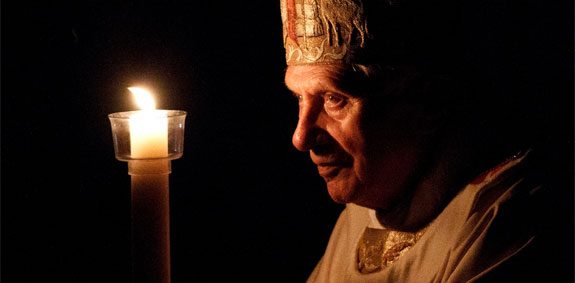
 “To say that God created light means that God created the world as a space for knowledge and truth, as a space for encounter and freedom, as a space for good and for love.”
— Pope Benedict XVI, Holy Saturday, 2012.
I.
Benedict XVI began his Sermon at this year’s Easter Vigil in St. Peter’s Basilica with these brief propositions: Easter is 1) the “feast of the new creation.” 2) “Jesus is risen and dies no more.” 3) Jesus opens us to a “new life, one that no longer knows illness and death.” 4) God “has taken mankind up into God himself.” We have a “new” creation contiguous to an “old” creation. Jesus, at a definite time and place, is risen. He will undergo no other death. This new life is beyond this earthly life; it arises out of it, but only with God’s grace.
The purpose of God is to associate men within the inner life of the Godhead. This “taking up” of man into the Trinitarian life is the original purpose of creation itself. What has newly opened up for mankind is its possibility to live this inner life of God. It is made possible by the Incarnation, life, death, and resurrection of Christ. “Creation has become greater and broader.” Reflecting this new creation, the Easter Liturgy begins with light. “Creation is presented as a whole that includes the phenomenon of time.” The first six days of creation are ordered to the Seventh Day, when God rested. Time begins not with itself but with creation. Before creation only God’s time, eternity, exists.
Creation is ordered to the coming together of the creatures God has brought forth from nothing. “The seven days are an image of completeness, unfolding in time. They are ordered towards the seventh day, the day of the freedom of all creatures for God and for one another. Creation is therefore directed towards the coming together of God and his creatures; it exists so as to open up a space for the response to God’s great glory, an encounter between love and freedom.”
That is a remarkable passage. Creation has a direction. It is not created for itself alone. Something is to “unfold in time.” What is this? All are ordered to the day of freedom both of God and creatures. God’s creation is not a necessity of His being. It is a gift of His inner life, His Love that is the essence of that inner life. The adventure of God, as it were, is freely given to be freely received. By whom? By us men. The cosmos provides a “space” wherein we can “respond” to God’s great glory. We must do this freely, in love.
II.
The Easter Vigil is suffused with light. Genesis begins with the creation of light. Benedict notes that the sun and moon are created not on the first day but the fourth. Why is this? To prevent us from making them gods and goddesses, as the ancients were tempted to do . The light of God is the light of intelligence suffusing the universe. The sun and the moon are creatures. “They are preceded by the light through which God’s glory is reflected in the essence of the created thing.” The essence of a created thing is that it exists; it exists as this kind of a thing. It did not cause itself to be.
Benedict next asks: “What is the creation account saying here?” It says that light “makes encounter possible.” If we cannot see, we cannot meet except by chance. It makes “communication possible. It makes knowledge possible, it makes freedom and progress possible.” Light and intelligence illuminate each other. Unless things are luminous, we cannot see them. If we cannot see them, we cannot know them. To see is directed to know.
Light, as Plato also saw, is an “expression of the good that both is and creates brightness.” “Evil hides.” “To say that God created light means that God created the world as a space for knowledge and truth, as a space for encounter and freedom.” The world is a place where knowledge and truth can be mutually known. When we know the truth, when we see things, we want to meet others, to tell them of what we saw and know. We are to make truth known to one another.
Matter is not evil. We are not Manicheans with a god of good and a god of evil. Evil does not come “from God-made things.” Where does it come from then? “It comes into existence only through denial. It is a ‘no.’” Evil arises from a free act that denies what should be there. This is what happens in the space of the cosmos, this drama of affirming or denying what is.
III.
Easter bathes us in pure light. This light comes to us in baptism. “Through the sacrament of baptism and the profession of faith, the Lord has built a bridge across to us, through which the new day reaches us.” Benedict combines the notion of the waters of baptism and a bridge from God to us. The early Church even called baptism “illumination.”
Why would baptism be called “illumination?” To use another image, “darkness poses a real threat to mankind.” Man can ‘see and investigate tangible material things.” What he cannot do, however, is to “see where the world is going or whence it comes.” Nor can we see “where our own life is going. We often cannot or will not see “what is good and what is evil.”
This darkness is “the real threat to our existence and to the world in general.” “If God and moral values, the difference between good and evil, remain in darkness, then all other ‘lights’, that put incredible technical feats within our own reach, are not only progress but also dangers that put us and the world at risk.”
We can light up our cities in such a way that the stars disappear from view. “With regard to material things, our knowledge and our technical accomplishments are legion, but what reaches beyond, the things of God and the question of good, we can no longer identify. The light of faith is offered to us to see the order of things that most concern us.
“God created the world as a space for knowledge and truth.” “God has taken mankind up into God Himself.” “Creation exists to open a space for response to God’s great glory.’
Benedict has a genius that takes him to the heart of what we would know. To put our lives and world in order, we need to know what we are, why we exist. Our end transcends even our nature. We are taken up into God Himself. We can say “no” to this gift in the space where the drama of our existence is worked out. This is the other side of our freedom. Its positive side is that we can also say “yes.” What is not possible is that God Himself says our “yes” or “no” for us. All that is possible is for God to show us the light and to give us, in the Passion, an example of what our “no” means.
If you value the news and views Catholic World Report provides, please consider donating to support our efforts. Your contribution will help us continue to make CWR available to all readers worldwide for free, without a subscription. Thank you for your generosity!
Click here for more information on donating to CWR. Click here to sign up for our newsletter.
