

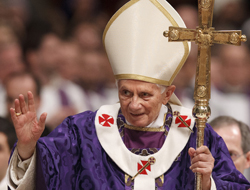

Interesting and thought-provoking articles have been popping up all over the Internet this week in the wake of the Holy Father’s surprise announcement on Monday—as have…shall we say…less-than-well-informed pieces. But skip those, and read these instead.
— First, if you haven’t yet read Carl’s editorial, posted today on the CWR homepage, you should. A snippet:
“Our faith is not in the pope,” [Cardinal Arinze] said shortly after Benedict’s announcement, “it is in Christ… So this event can help all of us to be deeper in our faith. To be, shall we say, less sentimental.” The last bit is more important than it might appear initially. Benedict XVI is, by all accounts, a very warm and personable man, but I’ve never heard the word “sentimental” associated with him. The fact is, we live not in the Information Age, but in the Sentimental Age, driven not by good thinking, tested prudence, or treasured wisdom, but by sentiments, feelings, emotions. Everywhere we turn, there are voices and texts and tweets flooding us with feelings and opinions.
But what of truth? Of reason? It says volumes (literally, if printed) that the greatest champion of reason today, the Vicar of Christ, is judged and mocked as “unreasonable” by a world that scorns reason like a junkie scorns rehab. Those who deny the transcendent and who wish to make (or re-make) man in their own image cannot and will not engage with this voice of reason for the simple reason that they will not stand to be exposed for the charlatans they are.
— In his editorial, Carl references an article by Father George Rutler at Crisis Magazine, “Benedict’s Decision in the Light of Eternity.” It is a moving reflection on what Pope Benedict has accomplished during his papacy and how his renunciation of the Throne of Peter is in continuity with what has preceded it:
The verdict of centuries from now will affirm the spiritual electricity of his Regensburg lecture, and how he spoke to the French academics in 2010, and, if words be immortal, his undying words in Westminster Hall. His general audiences regularly outnumbered those of his beloved predecessor and those accustomed to spectacle actually began to listen to the crystalline reasoning of what he said. Before he became pope, any form critic could detect his hand in Vatican documents when turgid prose suddenly broke into clarity. His first rate mind did not indulge the tendency of lesser minds to obscure what is profound and to think that what is obscure is perforce profound.
If he was expected to be a caretaker pope, he took care very well, proving himself unexpectedly radical in his reform of reform, which is more difficult than reform itself, for it restores the form that reformers forgot. So we had the renewal of liturgical integrity in an ecology of beauty, streamlining of the Curia, greater attention to episcopal appointments, the overdue beatification of Newman with all its portents for theological science, the Anglican Ordinariate which may be less significant for what it becomes than for the fact that it exists at all, and progress with the Eastern churches. His plans, like all “the best laid schemes of mice and men” were not completely realized. Not all that Benedict called “filth” was removed, and we can be sure that a media eager to affect being scandalized, will point out among those entering the Conclave, those who bring with them the shadows of what Benedict tried to dispel. But he continues to dignify in charity even those who may not understand that “dignitas.” He announced his renunciation of office in Latin, and by so doing indicated his hope that even if some of those listening may have mingled astonishment with incomprehension, his successor will be able to speak the official language of the Church he leads and the city he governs.
— John Allen has a very interesting piece on the ins and outs of how the next pope will be elected, titled “A quick course in Conclave 101.” Lots of fascinating details here; an excerpt:
In truth, what goes on is more akin to a liturgy than a political convention. In each round of balloting, every one of the cardinals eligible to vote (117 this time) has to process to the altar beneath Michelangelo’s fresco of the Last Judgment and place his ballot on a paten, then deposit it in a chalice (though last time, the Vatican used a specially designed urn). They vow they have voted for the candidate whom before God they believe should be elected, then return to their seats. The counting is an elaborate process involving three cardinals, and their work has to be checked by another three cardinals to ensure it’s accurate. All told, one round of balloting can take an hour or more to complete, so that two ballots are, in effect, a morning’s or afternoon’s work.
That’s the reality inside the Sistine Chapel: There are long stretches of time spent in silence and in prayer, with no floor speeches, no dramatic moments when a kingmaker pops up and swings his support to another candidate, no concessions and no victory laps.
— As was confirmed earlier this week by papal spokesman Father Federico Lombardi, a planned fourth encyclical on the virtue of faith will not be completed before the end of Benedict’s pontificate. Francis X. Rocca writes for CNS about this “missing encyclical” and its chances for eventual publication:
Father Lombardi has suggested that the former Pope Benedict might eventually publish the document under his own name, in which case it would not rank as part of the papal magisterium. But it is at least as likely that his successor will take up and finish the task.
Popes tend to honor their predecessors’ commitments, which is why everyone assumes that the next pope will travel to Rio de Janeiro for World Youth Day in July. Indeed, Pope Benedict’s own first encyclical, “Deus Caritas Est,” was started by his predecessor, Blessed John Paul II. …
Pope Benedict has been careful throughout his pontificate to distinguish his personal writings from his papal documents, by publishing his bestselling series of “Jesus of Nazareth” books under the name Joseph Ratzinger. The knowledge that the next encyclical was the work of more than one pope would further underscore its impersonal character and reinforce the idea, which Pope Benedict has conveyed so dramatically through his resignation, that the papacy is an office distinct from any individual who might hold it.
— Finally, if you’re still looking for more to read on, about, or by Pope Benedict, you could certainly delve into one or more of the three encyclicals he produced during his eight years as Supreme Pontiff (I’m going through Caritas in Veritate again). You’ll be light years ahead of any number of those ill-informed members of the media who have felt free to opine on Benedict’s life and legacy.
Deus Caritas Est (2005)
Spe Salvi (2007)
Caritas in Veritate (2009)
If you value the news and views Catholic World Report provides, please consider donating to support our efforts. Your contribution will help us continue to make CWR available to all readers worldwide for free, without a subscription. Thank you for your generosity!
Click here for more information on donating to CWR. Click here to sign up for our newsletter.
