Pope Leo XIV on Friday, Sept. 5, 2025, officially inaugurated the Laudato Si’ Village in Castel Gandolfo with a liturgical celebration highlighting the “vocation” of every person to care for creation, including a performance by Andrea Bocelli. /… […]
“Carlo Acutis, God’s Influencer” brings to life the story of the Church’s first millennial saint who used his passion for technology and the internet to spread his love for the Eucharist and his Catholic faith to people around the world. / Credi… […]
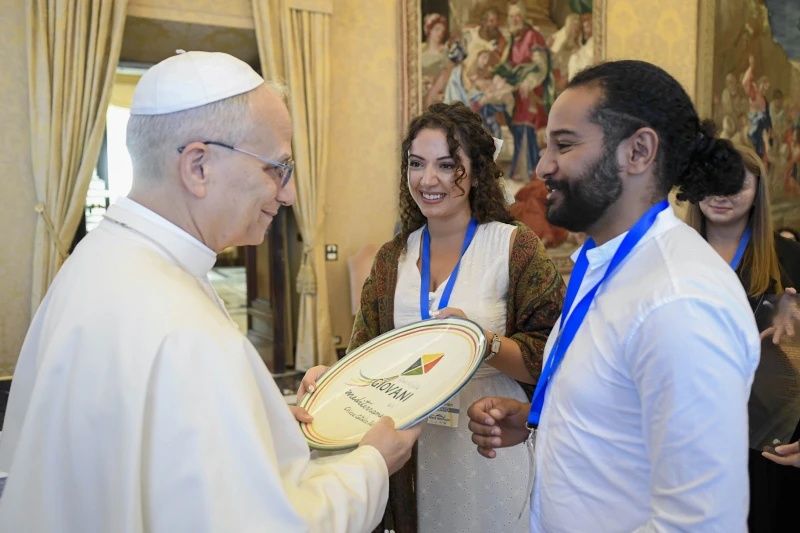
Pope Leo XIV meets young adults from the Mediterranean Youth Council in the Hall of the Consistory in the Vatican’s Apostolic Palace on Sept. 5, 2025. / Credit: Vatican Media.
Vatican City, Sep 5, 2025 / 10:00 am (CNA).
Real peace, often used as a slogan, begins in our own hearts and communities, Pope Leo XIV told a group of young adults from the Mediterranean region at the Vatican on Friday.
In a speech in both Italian and English Sept. 5, the pope called young people the “generation that envisions a better future and chooses to build it. You are the sign of a world that does not give in to indifference and complacency,” he added, “but rolls up its sleeves and works to transform evil into good.”
Leo met with around 50 members of the Mediterranean Youth Council, which was founded in 2022 and includes young adults from European and Middle Eastern countries bordered by the Mediterranean Sea.
“Peace is on the agenda of international leaders, it is the subject of global discussions, but sadly, it often gets reduced to a mere slogan,” the pontiff said. “What we need is to cultivate peace in our own hearts and in our relationships, to let it blossom in our daily actions, to work for reconciliation in our homes, our communities, our schools and workplaces, in the Church and among the Churches.”
Pope Leo tells young adults from the Mediterranean Youth Council at the Vatican on Sept. 5, 2025, “to cultivate prayer and spirituality, together with action, as sources of peace and points of encounter between traditions and cultures.”. Credit: Vatican Media.
Being a peacemaker is not easy, Leo said, and he denounced the use of religious traditions to justify violence, instead of bringing peace, fraternity, care for creation, and openness to others.
“We need to reject these forms of blasphemy that dishonor God’s Holy Name, and to do so by the way we live our lives,” he underlined. “We are called to cultivate prayer and spirituality, together with action, as sources of peace and points of encounter between traditions and cultures.”
“For believers, the future is not one of walls and barbed wire, but one of mutual acceptance,” he added.
The pope encouraged the young people to not give up, even if someone does not understand them or what they are working for: “St. Charles de Foucauld said that God also uses headwinds to bring us to port.”
“Do not be afraid: Be seeds of peace where the seeds of hate and resentment grow; be weavers of unity where polarization and enmity prevail; be the voice of those who have no voice to ask for justice and dignity; be light and salt where the flame of faith and the taste for life are dying out,” he said.
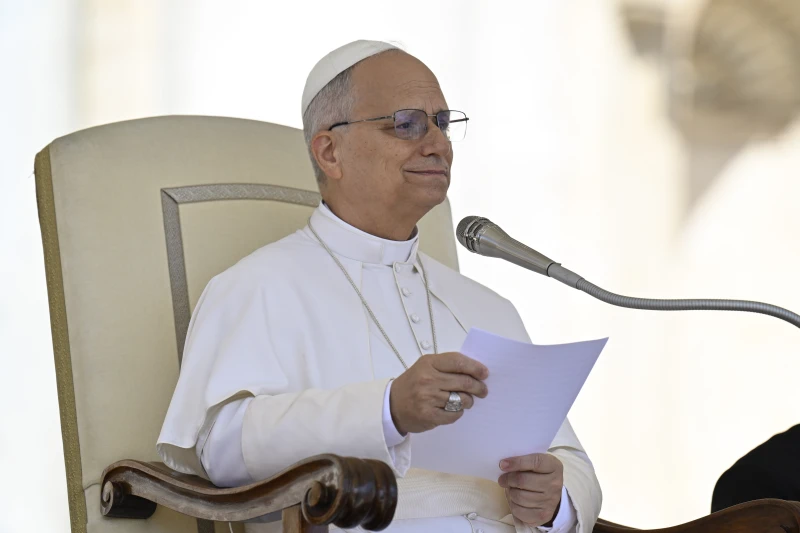
Pope Leo XIV appealed for help for Sudan during his Wednesday general audience in St. Peter’s Square on Sept. 3, 2025. / Credit: Vatican Media.
Vatican City, Sep 3, 2025 / 08:00 am (CNA).
Pope Leo XIV on Wednesday pleaded for international assistance for the North African country of Sudan, which is experiencing violence, famine, natural disasters, and disease.
“I am closer than ever to the Sudanese population, in particular families, children and the displaced,” Leo said at the end of his general audience at the Vatican Sept. 3.
“I pray for all the victims,” the pontiff added. “I make a heartfelt appeal to leaders and to the international community to guarantee humanitarian corridors and implement a coordinated response to stop this humanitarian catastrophe.”
The dramatic situation in Sudan, marked by months of armed clashes, mass displacement, and the threat of cholera, has prompted multiple warnings from humanitarian organizations.
In his appeal, Leo drew attention to the civilians trapped in the city of El Fasher, where they are experiencing famine and violence, and to a deadly landslide in Tarsin, which it is believed killed up to 1,000 people, with others still missing.
“And, as if that were not enough,” the pontiff added, “the spread of cholera is threatening hundreds of thousands of already stricken people.”
“It is time to initiate a serious, sincere and inclusive dialogue between the parties to end the conflict and restore hope, dignity and peace to the people of Sudan,” Leo urged.
Pope Leo XIV rides in the popemobile before his Wednesday general audience in St. Peter’s Square on Sept. 3, 2025. Credit: Vatican Media.
After three weeks indoors, the pope’s public audience returned to St. Peter’s Square on Wednesday following a dip in Rome’s soaring August temperatures.
‘No-one can save themselves’
In his spiritual message at the audience, Leo reflected on Jesus’ final moments on the cross as narrated in the Gospel of John, where the crucified Christ utters the phrase: “I thirst.”
The pope said the thirst of the Crucified One is not only the physiological need of a tortured body, but above all, the expression of a profound desire for love, relationship, and communion.
His cry, Leo XIV asserted, is that of a God “who is not ashamed to beg for a sip, because in that gesture he tells us that love, in order to be true, must also learn to ask and not only to give.”
The pontiff then stated that “Jesus does not save with a dramatic twist, but by asking for something that he cannot give himself.”
This, according to the Holy Father, opens a door to true hope: “If even the Son of God chose not to be self-sufficient, then our thirst too — for love, for meaning, for justice — is a sign not of failure, but of truth.”
“Jesus’ thirst on the cross is therefore ours too,” he added. “It is the cry of a wounded humanity that seeks living water. And this thirst does not lead us away from God, but rather unites us with him. If we have the courage to acknowledge it, we can discover that even our fragility is a bridge towards heaven.”
Thus, the pope said, on the cross, Jesus teaches us that human beings are not realized “in power, but in trustful openness to others, even when they are hostile and enemies.”
It is precisely through the acceptance of fragility that we achieve salvation, he emphasized, which “is not found in autonomy, but in humbly recognizing one’s own need and in being able to express it freely.”
“None of us can be self-sufficient. No-one can save themselves. Life is ‘fulfilled’ not when we are strong, but when we learn how to receive,” Leo said.
A difficult truth
“We live in a time that rewards self-sufficiency, efficiency, performance,” he said. “And yet the Gospel shows us that the measure of our humanity is not given by what we can achieve, but by our ability to let ourselves be loved and, when necessary, even helped.”
Leo XIV invited the faithful to rediscover the simple joy that is born of fraternity and free gift of self. He emphasized that in everyday gestures, such as “asking without shame” and “offering without ulterior motives,” lies a profound happiness, distinct from that which the world proposes.
“It is a joy that restores us to the original truth of our being: we are creatures made to give and receive love,” the pontiff affirmed.
He encouraged those listening to not be afraid or ashamed to reach out, even when they feel undeserving. “It is right there, in that humble gesture, that salvation hides,” he concluded.
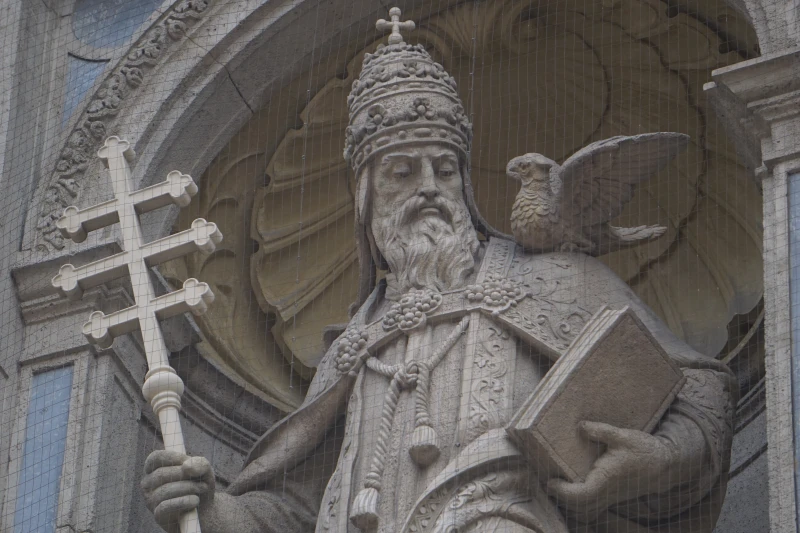
A statue of Pope Gregory I, also known as Saint Gregory the Great, with his famous Catholic iconography of a dove sitting on his shoulder, sits outside of St. Stephen’s Basilica in Budapest, Monday, Dec. 30, 2024 / Credit: Alexander Ruszczynski/Shutterstock
CNA Staff, Sep 3, 2025 / 07:15 am (CNA).
St. Gregory the Great, a central figure of the medieval western Church and one of the most admired popes in history, is commemorated in the Ordinary Form of the Roman Catholic liturgy. He was the first of the bishops of Rome to popularize the now-traditional papal title “servant of the servants of God,” which referred to Christ’s command that those in the highest position of leadership should be “the last of all and the servant of all.”
Born near the middle of the sixth century into a noble Roman family, the future St. Gregory the Great received a classical education in liberal arts and the law. He also had strong religious formation from his devout family, particularly from his mother, Silvia, also a canonized saint.
By around age 30, Gregory had advanced to high political office in Rome, during what was nevertheless a period of marked decline for the city.
Some time after becoming the prefect of the former imperial capital, Gregory chose to leave the civil administration to become a monk during the rise of the Benedictine order. In reality, however, the new monk’s great career in public life was yet to come.
After three years of strict monastic life, he was called personally by the pope to assume the office of a deacon in Rome. From Rome, he was dispatched to Constantinople, to seek aid from the emperor for Rome’s civic troubles, and to aid in resolving the Eastern church’s theological controversies. He returned to Rome in 586, after six years of service as the papal representative to the eastern Church and empire.
Rome faced a series of disasters caused by flooding in 589, followed by the death of Pope Pelagius II the next year. Gregory, then serving as abbot in a monastery, reluctantly accepted his election to replace him as the Bishop of Rome.
Despite this initial reluctance, however, Pope Gregory began working tirelessly to reform and solidify the Roman liturgy, the disciplines of the Church, the military and economic security of Rome, and the Church’s spreading influence in western Europe.
As pope, Gregory brought his political experience in Rome and Constantinople to bear, in the task of preventing the Catholic Church from becoming subservient to any of the various groups struggling for control of the former imperial capital. As the former abbot of a monastery, he strongly supported the Benedictine movement as a bedrock of the western Church. He sent missionaries to England, and is given much of the credit for the nation’s conversion.
Even as he undertook to consolidate papal power and shore up the crumbling Roman west, St. Gregory the Great maintained a humble sense of his mission as a servant and pastor of souls, from the time of his election until his death in 604.
This article was first published on Aug. 19, 2010, and has been updated.
Father James Martin, SJ. / Credit: Flickr by Shawn (CC BY-NC 2.0)
Vatican City, Sep 1, 2025 / 06:00 am (CNA).
Pope Leo XIV met in a private audience with Father James Martin, S.J., at the Vatican on Monday.Martin, who is in Rome to lead a Jubil… […]