No Picture
News Briefs

Hundreds of high school, college students participated in pro-life walkout

April 12, 2018 CNA Daily News 0

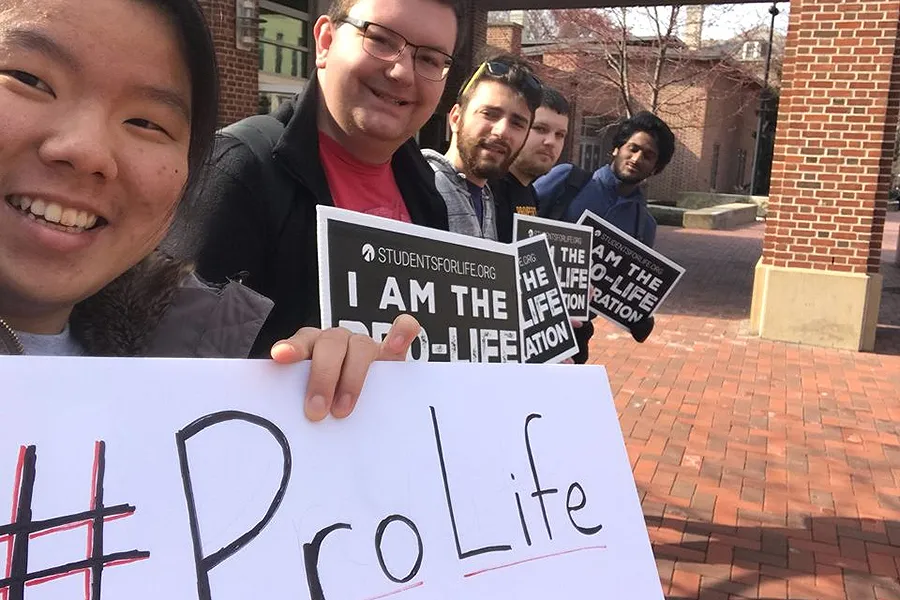
Washington D.C., Apr 12, 2018 / 04:23 pm (CNA/EWTN News).- Inspired by recent student walkouts over gun control, hundreds of high school and college students across the US took part in a pro-life walkout on Wednesday.

According to pro-life group Students for Life of America (SFLA), more than 400 students and student organizations told SFLA that they planned on participating in the April 11 walkout, though the actual number is likely higher, as students did not have to register with the group to participate.

“Across the country, pro-life students and groups stood up for the 321,384 babies killed by Planned Parenthood every year, against the violence of abortion, and in support of pregnant and parenting students,” SFLA president Kristan Hawkins said in a statement.

“In pictures worth millions of words, we saw students walking out, praying, and chalking pro-life messages to bring attention to the fact that one-fourth of our generation has been snuffed out of existence because of legalized abortion,” she added.

Participants were encouraged to use #Life and #ProLifeWalkout to document their participation on social media. Like the March for Our Lives walkout, the pro-life walkout lasted 17 minutes, during which time students mourned the 10 babies who would be killed by abortion within that time frame.


So proud of the more than 60 students who participated in the #ProLifeWalkout from my high school. We are the #ProLifeGeneration. @Students4LifeHQ pic.twitter.com/qgmN88lFlh

— Blake Barclay (@blakebarclayusa) April 11, 2018


The idea for the pro-life walkout came from Brandon Gillespie, a student at Rocklin High School in Rocklin, Calif., a suburb of Sacramento.

Gillespie said in March that the idea for the pro-life walkout came to him after his history teacher, Julianne Benzel, discussed the national gun control walkouts in her classroom. Benzel asked her students whether the same privileges would be afforded to students if they wanted to walk out over issues like abortion, or if a double standard existed. She was then placed on paid administrative leave following complaints about her discussion of the issue.

“If you’re going to allow students to get up and walk out without penalty, then you’re going to have to allow any group of students that wants to protest,” Benzel told Fox & Friends.

After hearing of Gillespie’s plan to hold a pro-life walkout, Students for Life created a website promoting the idea to schools throughout the nation.

“I also want to thank Brandon Gillespie at Rocklin High School for inspiring this national walkout and for not letting his school intimidate him out of hosting his walkout. The tremendous, truly grassroots interest we have seen in the walkout is further proof that the Pro-Life Generation is the majority and is strong and growing,” Hawkins said.

The website for the walkout included a list of high schools and colleges that registered with SFLA for the walkout, which included public and private schools from throughout the United States.


Proud to stand with Morality High School students during their time of silence for the their classmates lost to abortion and women hurt at during the #ProLifeWalkout! pic.twitter.com/CJekGhuGFr

— Bethany Janzen (@BethanySFLA) April 11, 2018


“…it’s time for the #ProLifeGen to stand up and say ‘Enough is Enough!’ We will no longer tolerate legal abortion in our nation, which has killed more than a fourth of our generation,” the walkout website stated.

“We will no longer watch as our leaders in Washington continue to fund our nation’s largest abortion vendor, Planned Parenthood, with more than $500 million of our taxpayer dollars. We will no longer permit Planned Parenthood and their allies in the abortion industry to target our peers for their predatory business cycle.”

Hawkins added that SFLA was notified of several students who reported that they faced discrimination for participating in a pro-life walkout, while the gun control walkout was given special accommodations by many schools.

Life Legal Defense Foundation, a non-profit that defends pro-life clients, sent a letter to Gillespie’s high school, notifying the administration that they could face legal ramifications if they interfered with the pro-life walkout and treated participating students differently than those who participated in the gun control walkout.

SFLA and Life Legal have offered to provide legal assistance to any students who faced discrimination for their participation in the pro-life walkout.

[…]

No Picture
News Briefs

New US law aims to prosecute websites that facilitate sex trafficking

April 12, 2018 CNA Daily News 1

Washington D.C., Apr 12, 2018 / 01:02 pm (CNA/EWTN News).- A new law aims to make it easier to prosecute websites that knowingly facilitate sex trafficking, such as Backpage.com.

President Donald Trump signed the “Allow States and Victims to Fight Online Sex Trafficking Act of 2017” into law April 11.

Under the new law, the government will be able to prosecute the owners or operators of websites which knowingly assist, support, or facilitate “the prostitution of another person,” or who act with reckless disregard for the fact that their conduct contributed to sex trafficking. Users and victims will be able to sue those sites.

The new law clarifies that Section 230 of the Communications Decency Act of 1996, which previously protected the operators of websites from legal liability for content posted by third parties, cannot be used as a defense to shield sites that knowingly promote sex trafficking and prostitution.

“[Section 230] was never intended to provide legal protection to websites that unlawfully promote and facilitate prostitution and websites that facilitate traffickers in advertising the sale of unlawful sex acts with sex trafficking victims,” the law reads.

Before the bill became law, federal authorities on April 6 seized Backpage, a massive classified ad site used largely for selling sex, which hosted ads depicting the prostitution of children. Ads posted on the site, which took in an estimated $135 million in annual revenue in 2014, were reportedly responsible for nearly three quarters of all cases submitted to the National Center for Missing and Exploited Children. The site was the subject of an extensive Senate report into its practices of promoting prostitution and the trafficking of minors, which was released in January 2017.

The Department of Justice on April 9 announced the charging of seven individuals, including Backpage’s founder Michael Lacey, in a 93-count federal indictment which detailed the site’s reported practices of facilitating prostitution and money laundering. The indictment alleges that the defendants knew that the majority of the website’s “adult” ads involved prostitution, and that the site would “sanitize” the ads by removing “terms and pictures that were particularly indicative of prostitution” but continuing to run the ads.

Backpage also allegedly had a policy for several years that involved deleting words in an ad denoting a child’s age, and publish the revised version, which created a “veneer of deniability” for those trafficking the children.

“This website will no longer serve as a platform for human traffickers to thrive, and those who were complicit in its use to exploit human beings for monetary gain will be held accountable for
their heinous actions,” said FBI Director Christopher Wray in a release from the DOJ.  “Whether on the street or on the Internet, sex trafficking will not be tolerated.”

Rep. Ann Wagner (R-MO) introduced the bill, and House Judiciary Chairman Bob Goodlatte (R-VA) added language to expand the scope of the bill to include advertisements for all forms of prostitution. In areas of the country where prostitution is legal, that fact can be taken into account in court as an affirmative defense.

Prostitution is currently illegal in all of the United States except in a few rural Nevada counties, but some estimates suggest there are over half a million people in the country in prostitution.

After the bill passed the Senate 97-2 with bipartisan support on March 21, a number of websites began to take down explicit content and online communities that promote pornography or prostitution. Craigslist shut down their Personals page on March 23, and Reddit removed several fora that users previously used to seek and advertise escort services and casual sexual encounters.

Critics of the law, including deputy Attorney General Stephen A. Boyd, voiced concern that some of its language – which would allow punishment for conduct that occurred before it was enacted – may be unconstitutional. Others have argued that it could have a chilling effect on free speech on the internet.

Santa Clara University Law Professor Eric Goldman said, in testimony to Congress in November 2017, that an amendment to Section 230 could lead to sites self-censoring any and all content that could be construed as sex trafficking, or, alternatively, dial down moderation so that they could less reasonably be accused of “knowing” that sex trafficking content existed on their site.

“If failing to moderate content perfectly leads to liability, some online services will abandon their efforts to moderate user content or even shut down,” Goldman said during the hearing.

“I really do fear the chilling effects,” said Mary-Rose Papandrea, a University of North Carolina Law Professor, during a symposium on April 6. “Because imagine you run a platform, and imagine now you are exposed to liability for everything a third-party posts on your website as soon as you’re told about it. What are you going to do? You’re going to take it down.”

“I worry this isn’t the end,” she continued. “We can carve out sex trafficking, and we can debate that…but my concern is what’s next.”

However, Mary G. Leary, law professor at The Catholic University of America, rejected this idea. She told CNA in an interview that the amendment to Section 230 is narrow enough that it only removes a website’s immunity if they knowingly enter into a venture with human traffickers, or if they intentionally promote prostitution.

“That is a very narrowly tailored, common sense bill. I think that any argument it will impair speech is just alarmist and misplaced,” she said.

Leary emphasized that criminal acts, such as prostitution and human trafficking, are not considered speech and have “never been protected by the First Amendment.”

“The Supreme Court has been quite clear that offers to engage in illegal activities are not protected speech,” she said.

Leary said testimony given to the Senate during the creation of the law singled out sites that are clearly “bad actors,” like Backpage, as opposed to the majority of websites that are “law abiding, good corporate citizens who want to end sex trafficking.” She said it is unlikely that most companies will simply look away and choose not to moderate content that promotes sex trafficking.

“That argument has not been proven by history,” she says. “There are many industries that, sadly, are places where sex trafficking takes place…hotels, travel and tourism, shopping areas, foster care facilities…these are places that have never had immunity. We have not seen them as an industry look the other way or pretend it doesn’t happen.”

In fact, she said, groups like the hotel industry have put together best practices to deal with illegal activities that take place on their premises. The new law does not require websites to police all content, but rather clarifies the purpose of Section 230, she said. There will be little effect for law abiding companies, because the law sets a high bar for prosecutors to prove that the company was knowingly and intentionally facilitating sex trafficking.

“What we will see are no longer companies out in the open, allowing and partnering with sex traffickers to sell women and children, with not only impunity but with absolute protection,” Leary said.  

Some online groups, such as the Women’s March, claim that the shuttering of sites that are used by people who are not being trafficked will drive the already shady business of prostitution even further underground, and make conditions worse for people who choose to sell sex for a living. Advocates in favor of prostitution have already created several new websites that are hosted overseas, in countries like Austria, to avoid the alleged self-censorship of American-hosted sites.

Critics, however, challenged the idea that prostitution is a profession of choice for women.

“Nobody says when they’re a little girl, ‘I want to grow up to be a prostitute,’” said Dr. Grazie Christie, Policy Advisor for The Catholic Association, speaking on EWTN’s Morning Glory.

The National Center on Sexual Exploitation, a Washington D.C.-based group that supports the new legislation, has compiled a site detailing resources available to current workers in the sex industry to provide “housing, food, referrals, and other short-term emergency assistance.”

“We are also concerned for those who turned to prostitution out of despair, lacking any other financial resources, and who now do not know where to turn,” said Dawn Hawkins, executive director of NCOSE, in a statement. “We encourage the public to share these resources widely so that survivors of commercial sexual exploitation can seek healing and support.”


[…]

No Picture
News Briefs

Director of women’s clinic: Abortion pill reversal is safe and effective

April 11, 2018 CNA Daily News 1

Denver, Colo., Apr 11, 2018 / 07:00 pm (CNA/EWTN News).- The director of a women’s clinic in Denver said that she has found an abortion pill reversal protocol to be safe and effective with her patients, following a recently published study on the procedure.

“Oftentimes in medicine, when we find that there is something that is actually making a difference and causing no harm, we will implement it into practice,” Dede Chism, a nurse practitioner and co-founder and executive director of Bella Natural Women’s Care in Englewood, Colo., told CNA.

The recent study, published in Issues in Law and Medicine, a peer-reviewed medical journal, examined 261 successful abortion pill reversals, and showed that the reversal success rates were 68 percent with a high-dose oral progesterone protocol and 64 percent with an injected progesterone protocol.

Both procedures significantly improved the 25 percent fetal survival rate if no treatment is offered and a woman simply declines the second pill of a medical abortion. The case study also showed that the progesterone treatments caused no increased risk of birth defects or preterm births due.

The study was authored by Dr. Mary Davenport and Dr. George Delgado, who have been studying the abortion pill reversal procedures since 2009. Delgado also sits on the board of the American Association of Pro-Life Obstetricians and Gynecologists.

“When it comes to saving the life of any human person, even when the chance is slim, isn’t it worth the effort, when the benefits outweigh any risk?” Chism said.

Medical abortions have become an increasingly common method of abortion in the United States, making up 30-40 percent of all abortions.

Medical abortions involve the taking of two pills – the first pill, mifepristone (RU-486) blocks the progesterone hormone, which is essential for maintaining the health of the fetus. The second pill, misoprostol, is taken 24 hours after mifepristone and works to induce contractions in order to expel the fetus.

Some women, after taking the first pill (mifepristone), experience regret and do not want to follow through with the abortion by taking misoprostol. Many doctors and providers, including Dr. Thomas Hilgers of the Pope Paul VI Institute, as well Chism, Delgado and Davenport, have found that they can improve the chances of a baby’s survival in these cases by flooding a woman’s system with more progesterone, in a hopes of overriding the progesterone-blocking effects of mifepristone.

The progesterone protocol is safe, Chism said, because it is a naturally occurring hormone in pregnant women that has been used for the treatment of pregnant women in various situations.

“What we’re trying to do is to bring the mom to a healthy progesterone level,” Chism said, whether that’s during an abortion pill reversal or monitoring a pregnant woman with low progesterone levels.

“We do this exact same thing in mom’s who’ve had early miscarriages that have a hard time conceiving and maintaining pregnancy,” she noted. “It’s common that women may not have enough progesterone on the back half of their cycle even to support a pregnancy, so what we’re trying to do is get them to a healthy progesterone level.”  

Because progesterone is known to be safe for pregnant women and unborn babies, the progesterone abortion pill reversal procedure is “common sense,” Chism added.

Critics of Delgado’s study argued that the peer-reviewed journal in which it was published is biased, because of its ties to the pro-life organization Watson Bowes Research Institute. Delgado told the Washington Post that he acknowledged this concern, but thought that his study would not get fair consideration from other journals due to political bias.

Delgado also told the Washington Post that he believed more research should be done, but that there should be nothing to stop doctors from using the progesterone protocol in the meantime.

“It hadn’t been studied formally in a big way, but we saw it was saving lives and had no alternatives. Were you going to wait when someone was dying in front of you?” he said.

“(T)he science is good enough that, since we have no alternative therapy and we know it’s safe, we should go with it,” he added.

Chism noted that the Bella clinic has treated several women who have sought abortion pill reversals. The progesterone protocol has been effective in women who have come in as soon as possible after taking the first dose of mifepristone, she said.

“We are currently in the midst of caring for a patient who took the abortion pill.  She is 4 weeks and 3 days from taking that first pill.  We were able to begin the reversal protocol in less than 24 hours from her initial dose. We did have a few scary days initially with bleeding and threatened loss of pregnancy, but she is now very stable with a normally growing baby,” she said.
 
“I think the fact that we have now over 300 successful reversals is evidence that it works,” she added. “This isn’t make-believe and it isn’t coincidental.”

Chism added that it is common practice in medicine to share information about protocols that have yet to undergo even more rigorous prospective studies, if they have been shown to be safe and effective in case studies.

Some critics also argued that the study was unnecessary since only a small percentage of women actually seek and follow through on abortion pill reversals.

“We’re not causing harm, and even if the possibility of saving a baby is small, even if the population who desires it is small, is it not worth it to recognize it?” Chism countered. “Isn’t it beautiful that there could be a possibility that just maybe could change and help you out when you’ve made a decision that you’ve regretted?”

Telling women that a safe and effective protocol exists is a matter of informed consent, Chism added.

“To tell someone that there is (no reversal), that this medical abortion is permanent and irrevocably irreversible, that’s not a true statement,” she said. “To be able to tell a patient that it may be possible in some circumstances to reverse an abortion pill, I think that is simply informed consent.”

[…]

No Picture
News Briefs

Paul Ryan announces retirement from Congress

April 11, 2018 CNA Daily News 0

Washington D.C., Apr 11, 2018 / 09:48 am (CNA/EWTN News).- Speaker of the House Paul Ryan (R-WI) will not run for reelection this November, he announced on Wednesday. Ryan’s departure confirms rumors that began swirling in mid-December 2017. He will retire in January, at the conclusion of his term.

Ryan, who is a Catholic, was first elected to Congress in 1998, and became the speaker of the house in October of 2015. He has become known for his conservative views and was Mitt Romney’s running mate in the 2012 presidential election.

In his speech announcing his retirement, Ryan cited his three teenage children as one of the main reasons why he would be leaving Congress. His eldest daughter is 16 years old, he said, the same age he was when his father passed away.

“What I realize is, if I am here for one more term, my kids will only have known me as a weekend dad,” he said.

“I just can’t let that happen.”

Regardless, Ryan insisted that he has “no regrets” from his tenure in Congress, and that he put all of his being into his work. He insisted that the current political climate did not influence his decision to retire from Congress.

On Twitter, President Donald Trump offered praise for Ryan, even though the two have butted heads in the past. Trump said that Ryan was a “truly good man” who will “leave a legacy of achievement that nobody can question.”

<blockquote class=”twitter-tweet” data-lang=”en”><p lang=”en” dir=”ltr”>Speaker Paul Ryan is a truly good man, and while he will not be seeking re-election, he will leave a legacy of achievement that nobody can question. We are with you Paul!</p>&mdash; Donald J. Trump (@realDonaldTrump) <a href=”https://twitter.com/realDonaldTrump/status/984066131303583746?ref_src=twsrc%5Etfw”>April 11, 2018</a></blockquote> <script async src=”https://platform.twitter.com/widgets.js” charset=”utf-8″></script>
Former Speaker of the House Nancy Pelosi (D-CA) also offered praise for Ryan, saying in a statement that, “Despite our differences, I commend his steadfast commitment to our country. During his final months, Democrats are hopeful that he joins us to work constructively to advance better futures for all Americans.”

<blockquote class=”twitter-tweet” data-conversation=”none” data-lang=”en”><p lang=”en” dir=”ltr”>.<a href=”https://twitter.com/NancyPelosi?ref_src=twsrc%5Etfw”>@NancyPelosi</a> reacts to Paul Ryan's retirement. <a href=”https://t.co/ceagNZpH48″>pic.twitter.com/ceagNZpH48</a></p>&mdash; Sahil Kapur (@sahilkapur) <a href=”https://twitter.com/sahilkapur/status/984072202344640514?ref_src=twsrc%5Etfw”>April 11, 2018</a></blockquote>
<script async src=”https://platform.twitter.com/widgets.js” charset=”utf-8″></script>

Ryan has talked about his Catholic faith numerous times during his two decades in Congress. He spoke at this year’s March for Life in Washington, D.C. and has spoken out in favor of religious freedom and pro-life legislation.

He has clashed with leaders of the U.S. bishops on other issues, notably the 2017 tax reform bill. Ryan championed the bill, while leaders of the U.S. bishops’ conference called parts of it “unconscionable,” saying it “appears to be the first federal income tax modification in American history that will raise income taxes on the working poor while simultaneously providing a large tax cut to the wealthy.”

Ryan did not announce what his plans are once he leaves Congress.

[…]

No Picture
News Briefs

Commentary: The peripheries of our own vision

April 10, 2018 CNA Daily News 0

Washington D.C., Apr 10, 2018 / 04:21 pm (CNA).- While Pope Francis’ latest apostolic exhortation focuses on joy and holiness in everyday life, one passage has drawn sharp reactions from Catholics on the left and the right.

“Our defense of… […]

No Picture
News Briefs

Condom distribution at Catholic hospital stops after Cincinnati archdiocese speaks up

April 10, 2018 CNA Daily News 0

Cincinnati, Ohio, Apr 10, 2018 / 02:19 pm (CNA).- A county-run needle exchange program hosted in a Catholic hospital’s parking lot has stopped distributing condoms, following action from Archbishop Dennis Schnurr and the Archdiocese of Cincinnati.
 
“This matter was addressed and favorably resolved last week, as soon as it came to the attention of the archdiocese,” Mike Schafer, director of the archdiocese’s communication and mission promotion department, told CNA April 9.
 
“Condom distribution is no longer part of the Hamilton County Public Health Harm Reduction Program, run from their van parked in the Mercy Health – Clermont Hospital parking lot,” he said. “Archbishop Schnurr engaged with Mercy Health leadership on this issue, with the resulting decision being to disallow condom distribution on hospital property.”  
 
The archdiocese was unaware that condom distribution was part of the Hamilton County Public Health Program until the fact was brought to its attention by CNA inquiries, said Schafer.

Mercy Health is not owned or operated by the Archdiocese of Cincinnati. Rather, its sponsors include the Sisters of Mercy, the Sisters of the Humility of Mary, and the Franciscan Sisters of the Poor. The system has hospitals in Ohio and Kentucky.

The Mercy Health – Clermont Hospital in Batavia, Ohio had been hosting in its parking lot a van that was part of a county-run needle exchange program. As part of its harm reduction strategy, the program offered condoms, as well as injection equipment and other health services, the Cincinnati Enquirer reported.

“After engaging in further discussion with Archbishop Schnurr from the Archdiocese of Cincinnati, we have asked the Hamilton County Health Department to discontinue the availability of condoms in the van,” Mercy Health spokesperson Nanette Bentley told CNA April 10. “The Hamilton County Public Health Department needle exchange program van will continue to serve the community, providing needle exchange and access to testing and resources.”

In April 3 comments to CNA, Bentley had described the program as “a harm reduction program aimed at reducing the spread of sexually transmitted diseases, including HIV and Hepatitis C.”

“The program includes needle exchange, access to testing and condoms as a holistic approach to harm reduction,” she had said, noting that clients would enter the Hamilton County Public Health property when they entered the van. The van was staffed only by county employees.

Previous news reports on the exchange program noted that condoms were distributed at the Mercy Health location, but not in a similar program hosted at two facilities of the Kentucky-based St. Elizabeth Healthcare system. That health system is sponsored by the Diocese of Covington.

The National Catholic Bioethics Center, which handles inquiries on Catholic bioethics issues, has always argued against condom distribution, Catholic bioethicist John Brehany, the center’s director of institutional relations, told CNA.

“One reason is that Pope Paul VI’s 1968 encyclical Humanae Vitae teaches that every sexual act must retain its essential openness to procreation,” he said. In addition, “if someone has a dangerous disease, really, the better ethical action is not to expose someone else to it at all.”


[…]