No Picture
News Briefs

Pope Francis on Gaza conflict: ‘Without justice, there is no peace’

April 3, 2024 Catholic News Agency 5
Pope Francis waves to pilgrims in St. Peter’s Square gathered for his weekly general audience on April 3, 2024. / Credit: Vatican Media

Vatican City, Apr 3, 2024 / 09:05 am (CNA).

Pope Francis during his general audience on Wednesday deplored the recent killing of humanitarian workers in the Gaza Strip, with the Holy Father renewing his appeal for an immediate cease-fire amid the ongoing Israel-Hamas war. 

The pope buttressed his plea with a catechesis focused on the virtue of justice, noting that it is the building block for a well-ordered society premised upon the rule of law. 

“I express deep regret for the volunteers killed while distributing food aid in Gaza,” the pope said to the 25,000 gathered in St. Peter’s Square on an overcast Wednesday morning. 

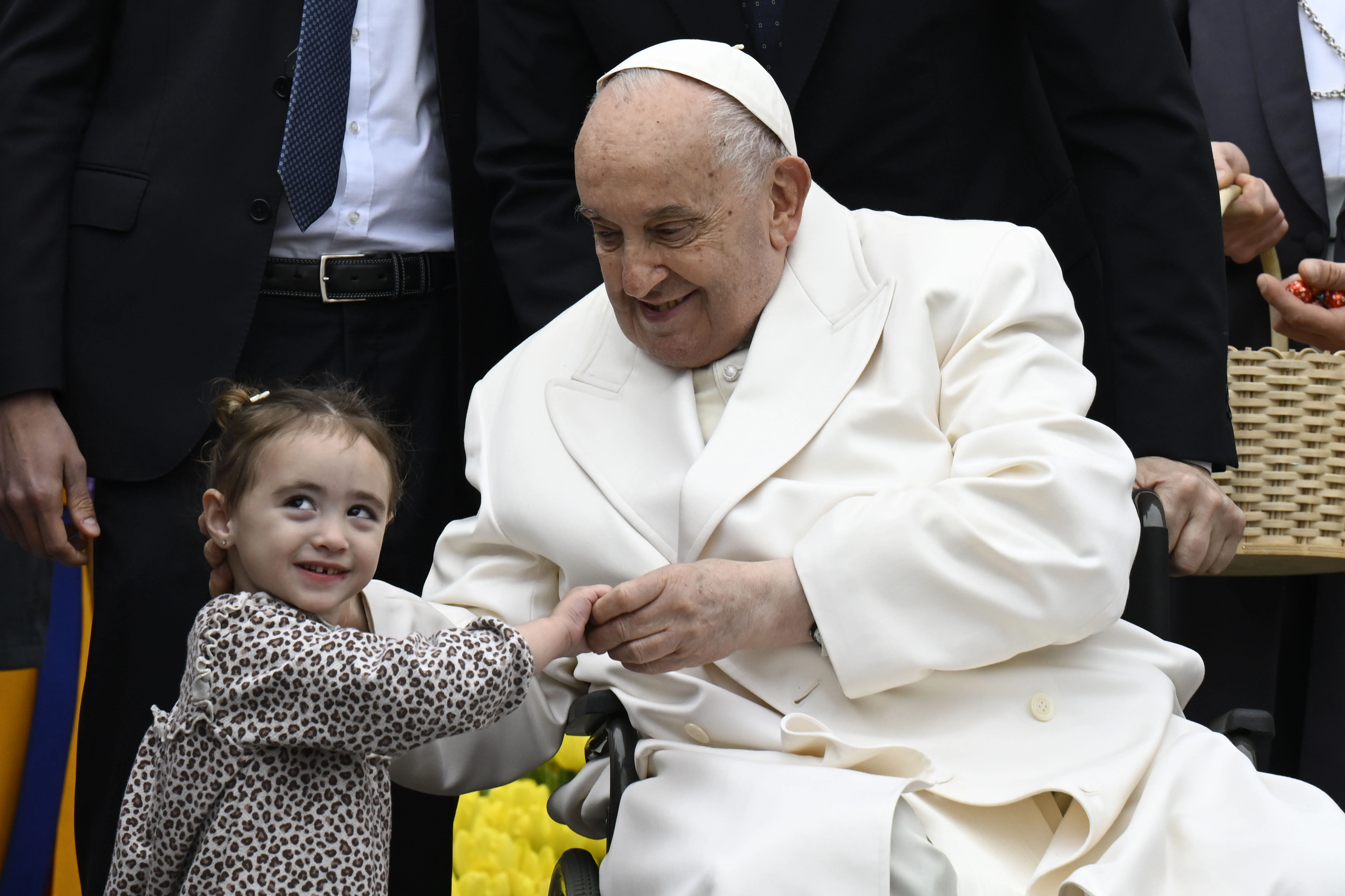
Pope Francis greets a young girl in St. Peter's Square during his general audience on April 3, 2024. Credit: Vatican Media
Pope Francis greets a young girl in St. Peter’s Square during his general audience on April 3, 2024. Credit: Vatican Media

Seven volunteers from the nonprofit World Central Kitchen were killed in an Israeli strike on Monday while traveling in a “deconflicted zone” after delivering 100 tons of food aid to a town in central Gaza. 

Israeli Prime Minister Benjamin Netanyahu called the incident “tragic,” suggesting that the Israel Defense Forces “unintentionally struck innocent people in the Gaza Strip.” 

Pope Francis on Wednesday reiterated his regular call for an immediate cease-fire in the Gaza Strip so that the “exhausted and suffering civilian population be allowed access to humanitarian aid.” The civilian death toll continues to mount in the beleaguered zone with reportedly nearly 33,000 deaths.

The pope also turned his attention to the ongoing war in “tormented” Ukraine. At one point Francis set down the text of his address to hold up a rosary and a copy of the New Testament that belonged to a slain 23-year-old Ukranian soldier named Oleksandr.

“This 23-year-old boy died in Avdiïvka, in the war. He left a life ahead of him,” the pope said. “I would like to have a little silence at this moment, everyone, thinking of this boy and of many others like him who died in this madness of war. War always destroys! Let us think of them and pray.”

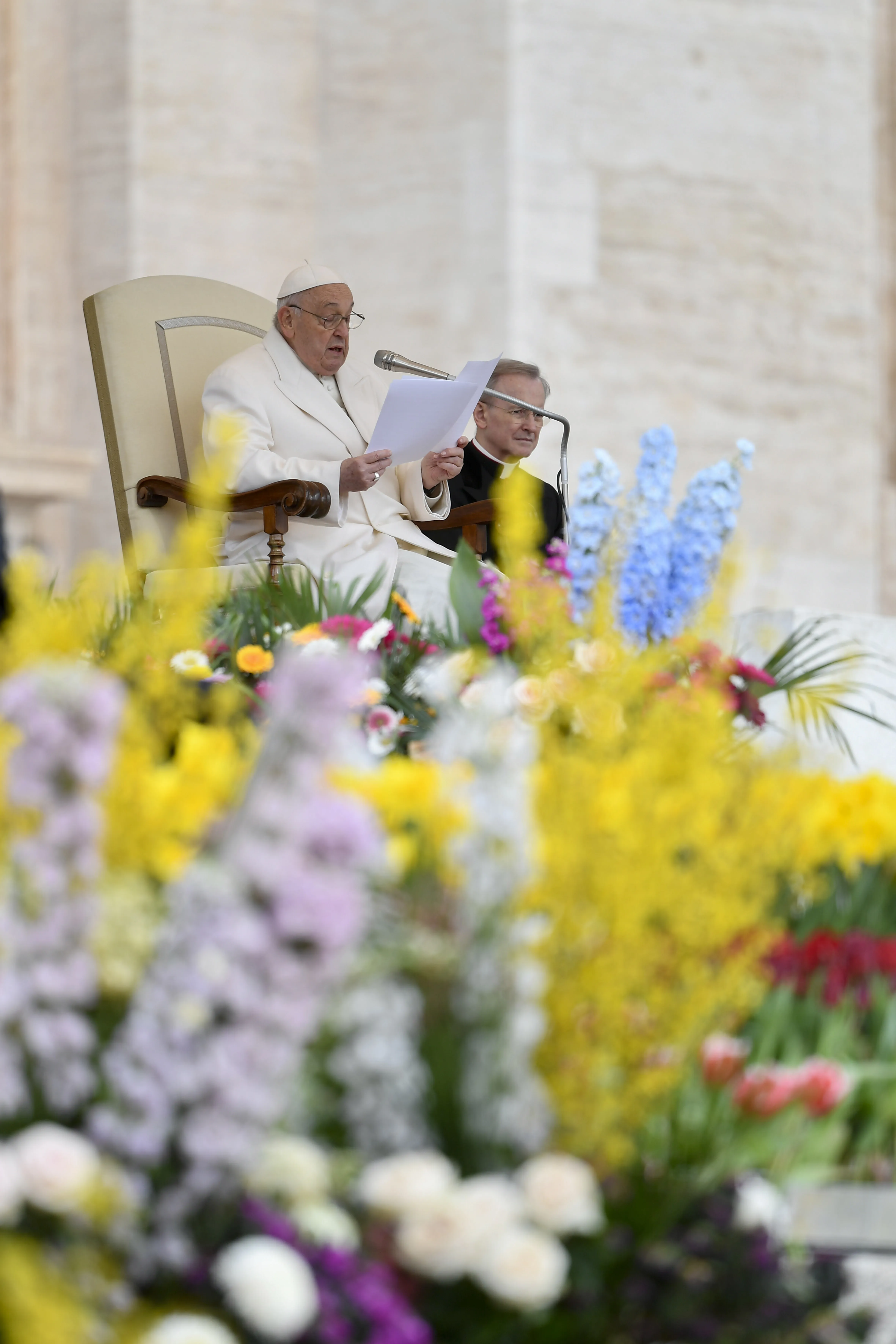
Pope Francis addresses pilgrims gathered in St. Peter's Square during his general audience on April 3, 2024. Credit: Vatican Media
Pope Francis addresses pilgrims gathered in St. Peter’s Square during his general audience on April 3, 2024. Credit: Vatican Media

Against the backdrop of these parallel conflicts, the pope framed his reflection on the virtue of justice, observing that it forms the basis of a well-ordered civil society that is built upon the rule of law — a principle of governance premised on the impartial application of legal norms for all citizens, institutions, and leaders. 

“Without justice, there is no peace,” Pope Francis said. “Indeed, if justice is not respected, conflicts arise. Without justice, the law of the prevalence of the strong over the weak is entrenched.” 

The pope stressed that justice is as a critical underpinning for the common good and the management of civil society, noting: “It is the virtue of law that seeks to regulate the relations between people equitably.” 

“A world without laws,” without justice  — and the corollary virtues of “benevolence, respect, gratitude, affability, and honesty” — would “be a world in which it is impossible to live,” the pope said.

“The righteous person reveres laws and respects them, knowing that they constitute a barrier protecting the defenseless from the tyranny of the powerful,” the pope expressed. “The righteous person does not think only of his own individual well-being but desires the good of society as a whole.” 

The pope defined the characteristics of the “righteous person” in part as one who “desires an orderly society.”

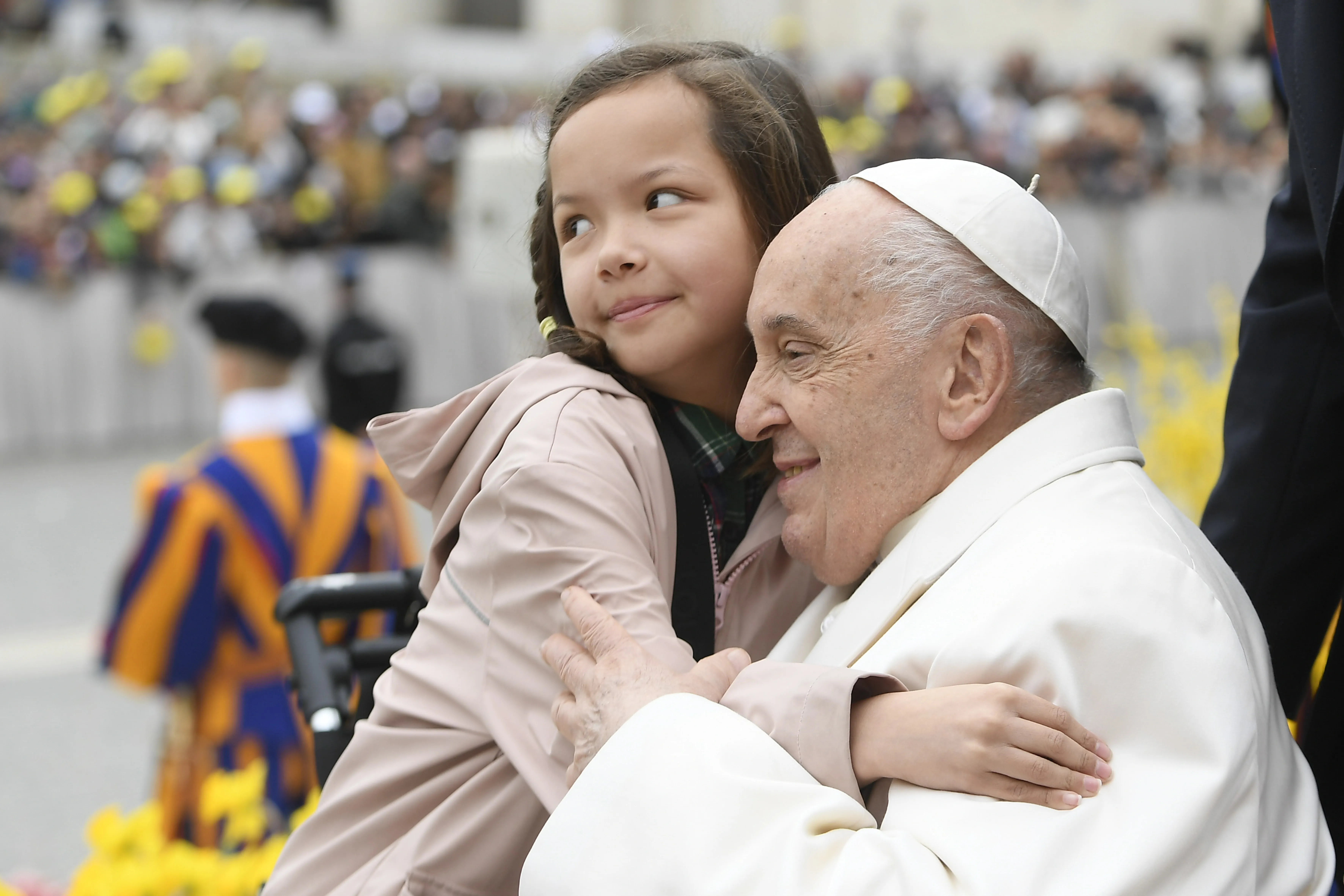
A young girl embraces Pope Francis during his general audience in St. Peter's Square on April 3, 2024. Credit: Vatican Media
A young girl embraces Pope Francis during his general audience in St. Peter’s Square on April 3, 2024. Credit: Vatican Media

“He desires an orderly society, where people give luster to the office they hold, and not the other way around. He abhors recommendations and does not trade favors. He loves responsibility and is exemplary in promoting legality,” the pope continued. 

The pope stressed the importance of imparting the virtue of justice into young people so as to build a “culture of legality.”

“It is the way to prevent the cancer of corruption and to eliminate criminality, removing the ground from beneath it.”

[…]

No Picture
News Briefs

This is Pope Francis’ prayer intention for the month of April

April 2, 2024 Catholic News Agency 1
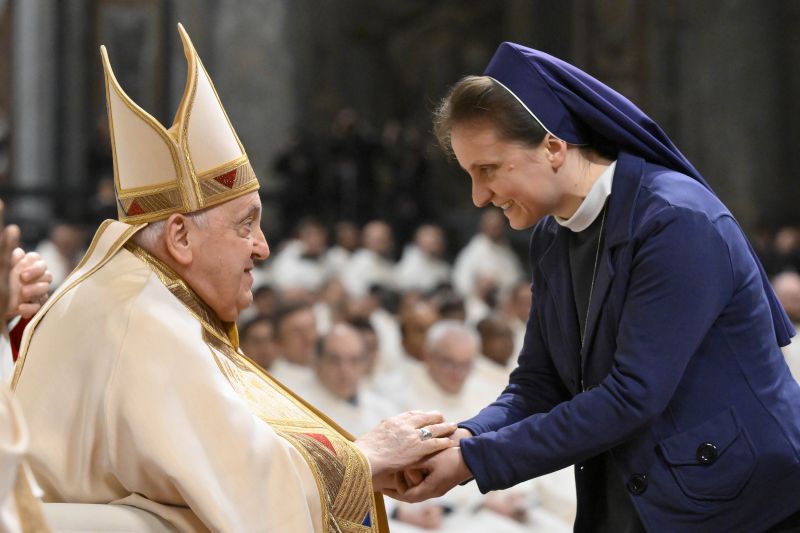
Pope Francis greets a woman religious at a Mass on the World Day of Consecrated Life, the feast of the Presentation of the Lord, on Feb. 2, 2024, in St. Peter’s Basilica at the Vatican. / Credit: Vatican Media

CNA Staff, Apr 2, 2024 / 12:40 pm (CNA).

Pope Francis’ prayer intention for the month of April is that the dignity and worth of women be recognized throughout the world. 

“In many parts of the world, women are treated like the first thing to get rid of,” Pope Francis said in a video released April 2. 

“There are countries where women are forbidden to access aid, open a business, or go to school,” he said, adding: “In these places, they are subject to laws that make them dress a certain way. And in many countries, genital mutilation is still practiced.”

He urged the world to “not deprive women of their voice. Let us not rob all these abused women of their voice. They are exploited, marginalized.”

The Holy Father pointed out that “in theory, we all agree that men and women have the same dignity as persons. But this does not play out in practice.”

“Governments need to commit to eliminate discriminatory laws everywhere and to work toward guaranteeing women’s human rights,” Francis said.

“Let us respect women. Let us respect their dignity, their basic rights. And if we don’t, our society will not progress.”

He concluded with a prayer: “Let us pray that the dignity and worth of women be recognized in every culture, and for an end to the discrimination they face in various parts of the world.”

Pope Francis’ prayer video is promoted by the Pope’s Worldwide Prayer Network, which raises awareness of monthly papal prayer intentions.

[…]

No Picture
News Briefs

Pope Francis: I was ‘used’ against Ratzinger in 2005 conclave, but he was ‘my candidate’

April 1, 2024 Catholic News Agency 5
Cardinal Joseph Ratzinger celebrates the special “pro eligendo summo pontifice” (to elect Supreme Pontiff) Mass at St Peter’s Basilica in the Vatican City on April 18, 2005. / Credit: MARCO LONGARI/AFP via Getty Images

CNA Staff, Apr 1, 2024 / 13:30 pm (CNA).

Pope Francis said he was “used” in the 2005 conclave in an effort to block the election of Cardinal Joseph Ratzinger, though he supported the candidacy of the man who soon became Pope Benedict XVI. 

“He was my candidate,” Francis said of his predecessor in excerpts from the forthcoming book “The Successor,” published by the Spanish newspaper ABC on Easter Sunday.  

In the book, Pope Francis told Spanish journalist Javier Martínez-Brocal that his name, then-Cardinal Jose Mario Bergoglio of Buenos Aires, was put forward as part of a “complete maneuver” by an unnamed group of cardinals to manipulate the conclave’s outcome. 

“The idea was to block the election of [Ratzinger],” he explained. “They were using me, but behind them they were already thinking about proposing another cardinal. They still couldn’t agree on who, but they were already on the verge of throwing out a name.” 

Francis said that at one point of the conclave, which began on April 18, 2005, he was receiving 40 of the 115 total votes. If cardinals continued to support him, Ratzinger would not have reached the necessary two-thirds threshold to be elected, likely prompting a search for an alternative candidate. 

Francis said that he realized the “operation” was afoot on the second day of voting and told the Colombian Cardinal Dario Castrillón to not “joke with my candidacy” and cease supporting him, “because I’m not going to accept” being elected. 

Austen Ivereigh, the pope’s English-speaking biographer, has previously written that Bergoglio, “almost in tears,” had begged not to be elected. 

Ratzinger, who had been the longtime prefect of the Congregation for the Doctrine of the Faith under Pope John Paul II, was elected that same day. 

Pope Francis did not say who this group of conclave manipulators consisted of nor who they planned to introduce as a third candidate, but the Argentinian prelate said that the group of cardinals “did not want a ‘foreign’ pope.” 

Several accounts from the time have claimed that a group of liberal European cardinals, known as the Saint Gallen Group, attempted to manipulate the outcome of the 2005 conclave. Three members of the group, German Cardinals Walter Kasper and Karl Lehmann and Belgian Cardinal Godfried Danneels, also participated in the 2013 conclave that elected Francis. According to Ivereigh, they advocated for Bergoglio after first securing his assent, a claim the cardinals have denied. 

According to Universi Dominici Gregis, an apostolic constitution governing papal conclaves, cardinal electors must refrain from “any form of pact, agreement, promise, or other commitment of any kind which could oblige them to give or deny their vote to a person or persons” under threat of automatic excommunication. 

Conclave proceedings are, by definition, secretive, as the term is derived from a Latin word that means a “locked room.” But in “The Successor,” Francis said that while cardinals are sworn to secrecy regarding conclave proceedings, “the popes have license to tell it.” 

Pope Francis also revealed that while others were putting his name forward in the hopes of forcing a stalemate, he believed Ratzinger “was the only one at that time [who] could be pope.” 

“After the revolution of John Paul II, who had been a dynamic pontiff, very active, with initiative who traveled … there was a need for a pope who maintained a healthy balance, a transitional pope,” the Holy Father said of his predecessor, who served from 2005 to 2013. 

Francis also said that he left Rome happy that Ratzinger had been elected and not himself. 

“If they had chosen someone like me, who makes a lot of trouble, I wouldn’t have been able to do anything,” he said. “At that time, it would not have been possible.” 

Nonetheless, Pope Francis added that the papacy “wasn’t easy” for Benedict XVI, who “encountered a lot of resistance within the Vatican.” 

Pope Francis was also asked what the Holy Spirit was saying to the Church through the election of Benedict XVI. 

“’I am in charge here,’” Francis said of the Spirit’s response. “’There is no room for maneuver.’” 

“The Successor” is part of a flurry of Francis-focused books being released in the 87-year-old Jesuit’s 11th year as pontiff, which also includes “Life: My Story Through History,” the pope’s first autobiography. 

The new book, which focuses on the relationship between Pope Francis and Benedict XVI, is set to be published in Spanish on Wednesday, April 3, with no details yet available on an English edition. 

[…]