US Supreme Court sends abortion pill case back to district court

October 9, 2020 CNA Daily News 1

CNA Staff, Oct 9, 2020 / 12:01 pm (CNA).- The US Supreme Court on Thursday refused to reverse a lower court’s order preventing the FDA from requiring in-person dispensation of the abortion pill during the coronavirus pandemic.

Justice Samuel Alito wrote a dissent, in which he was joined by Justice Clarence Thomas, which focused on “the inconsistency in the Court’s rulings on COVID–19-related public safety measures,” especially regarding First Amendment rights.

The court voted 6-2 Oct. 8 to postpone considering the Trump administration’s appeal that seeks a stay of an injunction that prevents the FDA from enforcing its regulation of mifepristone, the first of the two drugs taken in a medical abortion.

In July, Judge Theodore Chuang of the US District Court for the District of Maryland ruled that the FDA listing of the abortion pill regimen alongside higher-risk procedures and drugs posed an undue burden on women seeking abortions during the pandemic, because it required them to travel to a medical facility to obtain mifepristone. Chuang, and a federal circuit court which upheld his ruling in August, said that women should be able to take mifepristone without a visit to a doctor’s office.

The Supreme Court noted that the FDA “argues that, at a minimum, the injunction is overly broad in scope, given that it applies nationwide and for an indefinite duration regardless of the improving conditions in any individual State. Without indicating this Court’s views on the merits of the District Court’s order or injunction, a more comprehensive record would aid this Court’s review.”

Because of this, the court said the district court should “promptly consider a motion by the Government to dissolve, modify, or stay the injunction, including on the ground that relevant circumstances have changed,” giving it 40 days to rule after having received the government motion.

Alito wrote in his dissent that “there is no legally sound reason” for the court’s refusal to rule on the injunction.

“For all practical purposes, there is little difference between what the Court has done and an express denial of the Government’s application. In both situations, the FDA rule may not be enforced, and in both situations, the Government is able to move the District Court to modify the injunction based on changed circumstances.”

“There is, however, one difference (but not a legally significant one) between what the Court has done and the express denial of the Government’s application. Expressly denying a stay would highlight the inconsistency in the Court’s rulings on COVID–19-related public safety measures,” he noted.

“In response to the pandemic, state and local officials have imposed unprecedented rest rictions on personal liberty, including severe limitations on First Amendment rights. Officials have drastically limited speech, banning or restricting public speeches, lectures, meetings, and rallies. The free exercise of religion also has suffered previously unimaginable restraints, and this Court has stood by while that has occurred.”

He pointed to the court’s decisions in May and July upholding coronavirus limitations on religious services in California and Nevada, noting that “the Court deferred to the judgment of the Governor of Nevada that attendance at worship services presented a greater threat to public health than engaging in the diversions offered by the State’s casinos. The possibility that this dubious conclusion might have been based less on science than on the influence of the State’s powerful gaming industry and its employees was not enough to move the Court. Near-total deference was the rule of the day.”

“In the present case, however, the District Court took a strikingly different approach. While COVID–19 has provided the ground for restrictions on First Amendment rights, the District Court saw the pandemic as a ground for expanding the abortion right recognized in Roe v. Wade.”

Alito noted that the FDA adopted the regulation at issue in 2000, it has been enforced over the course of four administrations, and the agency “evidently decided that the mifepristone requirement should remain in force” during the pandemic.

“Nevertheless, a District Court Judge in Maryland took it upon himself to overrule the FDA on a question of drug safety. Disregarding THE CHIEF JUSTICE’s admonition against judicial second-guessing of officials with public health responsibilities, the judge concluded that requiring women seeking a medication abortion to pick up mifepristone in person during the COVID–19 pandemic constitutes an ‘undue burden’ on the abortion right, and he therefore issued a nationwide injunction against enforcement of the FDA’s requirement. The judge apparently was not troubled by the fact that those responsible for public health in Maryland thought it safe for women (and men) to leave the house and engage in numerous activities that present at least as much risk as visiting a clinic—such as indoor restaurant dining, visiting hair salons and barber shops, all sorts of retail establishments, gyms and other indoor exercise facilities, nail salons, youth sports events, and, of course, the State’s casinos.”

Alito wrote that “Under the approach recently taken by the Court in cases involving restrictions on First Amendment rights, the proper disposition of the Government’s stay application should be clear: grant. But the Court is not willing to do that. Nor is it willing to deny the application. I see no reason for refusing to rule.”

He concluded that the case “presents important issues that richly merit review. The District Court’s decision, if reviewed, is likely to be reversed. And if the FDA is right in its assessment of mifepristone, non-enforcement of the requirement risks irreparable harm. A stay is amply warranted.”


[…]

New Orleans priest defiles altar with pornographic filmmaking, arrested for obscenity

October 9, 2020 CNA Daily News 0

CNA Staff, Oct 9, 2020 / 11:10 am (CNA).- A priest in the Archdiocese of New Orleans has been arrested along with two women and charged with obscenity after he was discovered filming a pornographic video on a parish church altar.

Fr. Travis Clark, 37, the pastor of Sts. Peter and Paul in Pearl River, Louisiana, was arrested together with Mindy Dixon, 41, and Melissa Cheng, 23, on September 30. 

A local resident told police they noticed the lights were on in the parish church, and upon looking in the windows, saw the three engaged in sexual activity on the  altar. According to reports, the altar of the church had been outfitted with stage lighting.

The Archdiocese of New Orleans announced the following day, Oct. 1, that Clark had been arrested and removed from ministry. Initially, no details were given for the cause of his removal, other than to confirm that he was not accused of any offences related to abuse of minors. 

Details were not revealed until Oct. 8, when public records were released.

Dixon is a pornagraphic performer and “dominatrix.” According to Nola.com, she had posted on her social media the day before her arrest that she was headed to New Orleans to “defile a house of God” alongside another “dominatrix,” presumably Cheng. 

Police believe the sexual encounter to have been consensual, and have not filed charges related to sexual assault. The obscenity charge stemmed from the fact that the sex act was visible from a window.

Clark is expected to face canonical sanctions for violations of clerical continence, and for the profanation of an altar, which is constituted a crime in canon 1376 of the Code of Canon Law, which provides that “a person who profanes a movable or immovable sacred object is to be punished with a just penalty.”

Clark was ordained a priest in 2013, and became the pastor of Sts. Peter and Paul in 2019. He had recently been named the chaplain of Pope John Paul II High School in Slidell, Louisiana, replacing another priest who resigned this summer. That priest, Fr. Paul Wattingly, was also suspended from public ministry Oct 1, after he admitted to abusing a minor in 2013.

“Both of these situations are very troubling to me. When a priest does not live out his vocation faithfully he suffers consequences and I must notify the parishioners, school families, and public in general,” said Archbishop Gregory Aymond of New Orleans in an Oct. 1 statement announcing the suspensions. 

“Please pray for all those affected, especially the parishioners of the parishes and school communities where they have served,” he added. 

Aymond has since performed a penitential liturgy of atonement and re-consecration of the altar at Sts. Peter and Paul church following the act of profanation.

As news of the story spread Friday, one priest on Twitter urged Catholics to pray prayers of reparation, “consoling the heart of Jesus.”


I just heard about a priest who did something truly diabolical recently. I won’t share the details because it’s very upsetting. But please, PLEASE, spend some time in prayer today consoling the heart of Jesus in reparation for this sin, and all sins. You can pray this chaplet. pic.twitter.com/G6KhX9xmXw

— Fr. Tom Bombadil, Ring Wraith? (@calix517) October 9, 2020


Clark, Dixon, and Cheng have all been released on bail.


[…]

Millennial and Gen Z Catholics love Carlo Acutis. Here’s why

October 9, 2020 CNA Daily News 4

Washington D.C., Oct 9, 2020 / 04:00 am (CNA).-  

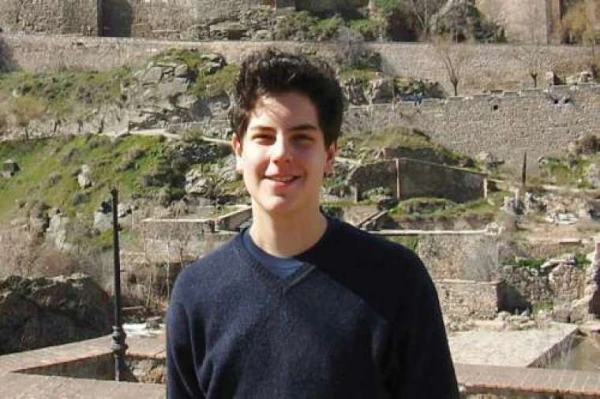
Servant of God Carlo Acutis is set to be beatified on Saturday, and will become the first member of the millennial generation to become officially known as a “blessed.”

Interest in the life of Carlo Acutis has been intense in the weeks leading up to his beatification. And while research shows that a growing number of millennials and Gen Z Americans do not practice any religious faith, CNA spoke with some Catholic contemporaries of Acutis, who said the video-game playing Italian makes them want to grow closer to God.

Born on May 3, 1991, Carlo Acutis died at the age of 15 on Oct. 12, 2006 after suffering from leukemia.

During his life, he made a website dedicated to Eucharistic miracles, and maintained a deep devotion to the Eucharist until his death. He also loved PlayStation, which is probably a first for anyone canonized or beatified.

Acutis serves as an example for how millennials and Gen Z should live their lives, Cecilia Cicone, a 25-year-old from Delaware, told CNA.

“Carlo puts flesh on what a saint who plays video games and goes on the internet looks like. He challenges me to examine my conscience and say, ‘Ok, I’m called to be a saint who uses the internet too. Am I using it to make God’s love known?’”

Acutis, she said, is a concrete example of “what holiness looks like in the 21st century.”

“We see that holiness can involve awkward middle school phases with popped collars and video games,” she said.

“With the beatification of Carlo Acutis, for the first time I experience the peace and joy of recognizing that I, too, can be a saint of the 21st century. It’s not a hypothetical anymore.”

Fr. John LoCoco, a priest of the Archdiocese of Milwaukee, is about six months younger than Acutis. And when he first heard about Acutis in 2006, he said he was “wholly unimpressed by his witness at first.”

“I never cared much for computers or video games, so it never made him ‘familiar.’ He was just a kid who blogged about the Eucharist,” LoCoco told CNA.

Gradually, however, LoCoco’s views on Acutis began to change, and now he thinks that Acutis “will be a stalwart saint in the modern age.”

“I think that what I have come to love is what seems to be the very gentle nature of Carlo,” LoCoco said. “His care for those who are picked on in school, his care for those whose parents were divorcing; Carlo seems so emotionally invested in the lives of people.”

LoCoco told CNA that he now finds the “profoundly quiet, honest sense that he had of God’s presence in all things” to be “remarkable.”

Maria Roberts, a 26-year-old computer programmer, is excited that her profession is about to gain its own patron saint, and she thinks that Acutis is a good example for how Catholics should be using the internet. 

“It is important for us as Catholics to think about how technology can be used for good and for evangelization, and not as a way to take advantage of others or demoralize young people,” she said.

“There is so much good to be done and so much suffering nowadays- young people should know that their talents can be used for God’s glory in many ways through our technological advances.”

Acutis’ age has been a sort of a spiritual wake-up call for some Catholics.

“The fact that we were alive at the same time and are so close in age seems to highlight even more the gap between our ‘levels’ of holiness,” Taylor Hyatt, a 28-year-old from Canada, told CNA. She was born the same year as Acutis.

“That said, I really appreciate his deep love for the Eucharist and interest in the Internet. We shared those interests, back when I was his age and up to now,” she said. Hyatt also admired Acutis’ interest in disability rights, a cause she is also involved with.

Fr. Paul Edmonstone, a recently-ordained priest in Ontario, was more blunt in his assessment of his life to Acutis’.

“For me personally, knowing how holy Blessed Carlo was makes me feel like a piece of crap,” he said. “I was born the same year as him and as a teenager wasn’t particularly saintly.”

“But I talked about him to our young adults group last week and showed them the picture of his tomb and more than a few people commented on the fact that he was wearing normal clothes, and that he played video games and was good with computers,” said Edmonstone.

“I have tried to use Pier Giorgio as an example young people can relate to but perhaps Blessed Carlo might be better these days given how contemporary he is.”

It is Acutis’ “normalcy” that makes him so interesting, some Catholics told CNA.

Acutis “is someone we can look at and quite literally picture ourselves,” Alex Trevino, a 30-year-old from Dallas, told CNA. “He’s buried in the clothes that I wore as a teenager.”

Trevino said that Acutis’ beautification shows young people “that you don’t need to be a priest, a bishop, or even a pope to be holy.”

“We need to see as a Church that sainthood, heaven, and eternal life with God is real and attainable,” he added. 

Ani, a 24-year-old from Texas, agreed. She described Acutis as “just a regular dude who grew up Catholic we all do, got sick like so many people do, and built a website to post about his specific interests like we do.”

“We talk about everyday sanctity a lot in Schoenstatt, the concept of doing things extraordinarily well,” Ani said to CNA. “I feel like Carlo’s maybe the first saint I’ve seen that’s had an actually normal, human, attainable way to do that.”

Unlike other saints who died young, such as St. Kateri, St. Therese, or St. Maria Goretti, Acutis had “no supernatural influence at any point,” said Ani.

“No visions, no tilma, no stigmata. Just a dude and his computer and his love of God. That stuff’s cool,” she said. 


[…]

Children who faced abortion baptized in Spain

October 8, 2020 CNA Daily News 1

CNA Staff, Oct 9, 2020 / 12:00 am (CNA).-  

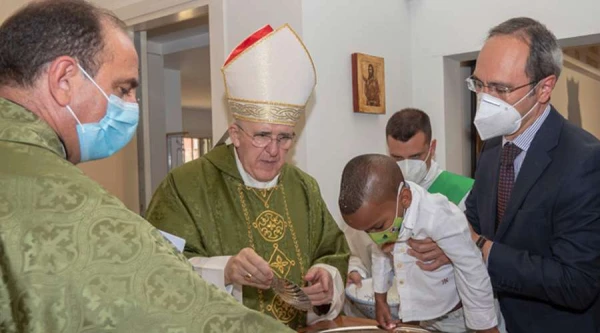
Fourteen children whose mothers considered abortion were baptized last month in Madrid by the city’s archbishop, Cardinal Carlos Osoro.

The newly baptized are children of women in vulnerable situations who considered abortion during their pregnancies. They were aided by the Más Futuro Association, a Catholic organization that offers support to expectant mothers and mothers in need.

Baptized Sept. 27 were a 6-year-old girl, two four-year-old boys and 11 babies less than a year old.

Nine more children were scheduled to be baptized at the same time, but were unable to be present because they were waiting for the results of coronavirus tests.

Cardinal Osoro honored the children’s mothers during the baptismal rite, telling them: “You have chosen life, we know that death will come, but you have chosen life.”

Some of the women had previously undergone abortions.

Present at the baptism were volunteers of the Más Futuro Association, who pray at abortion clinics in Madrid, and offer alternatives to women at the clinics who are considering abortion.


A version of this reported was first published by ACI Prensa, CNA’s Spanish-language news partner. It has been translated and adapted by CNA.


[…]