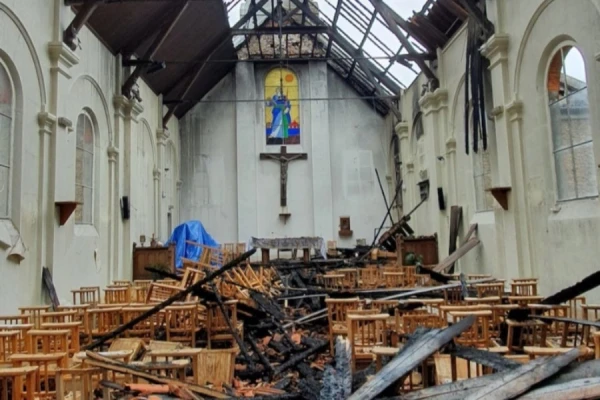
CNA Staff, Jul 22, 2020 / 03:55 am (CNA).-
The fire that ripped through the Gothic Cathedral of St. Peter and St. Paul in Nantes July 18 was reported around the world. But suspected arson attacks on French churches usually do not make international headlines.
Since 2010, the Paris-based L’Observatoire de la Christianophobie (Observatory of Christianophobia) has chronicled anti-Christian incidents in France and around the world.
It has recorded these events month by month on interactive maps since 2017, placing them in six categories: arson, murder/assault, vandalism, theft, bombing, and abduction.
Following Saturday’s fire at Nantes, the organization has reported several less well-publicized incidents, including the destruction of a crucifix on the Île-d’Arz in Brittany, the slashing of paintings in a church in Auxerre, and the decapitation of a statue of the Virgin Mary in Montaud.
Statistics suggest there are nearly three such attacks a day in France, which is sometimes described as the “eldest daughter of the Church” because the Frankish King Clovis I embraced Catholicism in 496.
The French Interior Ministry recorded 996 anti-Christian acts in 2019 — an average of 2.7 per day. The true figure may be higher, as it is thought that officials do not count fires of undetermined cause at churches across the country.
On July 4, for example, fire devastated the Parish of St. Paul in Corbeil-Essonnes. Investigators concluded that the blaze resulted from a gas leak caused by squatters, but locals questioned the official explanation.
Samuel Gregg, research director at the Acton Institute, told CNA that the spate of incidents had forced the French authorities to address the issue openly.
“Over the past two years, French government officials have started to talk about it more publicly, perhaps because the visibility of such attacks is now so great. Both President Emmanuel Macron and his new Prime Minister, Jean Castex, have, for instance, spoken clearly and forcibly about the recent attack on the cathedral in Nantes,” he said.
While the number of officially recorded anti-Christian incidents has remained steady over the past two years (1,063 in 2018 and 1,052 in 2019), it has risen by 285% between 2008 and 2019, according to Ellen Fantini.
Fantini, the director of the Observatory on Intolerance and Discrimination Against Christians in Europe (OIDACE) in Vienna, said that the trend of rising attacks was not confined to France. OIDACE records attacks on Europe’s churches on its website, but official tallies are hard to come by.
“Most European countries do not provide statistics about anti-Christian incidents. Many don’t even record them as such. Another problem is that many church officials don’t even report incidents — they just sort of get on with it: clean up and move on,” she told CNA.
“Among countries that do report, those numbers are rising, as well. For example, according to the data provided to the OSCE (Organization for Security and Co-operation in Europe) by the U.K., anti-Christian crimes doubled from 2017 to 2018. We know they are rising in Spain, Germany, and Sweden, as well.”
In England and Wales, the government is offering funding to places of worship facing potential hate attacks.
Asked why attacks are increasing, Fantini said: “This is a complicated question to answer because so often we don’t know the identity — or even the ideological motivations — of the perpetrators. Sometimes the motives are clear, but other times we have to make our best guess. As radicalized movements increase in both numbers and intensity, the number of attacks on churches seems to rise.”
She continued: “I have said before that churches are ‘lightning rods’ for activists. And each group has their own reasons for choosing to attack a church. Churches can represent ‘the patriarchy,’ ‘authority,’ ‘tradition,’ ‘homophobia,’ ‘the Christian West,’ etc. Islamists target churches for different reasons than anarchists, for example. But all of these groups are more and more active these days.”
“A further complicating problem is the unique nature of churches which tends to make them more vulnerable — they’re open to the public during the day and they usually don’t have much, if any, security.”
For Fantini, the most effective way to respond to the attacks is through local action.
She said: “I think it starts with church communities and the faithful. They have to demand protection and speak out when their churches are targeted. In France, there is an excellent initiative started last year called Protège ton église (Protect your church). Young Catholics organize themselves in towns across France to check on their churches at night, peacefully dissuade or report vandals, and generally make their presence known.”
“Governments also need to start protecting vulnerable churches with as much attention as they do other vulnerable places of worship.”
Gregg noted that French bishops have spoken out about the attacks, including Archbishop Michel Aupetit of Paris and Archbishop Éric de Moulins-Beaufort, president of the French bishops’ conference.
“It has also been a subject that French bishops have raised in regularly scheduled meetings with the state authorities, including as recently as March this year when they asked for a security plan for churches to be put in place,” he said.
“So some French bishops have been proactive on this subject. Nonetheless, the attacks continue. Part of the challenge is that these are, for the most part, open buildings so that Catholics and others can enter and pray; they are not supposed to be, and should not be, mere museum pieces.”
Gregg suggested that bishops elsewhere in Europe should follow the French bishops’ lead.
“By that I don’t mean yet another anodyne NGO-like statement of the type that too many European bishops and bishops’ conference bureaucracies are prone to issue, and which no one reads,” he said. “I mean bishops and clergy speaking about the topic to the faithful and talking about it more frequently in the public square.”
“They could be asking questions such as ‘Why are so many Europeans rather blasé about attacks on buildings and sites that are part of Europe’s cultural landscape?’ Or ‘What does ongoing vandalism to religious sites say about how European attitudes towards religious tolerance?’”
“In other words, it is an opportunity to spark wider discussions about topics ranging from religion’s place in modern Europe to Christianity’s irreplaceable contribution to the development of Western civilization.”
Fr. Benedict Kiely, the founder of Nasarean.org, a charity supporting persecuted Christians, told CNA that Christians should not watch silently as churches are attacked.
“Practically, cathedrals, etc, must receive proper protection from civil authorities and any attacks on churches or religious images must be treated as what they are — hate crimes,” he commented.
“Secondly, we must loudly raise our voices to decry these continuing attacks and not be cowed into silence. Our leaders must be courageous.”
Reflecting on the future, Fantini said: “How much worse can it get depends on what line activists are willing to draw for themselves. Will they stop at burning an empty church? Will they stop at decapitating statues? Certainly the climate today, both in Europe and America, does not leave me optimistic that things will improve soon.”
 […]
[…]