Catholic bishop: ‘the Church must proclaim the truth’ on new French abortion law

August 21, 2020 CNA Daily News 0

CNA Staff, Aug 21, 2020 / 10:00 am (CNA).-  

French Bishop Marc Aillet expressed his objections to a bioethics bill recently passed by the National Assembly, which expands the legally protected grounds for an abortion in France to include “psychosocial distress,” a move which bishops have said assures abortion nearly on demand.

Aillet, the Bishop of Bayonne, Lescar and Oloron, criticized the bill in light of the teaching of the Church in an Aug. 15 statement. The bishop said the Church must fulfill its prophetic mission of proclaiming the truth about man and God’s design for his creation.

France’s National Assembly, the lower house of the country’s parliament, passed a bill Aug. 1 adding “psychosocial distress” as grounds for an abortion as part of the country’s Bioethics Law.

Abortion is permitted in France in the first trimester of pregnancy, and later in the pregnancy under certain medical circumstances.

The Assembly also approved state-funded medically assisted procreation for lesbian couples, as well as the genetic modification of embryos for research.

Aillet said the bill represents a “major anthropological rupture.”

“Some courageous opposition MPs defended with pertinent arguments the right of a child to have a father and a mother and the inviolable dignity of the human embryo, which would be unreasonable in the light of science to not recognize as a full human being. A few members of the majority, no less courageous, dared to vote against the bill,” the bishop noted.

“The government took advantage of summertime lethargy and the French taking time to relax, understandable after the constraints of the lockdown, to pass this bill during a time of general indifference. The mainstream media have mysteriously remained very quiet on the subject throughout these days,” Aillet lamented.

An ethical disaster

The bill will turn human embryos into “laboratory mice,” the bishop charged, opening the door to “making transgenic and even chimeric embryos, thus in a certain way abolishing the dividing line between man and animal.”

Aillet also said the subjective grounds of  “psychosocial distress” for abortion are unverifiable. 

Abortion is always “the murder of a child who has no voice,” the bishop said, what Saint John Paul II called “the deliberate suppression of an innocent human being” in his encyclical Evangelium vitae.

The prophetic mission of the Church

Aillet declared that “the prophetic mission of the Church is precisely to proclaim, in season and out of season, the Truth about man, of which the Church is the depositary by divine mandate.”

“The prophetic mission of the Church,” the bishop said, “is to alert humanity today and to warn it against the temptation of self-destruction.”

He noted the incongruence of “on one hand recognizing that by claiming to be master of the universe by the prowess of science, that we are leading the planet on the path of an ‘ecological catastrophe,’ and deciding, in the name of the same science, to take control of human life, from its conception to its natural death, without leading humanity towards an even more damaging catastrophe!”

“One cannot, without serious prejudice to the future of mankind, oppose with impunity the Design of the Creator,” he added.

“This is the fundamental reason for our defense of the dignity of the human person, beginning with the smallest and most vulnerable,” Aillet explained.

For the French bishop “the prophetic mission of the Church therefore consists, not first of all in trying to be heard according to the criteria of the world, but in speaking to  people’s consciences, that intimate sanctuary where the voice of God resounds, who commands every man to do good and avoid evil.”

“The prophetic mission of the Church still consists in pointing to the moral gravity of this bioethical bill in deciding to deprive children of the right to have a father and a mother.”

“It is not, however, a question of judging or condemning the people who, often in spite of themselves and under pressure from the surrounding environment or abused by flattering and lying propaganda, come to use these means in order to satisfy a legitimate desire to have a child or to avoid other ailments. The Lord knows their hearts and is always quick to show Mercy. All the more reason to warn them and accompany them with charity, but in the Truth.”

However, the prelate warned that “those who, knowing the moral gravity of these practices, through electioneering demagogy or ideology, enact unjust laws that are binding on all, are more guilty and reprehensible. Saint Thomas Aquinas asserted that a civil law inconsistent with natural law and divine law “is more violence than law.”

The bioethics bill goes back to the French Senate for a second reading, where it can be amended again, before being put to a vote by a joint committee of the two houses at the end of 2020. However, the decision of the National Assembly is final when a consensus cannot be reached.

“It is therefore necessary to continue to alert consciences, in particular of the senators who will have study the bill,” Aillet urged.

Spiritual Warfare

Spiritual warfare is also part of the prophetic mission of the Church, the bishop said. “What is at stake is the creative and redemptive Design of God, which it is clear “the one we call the Devil or Satan opposes from the beginning and until the end of time.”

“It is no doubt a matter of battling with all the human means at our disposal as responsible citizens,” he continued.

“For us faithful of the Catholic Church, it will also be a matter of fighting with the traditional spiritual weapons: the prophetic Word – which like that of Jesus can push back darkness and cast out demons – prayer, in particular the Rosary, and fasting.”

Therefore “the Lord is looking for souls of prayer and sacrifice to courageously engage in this combat,” the prelate encouraged.

“On the solemnity of the Assumption of Our Lady, principal patroness of France, we will entrust this fight to the Virgin Mary, renewing the vow of Louis XIII,” Aillet concluded.


A version of this report was first published by ACI Prensa, CNA’s Spanish-language news partner. It has been translated and adapted by CNA.

[…]

‘I really pray for these kids’: the Catholic ambassador on a mission to help Europe’s largest minority

August 21, 2020 CNA Daily News 1

CNA Staff, Aug 21, 2020 / 04:00 am (CNA).- In 2013, Franz Salm-Reifferscheidt made a life-changing visit to Rome. The retired Austrian businessman had an appointment with the Grand Chancellor of the Order of Malta, an almost 1,000-year-old Catholic lay religious order.

After working for 30 years for a baby food company, Salm had settled into a comfortable retirement. 

“I had a nice life, making a walk with my dog, and so on, and journeys with my wife and grandchildren,” he told CNA. 

“And then this friend, the president of the [order’s] German association, said: ‘Come on! You have time. You are fit. Couldn’t you do something for the order?’”

Salm joined the Order of Malta when he was 26. But as he was now in his late 60s, he wasn’t sure what he could offer the organization which, as a sovereign body, has diplomatic relations with more than 100 states, and engages in charitable work in 120 countries.

When he arrived for the meeting in Rome, the Grand Chancellor spoke about the order’s diplomatic work.

“Then all of a sudden, he said: ‘What would you do better?’ And I thought about the Roma, because these people are the biggest minority in Europe with 12 million people. They are segregated. Nobody likes them. They live in terrible conditions in settlements without running water and electricity,” he recalled.

Salm suggested that the order could combine its diplomatic and social missions if it extended its outreach to the Roma people — commonly known as Gypsies — because their plight was also a political issue. 

“The Grand Chancellor said: ‘That’s what we are really looking for.’ And two weeks later, I was appointed Ambassador for the Roma People at Large,” he said.

Salm quickly realized that he had accepted a staggeringly difficult challenge. Ever since the Roma arrived in Europe from northern India around the ninth century, they have suffered from hardship and persecution. Locals named them “Gypsies,” mistakenly believing that they came from Egypt.

Today, despite their nomadic reputation, Roma are overwhelmingly sedentary. More than 70% of Roma households live in poverty and just one in four Roma children graduate from high school. 

Despite these daunting facts, Salm set to work with an energy that impressed members of the order. Building on the organisation’s previous work with Roma communities, he developed initiatives in Albania, Austria, Belgium, Hungary, Romania, Slovakia, Slovenia, and Ukraine.

As a roving ambassador, he was able to link the projects together, drawing on his experience of building up the market for baby food in Eastern Europe.

Salm (pictured above) explained that a fully equipped center offers seven services: washing facilities, health checks, a kindergarten and playground, tutoring for children, counseling for mothers, apprenticeships, and a music school or other cultural endeavor. 

One of the biggest obstacles to improving the wellbeing of the Roma is that parents take their children out of school in order to work. Salm believes that the Order of Malta has found a way of overcoming this problem that could serve as a model across Europe. 

“Our donors ask: ‘How do you measure the success of your work?’ And it’s always the same: the children have more self-esteem, are clean and friendly — because that’s what we teach them every day — and, finally, much better in school.”

Salm cites a school run by the order in Romania. 

“This school was within the last rank of all the schools in this district. And after four or five years, it went better and better. And now, seven years later, this school is in the upper third, far above the average. No kid in the last two years failed the class,” he said. 

“And in our center, we could really come to the point where no kid misses the school. Of course, because they want to come to us.”

On Aug. 29, Salm will open the order’s 19th center for Roma people, in Croatia. 

“The hardest part is to convince the mayors of the area that this work is necessary,” he said, because they believe that offering any help to the Roma encourages them to settle permanently. 

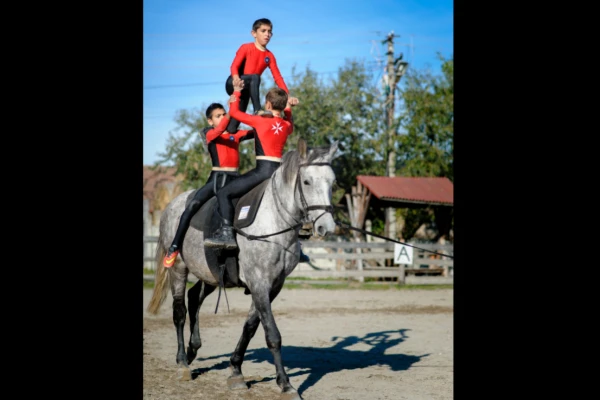
But it is possible to win local officials over. The ambassador cited the example of a settlement in Romania, where the order has opened a riding school, giving children the opportunity to learn skills such as equestrian vaulting, or gymnastics on horseback.

When lockdown was imposed on the country this spring, some Roma communities resisted quarantine measures, leading to clashes with police. 

“Almost everywhere there was an aggressive reaction, unfriendly. So for the authorities not a very easy situation, very unpleasant. But not in this center where we have this horse riding. The mayor was from the beginning against this center, always, until this year when there had to be quarantine for this center,” he said.

“The Roma people in this settlement understood the situation, understood that it was necessary to put the settlement under quarantine. They accepted the situation. So the mayor excused himself officially that he changed his mind. Now he is not, I would say, a friend of the Roma, but now he understands that this work is successful.”

Another major concern for Salm is fundraising. He currently has a budget of 1.5 million euros ($1.8 million). But given the economic uncertainty resulting from the coronavirus crisis, he is not sure if he will be able to replenish it when it runs out. 

He said: “I have to do the fundraising myself. I would say this is the most difficult work. My wife is always astonished that it is possible for me to find donors. But this year it’s 1.5 million euros and I have it. I can finance the work for this year. But what will be next year?”

Salm emphasized that the Roma community in Europe is not homogenous. There are different subgroups in different countries. 

“You have the very proud Lovari in Hungary. ‘Ló’ means ‘horse.’ You have the very poor Băieși living in Romania. You have many, many different groups,” he explained.

This diversity extends to religion. 

“They take the religion of the country they live in,” Salm said. “So in Hungary they are Catholic. In Bucharest [Romania] they are Orthodox. In Bosnia they are Muslims. But most of the Roma are Catholic. They are Catholic in Hungary, Transylvania in Romania, Slovakia, Austria, Croatia, France, Spain, Italy — in all the Catholic countries they are Catholic.”

Salm is now 76, but he is determined to keep serving the Roma people until his 80th birthday.

“I want to do it four years more, if God allows me and gives me the power and the help to do it. And then I have to find somebody else who does it,” he said. 

In the coming weeks, Salm will not only celebrate the opening of the new center in Croatia. He will also mark the 50th anniversary of his wedding — coronavirus restrictions permitting — with his four children, seven grandchildren, and other close family. 

Asked if his Catholic faith helped him in his work, he said: “Very much. I really pray for these kids, these families, and I have to live with the knowledge that every human being has the same dignity. And if you believe in this dignity, then it’s not a question if you help, it’s just a question how to help.”

[…]

KofC says ‘under God’ in flag pledge represents ‘fundamental American belief’

August 20, 2020 CNA Daily News 1

CNA Staff, Aug 20, 2020 / 05:35 pm (CNA).- After some caucus meetings at the Democratic National Convention omitted the words “under God” from the Pledge of Allegiance, the Knights of Columbus told CNA the words represent a fundamental American belief, and said the group is proud of its role in their addition to the pledge.

“The Knights of Columbus is proud of our instrumental role in persuading Congress to add the words ‘under God’ to the Pledge of Allegiance in 1954,” Knights of Columbus Supreme Knight Carl Anderson told CNA Aug. 20.

“Those words express a fundamental belief that we have held as a nation since our founding, that we are endowed by our creator with certain unalienable rights,” Anderson added.

Anderson’s remark came amid reports that at meetings held as part of the Democratic National Convention, delegates omitted the words “under God” as they led the Pledge of Allegiance. The omissions came during meetings of the DNC’s Muslim caucus and LGBTQ caucus.

The Pledge of Allegiance in its modern form was composed in 1892, and officially recognized by Congress in 1942. The Knights of Columbus were instrumental in encouraging that the words “under God” be officially adopted into the Pledge of Allegiance in the early 1950s.

Along with other groups, the Knights of Columbus advocated for inclusion of the phrase, and in early 1954, Congress passed a bill to do so. President Dwight Eisenhower signed the bill into law on Flag Day, June 14, 1954.

“In this way we are reaffirming the transcendence of religious faith in America’s heritage and future; in this way we shall constantly strengthen those spiritual weapons which forever will be our country’s most powerful resource, in peace or in war,” Eisenhower said at the time.

The United States Flag Code contains the official text of the Pledge of Allegiance, and contains norms regarding the etiquette for display and care of the U.S. flag.

For his part, Anderson said the phrase reminds Americans of “a fundamental belief that we have held as a nation since our founding, as expressed by President John F. Kennedy in his Inaugural Address that our rights as Americans ‘come not from the generosity of the state but from the hand of God.’”


[…]

After Netflix apologizes for ‘inappropriate’ film poster, theologian says Cuties movie is unacceptable

August 20, 2020 CNA Daily News 0

Washington, D.C. Newsroom, Aug 20, 2020 / 04:00 pm (CNA).- Netflix has apologized after a poster advertising an upcoming film was accused of normalizing pedophilia. But one theologian told CNA that an apology for the image is not enough, and that the film itself sexualizes children.

The promotional material for the film provoked widespread criticism overnight on Aug. 19, with many claiming that the film’s promotional material appeared to sexualize children.

“We’re deeply sorry for the inappropriate artwork that we used for Mignonnes/Cuties,” Netflix’s official Twitter account tweeted on Thursday, August 20. 

“It was not OK, nor was it representative of this French film which premiered at Sundance. We’ve now updated the pictures and description,” said Netflix. 

The film, whose original French title “Mignonnes” was translated to “Cuties” for its American release, was released on April 1, 2020 in France. It is set to premiere on Netflix on September 9. 

The initial Netflix description of the film was “Amy, 11, becomes fascinated with a twerking dance crew. Hoping to join them, she starts to explore her femininity, defying her family’s traditions.” 

The French-produced film features pre-teen girls involved in groups that perform sexualized dance routines.  

Twerking is a style of sexually provocative dance involving thrusting hip movements and suggestive stances. The dance style has been banned at several American high schools. 

The description has since been updated to “Eleven-year-old Amy starts to rebel against her conservative family’s traditions when she becomes fascinated with a free-spirited dance crew.” 

The “free-spirited dance crew” in the film is the titular “Cuties.” In the film, Amy is a Senegalese Muslim who lives with her mother and younger brothers in Paris. 

The original poster featured Amy, who is played by tween actress Fathia Youssouf, in a low squat position with her legs spread. She, and the other young actresses in the film, are pictured wearing dance costumes consisting of spandex “booty shorts” and cropped tops, and are all posed in a suggestive manner. 

The poster for the film has since been changed to an image of Youssouf looking over her shoulder. The original poster that accompanied the French release of the film featured the preteen actresses fully clothed. 

Dr. Chad Pecknold, a professor of theology at the Catholic University of America and the father of a six-year-old daughter, told CNA that he was disturbed by the initial advertisements for the film. 

“I was utterly shocked to see young girls just a bit older than my daughter in sexually suggestive poses,” said Pecknold.

“But my moral revulsion at what can only be the normalization of pedophilia only increased when I realized the producers claim to be criticizing the sexualization of children by, in fact, sexualizing children,” he added.

The director of the film, Maimouna Doucouré, said that she was inspired to make Cuties after noticing that some “very young girls” had hundreds of thousands of followers on social media. 

“There were no particular reasons [for the number of followers], besides the fact that they had posted sexy or at least revealing pictures: that is what had brought them this ‘fame,’” she said in an interview in August with CineEuropa.

“Today, the sexier and the more objectified a woman is, the more value she has in the eyes of social media. And when you’re 11, you don’t really understand all these mechanisms, but you tend to mimic, to do the same thing as others in order to get a similar result,” she said. 

She told CineEuropa that it is “urgent” that this matter be discussed, and that she thinks “a debate be had on the subject.” 

Pecknold disagrees that “Cuties” is the proper way to conduct a discussion on anything. 

“This is a rationale that only Jeffrey Epstein could love,” he told CNA.

[…]

Ukrainian Catholics in US provide aid to victims of Ukraine floods

August 20, 2020 CNA Daily News 0

Denver Newsroom, Aug 20, 2020 / 03:13 pm (CNA).- Ukrainian Catholics in the US have donated more than $136,000 to assist the victims of the floods that have devastated western Ukraine.

The fundraising effort has been coordinated by Bishop Andriy Rabiy, auxiliary bishop of the Ukrainian Archeparchy of Philadelphia.

Flooding in Ukraine’s Ivano-Frankivsk and Chernivtsi oblasts in late June hit some 300 towns, with at least as many miles of road damaged or destroyed. Gas supplies to some 10,000 people were disrupted.

“There is very little or no help received from the government. People really appreciate help they get from Caritas and our contributions and are amazed how quickly they receive that what they need,” Bishop Rabiy stated.

“In the Gospel, we hear the story of how Jesus multiplied the fishes and the loaves. He took five loaves and two fish, blessed, multiplied this small offering and fed over 5000 people. So it is with us. What we offer, Our Lord will bless and multiply to provide for the needs of those suffering from the destruction of this tragic flood,” said Bishop Rabiy, according to the statement.

“Your generous support will make a big difference in the lives of our brothers and sisters in need. Thank you to each and every one of you for your contribution to this flood relief effort. We are most grateful and appreciative of your sacrificial giving.”

Bishop Rabiy told CNA that many people in the country already struggle with finances and poverty. He said the affected region in particular survives off of farming, or migration to other cities or countries.

“Overall in the country, they do have a huge economic hardship, but this region, in particular, that was hit by floods and mudslides, it’s a very poor region. There are very few jobs that people can find. They basically have to travel abroad or into other major cities in Ukraine to find a job and actually support their families,” he said.

Bishop Rabiy said that following the heavy rains, a majority of people have had their basements flooded, wiping out a large portion of their food supplies. He also said strong currents have forced large boulders onto people’s properties, which will need to be removed before farming continues.

He said it will be sometime before property owners can return to normal. It has been a high point of distress for the victims, he said, noting that farmers had taken out loans to fund their agriculture but now have no means to pay it back.

“For the occupants of the mountains, that’s where many mudslides took place, and basically that’s dirt with stones, sometimes as high as three, four feet, it actually came into people’s gardens,” he told CNA.

“Whatever they were growing this year, it’s all gone. It is going to take several years before they actually get back to normal,” he added. “I hear human stories how people try to commit suicide because they took on a loan … and now that everything is gone. That’s a very sad story and that happens too.”

He said the donations are issued on a person by person basis, trying to connect the individuals with the help they need to survive. He said the donations may go toward food, water, medicine, but it may also offer people grants to buy buildings supplies, furniture, and bedding prior to winter. He said families are entered into a database and organized by the greatest need.

Funds were given to the Ukrainian Archeparchy of Ivano-Frankivsk, and its suffragan eparchies of Chernivtsi and Kolomyia.

Bishop Rabiy expressed the importance of acts rooted in charity: “It is a part of our Christian matrix, I believe this is who we are, even if we open up the letters of Saint Paul, there he was asking people … to start putting something away because on the way back to Jerusalem he is going to take the gifts … for the starving people down in Jerusalem,” he told CNA.

[…]