No Picture
News Briefs

Commentary: Reading Pope Francis in love

April 9, 2018 CNA Daily News 13

Denver, Colo., Apr 9, 2018 / 11:43 am (CNA).- In his first homily as pope, Francis quoted Leon Bloy, the French convert, author, and mystic who has influenced some of modernity’s most significant literary voices. Gaudete et exsultate, the pope’s newly released apostolic exhortation, again turns to Bloy, invoking the writer’s famous observation that “the only great tragedy in life is not to become a saint.”

Bloy was right, of course, and most of the pope’s readers are likely disposed to agree with him. But there is another Bloy quote that readers of Gaudete et exsultate would do well to keep in mind: “Love does not make you weak, because it is the source of all strength.”

Gaudete et exsultate was certainly written with love: whatever one thinks of Pope Francis, there is ample evidence that he loves the Church, and he loves her members. It ought to be read in love as well. But before the document was even released, a predictable fractioning of the Lord’s body foretold the way the exhortation would likely be read: through the lenses of suspicion and criticism that have characterized much of the debate about Pope Francis.

Unsurprisingly, early responses to the exhortation have followed a familiar pattern.

Those who are sometimes critical of the pope have noted that the text lacks any mention of chastity, and complained that it seems to have an antinomian or anti-intellectual bent: criticizing those with “a punctilious concern for the Church’s liturgy, doctrine and prestige,” and taking special pains to condemn intellectual arrogance. Their response, in a few lamentable cases, has been the established refrain of Francis-bashing, which colors and discredits the legitimate questions being asked about many of the pope’s initiatives.   

Some of the pope’s progressive defenders have snapped up those same passages, seeming to revel in certitude that the pope must be talking about their “conservative” counterparts, and brandishing his words like weapons. They’ve also found consolation, and claimed bragging rights, in the passages of the pope’s exhortation that call for solidarity with migrants, claiming penumbras of endorsement for the “seamless garment” approach to the Catholic social teaching.

Doubtless, on Twitter, Facebook, and in some blogs and journals, these two camps will volley fire with newfound ammunition in their battle over Francis, and their war for the Church.

But all of that misses the point. In fact, all of that defies the point. Francis’ exhortation proposes that charity is the heart of holiness- a proposal that echoes his recent predecessors, and more important, echoes the words of Jesus. If Catholic leaders and pundits can’t receive an exhortation in charity, and discuss it in charity, then the need for the document is more profound than most of us care to admit.

As with all of Francis’ documents, Gaudete et exsultate contains ambiguous passages, which lend themselves to misinterpretation and misappropriation. It paints with a broad brush, and it is not systematic. This is frustrating. And sometimes, it stings.

But the document is an exhortation. It is written to exhort us.

“What follows is not meant to be a treatise on holiness, containing definitions and distinctions helpful for understanding this important subject, or a discussion of the various means of sanctification,” Francis wrote. “My modest goal is to repropose the call to holiness in a practical way for our own time, with all its risks, challenges and opportunities. For the Lord has chosen each one of us ‘to be holy and blameless before him in love.’”

The document is meant to call us sinners to repentance and conversion. To call the lukewarm- most of us- to holiness. Not all parts are relevant to all Catholics; it fails to mention some patterns of sinfulness altogether. It is written by a fellow sinner, and the author’s humanity, foibles and all, show through the text. But it’s written in love. Which means that we should receive it by examining our own hearts, to find the places where the exhortation exhorts us.

An exhortation like this should be received in quiet and penitential humility. If we’re second-guessing it, armchair-quarterbacking the things it should have said, we’ve missed the point. If we’re using it to smite our enemies, we’ve missed the point. If it leads us away from love, the biggest problem is with us, and not with the text.

“Let us ask the Holy Spirit to pour out upon us a fervent longing to be saints for God’s greater glory, and let us encourage one another in this effort,” Francis writes.

Let’s receive Gaudete et exsultate as it’s written. Let’s be strengthened by love- from the pontiff, from one another, and from the Lord. Let’s put aside the arguments for the moment, and ask the Lord to help us be the saints he calls us to become.  

[…]

No Picture
News Briefs

Pope Francis issues exhortation praising the “middle class” of holiness

April 9, 2018 CNA Daily News 2

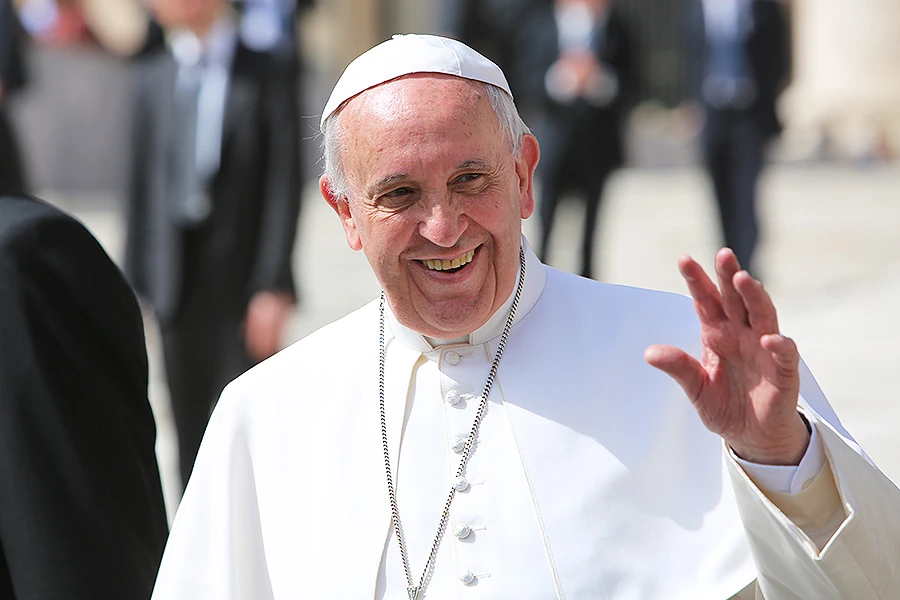
Vatican City, Apr 9, 2018 / 09:56 am (CNA/EWTN News).- Pope Francis released an apostolic exhortation in which he aims to “repropose” the universal call to holiness – which he says is the mission of life for every person.

Published April 9, Gaudete et exsultate, or “Rejoice and be glad,” is Francis’ third apostolic exhortation. It is subtitled “On the call to holiness in the contemporary world.”

The 44-page exhortation explains that holiness is the mission of every Christian, and gives practical advice for living out the call to holiness in ordinary, daily life, encouraging the practice of the Beatitudes and performing works of mercy.

Francis mentioned the holiness “in those parents who raise their children with immense love, in those men and women who work hard to support their families, in the sick, in elderly religious who never lose their smile. In their daily perseverance I see the holiness of the Church militant. Very often it is a holiness found in our next-door neighbours, those who, living in our midst, reflect God’s presence. We might call them ‘the middle class of holiness.’”

Francis said that all Catholics that, like the saints, “need to see the entirety of your life as a mission,” and explained that this is accomplished by listening to God in prayer and asking the Holy Spirit for guidance in each moment and decision.

“A Christian cannot think of his or her mission on earth without seeing it as a path of holiness,” he stated, explaining that this path has its “fullest meaning in Christ, and can only be understood through him.”

Using the words of Pope Emeritus Benedict XVI, Francis wrote that “holiness is nothing other than charity lived to the full.” As a result, the measure of our holiness stems not from our own achievement, but “from the stature that Christ achieves in us.”

Therefore, Pope Francis said, to walk the path of holiness requires prayer and contemplation alongside action; the two cannot be separated.

The pope also touched on what he calls the “two enemies of holiness” – modern versions of the heresies of Pelagianism and Gnosticism, saying that these lead to “false forms of holiness.”

In the modern form of Gnosticism, Francis said, one believes that faith is purely subjective, and that the intellect is the supreme form of perfection, not charity.

This can lead Catholics to think that “because we know something, or are able to explain it in certain terms, we are already saints,” he said, when really, “what we think we know should always motivate us to respond more fully to God’s love.”

In contemporary Pelagianism, he said the common error is to believe that it is by our own effort that we achieve sanctity, forgetting that everything in fact “depends not on human will or exertion, but on God who shows mercy (Rom. 9:16).”

The pope explained that “the Church has repeatedly taught that we are justified not by our own works or efforts, but by the grace of the Lord, who always takes the initiative,” and that even our cooperation with the gift of divine grace is itself “a prior gift of that same grace.”

Some may be asked, through God’s grace, for grand gestures of holiness – as can be seen in the lives of many of the saints, Francis said – but many people are called to live the mission of holiness in a more ordinary way, and in the context of their vocation.

However large or small one’s call seems, Francis said that acts of charity are always undertaken “by God’s grace,” not as people “sufficient unto ourselves, but rather ‘as good stewards of the manifold grace of God’ (1 Peter 4:10),” he said.

The pope offered several practical recommendations for living out these “small gestures.” In addition to the frequent reception of the sacraments and attendance at Mass, he said that in the Beatitudes Jesus explains “with great simplicity what it means to be holy.”

He also said that a way to practice holiness is through the works of mercy, though he warned that to think good works can be separated from a personal relationship with God and openness to grace is to make Christianity into “a sort of NGO.”

The saints, on the other hand, show us that “mental prayer, the love of God and the reading of the Gospel” in no way detract from “passionate and effective commitment to their neighbors.”

The pope highlighted several qualities he finds especially important for living holiness in today’s culture, including: perseverance, patience, humility, joy, a sense of humor, boldness, and passion.

Boldness and passion, he said, are important in order to avoid despondency or mediocrity, which he said can weaken us in the ongoing spiritual battle against evil.  

In the journey toward holiness, “the cultivation of all that is good, progress in the spiritual life and growth in love are the best counterbalance to evil,” he said, emphasizing that the existence of the devil is not a myth or an abstract idea, but a “personal being that assails us.”

“Those who choose to remain neutral, who are satisfied with little, who renounce the ideal of giving themselves generously to the Lord, will never hold out” against temptation, he stated.

“For this spiritual combat, we can count on the powerful weapons that the Lord has given us: faith-filled prayer, meditation on the word of God, the celebration of Mass, Eucharistic adoration, sacramental Reconciliation, works of charity, community life, missionary outreach,” he listed.

About the importance of prayer on the path to holiness, the pope said that though “the Lord speaks to us in a variety of ways, at work, through others and at every moment… we simply cannot do without the silence of prolonged prayer.”

“Naturally, this attitude of listening entails obedience to the Gospel as the ultimate standard, but also to the Magisterium that guards it,” he stated, “as we seek to find in the treasury of the Church whatever is most fruitful for the ‘today’ of salvation.”

Cardinal Daniel DiNardo, president of the United States bishops’ conference, praised the exhortation in a statement released Monday, saying: “In this exhortation, Pope Francis is very clear – he is doing his duty as the Vicar of Christ, by strongly urging each and every Christian to freely, and without any qualifications, acknowledge and be open to what God wants them to be – that is ‘to be holy, as He is holy’ (1 Pet 1:15). The mission entrusted to each of us in the waters of baptism was simple – by God’s grace and power, we are called to become saints.”

[…]

No Picture
News Briefs

Condom giveaways, needle exchanges: Are Catholic hospitals called to more?

April 8, 2018 CNA Daily News 3

Cincinnati, Ohio, Apr 8, 2018 / 06:00 am (CNA).- A clean needle exchange program that distributes condoms is hosted in the parking lot of an Ohio Catholic hospital, and one Catholic bioethicist thinks the system can do better.
 
“I would say Catholics are called to more. At a minimum, Christ articulated a higher standard for moral life than what other people are doing,” Catholic bioethicist John Brehany told CNA April 4, addressing the needle exchange aspect in particular.
 
The hospital statement justifying the practice stressed harm reduction.
 
“It seems to me that they have a good motive,” Brehany said. “They want to help people, they want to help people avoid harm. That’s understandable, is that good enough? Is that what Christians are called to do?”
 
Brehany is director of institutional relations at the National Catholic Bioethics Center, which handles inquiries on Catholic bioethics issues. He has a doctorate in healthcare ethics, a licentiate in sacred theology and is past executive director of the Catholic Medical Association.
 
The Mercy Health Clermont Hospital in Batavia, Ohio is hosting in its parking lot an Exchange Project program that offers condoms as well as injection equipment and other health services, the Cincinnati Enquirer reports.
 
“First and foremost, the needle exchange services program is a harm reduction program aimed at reducing the spread of sexually transmitted diseases, including HIV and Hepatitis C,” Mercy Health spokesperson Nanette Bentley told CNA April 3. “The program includes needle exchange, access to testing and condoms as a holistic approach to harm reduction.”
 
“When clients enter the van, they enter the property of Hamilton County Public Health,” Bentley said. “The van is staffed solely by employees of Hamilton County Public Health and all services are provided by those employees.”
 
“Mercy Health – Clermont Hospital provides a central location for the van to offer its harm reduction program but does not provide any services on the van,” she added, saying that Mercy Health provides “many other medical and preventive services for patients with substance abuse issues.”
 
In Kentucky, the St. Elizabeth Healthcare system hosts the needle exchange program in parking lots at its Covington hospital and at St. Elizabeth Urgent Care in Newport. However, these programs will not distribute condoms.
 
“St. Elizabeth Healthcare is dedicated to caring for our patients’ medical needs without compromise of the Catholic Church’s teachings concerning birth control,” Guy Karrick, a spokesman for St. Elizabeth, told The Cincinnati Enquirer. “We are going above and beyond for our community to get a program in place as quickly as possible.”
 
St. Elizabeth considers hospital property to be bound by Catholic teaching, such as the U.S. bishops’ Ethical and Religious Directives for Catholic Health Care Services.
 
“Catholic health institutions may not promote or condone contraceptive practices,” one directive reads.
 
Karrick did suggest the program might be best off on health department grounds.
 
Brehany said he couldn’t adequately assess the entire program since he did not have all the details. He also stressed that issues of cooperation in evil are among the most complex in moral theology. While some Church teachings are clear and settled, others are not. For instance, the use of contraception in marriage is clearly forbidden, but Church teaching on the ethics of using condoms to reduce the transmission of disease outside of marriage is less developed.

In 2010, Pope Benedict XVI told journalist Peter Seewald that while condoms could not be considered “a real or moral solution,” their use by homosexual prostitutes might be considered “a first step in the direction of a moralization, a first assumption of responsibility.”

Benedict later clarified that “naturally the church does not consider condoms as the authentic and moral solution” to the spread of AIDs or other other sexually-transmitted diseases.
 
“At the National Catholic Bioethics Center, when it comes to the question of justifying the use of condoms to prevent disease transmission, we’ve always argued against that,” Brehany told CNA. “One reason is that Pope Paul VI’s 1968 encyclical Humanae Vitae teaches that every sexual act must retain its essential openness to procreation.”
 
In addition, he said, “If someone has a dangerous disease, really, the better ethical action is not to expose someone else to it at all.”
 
Dr. Lynne Saddler, district director of the Northern Kentucky Health Department, voiced gratitude for the partnership with St. Elizabeth’s, the Catholic system that barred condom distribution.
 
Although the National Harm Reduction Coalition of New York City praised St. Elizabeth’s participation in the program, it advocated that the system add condom distribution “as part of a comprehensive HIV prevention strategy for a particularly vulnerable population.”
 
Dr. Judith Feinberg, who ran the first needle exchange program in the Greater Cincinnati area in 2014, said the program was about doing anything possible to keep people safe.
 
“The whole point is to prevent disease, and the condoms are part of preventing disease,” she said.
 
According to Brehany, the issue of cooperation in evil is “complex” and must be evaluated on several factors including intent and the nature of one’s involvement with another person’s unethical action. Catholic teaching, especially as taught in St. John Paul II’s 1993 encyclical “Veritatis Splendor,” rejects both a utilitarian mode of thinking and an ethical approach based only on good intentions or good consequences.
 
Further, those cooperating in moral evil must always be aware of whether their cooperation might cause others to believe that a practice is morally allowed.
 
“Adequately discerning the effect of our actions on other people’s faith is always a consideration in issues of cooperation,” said Brehany.
 
As for needle distribution, while Church teaching is less developed, he suggested that a clean needle distribution would be more justifiable if the goal included weaning someone off drugs, rather than intending to help them maintain their drug use in a manner that merely reduced the risk of spreading disease.
 
CNA sought comment from the Cincinnati archdiocese, but was referred to Mercy Health.

The Mercy Health system has hospitals in Ohio and Kentucky. Its sponsors include the Sisters of Mercy, the Sisters of the Humility of Mary, and the Franciscan Sisters of the Poor.
 
The St. Elizabeth Healthcare system is sponsored by the Diocese of Covington. It operates six facilities in northern Kentucky.


[…]

No Picture
News Briefs

Pope: Relationship with Jesus is our own personal love story

April 8, 2018 CNA Daily News 0

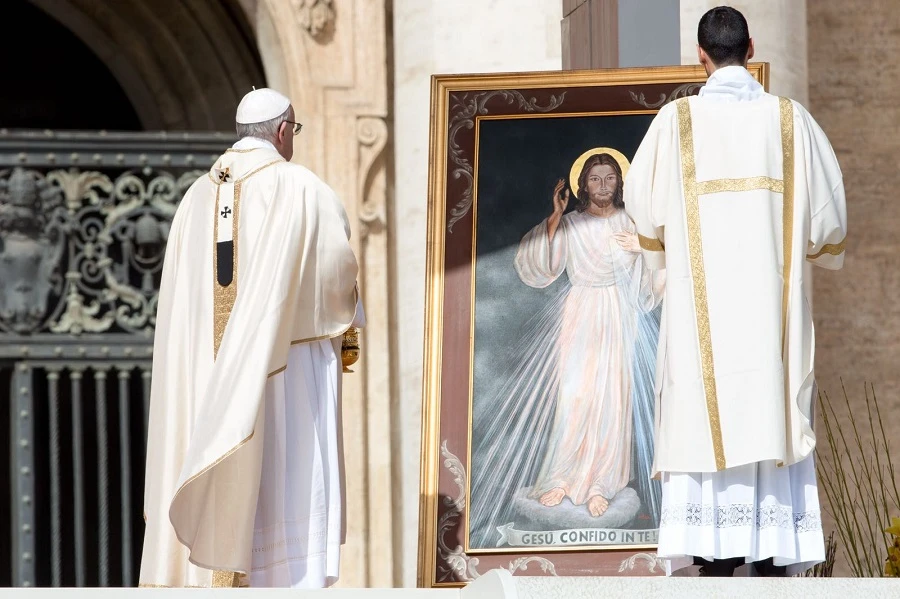
Vatican City, Apr 8, 2018 / 04:20 am (CNA/EWTN News).- On the Second Sunday of Easter, also known as Divine Mercy Sunday, Pope Francis said that our relationship with God is a personal one, filled with his love and mercy, where we proclaim like St. Thomas: “My Lord and my God!”

“To enter into Jesus’ wounds is to contemplate the boundless love flowing from his heart. It is to realize that his heart beats for me, for you, for each one of us,” the pope said April 8.

“Just like in a love story, we say to God: ‘You became man for me, you died and rose for me and thus you are not only God; you are my God, you are my life. In you I have found the love that I was looking for, and much more than I could ever have imagined.’”

Francis reflected on St. Thomas’ exclamation in the Gospel of John during his homily for Mass for Divine Mercy Sunday in St. Peter’s Square. He pointed out that it may feel strange at first to say “my Lord and my God.”

But he noted how God himself said, at the beginning of the Ten Commandments: “I am the Lord your God” showing that he desires a personal relationship with each one of us, to be possessed by us, just like a jealous lover.

The Mass also marked the start of an April 8-11 meeting in Rome of some-600 Missionaries of Mercy, who were first commissioned on Ash Wednesday 2016 during the jubilee. Their mandate was extended by Pope Francis at the close of the holy year and the meeting is focused on spiritual formation and fellowship-building.

“As today we enter, through Christ’s wounds, into the mystery of God, we come to realize that mercy is not simply one of his qualities among others, but the very beating of his heart,” Francis said.

“Then, like Thomas, we no longer live as disciples, uncertain, devout but wavering. We too fall in love with the Lord! Don’t be afraid of this word, in love with the Lord!”

How can we savor this love that Jesus bestows on us? How can we touch his mercy with our own hand? the pope asked. First, he said, is through the Sacrament of Confession, where we let ourselves be forgiven by God.

Francis outlined three roadblocks we put up in our hearts about confession: shame, discouragement, and believing we are unforgiveable.

“Before God we are tempted to do what the disciples did in the Gospel: to barricade ourselves behind closed doors,” he said. “They did it out of fear, yet we too can be afraid, ashamed to open our hearts and confess our sins.”

When we feel ashamed of our sins, this can be a gift, the pope said, because it is an invitation to our soul to let God overcome the evil in our lives, and we should not be afraid to experience shame, he said, but instead, “pass from shame to forgiveness!”

Another struggle we might face, he said, is one of resignation or discouragement, letting ourselves think: “I’ve been a Christian for all this time, but nothing has changed; I keep committing the same sins.”

“Then, in discouragement, we give up on mercy,” he continued. “But the Lord challenges us: ‘Don’t you believe that my mercy is greater than your misery? Are you a backslider? Then be a backslider in asking for mercy, and we will see who comes out on top.’”

When we fall into the same sin again and again, we may experience great sorrow, but even this sorrow is beneficial, because it “slowly detaches us from sin,” he said.

Thirdly, another “closed door” we may put up to keep ourselves from confession is not wanting to forgive ourselves, the pope said. Someone who has committed a grave sin may think that if they cannot, or do not want to, forgive themselves, how could God want to forgive them?

“This door, however, is only closed on one side, our own; but for God, no door is ever completely closed,” he said.

“As the Gospel tells us, he loves to enter precisely ‘through closed doors,’ when every entrance seems barred. There God works his wonders. He never chooses to abandon us; we are the ones who keep him out.”

“Let us today, like Thomas, implore the grace to acknowledge our God: to find in his forgiveness our joy, and in his mercy our hope,” he said.

Following the Mass, Pope Francis led faithful in praying the customary Regina Coeli prayer. In his brief message before the prayer, the pope thanked all the Missionaries of Mercy gathered in Rome for their meetings.

He also wished a happy Easter to those who are members of the Orthodox Church and are thus celebrating Easter today. “May the Risen Lord fill them with light and peace, and comfort the communities that live in particularly difficult situations,” he said.

Francis also denounced the use of chemical bombs, following an attack in Douma, Syria that killed over 40 men, women, and children, saying, “there is no such thing as a good war or a bad war. Nothing justifies the use of such bombs.”

[…]

No Picture
News Briefs

Cardinal Burke: Pope’s authority is derived only from obedience to God

April 7, 2018 CNA Daily News 3

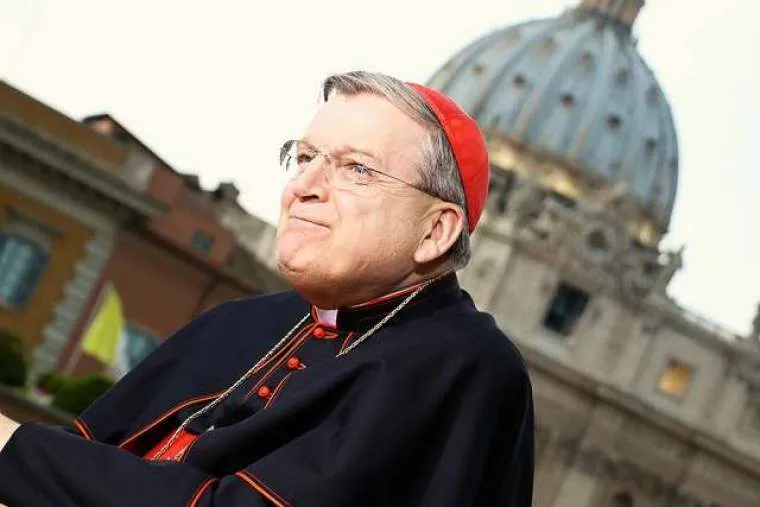
Rome, Italy, Apr 7, 2018 / 03:46 pm (CNA/EWTN News).- Speaking Saturday in Rome, Cardinal Raymond Leo Burke said that the pope is the highest authority in the Church, but because his power is derived from the divine law, the faithful are obligated to reject his teaching if it falls outside that divine law.  

“According to the Holy Scriptures and the Sacred Tradition, the Successor of St. Peter enjoys a power that is universal, ordinary and immediate on all the faithful,” Burke said at a conference on confusion within the Church, held in Rome April 7.

“Since this power comes from God himself, it is limited by natural law and by divine law,” he continued, “which are the expressions of the eternal and immutable truth and goodness that come from God, are fully revealed in Christ and have been transmitted in the Church uninterruptedly.”

“Therefore, any expression of doctrine or practice that is not in conformity with the Divine Revelation, contained in the Holy Scriptures and in the Tradition of the Church, cannot constitute an authentic exercise of the Apostolic or Petrine ministry and must be rejected by the faithful.”

Burke spoke alongside Cardinal Walter Brandmueller, Bishop Athanasius Schneider, philosopher Marcello Pera, professors Renzo Puccetti and Valerio Gigliotti, and journalist Francesca Romana Poleggi.

The conference, which was put on partly to honor the last wishes of the late Cardinal Carlo Caffarra, archbishop emeritus of Bolona, was titled: “Church, where are you going?”

The subtitle, “Only the blind would deny there is confusion in the Church,” was taken from one of Caffara’s last interviews before his death on Sept. 6, 2017.

Topics at the conference included questions about the Church’s doctrine on matters of sexual morality; the issue of conscience and the concept of “discernment;” and the limits of papal authority and infallibility, which the Church teaches is applicable only in cases of certain public statements on faith and morals.

Cardinal Burke presented a lengthy speech outlining both what papal power is and what its limits are. He also discussed what he believes to be the role of the bishops and the faithful when the pope is thought to have stepped outside these bounds.

Burke explained that while it is both the pope and the bishops who share in the care of the universal Church, it is only the pope who “exercises the fullness of power, so that the unity of the universal Church may be effectively safeguarded and promoted.”

“It is clear that the fullness of power has been given by Christ himself and not by any human authority or popular constitution, and that, therefore, it can only be exercised in obedience to Christ,” he continued.

He argued that from the beginning of the Church, this idea of the “fullness of power” has been well-defined and that it was well understood that it did not allow certain actions to be performed by the Roman Pontiff.

“For example,” Burke stated, “[the pope] could not act against the Apostolic Faith. Moreover, for the good of the good order of the Church, it was a power to be used sparingly and with the greatest prudence.”

Asking how we should correct the pope if he does overstep the limits of his power, Burke pointed to two steps, which he called “a brief and preliminary answer, based on natural law, on the Gospels and on the canonical tradition.”

First, he said, “the correction of the presumed error or abandonment of his duty should be addressed directly to the Roman Pontiff; and then, if he continued to err or not answer, a public declaration should be made.”

“The Roman Pontiff is – like all the faithful – subject to the Word of God, to the Catholic faith and is the guarantor of the obedience of the Church and, in this sense, servus servorum [servant of the servants].”

He noted that he believes devout Catholics must always teach and defend the fullness of power that Christ gave to “His Vicar on earth.” But at the same time, they must teach and defend the power “within the teaching of the Church and the defense of the Church as the Mystical Body of Christ.”

Cardinal Joseph Zen, a bishop emeritus of Hong Kong, was not present, but sent a brief video message recorded in February 2018, stating that though he was not able to travel to the conference, he was there with his prayers and with his heart.

Zen, who has spoken out strongly against a possible forthcoming agreement between the Holy See and the Chinese government, said that the Church is a great family, and that at the center of the family is the Holy See, which is very important.

He noted how Pope Francis likes to emphasize the importance of the peripheries, but said that “in this moment, our periphery, China… is in much difficulty, great difficulty,” and that “many voices from this periphery do not arrive at the center [of the Church.]”

“We have a great desire to have more communication between the center and the periphery,” he continued, “because if one wants to help the Church in China, one should know [the country]” and not only statistics or what can be read in books.

“At the moment, we are afraid that at the center they do not bring a decision that will truly help to grow the Church. This is the worry of many,” he stated.


[…]