No Picture
News Briefs

US bishops: Pope Francis talks Fr. James Martin, euthanasia, at private meeting
February 20, 2020 CNA Daily News 0

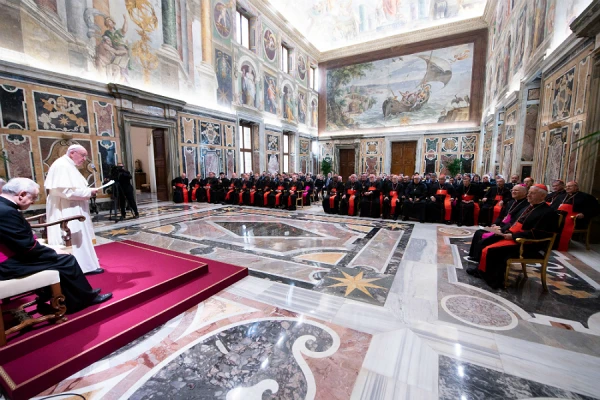
Vatican City, Feb 20, 2020 / 05:00 pm (CNA).- During a private meeting with bishops from the southwestern United States, Pope Francis talked about his 2019 meeting with Fr. James Martin, SJ, and about pastoral care and assisted suicide.

The pope met Feb. 10 for more than two hours with bishops from New Mexico, Arizona, Colorado, Utah, and Wyoming.

Several bishops present at the meeting told CNA that in addition to discussions about his then-pending exhortation on the Amazon region, and on the challenges of transgenderism and gender ideology, Pope Francis discussed his Sept. 30 meeting with Martin, an American Jesuit who is well-known for speaking and writing about the Church’s ministry to people who identify themselves as LGBT.

“The Holy Father’s disposition was very clear, he was most displeased about the whole subject of Fr. Martin and how their encounter had been used. He was very expressive, both his words and his face –  his anger was very clear, he felt he’d been used,” one bishop told CNA.

Martin met with Pope Francis shortly after a Sept. 19 column by Archbishop Charles Chaput criticized “a pattern of ambiguity” in Martin’s work, which Chaput said “tends to undermine his stated aims, alienating people from the very support they need for authentic human flourishing.”

“I find it necessary to emphasize that Father Martin does not speak with authority on behalf of the Church, and to caution the faithful about some of his claims,” Chaput added.

The meeting between Martin and the pope was taken by some as a response to Chaput’s column.

The meeting took place in a papal library ordinarily reserved for high-level audiences with the pope, which some journalists saw as a significant decision.

“By choosing to meet him in this place, Pope Francis was making a public statement. In some ways, the meeting was the message,” America Magazine reported of the encounter.

But bishops who met with the pope this week said that while Pope Francis had accommodated a request for a meeting with Martin, he was clear with them that he did not intend for it to convey any significance.

In fact, one bishop at the meeting told CNA that Pope Francis has said he “made his displeasure clear” about the way the meeting was interpreted, and framed by some journalists.

“He told us that the matter had been dealt with; that Fr. Martin had been given a ‘talking to’ and that his superiors had also been spoken to and made the situation perfectly clear to him,” another bishop said.

“I do not think you will be seeing that picture of him with the pope on his next book cover,” the bishop told CNA.

For his part, Martin told CNA Feb. 20 that “I can’t comment on what the Holy Father told me, since he asked me not to share the details with the media, other than to say that I felt profoundly inspired, consoled and encouraged by our half-hour audience in the Apostolic Palace, which came at his invitation.”

Two bishops told CNA that Martin’s work in regards to the LGBT community was also discussed with the heads of numerous Vatican congregations, and that some officials expressed concern about aspects of the priest’s work.

According to bishops present at the papal meeting, Pope Francis also spoke about euthanasia, and was asked about comments from Archbishop Vincenzo Paglia, who said at a December symposium that priests should “let go of the rules” in order to be present with people who have initiated assisted suicide.

At the symposium Paglia mentioned that he would be hold the hand of someone dying from assisted suicide, and that he does not see such an action as lending implicit support for the practice.

Pope Francis apparently told bishops that while priests must love mercifully those who have terminal illnesses, they can not “accompany” someone who is in the act of suicide, which the Catholic Church teaches to be gravely immoral.

One bishop told CNA that the same matter was brought up with the heads of Vatican offices, and “they were really clear that what [Paglia] said was a big problem, and that other bishops have brought it up.”

Vatican officials said “you just can’t do that,” a bishop said, in reference to any pastoral action that might seem to imply approval of, or cooperation with, assisted suicide.


Ed Condon contributed to this report.
 

[…]

No Picture
News Briefs

Head of Australian bishops’ conference in Rome ahead of plenary council

February 20, 2020 CNA Daily News 2

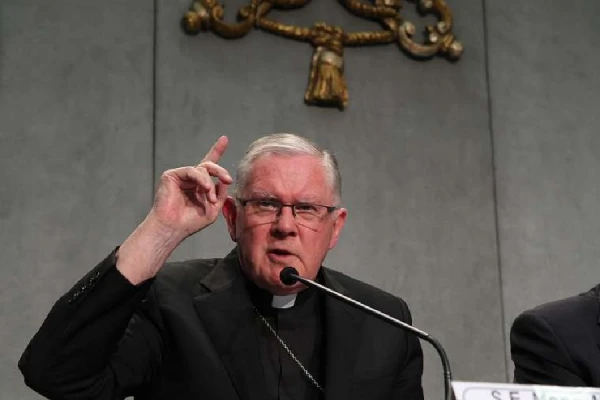
Brisbane, Australia, Feb 20, 2020 / 02:00 pm (CNA).- Archbishop Mark Coleridge of Brisbane, president of the Australian bishops’ conference, is in Rome for high-level discussions ahead of the Church in Australia’s first plenary council since Vatican II, set to begin in October.

According to The Catholic Leader, during his two-week trip to Rome, Coleridge will meet with senior curial figures and Pope Francis to discuss the plenary council, its key themes, and its organizing principles.

The council, to be held in Adelaide in October, is part of the Church in Australia’s response to the sexual abuse crisis, as well as a number of other issues, including efforts by local governments to pass laws encroaching on religious freedom and the seal of confession. 

Although there will be lay participation in the council sessions, only the bishops will vote on binding resolutions, which will be sent to the Vatican for approval. 

In Rome, Coleridge also reportedly plans to discuss the Vatican’s response to the Australian Royal Commission’s recommendations on the protection of minors, the seal of confession, and the case of imprisoned Cardinal George Pell.

A law passed in the state of Victoria in 2019 requires clergy to report suspected child abuse to the authorities, even if it was revealed in the confessional— requiring priests to break the sacramental of seal. The state’s premier, Daniel Andrews, said he hoped the legislation would “send a message” to the Church on child sex abuse. A national standard for mandatory reporting by clergy is also being considered.

Coleridge will also discuss Cardinal Pell, the former Vatican prefect of the Secretariat for the Economy, who is now in prison near Melbourne following his conviction by a Victoria court in December, 2018.

Pell was convicted on five charges of child sexual abuse and sentenced to six years in prison, of which he must serve three years and eight months before being eligible for parole. Currently in a maximum-security prison, Pell has appealed his conviction to Australia’s High Court, which will hear the case on March 11 and 12.

As Coleridge traveled to Rome, another Australian bishop emphasized the importance of a valid ecclesiology, Catholic language, and clear expression of Church teaching during the upcoming plenary council.

Bishop Richard Umbers, auxiliary bishop of the Archdiocese of Sydney, said this week at the University of Notre Dame in Sydney that there must be a proper understanding of the hierarchical structure of the Church, and respect for Church teaching, during the council assembly.

Ecclesiology, he said, “is going to be one of the key areas of conflict in the plenary [and] I have been very vocal in asking for explicit ecclesiology,” as reported by The Catholic Weekly.

Umbers went on to say that “we need to use a language that is Catholic” when discussing issues at the council.

“Not all the ideas that circulate among the people of God are compatible with the faith,” he said, noting that “it needs to be said that we are not going to redefine sin. We are not going to change the sacrament of Holy Orders and neither do we have the power to do so.”

The plenary council was preceded by a “listening and dialogue phase” where the lay faithful submitted suggested topics on what is asked of the Church in Australia, and the future of the Church.

According to the final report on the listening phase, “strongly discussed topics included the rule of celibacy for priests, the ordination of women and the inclusion of divorced and remarried Catholics.”

The desire for “greater listening” and lay involvement in the Church, as well as better evangelization was also present in the submitted answers, the report said.

The Australian bishops’ close collaboration with Rome stands in contrast to the so-called synodal process underway in Germany.

Last October, the German bishops’ conference voted to begin a “binding synodal process” to consider the Church’s teaching on sexual morality, clerical celibacy, and the power and authority of the clergy.

The synodal assembly includes priests, deacons, religious, pastoral workers and other lay Catholic groups. Unlike Australia, each member can vote on resolutions, with the votes of laypeople carrying equal weight with those of bishops.

In September, the Vatican issued a canonical critique of the German synodal plans, concluding that they are “not ecclesiologically valid.”

In a September letter to Cardinal Reinhard Marx, head of the German bishops’ conference, the prefect of the Vatican’s Congregation for Bishops—Cardinal Marc Ouellet— presented an assessment by the Pontifical Council for Legislative Texts which said the German plans were outside of the Church’s recognized structures. The process, the Vatican said, must conform to principles outlined by Pope Francis in June, in which the pope outlined the principles of authentic synodality.

In his letter to German Catholics, Francis said that “Every time the ecclesial community has tried to resolve its problems alone, trusting and focusing exclusively on its forces or its methods, its intelligence, its will or prestige, it ended up increasing and perpetuating the evils it tried to solve.” 

The Vatican legal assessment of the German plans determined that the synodal assembly was actually better described as a particular council, similar to the Australian plans, but lacking the necessary cooperation with Rome.

[…]

No Picture
News Briefs

Pope Francis urges Catholic educators to teach inclusive integral ecology

February 20, 2020 CNA Daily News 2

Vatican City, Feb 20, 2020 / 10:08 am (CNA).- Pope Francis called for an educational revolution Thursday, telling the Congregation for Catholic Education that more effort needs to be made to accelerate the inclusiveness of education.

Ecology and fraternity are an integral part of education, Pope Francis told the Catholic education leaders ahead of the pope’s Global Compact on Education taking place May 14.

“The educational pact must not be a simple order, it must not be a rehash of the positivisms we have received from an Enlightenment education. It must be revolutionary,” Pope Francis said Feb. 20.

The pope said that the purpose of an “education that focuses on the person in his integral reality” is “above all” oriented “to the discovery of fraternity that produces the multicultural composition of humanity.”

Pope Francis called for educators capable of resetting their teaching methods to form young people in an “ecological ethic.” He said education is a “dynamic reality,” which is “never a repetitive action.”

“Education is called with its pacifying force to form people capable of understanding that diversity does not hinder unity, rather they are indispensable for the richness of one’s own identity and that of everyone,” Francis said.

“As for the method, education is an inclusive movement. An inclusion that goes towards all the excluded: those for poverty, for vulnerability due to wars, famines and natural disasters, for social selectivity, for family and existential difficulties,” he said.

Educational intiativies for migrants and refugees should be put into action “without any distinction of sex, religion, or ethnicity,” the pope told the congregation.

Pope Francis said a “peace-making educational movement” is needed in light of the fractures between cultures masking a “fear of diversity and difference.”

“Inclusion is not a modern invention, but is an integral part of the Christian salvific message,” Pope Francis said.

The pope addressed the plenary assembly of the Congregation for Catholic Education. The congregation oversees 216,000 Catholic schools attended by over 60 million pupils, and 1,750 Catholic universities with over 11 million students.

The congregation devotes particular attention to institutions of Catholic higher education, which exist “by their nature aim to secure that the Christian outlook should acquire a public, stable and universal influence in the whole process of the promotion of higher culture,” according to St. John Paul II’s 1979 apostolic constitution on ecclesiastical universities and faculties, Sapientia Christiana.

Ex corde Ecclesiae, St. John Paul II’s 1990 apostolic constitution on Catholic universities, states that “A Catholic university’s privileged task is to unite existentially by intellectual effort two orders of reality that too frequently tend to be placed in opposition as though they were antithetical: the search for truth, and the certainty of already knowing the fount of truth.”

“Every human reality, both individual and social has been liberated by Christ: persons, as well as the activities of men and women, of which culture is the highest and incarnate expression…. Jesus Christ, our Saviour, offers his light and his hope to all those who promote the sciences, the arts, letters and the numerous fields developed by modern culture,” it states. “Therefore, all the sons and daughters of the Church should become aware of their mission and discover how the strength of the Gospel can penetrate and regenerate the mentalities and dominant values that inspire individual cultures, as well as the opinions and mental attitudes that are derived from it.”

Pope Francis has tasked the Congregation for Catholic Education with organizing his Global Educational Summit.

When the educational pact was first announced in September, “the most significant personalities of the political, cultural and religious world” were invited to attend.

The foundation of the pact is “openness to others,” according to the instrumentum laboris for the education summit.

The aim of the Global Education Pact is to “renew the passion for a more open and inclusive education, capable of patient listening, constructive dialogue, and mutual understanding,” Pope Francis told the congregation.

[…]

No Picture
News Briefs

Bishop Wall: Pope Francis ‘passionate about life’ from conception to natural death

February 20, 2020 CNA Daily News 3

Gallup, N.M., Feb 20, 2020 / 03:01 am (CNA).- After visiting with Pope Francis for two and a half hours during his region’s ad limina visit, Bishop James Wall of Gallup told CNA that he was encouraged by the Holy Father’s passion for the pro-life movement, his love for the vulnerable in society, and his willingness to discuss anything.

“The Holy Father just (said), ‘What would you want to talk about?’” Wall told CNA.

“So I saw an opportunity, and it was kind of funny. I said, ‘Holy Father, we’re pro-life.’ And he joked and he goes, ‘Well, so is the Holy Father.’”

Wall said he then told Pope Francis that he wanted to talk about how much of the Church, and society at large, has still rejected the message of Humanae vitae, St. Paul VI’s 1968 encyclical reaffirming the Church’s teaching on sexuality and against contraception, more than 50 years after it was written.

The rejection of Humanae vitae’s teachings has created a “vocational crisis,” Wall added, because parents are not learning to be generous with God, and therefore their children are not learning to be generous with God and to trust him with his plan for their lives.

Wall said Pope Francis responded that he especially sees this crisis in the disappearance of people with disabilities from society.

“(Pope Francis) said, ‘Yes, the question about why is it in our society that we see fewer and fewer people with disabilities?…Because we do tests of children in the womb, and if we see that they have a disability, then we abort them. This is a great evil.’”

People with disabilities are created in the image and likeness of God, as are all people, and they have “a unique role to play in society, because they help us to love and they teach us about love,” the Pope told the bishops.

“It’s a beautiful line from the Holy Father,” Wall told CNA.

The bishops of the US Conference of Catholic Bishops’ Region XIII met with Pope Francis Feb. 10. The region includes the bishops of Utah, Colorado, Wyoming, New Mexico, and Arizona.

Wall said he discussed with Pope Francis that the Native American people in his diocese still value life – they care for children with Down syndrome, and they have great respect for their grandparents and elders.

Pope Francis then spoke about the importance of respecting life “from conception until natural death, the littlest to the oldest” and the need to protect the most vulnerable in society.

“It was awesome to see the Holy Father just really be so passionate about life, and passionate about life of people with disability. I thought that was beautiful,” Wall said.

One of the problems with the way society talks about life is that they use the term “quality of life,” Wall noted.

“That’s such a loaded term,” he said. “My quality of life could be different from your quality of life, but that doesn’t mean that my life is better or worth more than your life. Every life is worth it and worth living.”

“And whether somebody has a disability, whether somebody’s old and young, whatever the case is, or if somebody makes a lot of money or doesn’t, the quality of life is the same for everyone, (because) our quality of life is we’re all created in the image and likeness of God.”

Priests should be preaching the truth about Church teaching regarding contraception and human life in order to foster a deeper culture of life among Catholics, Wall added.

“That’s something that we shouldn’t shy away from preaching – preaching the truth of Humanae vitae, preaching the truth of the theology of the body, preaching the truth of what all the Church teaches when we talk about the sacredness of life,” he said.

“And we need to be able to name it for what it is,” he added. “So when we talk about abortion, or we talk about contraception, and we talk about embryonic stem cell research, euthanasia, physician-assisted suicide – we call it for what it is. We pray for an end to these intrinsic evils in our society.”

Parishes should also give couples who are living according to Church teaching a chance to share their testimonies, Wall said, in order to counter the perception that everyone is using contraception and that it must be okay because it is so widely used.

Wall said he would also encourage Catholics to read Humanae vitae.

“It was a prophetic document from Pope St. Paul VI…because, in terms of the negative things, he said, ‘If the Church were to go down this rabbit hole (of approving contraception), these are all the things that we’re going to see happen. We’re going to see an increase in abortion. We’re going to see an increase of violence, sexual acts of violence, sexual acts against women, men objectifying women. We’re going to see an increase in divorce.’ All these things happened (when) society gave into it.”

“But, in the positive sense, Pope St. Paul VI said, ‘If we’re faithful to God’s plan for marriage and God’s plans for life, what we’re going to see is we’re going to see a blossoming of marital life.’ So when we see couples that are open to God’s plan, what we see is anywhere from a 2 to 4% divorce rate. In other words, we see in 94 to 96% success rate, meaning couples are together. They’re being faithful to their marriage vows and staying together ‘til death do they part.”

Wall added that after his region’s ad limina visit, he felt very close to the Holy Father and appreciated his openness to discuss anything.

“We didn’t send him a list of questions and have him get prepared for it. He wanted to talk about things. So if you asked him a question, he would sit there and he would really think about it. You could tell he was very thoughtful and very prayerful…and I found that very inspiring. I took away a great love for the Church and a real closeness to him.”

[…]