

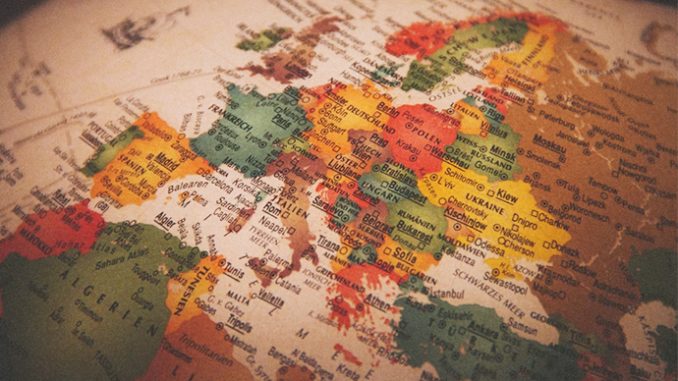
During the 2013 conclave, many European cardinal electors likely voted for Jorge Mario Bergoglio, the Argentinian-born son of an Italian immigrant, with the hope that he would bridge Europe, the traditional heartland of the Church, and the Americas, where half of the world’s Catholics live today. Consequently, many European cardinals were probably disappointed that Pope Francis paid so little attention to the Old Continent.
Pope Leo XIV, however, is quickly restoring the importance of Europe, completing highly successful pilgrimages to Monaco, Spain, and France. This is a welcome change, for several reasons.
There is a country where the number of adult and adolescent baptisms has tripled in just four years. The Bible is a bestseller there, as is the pope’s latest encyclical. Priestly vocations are on the rise, while theology is becoming a hot university major, even though enrollment in the humanities around the world is declining as young people prefer to be software engineers or work in AI. Pope Leo XIV’s recent visit to that nation was a smashing success. This country is not Nigeria, Uganda, or the Philippines; it’s not even in the Global South. I’m talking about France.
For anyone with a rudimentary knowledge of history, France has been known for an exceptionally aggressive secularism since the 1789 Revolution. Laïcité has been an inspiration for secularists around the world, not only in the historically Christian West; the founding father of the modern Turkish state, Atatürk, for example, was inspired by the French model to create the first Muslim society with an anti-religious government.
In 1980, Pope St. John Paul II lamented in the homeland of Saints Joan of Arc, Bernadette, and Thérèse of Lisieux: “France, the eldest daughter of the Church, what have you done with your baptism?” Yet the Polish pope did not give up on France, nor did his German successor, who visited the country in 2008. John Paul visited France eight times, more than any nation apart from his native Poland, and appointed masters of the new evangelization, like the late Cardinal Jean-Marie Lustiger, himself a convert from Judaism, as bishops.
Recent developments in France show that paying so much attention to that nation, not long ago a seemingly hopeless case from the perspective of the Church, was worth it. And France isn’t the only European nation where Catholicism is presently on the rise. In Ireland, like France, a nation with strong Catholic roots where the Faith seemed irrevocably lost, Gen Z is more likely to identify as Catholic and attend Mass than the millennial generation. In Spain, meanwhile, the number of young adults identifying as Catholics has been growing. In traditionally Protestant regions like Scandinavia and the UK, the surging number of Catholic catechumens is undoing the revolutions of Martin Luther and Henry VIII. While not impervious to secularism, nations like Poland, Croatia, Slovakia, war-torn Ukraine, and, to an extent, Italy, particularly its southern regions, maintain relatively intact Catholic cultures.
In other words, the Holy Spirit hasn’t given up on Europe. Yet during Francis’ pontificate, one could think otherwise. In 2013, the election of the first non-European pope in centuries was interpreted by many as the beginning of a post-European Church. And Francis acted accordingly.
The Argentinian pontiff made his first pastoral visit to a European country, Albania, a year and a half into his pontificate; this was a matter of historic justice, as the small Muslim-majority nation (which nevertheless has a robust Catholic minority) had only experienced one papal visit, a one-day pilgrimage by John Paul II in 1993. Yet many nations with large Catholic populations and rich Catholic heritage were snubbed by Francis; he never set foot in Austria, Croatia, or Slovenia. Although the state of the faith in Germany is pitiful, almost twenty million Catholics live in the homeland of Benedict XVI; they could use a papal boost, but never got one from Benedict’s immediate successor.
While historically a Protestant nation, the United Kingdom is home to millions of Catholics who had to travel to Rome to see their pope, as did millions of Ukrainian Catholics (Russia’s full-blown aggression began almost nine years into Francis’ pontificate, and prior to that there were no major security concerns to prohibit a papal visit to, say, Kyiv or Lviv). France never enjoyed a proper visit under Francis, who only paid a one-day visit to the island of Corsica (Francis also spoke at the European Parliament in Strasbourg and gave an address on the need to welcome migrants to the Mediterranean bishops gathered in Marseilles, but these two events were closed to the public).
Arguably, the most bizarre snub was that of Spain, home to forty-five million baptized Catholics, the nation that brought the Faith to Francis’ native region of Latin America, and produced countless saints and religious orders, including the Argentinean pope’s own Society of Jesus. By comparison, Benedict visited the Iberian nation three times in his relatively short, eight-year pontificate.
When Francis did visit a European nation with millions of Catholics, it was often not for a pastoral visit but to preside over international Church events, such as the World Meeting of Families in Ireland or World Youth Day in Poland (Francis never even visited Warsaw) or Portugal (Francis also visited Fatima for the centennial of the Marian apparitions in 2017, but this was not accompanied by visits to major Portuguese cities).
During the 2013 conclave that elected Francis, slightly more than half of the cardinal electors were European. Twelve years later, less than forty percent were. And a disproportionate number of European cardinals appointed by Francis were officials of the Roman Curia or diplomats rather than residential bishops; thus, in 2025 such large, ancient European sees as Milan, Venice, Vienna, Kraków, Prague, and Vilnius were without representatives at the conclave.
Leo XIV’s pivot back to Europe is welcome news for several reasons. First, Jesus Himself tells us to “go into the whole world and proclaim the gospel to every creature” (Mark 16:15). We are to go to the whole world and not ignore any part of it. One could conceivably argue that Benedict XVI, who never made any pastoral visits to Asia, for instance, was a bit too preoccupied with the Old Continent. Yet greater sensitivity to regions of the world where the Church is young and dynamic does not mean that older local Churches should be ignored. Because the Vatican is in Europe, visiting European nations is logistically much easier than Francis’ travel itinerary would suggest.
As a spiritual son of St. Augustine, born in present-day Algeria, Pope Leo XIV knows the fate of the Church in North Africa and Asia Minor. One would not want the same to happen to a continent with such a rich Catholic heritage as Europe. Do we really want the Chartres Cathedral, the Sagrada Familia, or Monte Cassino (and major Eastern Christian sites like Mount Athos) to become mere museums? Of the sixteen Marian apparitions recognized by the Church, all but two (Guadalupe in Mexico and Kibeho in Rwanda) took place in Europe. Who will take be their custodian when the Faith is gone?
Although the Catholic Church in many European countries, most notably France, is experiencing revival today, that Catholic moment needs to be boosted. France’s current dynamism comes after decades of severe decline. The dominant culture in Europe is hostile to the faith. Greater papal attention to the Old Continent can give neophytes, who face numerous challenges, confidence in their newfound faith.
Recently, Africa surpassed Europe in terms of the number of Catholics. More than a century ago, Hillaire Belloc famously wrote that “Europe is the Church, the Church is Europe.” This is no longer the case, which is inspiring evidence that many missionaries have taken Christ’s mandate to preach the Good Word everywhere to heart. Yet Europe is still the home of one in five Catholics, or nearly 300 million souls. In terms of the number of Catholics, South America and Africa are ahead of Europe, which nevertheless remains the home of more believers than Asia, North America, and Oceania. Thus, Europe is still a major center of the Church, and its faithful are too many for their spiritual needs to be ignored.
Today, it is easy to be wowed by the dynamism of the Church in sub-Saharan Africa and parts of Asia and think, to paraphrase Sinclair Lewis, that secularism can’t happen there. Yet as recently as the early 1960s, the Irish, Quebecois, Belgians, and Austrians were just as impressively pious as many Ugandans, Congolese, or Vietnamese today. It is conceivable that in sixty years’ time, congregations in cathedrals in Kinshasa or Lagos could be as sparse and grey-haired as those in Dublin or Vienna today. In fact, South Africa legalized same-sex “marriage” twenty years ago, earlier than most American states and European nations; the DNA of no nation or region is immune to secularism.
Evidence of this also comes from Francis’ native continent. In 2002, Philip Jenkins wrote in The Next Christendom that Europe was no longer the heartland of the Church; in his view, Latin America was a more fitting candidate for that title. Yet the election of a Latin American pope did not reverse the tide of secularism in his home region. In recent years, many Latin nations, including Francis’ native Argentina, have legalized same-sex marriage and abortion on demand. A tangible sign of anti-Catholic backlash, similar to that in Quebec in the 1960s or Ireland in the 1990s, took place in Chile a decade ago, where churches were burned down. In Chile, just over half the population is still Catholic, while more than a quarter of Chileans are “nones.” Going the way of Italy and Spain, once synonymous with large families, Chile and Puerto Rico (which also has the world’s highest sterilization rate) boast some of the world’s lowest fertility rates. Uruguay, meanwhile, is something like a Latin Amsterdam, becoming the first nation in South America to legalize euthanasia and the first in the world to permit recreational cannabis use.
The stunning spread of secularism in Latin America shows that the rejection of faith and morals is not a uniquely European phenomenon. Europe, however, was the first region to experience such an aggressive anti-Christian backlash. Because Europe and the West are the world’s leading regions in terms of economic development and political power, they are often a model for developing countries. Since the West helped get the world into this secularist mess, it would be useful to support those Catholics who are fighting the culture wars.
As Catholic demographics change, no pope can be Eurocentric. But neither can he be Americentric, Afrocentric, or Asiacentric. Today’s Church is well-represented on every continent, which beautifully attests to the universalism of our faith. Yet the recent resurgence of European Catholicism, arguably most evident in France, does not imply that Europe’s Catholic identity is gone. To ignore the spiritual needs of an entire continent goes against the essence of evangelism. It is refreshing that Pope Leo XIV, who, less than a year and a half into his pontificate, has paid successful pastoral visits to three European nations, understands this.
If you value the news and views Catholic World Report provides, please consider donating to support our efforts. Your contribution will help us continue to make CWR available to all readers worldwide for free, without a subscription. Thank you for your generosity!
Click here for more information on donating to CWR. Click here to sign up for our newsletter.



In his “pivot” toward Europe and especially France, might it be that the needed conversion of Secularism will be advanced by flagging the incompatible CONJUNCTION between Christianity and Islam? Not the subliminal assumption toward “convergence”? The symmetrical comparison is not harmoniously between the two scriptures, but between Jesus Christ and the Qur’an.
Three points and a Question:
FIRST, St. Augustine (and Aquinas’) focus on the unity of “interiority” and exterior actions, always together. Might this unity be the elusive “grammar” for fruitful dialogue between some individual “witnesses to Christ” and some individual “followers of Islam”? Otherwise, two opposite understandings of both Faith and “the rule of law” (civil versus Shariah)…
SECOND, the proposed—not imposed—commitment to Jesus Christ might well increase with incisive insights into the contradictory nature of Islam:
Absent the Incarnation event (!) into universal human history, the Islamic worldview bifurcates the contemplative and active realms. (Possibly even a “paradigm shift” in the life of Muhammad—between anti-paganism in Mecca, and after the Hegira [A.D. 622] going native in tribal Medina?) Incisively, Muhammad replaces [!] Mary (the Mother of the eternal God) with himself as the Messenger of the “uncreated” Qur’an. The Qur’an echoes the “Law of Moses” but goes silent on the six prohibitive Commandments, leaving a vacuum for warrior-code jihad. Absent Christ, the transnational family of umma replaces [!] both a distinct civil society and the sacramental Mystical Body of Christ. In the Qur’an itself, the unity of the Triune One is imprinted as a pagan-like “triad” of God, the Son…and Mary. No Holy Spirit.
THIRD, unlike Christianity, the premise of Islam is an enforceable Original Purity. (Jean Jaques Rousseau’s noble savage in a turban?) Not freewill and then no sin “original” to ourselves; instead an arbitrary and then deterministic Allah. Philosophically, the Islamic principle (!) of “abrogation” replaces the “non-demonstrable first principle of non-contradiction.” No invitation for coherence of Faith in the infinite and finite Reasoning. Parallel to ungrounded rationalism in the West, a fixed fideism with no need for personal conversion or Redemption.
QUESTION: What does “fraternity” mean—whether Secularist or Islamic—when amputated from its Incarnational roots? How, for the Church and Europe/post-1789 France to navigate the conjunction (!) between the mosque-state and a distinct civil society of nation-states?
Maybe this: “Equality, which is a presupposition of interreligious dialogue, refers to the equal ‘personal dignity’ of the parties in dialogue, ‘not’ to doctrinal content, ‘nor even less’ to the position of Jesus Christ—who is God himself made man—in relation to the founders of the other religions” (Dominus Iesus, 2000, n. 22).
For the ordinary Muslim on the street, how might the asserted Original Purity of Islam and an inscrutably transcendent Allah, fall short of an infinitely relational Triune One who IS absolute simplicity? And not to be falsely cast as a pagan “triad” as in the Qur’an: God, the Son…and Mary?
One Proposition, two Insights (Muslim and a Christian) and a Summary:
FIRST, Instead of the Qur’an as believed to be the very “essence of God,” the real essence (!) of God is the unity of His “essence” and his very “existence”. With Islam, not merely another existent being within Creation, but also not the insular and monolithic monotheism of Allah. Instead, the gratuitous (?) ground of all being who both IS what he does and DOES what he is.
For the “followers of Islam” the refrain in every chapter of the chapter/surrah of the Qur’an (113 out of 114) is “In the name of Allah, Most Gracious, most Merciful”….For the “witnesses to Christ” the incarnate Jesus Christ IS the “Merciful” in person. God transcends His own transcendence! And we have the gracious freedom to participate in the very inner life of God—the life who is “Gracious.” Not to expropriate the very “nature” of God, but “deification” as His gift for each of us to willingly “participate,” or not.
ONE INSIGHT: a perceptive “follower of Islam” worded it this way:
“It all comes down to knowing whether one should hold strictly to the fundamental religious values which were those of Abraham and Moses, on pain of falling into blasphemy —as the Muslims believe; or whether God has called men to approach him more closely, revealing to them little by little their fundamental condition as sinful men, and the forgiveness that transforms them and prepares them for the beatific vision—as Christian dogma teaches.” (al Akkad in 1956, as cited by Jean Guitton, “The Great Heresies and Church Councils,” 1965).
ANOTHER INSIGHT on the mystery of God and Creation, this from a “witness to Christ”:
“The responses of the Old Testament and ‘a fortiori’ of Islam (which remains essentially in the enclosure of the religion of Israel) are incapable of giving a satisfactory answer to the question of ‘why’ [!] Yahweh, why Allah, created a world of which he did not have need in order to be God. Only the fact is affirmed in the two religions, not the ‘why’ [!]. The Christian response is contained in these two fundamental dogmas: that of the Trinity [!] and that of the Incarnation” [!] (Hans Urs on Balthasar, “My Work in Retrospect,” 1993).
SUMMARY: The true God who IS love transcends the Islamic bubble of “why can’t you let God be God?” Where “fitrah” (remotely like natural law?) is our baked-in orientation toward God and is the “germ of Islam”—the, yes, alarming (Benedict’s term) event of the Incarnation is the “kernel” of Christianity.
The conjunction of divergent religions—not simplistically only a convergence.
Although Europe is no longer representative of the world’s larger Catholic presence, its significance as the root and stock of the language, cultural formation of the Christian revelation must not, for sake of retention of the meaning of the words revealed by Christ and his Apostles be discounted. Europe’s heritage is consequently irreplaceable.
Words, Gospel accounts, Apostolic tradition in Greek and Latin is all transcribed intellectually by the Fathers of the Church. All who were European. Those from N Africa, notably Augustine, Alexandrians Athanasius and Cyril were by culture arguably more European.
The diminishment of Europe initiated by progressives, ignoring Europe’s key intellectual, cultural positioning has damaged the entire body of the Church. Nor may we discount the historical positioning of the Chair of Peter. Otherwise the Church will grow elsewhere and survive although at significant cost.
Good to see the non-abandonment of Europe by Pope Leo!