

 By
By The Sept. 15 murder of Father Román de la Cruz Hernández was likely perpetrated by organized crime and is not an isolated incident but forms part of a pattern of fear and intimidation.

The recent murder of Father Román de la Cruz Hernández in the Mexican state of Hidalgo has once again drawn attention to the violence plaguing the country and has renewed concerns over how organized crime acts with impunity.
De la Cruz, 48, the parish priest of Santa Cruz in Huejutla, Hidalgo, was found dead on a road in the Lolotla district on Sept. 15.
On Sept. 17, Francisco Ángel Fernández Hasbun, chief of staff for the Hidalgo state attorney generalʼs office, stated in a video that the agency is “conducting the appropriate investigations.”
According to local media, the priestʼs body was found with gunshot wounds near a pickup truck, accompanied by a placard bearing a message whose content has not been disclosed by the authorities.
The Mexican Bishops’ Conference (CEM) has demanded a “thorough investigation” of the case, while Bishop José Hiraís Acosta Beltrán of the Diocese of Huejutla lamented “the alarming situation of violence being experienced in our country.”
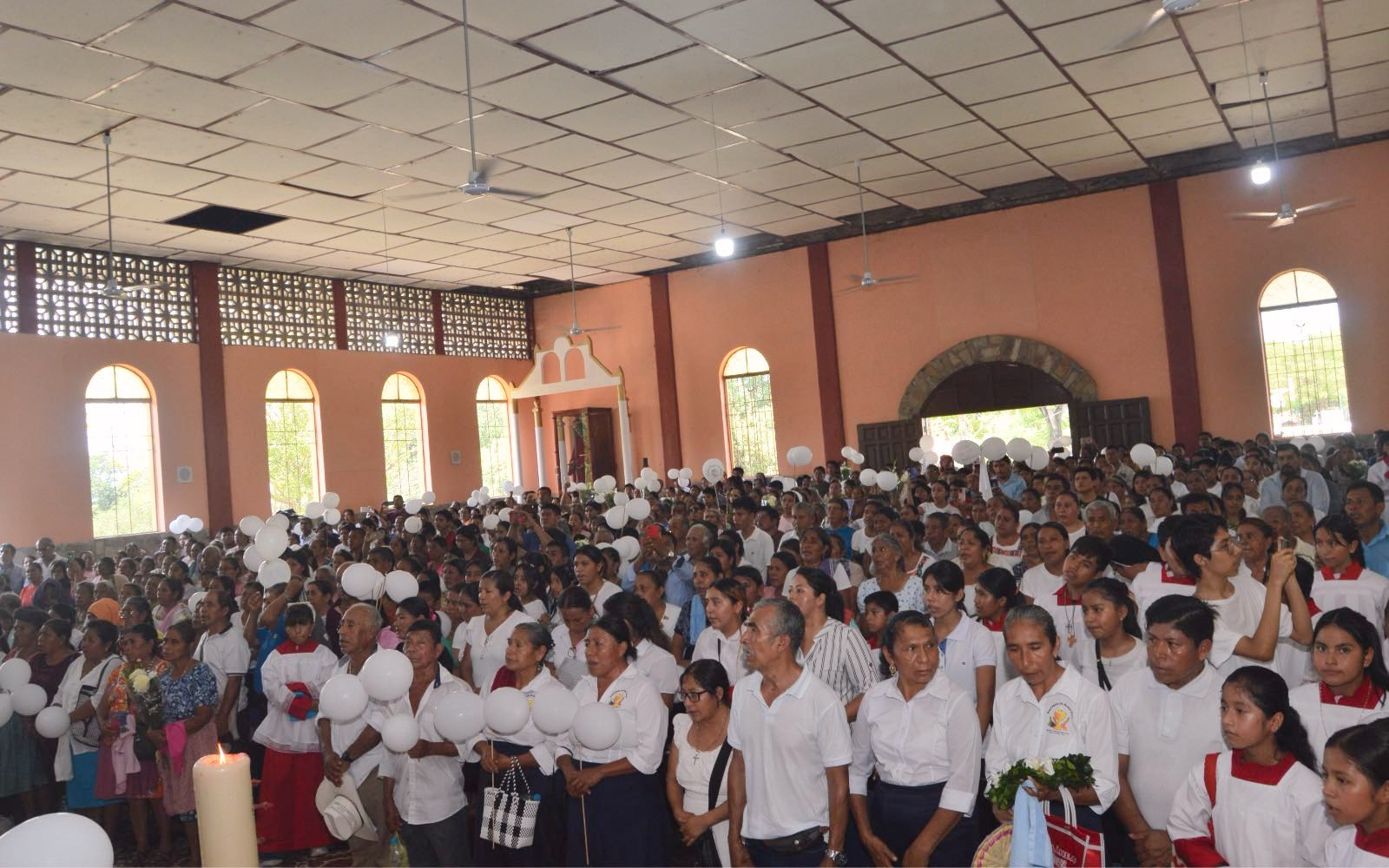
Around 600 people marched for peace in Huejutla on Sunday, Sept. 20, and attended a Mass for De la Cruz. During the homily, Acosta called for “a culture of peace and reconciliation,” asking for the crime to be solved and urging that “neither this event nor the other crimes that have wounded our Mexican nation be allowed to go unpunished.”
On the afternoon of Sept. 21, Acosta and Fernández met and delivered a brief joint statement.
Fernández said important information regarding the case was provided during the meeting and said the two believe the case will resolve quickly, noting the Church’s collaboration with the authorities during the inquiries.
‘The telltale signs of organized crime’
According to the Catholic Multimedia Center, a group that documents violence against Church members in Mexico, four priests have been murdered so far during President Claudia Sheinbaum’s term in office. The total number of priests murdered since 1990 exceeds 60.
The center’s director, priest and journalist Father Omar Sotelo, told ACI Prensa, the Spanish-language sister service of EWTN News, that the murder “bears the telltale signs of organized crime.”
Sotelo noted that “extortion and threats against priests in the country are an ongoing reality.”
He noted that, among those recorded and analyzed by the group, “more than 80% of cases remain unsolved,” including the 1993 murder of Cardinal Juan Jesús Posadas Ocampo, archbishop of Guadalajara, a case that stands as “a monument to impunity.”
In a 2016 Facebook video, Cardinal Juan Sandoval Íñiguez, then-archbishop emeritus of Guadalajara and Posadas’ successor, declared the murder “a crime by the state, perpetrated by the Federal Judicial Police.” He even named Rodolfo León Aragón, then-director of the police, as the one behind the murder, who Sandoval said probably got his orders from then-Attorney General Jorge Carpizo, whose death in 2012 ended the investigation.
‘This could happen to us, too’
Julieta Appendini, director of the pontifical foundation Aid to the Church in Need (ACN) in Mexico, told ACI Prensa “it is important not to view these murders merely as isolated criminal acts.”
The impact of a crime against a priest “goes far beyond the loss of an individual,” she said, noting that “the priest often has a very close presence in the life of the community: He knows the families, ministers to the sick, listens to people’s problems, celebrates the sacraments, and can also serve as a figure of trust and mediation.”
“When he is murdered, the community loses someone who fulfilled many of those roles, and an even greater sense of fear and helplessness can take hold.”
She warned that the murder could serve as a warning to other priests: ‘This could happen to us, too.’”
‘The goal is to sow fear’
“The goal is to sow fear,” Sotelo said. The community of Huejutla “is afraid; they have already told us so.”
Despite this, he affirmed that, “the clergy of Huejutla will continue working and carrying out their pastoral mission just as they are doing now.”
According to Sotelo, this type of murder demonstrates “the ruthless power” of organized crime in the country, “where, regrettably, the authorities have been ineffective in managing the situation and ensuring the safety of the Mexican people.”
Appendini pointed out that “a priest working in a community affected by violence does not merely celebrate the sacraments. Often, he is one of the individuals who remains when others have had to leave; he ministers to the families, listens to the victims, defends the vulnerable, and can become a voice denouncing these acts of violence.”
“That can place him in a vulnerable position vis-à-vis those seeking to control territory or impose silence,” she said.
Appendini noted that ACN’s 2025 Religious Freedom Report “points to threats, extortion, murders, assaults, and pressure to remain silent directed at priests and other religious leaders in Mexico.”
However, she clarified that “not every attack on a priest is necessarily motivated by an intent to attack religion. In Mexico, violence can be linked to territorial control, drug trafficking, extortion, or land disputes.”
Religious freedom “comes into play when a person is put at risk precisely for carrying out their mission and ministering to their community,” she said.
‘We must not normalize these situations’
“Fear also has consequences for religious freedom,” Appendini warned, noting that “a person may legally have the right to practice their faith, but if doing so publicly, serving their community, or speaking out against violence puts him in danger, then that right is not being fully exercised.”
“That is why, at ACN, we believe we must not normalize these situations or reduce them merely to statistics. When a priest who serves his community is threatened or murdered, we must also ask ourselves what is happening to that community and to the freedom of the people living there,” she noted.
Sotelo acknowledged that, in both his priestly ministry and his work as a journalist, “we sometimes feel fear; we know that at any moment we could even lose our lives for speaking about these kinds of circumstances.”
However, he affirmed that “God is with us, the Master Jesus is with us, and in the face of that, we have no choice but to continue carrying out our pastoral work as a priest, a journalist, as a reporter.”
This story was first published by ACI Prensa, the Spanish-language sister service of EWTN News. It has been translated and adapted by EWTN News English.
If you value the news and views Catholic World Report provides, please consider donating to support our efforts. Your contribution will help us continue to make CWR available to all readers worldwide for free, without a subscription. Thank you for your generosity!
Click here for more information on donating to CWR. Click here to sign up for our newsletter.

Leave a Reply