During his Aug. 16 Angelus address at Castel Gandolfo, the pontiff urged a 2-state solution in the Israel-Palestine conflict.
Pope Leo XIV waves to the faithful gathered at the Piazza della Libertà at Castel Gandolfo for his Sunday Angelus on Aug. 16, 2026. | Credit: Vatican Media
In his Sunday Angelus address on Aug. 16, Pope Leo XIV renewed his appeal for peace in the Israel-Palestine conflict, calling for a two-state solution and an end to violence against Palestinians in the West Bank.
“I renew my appeal for an end to the ongoing violence against the Palestinian civilian population in the West Bank, and I urgently call on the international community to work toward advancing the two-state solution, for a just and lasting peace,“ Leo said in his address.
The pope delivered his Angelus address once more from the Apostolic Palace of Castel Gandolfo after traveling there from the Vatican to celebrate the feast of the Assumption on Aug. 15, for which he also delivered an Angelus address. He will remain there from Aug. 12–18.
The Vatican’s longtime support for a 2-state solution
The pope and the Holy See have consistently called for a two-state solution to the conflict in the Holy Land.
In 2025, Leo met separately with the Israeli and Palestinian presidents and discussed the solution with both heads of state.
During a Sept. 23 press briefing with reporters at Castel Gandolfo, the pope highlighted the Vatican’s long-standing support for the two-state solution.
“The Holy See has supported the two-state solution for many years,” the pope recalled, pointing out that the Vatican formally recognized Palestine in 2015 with the signing of the Comprehensive Agreement. “The Holy See recognized the two-state solution some time ago. That is clear: We must seek a path that respects all peoples.”
Despite challenges, each person has own place with the Father
During his Angelus, Leo also preached on the Gospel of the day, recounting Jesus healing the daughter of a Canaanite woman. The pope noted the woman’s persistence and faith in seeking a miracle, despite Jesus and his disciples initially refusing her.
“The disciples see her as a nuisance, and Jesus himself resists her pleas,” the pope said. “Reflecting upon this, we can understand Jesus’ obedience in fulfilling his mission by allowing himself to be moved by what he sees and hears. Finally, he says to her: ‘Woman, great is your faith! Let it be done for you as you wish.’”
From her persistence, Leo explained, the faithful can learn “humility and determination” and that “each person has his or her own place with the Father.”
If you value the news and views Catholic World Report provides, please consider donating to support our efforts. Your contribution will help us continue to make CWR available to all readers worldwide for free, without a subscription. Thank you for your generosity!
Click here for more information on donating to CWR. Click here to sign up for our newsletter.
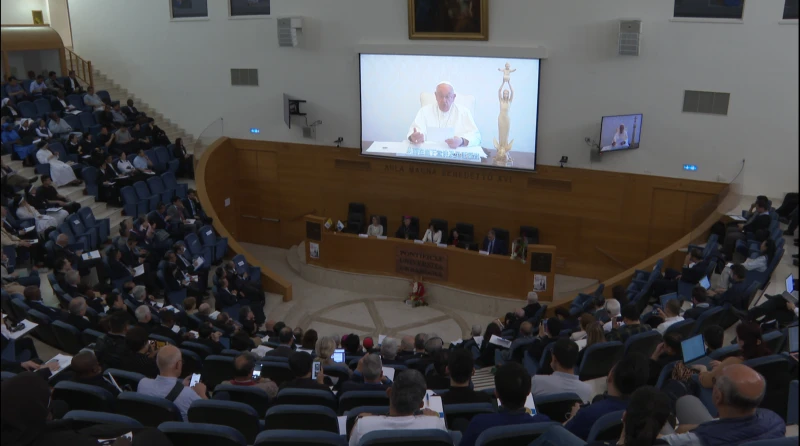
Pope Francis delivers a video message to the conference “100 Years Since the ‘Concilium Sinense’” at the Pontifical Urban University in Rome on Tuesday, May 21, 2024. / Credit: Fabio Gonnella/EWTN
Rome Newsroom, May 21, 2024 / 13:57 pm (CNA).
Pope Francis has praised the Catholic Church’s first council in China 100 years ago as “an authentic synodal journey” that opened the way for the Church in China “to increasingly have a Chinese face.”
In a video message to a conference in Rome on the Catholic Church in China, the pope noted that Chinese Catholics have endured “times of patience and trial” in the past century.
“The Lord in China has safeguarded the faith of the people of God along the way. And the faith of God’s people has been the compass that has shown the way throughout this time,” Pope Francis said in the May 21 address.
Pope Francis delivers a video message to the conference “100 Years Since the ‘Concilium Sinense’” at the Pontifical Urban University in Rome on Tuesday, May 21, 2024. Credit: Fabio Gonnella/EWTN
The pope pointed to a Church council that took place in Shanghai 25 years before the Chinese Communist Revolution as an example of a moment when “the communion between the Holy See and the Church in China manifested its fruits, fruits of good for all the Chinese people.”
The 1924 council, called the Primum Concilium Sinense, brought together 105 Catholic missionaries, bishops, and Chinese Catholics to establish a framework for a native Chinese hierarchy.
“The Fathers gathered in the Concilium Sinense lived an authentically synodal experience and made important decisions together,” Pope Francis said.
“Remembering the Council of Shanghai can also suggest today new paths to the entire Church and open paths to be undertaken with boldness to proclaim and bear witness to the Gospel in the present,” he added.
Among the crowd listening to the pope’s video message were representatives from the People’s Republic of China, including Bishop Shen Bin of Shanghai, who was unilaterally installed by Chinese authorities as bishop of Shanghai in April 2023 without a papal mandate, thereby breaking the terms of the Vatican-China deal. Pope Francis confirmed his appointment in July 2023.
The Holy See first entered into a provisional two-year agreement with Beijing on the appointment of bishops in 2018, which has since been renewed twice and is again up for renewal this fall.
Pope Francis opted not to speak of the Vatican’s diplomatic efforts with Beijing or religious freedom in China in his message but said that Chinese Catholics today “bear witness to their faith through works of mercy and charity, and in their witness they give a real contribution to the harmony of social coexistence.”
A large statue of Our Lady of Sheshan stood on the pope’s desk as he spoke. The pope noted that during the month of May many Chinese Catholics usually go on pilgrimage to the Marian Shrine of Sheshan, located near Shanghai.
“I too ideally climb the hill of Sheshan, and let us all together entrust to Mary, Help of Christians, our brothers and sisters in the faith who are in China, all the Chinese people, and all our poor world, asking for her intercession, so that peace may always win everywhere,” Pope Francis said.
Following the pope’s message, Shen Bin delivered a 15-minute speech in Chinese to the packed auditorium of the Pontifical Urban University on the Janiculum Hill overlooking St. Peter’s Basilica.
The Chinese bishop offered a different interpretation of the 1924 council from the pope in his speech, saying that “the Council of Shanghai did not lead to an immediate and radical change in the Church in China,” adding that by the 1949 Communist Revolution “only 29 of China’s 137 dioceses had Chinese bishops, and only three of 20 archbishops were Chinese.”
“The Catholic Church in China had not really freed itself from foreign powers to become a work led by Chinese Christians and had not yet managed to shed the label of ‘foreign religion,’” he said.
Shen Bin, who has held leadership positions in the Chinese Catholic Patriotic Association established by the Chinese Communist Party and under the control of the United Front Work Department, went on to defend Beijing’s religious freedom record and underlined the need for the Church in China to “follow a path of sinicization.”
“The policy of religious freedom implemented by the Chinese government has no interest in changing the Catholic faith but only hopes that the Catholic clergy and faithful will defend the interests of the Chinese people and free themselves from the control of foreign powers,” Shen Bin said in his speech.
“Today the Chinese people are carrying out the great rebirth of the Chinese nation in a global way with Chinese-style modernization, and the Catholic Church in China must move in the same direction, following a path of sinicization that is in line with Chinese society and culture today,” the Shanghai bishop added.
The conference, titled “100 Years Since the ‘Concilium Sinense’: Between History and the Present,” was held in Chinese and Italian in the Great Hall of the Pontifical Urban University. The Pastoral Commission for China and Agenzia Fides, the information service of the Pontifical Mission Societies, organized the conference, which featured Vatican Secretary of State Cardinal Pietro Parolin and Cardinal Luis Antonio Tagle as speakers.
Speaking to journalists on the sidelines of the conference, Parolin said the Holy See would like to increase and deepen its contacts in China.
“We have been hoping for a long time now to have a stable presence in China, even if initially it may not have the form of a papal representation of an apostolic nunciature,” Parolin said.
Vatican City, Jul 12, 2017 / 02:18 pm (CNA/EWTN News).- In a message sent to catechists from all over the world, Pope Francis stressed the need to not only make Christ the center of their lives, but to be creative and adaptable in finding ways to reach the people in their area.
“The catechist is creative; they search for different means and forms of announcing Christ,” the Pope said in his July 12 message.
Believing in Jesus is “beautiful,” he said, because Jesus is the way, truth and life “who fills our existence with joy and gladness.”
“This quest to make Jesus known as supreme beauty leads us to find new signs and ways of transmitting the faith,” he said, noting that while the means might be different, what’s important is to imitate “the style of Jesus, who adapted to the people he had before him in order to make them close to the love of God.”
To change and adapt oneself in order to make the message closer to the people is necessary, he said, but stressed that at the same time, the message being transmitted is “always the same, because God doesn’t change, but renews all things in him.”
Pope Francis said that in the quest of making Jesus known to the world, “we must not be afraid because he precedes us in this task. He is already in the man of today, and there awaits us.”
The Pope sent his message to participants in the First International Symposium on Catechesis, which is taking place July 11-14 in Buenos Aires.
The event is being offered through the Faculty of Theology of the Pontifical Catholic University of Argentina (UCA), and is organized by the Episcopal Commission for Catechesis and Biblical Pastoral Care.
Pope Francis opened his message, sent in Spanish, by referencing a quote from his namesake, St. Francis of Assisi.
He noted that at a certain point, when one of St. Francis’ followers asked to be taught how to preach, the saint responded by saying: “Brother, when we visit the sick, help children and give to the poor, we are already preaching.”
“In this beautiful lesson is enclosed the vocation and task of the catechist,” he said, explaining that catechesis is not simply a job or a task external to the person of the catechist.
Rather, “their whole life revolves around this mission,” he said, noting that to be a catechist is “a vocation of service in the Church, which is received as a gift on the part of the Lord and must in turn be transmitted.”
To do this, one must return to the first encounter with Christ that changed their life. This moment, Francis said, is “the fundamental announcement that must resonate again and again in the life of the Christian, and even more in the one who is called to announce and teach the faith.”
The Pope then pointed to the importance of respecting popular piety in the people, saying it’s important to “care for the potential of piety and love that popular religiosity holds so that they transmit not only the contents off the faith, but a true school of faith is created which cultivates the gift of the faith that has been received.”
A catechist is also someone who journeys both from and with Christ, he said. “They are not a person who starts from their own ideas and preferences, but who allows themselves to look to him, to this gaze that makes their heart burn.”
The more that Jesus is the center of our lives, the more he teaches us to go out of ourselves, Francis said, adding that we are then “decentralized” and able to be close to others.
“This dynamism of love is like the movement of the heart,” and Jesus himself gives us an example of how to live this when he retreats to pray, and then “immediately goes to the encounter of those who are hungry and thirsty for God in order to heal and save them.”
“From here arises the importance of the ‘mystagogical’ catechesis, which is the constant encounter with the Word and with the sacraments, and not something merely occasional prior to the celebration of the sacraments of Christian initiation,” he said.
Pope Francis closes his speech by thanking catechists for their work, “above all because you walk with the People of God,” and encouraged them “to be joyful messengers, guardians of the good and the beauty that shines forth in the faithful life of the missionary disciple.”
The pope spoke with hundreds of thousands of young people in Madrid on the first day of his six-day apostolic visit to Spain. […]
3 Comments
I’d suggest that Prevost cancel all his trips in favor of a visit to the West Bank to mediate more favorable treatment of Palestinians. That’s the least that the Head of the Vatican State could do. Words are…are…are…simply words.
The onward journey is long. Pilgrims on journey cannot afford to weaken themselves by fighting, killing, and dying. “Violence is the weapon of the weak. Nonviolence that of the strong” – Mahatma Gandhi


 By




I’d suggest that Prevost cancel all his trips in favor of a visit to the West Bank to mediate more favorable treatment of Palestinians. That’s the least that the Head of the Vatican State could do. Words are…are…are…simply words.
The onward journey is long. Pilgrims on journey cannot afford to weaken themselves by fighting, killing, and dying. “Violence is the weapon of the weak. Nonviolence that of the strong” – Mahatma Gandhi
Thank you Holy Father for not forgetting the suffering of Palestine.