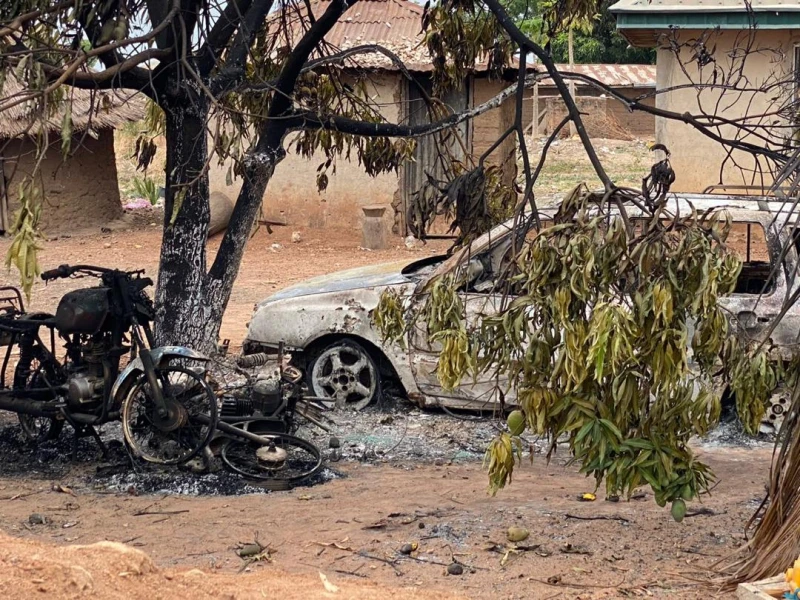
Burned vehicles after Good Friday raid on April 7, 2023, in Ngban, Benue state, Nigeria. / Courtesy of Justice, Development, and Peace Commission
Washington, D.C. Newsroom, Aug 21, 2025 / 06:00 am (CNA).
Nigeria is the deadliest country in the world for Christians, according to the new chair of the U.S. Commission on International Freedom (USCIRF).
Vicky Hartzler, a Republican who represented Missouri in the U.S. House of Representatives for 12 years, became chair of the commission in June. In an interview with CNA, she said of her new mission: “We want to make a difference. We want to save lives.”
United States Commission on International Religious Freedom Chair Vicky Hartzler. Credit: U.S. Commission on International Religious Freedom
Hartzler’s top priority is Nigeria. Citing statistics from Open Doors, an international organization dedicated to helping persecuted Christians, Hartzler said 69% of Christians killed worldwide in 2023 died in Nigeria, with more than 50,000 killed since 2009. The violence includes mass killings of worshippers, such as the June attack on a Catholic church where more than 200 people were slaughtered.
Hartzler is calling on the U.S. State Department to designate Nigeria a Country of Particular Concern (CPC) and pressure its government to better protect citizens and prosecute those committing crimes against religion.
Iran and China remain major focuses. In Iran, Hartzler said more than 900 executions took place in 2024, and 96 Christians received sentences totaling more than 260 years in prison.
China, meanwhile, continues its so-called sinicization campaign, especially against Uyghur Muslims in the Xinjiang region, requiring mosques and churches to display portraits of leader Xi Jinping and replace traditional worship with Chinese Communist Party propaganda. Hartzler said these examples not only represent repression but also are systematic attempts to erase authentic religious practice.
Stephen Schneck, who served as chair of the USCIRF under President Joe Biden and is a former director of the Institute for Policy Research and Catholic Studies at The Catholic University of America, equates USCIRF’s work within a Catholic tradition of defending religious liberty, tracing back to the Second Vatican Council’s declaration of religious freedom Dignitatis Humanae.
He warned of “a historic uptick in the persecution of religion around the world” and highlighted two genocides in Asia: against Uyghur Muslims in China and the Rohingya in Myanmar. For Schneck, it is vital not only to document these atrocities but also ensure they remain in international focus.
U.S. Commission on International Religious Freedom Commissioner Stephen Schneck. Credit: U.S. Commission on International Religious Freedom Public Hearing/Screenshot
Maureen Ferguson, a former senior fellow at The Catholic Association and EWTN radio host, wants to draw attention to Nicaragua, where President Daniel Ortega’s regime has targeted the Catholic Church by arresting priests, expelling nuns, and even monitoring homilies.
“When they kick out the nuns, what are the nuns doing?” Ferguson asked. “They take care of the street girls, the elderly poor who are dying. Who’s taking care of them now? The government is certainly not taking care of these people.”
Ferguson also pointed to Cuba’s ongoing repression of churches and independent religious voices as another regional priority for USCIRF.
U.S. Commission on International Religious Freedom Commissioner Maureen Ferguson, pictured here introducing Vice President JD Vance at the 2025 National Catholic Prayer Breakfast in Washington, D.C. Credit: EWTN News/Screenshot
She framed international religious freedom as part of a broader defense of human dignity. “The right to practice your faith is one of the most fundamental human rights,” Ferguson said, linking it with conscience rights and the sanctity of life.
Schneck said USCIRF’s bipartisan structure adds weight to its recommendations. But he cautioned that designations such as CPC or the Special Watch List are not enough without enforcement.
“Too often these designations come with no sanctions, or sanctions are waived,” he said.
Hartzler and her fellow commissioners also highlighted USCIRF’s Victims List, which features individuals imprisoned or tortured for their beliefs. By publicizing their names and stories, the commission seeks to pressure governments into releasing them and to remind the world that religious persecution is not abstract but lived by real people.
The commissioners all agree that Americans have a role to play. Hartzler urged people not just to pray but also to act: calling elected officials, pressing the White House and State Department, and demanding that religious freedom be a core element of U.S. foreign policy.
The U.S. State Department is expected to release the annual International Religious Freedom report soon.
USCIRF is an independent, bipartisan legislative branch agency created by the 1998 International Religious Freedom Act, as amended. The commission monitors the universal right to freedom of religion or belief abroad; makes policy recommendations to the president, secretary of state, and Congress; and tracks the implementation of these recommendations.
If you value the news and views Catholic World Report provides, please consider donating to support our efforts. Your contribution will help us continue to make CWR available to all readers worldwide for free, without a subscription. Thank you for your generosity!
Click here for more information on donating to CWR. Click here to sign up for our newsletter.
Thousands of Christians peacefully and prayerfully march to a rally in front of the Nigerian Plateau state governor’s office building in protest of the 2023 Christmas massacre that left over 200 Christian Nigerians dead, Jan. 8, 2024. / Credit: Photo courtesy of Rev. Dr. Gideon Para-Mallam, photo by Plateau State Government Media Team
Washington, D.C. Newsroom, Feb 7, 2024 / 16:00 pm (CNA).
The House Foreign Affairs Committee has advanced a resolution to increase sanctions and pressure on the Nigerian government over the rampant persecution of Christians and other minorities in the country.
Sponsored by Rep. Chris Smith, R-New Jersey, the resolution would call on the Biden administration to designate Nigeria a “country of particular concern” (CPC), a designation that comes with additional sanctions.
The resolution would also urge the administration to appoint a special U.S. envoy to Nigeria to monitor and report on incidents of persecution.
Smith and other proponents of the bill, including Alliance Defending Freedom International (ADF), maintain that adding Nigeria to the State Department’s CPC blacklist would be an effective means to pressure the Nigerian government to address the persecution.
Sean Nelson, a legal counsel for ADF, has previously told CNA that the CPC list is “the most powerful tool the U.S. government has to influence the religious freedom situation in other countries.”
For years now Nigeria has been recognized by religious rights groups as one of the most dangerous countries in the world to be a Christian. According to Open Doors International 4,998 Christians were killed in Nigeria in 2023, meaning that 82% of all Christians killed for their faith last year were in Nigeria.
In late January, Nigerian Bishop Wilfred Anagbe of the Diocese of Makurdi told CNA that the persecution amounts to a Christian “genocide” in which radical Islamic groups’ goal is to “systematically” eliminate the Christian population from Nigeria.
Despite this, the Biden administration has left Nigeria off the CPC list for the last three years. This year the administration’s decision to leave Nigeria off the list came just weeks after a series of attacks on Christmas left more than 200 Nigerian Christians dead.
“Following the Biden administration’s repeated failure to designate Nigeria as a country of particular concern despite widespread outcry, we are grateful to the members of Congress who are taking these vital steps to increase pressure on Nigeria for its egregious violations of religious freedom,” Nelson said in a Wednesday press release.
“No person should be persecuted for their faith, and it is imperative that the U.S. government condemn the targeted violence, unjust imprisonments, and egregious blasphemy laws that plague Christians and religious minorities in Nigeria,” he added.
Nelson told CNA that the resolution “lays out an undeniable case that Nigeria has engaged in and tolerated egregious, systematic, and ongoing violations of religious freedom, and some of the worst in the world, particularly for Christians in the north.”
If Congress passes the resolution, Nelson said he hopes the Biden administration would “listen and change course.”
“More importantly,” he said, he believes the resolution’s passage “would send an immense signal of support for the victims of persecution in Nigeria themselves, who have asked for the international community to raise their voices and would put pressure on the Nigerian government to take the persecution seriously, hold attackers accountable, and free those who have been imprisoned and charged under blasphemy-related allegations.”
“There has already been a great amount of outcry over the lack of the CPC designation for Nigeria by the USCIRF and civil society organizations that focus on international religious freedom,” he said. “Having the voice of Congress echo those concerns would also give the concerns an international amplification that is sorely needed.”
According to Nelson, the Nigerian resolution will now move forward for a vote in the House. However, no date has been set for when the vote will take place.
Dallas, Texas, Sep 22, 2018 / 11:39 am (CNA/EWTN News).- The Hispanic community in the United States produces many fruits, but must be careful to water the roots, Bishop Oscar Cantú of Las Cruces, New Mexico, warned the crowd at V Encuentro.
Cantú, along with Cardinal Blaise Cupich of Chicago, and three lay speakers on a panel, spent the morning praising the unique gifts of the Hispanic community in the United States, but cautioned against growing too complacent in their faith and ignoring the potential of young people.
Bishop Cantú, who is in the process of transferring to the San Jose diocese in California, related his experience living in Las Cruces with the current state of the Church in the United States and the Latino community in particular.
In Las Cruces, Cantú encountered a tumbleweed for the first time–a plant that had dried up and detached from its root system and literally tumbled away.
“I wonder sometimes, reflecting on a very changed world, a world that is changing before our very eyes–so rapidly and so drastically, said Cantú.
“I wonder and I worry, sometimes: Are we becoming spiritual tumbleweeds?”
One risks becoming a “spiritual tumbleweed,” he said, if their roots are not sufficiently deep during a dry season, the bishop explained. He spoke during a panel for the National V Encuentro, a gathering of Hispanic Catholics throughout the United States.
“And the dry season is here, my friends, and it will be a long one,” said Cantú. Now is the time, he said, for people to “dig deep so that our roots may find water, that our roots may find living water.”
Cantú recounted a story from his time in seminary, when he accidentally genuflected when entering a row in a movie theater. He said that people today long for something sacred within their “spiritual DNA,” and when they do not encounter this, they end up treating the non-sacred objects things as if they are in fact sacred.
“People are not finding what is truly sacred,” he said, and “because they encounter you and me, that are supposed to show signs of the sacred, and maybe they don’t see it.”
People should strive to tap their roots into the “living water” in order to produce sacred fruit, Cantú advised the crowd.
“The human heart still yearns for what is beautiful, for what is truly beautiful, for what is good, and for what is true. We have that. The church has what is truly good, what is truly beautiful and good. His name is Jesus Christ.”
After Cantú spoke, he appeared on a panel with three laypeople–Sean Callahan, president and CEO of Catholic Relief Services; Brenda Noriega, Young Adults Ministry Coordinator, Diocese of San Bernardino; and Wanda Vásquez, Hispanic Ministry Director, Archdiocese of New York–where they discussed the fruits that had emerged from the four-year V Encuentro process.
Vásquez said it was “amazing” how people came together, and how the eight dioceses in her Encuentro region were able to work alongside each other during the planning stages. She particularly highlighted how the more experienced people were able to share their expertise with younger members, and that while “we are a young church, but we also are an experienced Church.”
Cantú and Noriega both said that young Hispanics need to be included in leadership positions and reminded of their particular talents. Noriega first began working in Hispanic ministry for her diocese at the age of 25, and she reiterated that it was extremely important to “make sure young people are sat at the table” and given positions on things like parish councils.
Cantú said that he often encounters discouraged youth, and that he himself felt similar growing up in a time where “it was a liability to be Hispanic.” He said that when he was applying to seminary, he was praised by a religious sister for being bilingual and fully immersed in two cultures. This sister told him that he would be “a gift to the Church,” and that he hopes the larger Latino community will “never forget that you are a blessing to the Church.”
Callahan reminded the crowd to keep their doors open to the stranger, and to also be cautious about identifying only as “Hispanic Catholics.” He believes the Latino Catholic community has the ability to lift up the entire Church, and should take steps to build bridges with the rest of the Church in the United States.
He advised people that even though the attendees of the non-Spanish Masses at a parish may look different from them, they should go out of their way to interact with them and get to know them.
“Let’s build a united church, so we can start lifting up everyone in the Catholic Church in the United States,” said Callahan, to loud applause.
Cupich, who led the morning prayer, had a slightly more optimistic look on the future of the Church than Cantú. Cupich said that he feels the Church in the United States is experiencing a “new birth,” and the Latino community is a big part of this panel. The cardinal was critical of what he called an “overly rational, logical, cerebral” approach to God in American culture, and that “faith is not only about what we hold, but it is about who holds us.”
This, explained Cupich, is where Latino culture comes in.
“The Latino experience is reminding us that faith is not only about what we hold, but who holds us,” he said.
Cupich said that while like in any birth there are “pains” and “sacrifices,” but he is convinced that the Church, as well as non-Catholic Americans, “will one day look back at the contributi you (Latinos) are making to our faith, and yes, to our nation, and rejoice at the new birth that has taken place.”
“What’s the Eucharist?” Kent Shi, a 25-year-old Harvard graduate student, asked that question when he attended eucharistic adoration for the first time. The answer put him on a path to conversion. / Julia Monaco | CNA
Cambridge, Massachusetts, Apr 16, 2022 / 09:03 am (CNA).
One convert’s journey to Catholicism began with an invitation to an ice-cream social.
Another says he instantly believed in the Real Presence the moment someone explained what the round object was that everyone was staring at during eucharistic adoration.
For a third, the poems of T.S. Eliot — and a seemingly random encounter with a priest on a public street — led to deeper questions about truth and faith.
Their paths differed but led them to the same destination: St. Paul’s Catholic Church in Cambridge, Massachusetts, where they are among 31 people set to be fully initiated into the Catholic Church during the Easter vigil Mass on Saturday, April 16.
That number of initiates is a record high for St. Paul’s, a nearly century-old Romanesque-style brick church whose bell tower looms over Harvard Square.
A scheduling backlog caused by the COVID-19 pandemic is partly responsible for the size of this year’s group of catechumens (non-baptized) and candidates (baptized non-Catholics.) But Father Patrick J. Fiorillo, the parochial vicar at St. Paul’s, believes there’s more to it than that.
“There’s definitely a significant segment of people who started thinking more deeply about their lives and faith during COVID-19,” Fiorillo said. “So, coming out of Covid has given them the occasion to take the next step and move forward.”
Fiorillo is the undergraduate chaplain for the Harvard Catholic Center, a chaplaincy based at St. Paul’s for undergraduate and graduate students at Harvard University and other academic institutions in the area. This year, 17 of the 31 initiates are Harvard students.
“Everybody assumes that, because this is the Harvard Catholic Center, that everybody here is very smart and therefore has a very highly intellectual orientation towards their faith,” Fiorillo told CNA.
“That is definitely true of some people. But I would say the majority are not here because of intellectually thinking their way into the faith. Some are. But the majority are just kind of ordinary life circumstances, just seeking, questioning the ways of the world, and just trying to get in touch with this desire on their heart for something more,” he said.
Fiorillo says welcoming converts into the Church at the Easter vigil is one of the highlights of his ministry.
“It’s an honor. It gives me hope just seeing all this new life and new faith here. So much in one place,” he said.
“When I tell other people about it, it gives them hope to hear that many young people are still converting to Catholicism, and they’re doing it in a place as secular as Cambridge.”
Prior to the Easter vigil, CNA spoke with five of St. Paul’s newest converts. Here are their stories:
‘This is what I’ve been looking for’
Katie Cabrera, a 19-year-old Harvard freshman, told CNA that she was excited to experience the “transformative power of Christ through his body and blood” at Mass for the first time at the Easter vigil.
A native of Dorchester, Massachusetts, she said she was baptized as a child and comes from a family of Dominican immigrants. Her father, who grew up in an extremely impoverished area, lacked a formal education, but always kept the traditions of the Catholic faith close to him in order to persevere in difficult times.
Her father’s love for her and his Catholic faith deeply inspired Cabrera, and served as an anchor for her faith throughout her life.
Growing up, however, Cabrera attended a non-denominational church with her mother. Because she felt the church’s teachings lacked an emphasis on God’s love and mercy, Cabrera eventually left.
“Even though I Ieft, I always knew that I believed in God,” Cabrera said. “So, I was at a place where I felt kind of lost, because I always had that faith, but I didn’t know what to do with it.”
“There was a void that existed in my heart,” says Katie Cabrera, a Harvard undergraduate student. She discovered what was missing when she started to get involved with the Harvard Catholic Center. Courtesy of Katie Cabrera
After she arrived at Harvard, she accepted a friend’s invitation to attend an ice-cream social at the Harvard Catholic Center — “and that was like, sort of, how it all started,” she told CNA.
Once she was added to the email list for the center’s events, she felt a “calling” that she “really wanted to officially become Catholic” after many difficult years without a faith community.
Catholic doctrine about the sacraments was no hurdle for Cabrera, as she credits Fiorillo with explaining the faith well.
“There was a void that existed in my heart,” she said. “As soon as Father Patrick started teaching about marriage and family, theology of the body, and the sacraments, I was like, ‘This is what I’ve been looking for my whole life.’”
‘What’s the Eucharist?’
“What is that thing on the thing?”
Kent Shi laughs when he recalls how perplexed he was the first time he attended eucharistic adoration at St. Mary’s of the Assumption in Cambridge.
Someone helpfully explained that what Shi was looking at was the Eucharist displayed inside a monstrance.
“What’s the Eucharist?” he wanted to know.
For many non-Catholics considering entering the Catholic Church, the Real Presence can be a major obstacle. But Kent Shi, a Harvard graduate student, says that once the Eucharist was explained to him, he instantly believed. Julia Monaco | CNA
For many non-Catholics considering entering the Catholic Church, the Real Presence can be a major obstacle.
Not Shi. He says that once the Eucharist was explained to him that day, he instantly believed.
Shi, 25, told CNA that he considered himself an agnostic for most of his life, meaning he neither believed nor disbelieved in God.
Between his first and second years as a graduate student in Harvard’s Kennedy School of Government, however, he accepted Christ and started attending services at a Presbyterian church.
One day in the summer of 2021, a crucifix outside St. Paul’s that Shi says he “must have passed multiple times a week for months and never noticed” caught his eye, and deeply moved him.
Shortly after, he accepted a friend’s invitation to attend eucharistic adoration at St. Mary’s even though he “didn’t know what adoration meant.” Unaware of what he was about to walk into, Shi asked a friend what the dress code was for adoration. His friend replied, “Respectful.”
And so, respectfully dressed in a button-down shirt and slacks, Shi sat in the front row with his friend, only a few feet from the monstrance. That’s when the questions began.
It wasn’t long after that encounter that Shi began attending Mass at St. Paul’s and the parish’s RCIA (Rite of Christian Initiation for Adults) program. Shi asked CNA readers to pray for him and his fellow RCIA classmates.
“There’s a lot of prodigal sons and daughters here, so we would very much appreciate that,” he said, “especially me.”
Poetry and art opened the door
For Loren Brown, choosing to attend a secular university like Harvard proved to be “providential.”
The 25-year-old junior from La Center, Washington, said he comes from a “lapsed” Catholic family and wasn’t baptized.
He didn’t think much about the faith until the spring semester of his freshman year, when, he says, Catholic friends of his “began to question my lack of commitment to faith.”
Later, when students were sent home to take classes virtually due to the pandemic, he had time to reflect and began to read some of the books they’d recommended to him. The poetry of T.S. Eliot (his favorite set of poems being “Four Quartets”) and the “Confessions” by St. Augustine, in particular, “pulled me towards the faith,” he said.
Brown describes his conversion as a “gradual process” which backed him into a “logical corner.” But a chance meeting with a priest also played a pivotal role.
One day in the summer of 2021 while walking back to his dormitory he encountered a man wearing a priestly collar outside St. Paul’s Church on busy Mount Auburn Street.
It was Father George Salzmann, O.S.F.S., graduate chaplain of the Harvard Catholic Center.
“He asked me how I was doing, what I was studying, and we immediately found a common interest in St. Augustine,” Brown told CNA.
“You know, there’s this great window of St. Augustine inside St. Paul’s and you should come see it,” Brown remembers the gregarious priest telling him. Salzmann wound up giving Brown a brief tour of the church, which was completed in 1923.
Harvard undergraduate student Loren Brown describes his conversion to Catholicism as a “gradual process” which backed him into a “logical corner.” But a chance meeting with a priest also played a pivotal role. Courtesy of Loren Brown
The next week, Brown found himself sitting in a pew for his first Sunday Mass at St. Paul’s. He hasn’t missed a Sunday since, a routine that ultimately led him to join the RCIA program that fall.
Brown says he now realizes that coming to Harvard was about more than majoring in education.
“What I wanted out of Harvard has completely changed,” he said. “Instead of an education that prepares me for a job or a career, I want one that forms me as a moral being and a human.”
‘I can’t do this alone. Please help me.’
Verena Kaynig-Fittkau, 42, is a German immigrant who came to the U.S. 10 years ago with her husband to do her post-doctoral research in biomedical image processing at Harvard’s engineering school.
The couple settled in Cambridge, where they had their first child. Two subsequent pregnancies ended in miscarriage, however. That second loss was overwhelming for Kaynig-Fittkau, who says she was raised as a “secular Lutheran” without any strong faith.
“It broke me and a lot of my pride and made me realize that I can’t do things by myself,” she told CNA.
She found herself on knees one Thanksgiving, pleading with God. “I can’t do this alone,” she said. “Please help me.”
She says God answered her prayer by introducing her to another mother, who she met at a playground. She was a Christian who later invited Kaynig-Fittkau to attend services at a Presbyterian church in Somerville, Massachusetts.
In that church, there was a lot of emphasis on “faith alone,” she said. But Kaynig-Fittkau, who now works for Adobe and is the mother of two girls, kept questioning if her faith was deep enough.
A YouTube video about the Eucharist by Father Mike Schmitz sent Verena Kaynig-Fittkau on a path toward converting to Catholicism. Courtesy of Verena Kaynig-Fittkau
Then one day she stumbled upon a YouTube video titled “The hour that will change your life,” in which Father Mike Schmitz, a Catholic priest from the Diocese of Duluth, Minnesota, known for his “Bible in a Year” podcast, speaks about the Eucharist.
Intrigued, she began watching similar videos by other Catholic speakers, including Father Casey Cole, O.F.M., Bishop Robert Barron, Matt Fradd, and Scott Hahn, each of whom drew her closer and closer to the Catholic faith.
Familiar with St. Paul’s from her days as a Harvard researcher and lecturer, she decided to attend Mass there one day, and made an appointment before she left to meet with Fiorillo.
When they met, Fiorillo answered all of her questions from what she calls “a list of Protestant problems with Catholicism.” She entered the RCIA program three weeks later.
Recalling her first experience attending eucharistic adoration, she said it felt “utterly weird” to be worshiping what she describes as “this golden sun.”
A conversation with a local Jesuit priest helped her better understand the Eucharist, however. Now she finds that spending time before the Blessed Sacrament is “amazing.”
“I am really, really, really excited for the Easter vigil,” Kaynig-Fittkau said. “I can’t wait, I have a big smile on my face just thinking about it.”
The rosary brought him peace
Another catechumen at St. Paul’s this year is Kyle Richard, 37, who lives in the Beacon Hill neighborhood of Boston and works in a technology startup company downtown.
Although he grew up in a culturally Catholic hub in Louisiana, his parents left the Catholic faith and joined a Full Gospel church. Richard said he found the church “intimidating,” which led him eventually to leave Christianity altogether.
When Richard was in his mid-twenties, his father battled pancreatic cancer. Before he died, he expressed a wish to rejoin the Catholic Church. He never did confess his sins to a priest or receive the Anointing of the Sick, Richard recalls sadly. But years later, his non-believing son would remember his father’s yearning to return to the Church.
“I kind of filed that away for a while, but I never really let it go,” he said.
While Kyle Richard’s father was dying from pancreatic cancer, he returned to the Catholic faith, which made a lasting impression on his non-believing son. Courtesy of Kyle Richard
Initially, Richard moved even farther away from the Church. He said he became an atheist who thought that Christianity was simply “something that people used to just soothe themselves.”
Years later, while going through a divorce, he had a change of heart.
Feeling he ought to give Christianity “a fair shot,” he began saying the rosary in hopes of settling his anxiety. The prayer brought him peace, and became a gateway to the Catholic faith.
Before long, he was reading the Bible on the Vatican’s website, downloading prayer apps, and meditating on scripture.
A Google search brought him to St. Paul’s. Joining the RCIA program, he feels, was a continuation of his father’s expressed desire on his deathbed more than a decade ago.
“I think he would be proud, especially because he was born on April 16th and that is the date of the Easter vigil,” he said.
So, you don’t know Saudi Arabia’s human rights record, and you don’t know how to use Google to find out about it. OK. Someone else will need to help you with this one.
You could even check to see if the Catholic World Report has had any articles relevant to your question.
Of course they do. But your question was not asked in good faith, because you have someone whom you cannot bear to suffer criticism, any more than a Muslim can bear to hear criticism of Mohammed.
But the Saudis get a pass? What a surprise.
How many Christians live in Saudi Arabia?
So, you don’t know Saudi Arabia’s human rights record, and you don’t know how to use Google to find out about it. OK. Someone else will need to help you with this one.
You could even check to see if the Catholic World Report has had any articles relevant to your question.
Of course they do. But your question was not asked in good faith, because you have someone whom you cannot bear to suffer criticism, any more than a Muslim can bear to hear criticism of Mohammed.