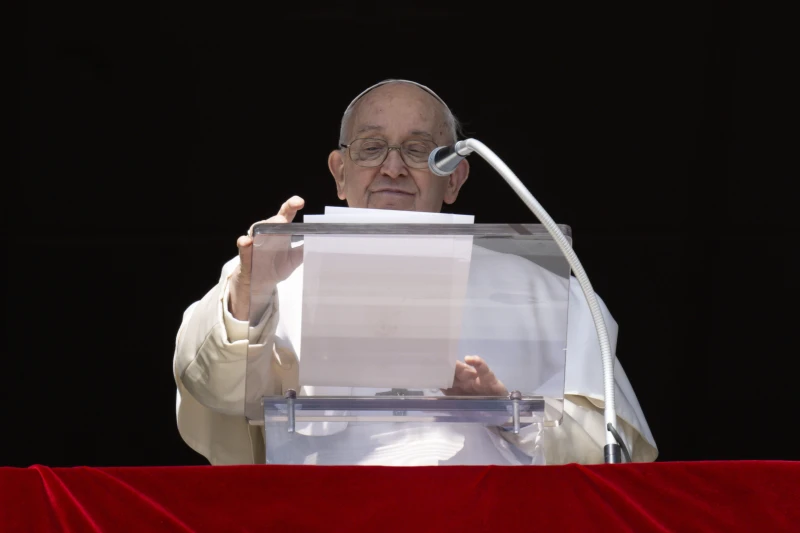
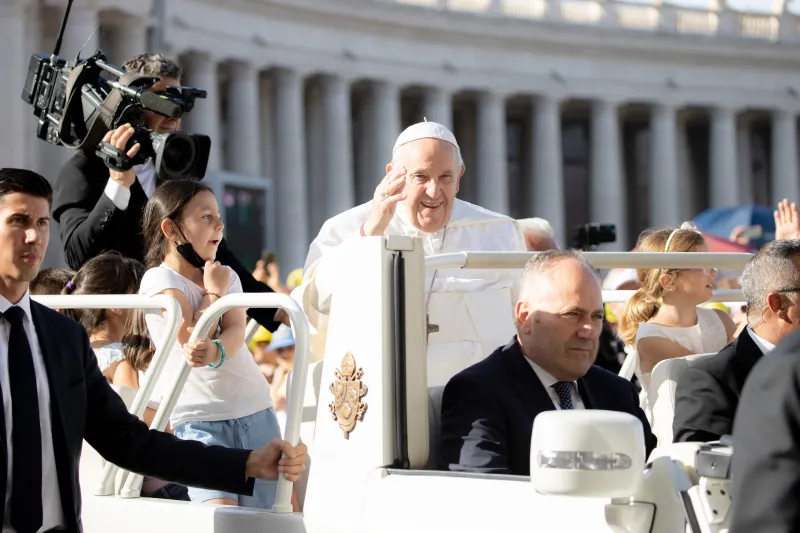
Pope Francis addresses pilgrims in St. Peter’s Square during his Sunday Angelus on Feb. 18, 2024. / Credit: Vatican Media
CNA Staff, Feb 28, 2024 / 13:37 pm (CNA).
Pope Francis’ prayer intention for the month of March is for the martyrs of our day and witnesses to Christ.
“This month, I want to tell you a story that is a reflection of the Church today. It is the story of a little-known witness of faith,” Pope Francis stated in a video released Feb. 27.
“Visiting a refugee camp in Lesbos, a man told me, ‘Father, I am Muslim. My wife was Christian. Terrorists came to our place, looked at us and asked what our religion was. They approached my wife with a crucifix and told her to throw it on the ground. She didn’t do it, and they slit her throat in front of me.’ That’s what happened.”
The Holy Father added, “I know he held no grudges. He was focused on his wife’s example of love, a love for Christ that led her to accept, and to be faithful to the point of death.”
He reminded the faithful that “there will always be martyrs among us” and that it is a “sign that we’re on the right path.”
“A person who knows told me there are more martyrs today than at the beginning of Christianity,” he explained.
“The courage of the martyrs, the witness of the martyrs, is a blessing for everyone.”
Pope Francis concluded with a prayer: “Let us pray that those who risk their lives for the Gospel in various parts of the world might imbue the Church with their courage and missionary drive. And to be open to the grace of martyrdom.”
Pope Francis’ prayer video is promoted by the Pope’s Worldwide Prayer Network, which raises awareness of monthly papal prayer intentions.
If you value the news and views Catholic World Report provides, please consider donating to support our efforts. Your contribution will help us continue to make CWR available to all readers worldwide for free, without a subscription. Thank you for your generosity!
Click here for more information on donating to CWR. Click here to sign up for our newsletter.
The Catholic faithful gathered in the Cenacle in Jerusalem for the Mass of the Lord’s Supper that the Franciscan friars celebrated on Holy Thursday, March 28, 2024. The Cenacle is at the center of strong tensions and disputes regarding ownership and rights of access and celebration. An ancient tradition places King David’s tomb here and over the centuries Jews and Muslims have leveraged this to first expel the Franciscans and then to prevent Christian worship, which they deemed sacrilegious. / Credit: Marinella Bandini
Jerusalem, Mar 28, 2024 / 17:15 pm (CNA).
On Holy Thursday, the doors of the Cenacle in Jerusalem were opened to welcome the Franciscans of the Custody of the Holy Land. In this “Upper Room,” called the Cenacle in the Holy Land, Jesus had his Last Supper, washed his apostles’ feet, and instituted the Eucharist.
It was here that the Franciscans celebrated the Mass of the Lord’s Supper, reenacting those same gestures. (At the Basilica of the Holy Sepulcher, however, the celebration is held on Thursday morning due to the Status Quo. Here is Cardinal Pierbattista Pizzaballa’s homily from that Mass.)
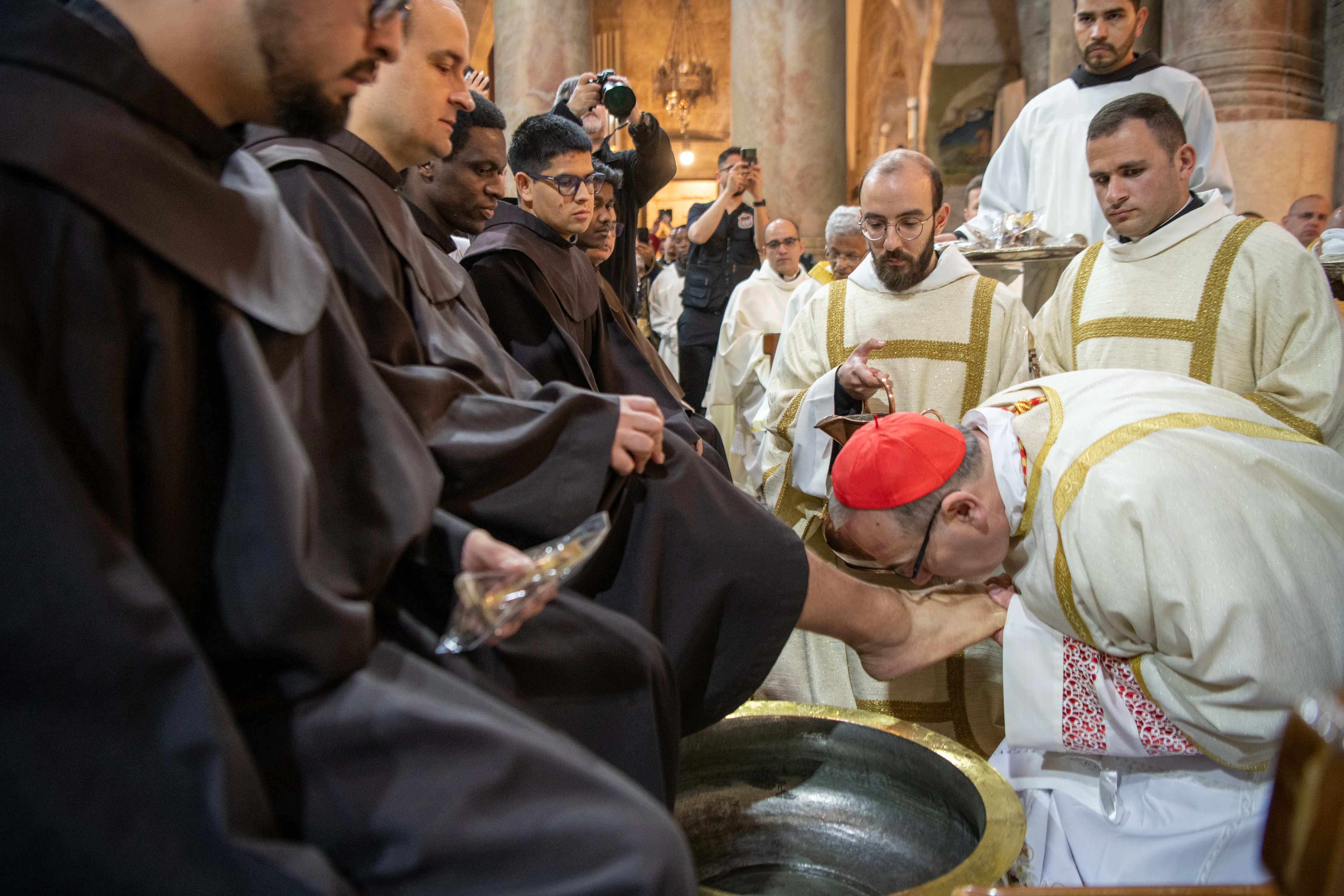
Cardinal Pierbattista Pizzaballa, the Latin Patriarch of Jerusalem, kisses the feet of a Franciscan friar during the “Washing of the Feet” ritual at the Mass of the Lord’s Supper celebrated at the Holy Sepulchre on Holy Thursday. The celebration is held on Thursday morning due to the Status Quo. March 28, 2024. Courtesy of the Custody of the Holy Land
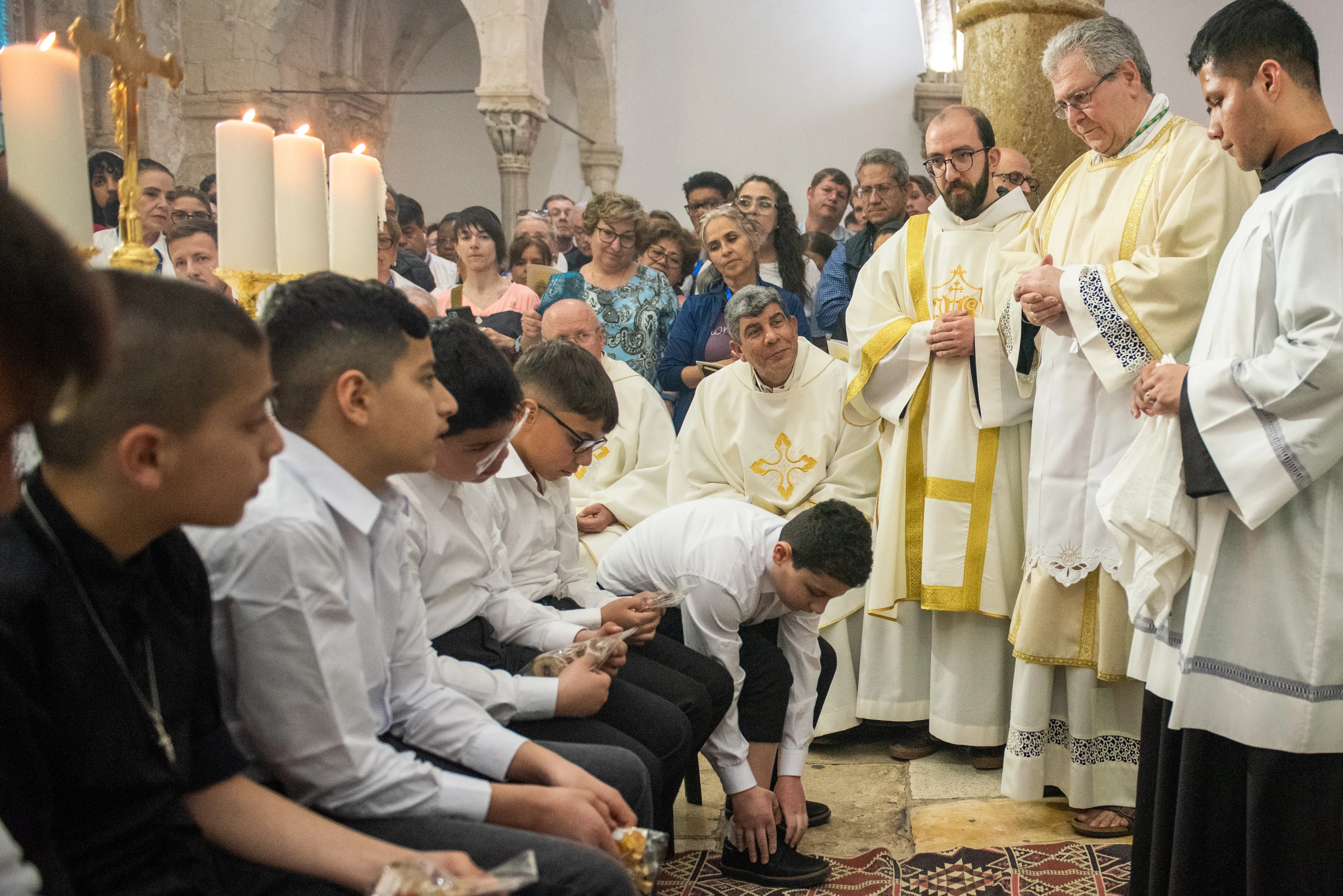
The custos of the Holy Land, Father Francesco Patton, presided over the Eucharistic celebration at the Cenacle. In his homily, before washing the feet of six teachers and six students from the Terra Sancta School in Jerusalem, he emphasized the value of the “new commandment” that Jesus gave to his apostles here: “As I have loved you, so you also should love one another” (Jn 13:34).
“To love means to give oneself and to serve,” he said. “In this celebration, we want to nourish ourselves with Jesus because if he is alive within us, then we too will become capable of loving one another as he loved us. And we also want to learn from Jesus not to be served but to serve.”
Some students from the Terra Sancta School in Jerusalem who took part in the “Washing of the Feet” ritual during the Mass of the Lord’s Supper celebrated at the Cenacle in Jerusalem on Holy Thursday, March 28, 2024. Addressing them specifically in his homily, the Custos of the Holy Land emphasized the value of the “new commandment” that Jesus gave to his apostles here: “As I have loved you, so you also should love one another” (John 13:34). Credit: Marinella Bandini
Holy Thursday is the only day, along with Pentecost Sunday, when the Franciscans have the right to gather in the Upper Room to pray. Usually, it is a liturgy of the word, but since 2021 they have celebrated Mass. Outside, Israeli Army personnel ensure security.
The Cenacle is at the center of strong tensions and disputes regarding ownership and rights of access and celebration. An ancient tradition places King David’s tomb here, and over the centuries, Jews and Muslims have leveraged this place to first expel the Franciscans and then to prevent Christian worship, which they deem sacrilegious.
Father Narciso Klimas, historian and archivist of the Custody of the Holy Land, explained to CNA: “The Custody has all the documents confirming our ownership of Mount Zion.” Even today, traces of Christian presence are visible, both in the architecture of the place and in some symbols.
“The presence of the Franciscans at the Cenacle,” Klimas explained, “dates back to 1342, but as early as 1333, the rulers of Naples, Robert of Anjou and Sancha of Majorca, acquired the land and donated it to the friars. This was the first headquarters of the Custody of the Holy Land.” To this day, the official title of the Custos of the Holy Land is “Guardian of Mount Zion and the Holy Sepulchre.”
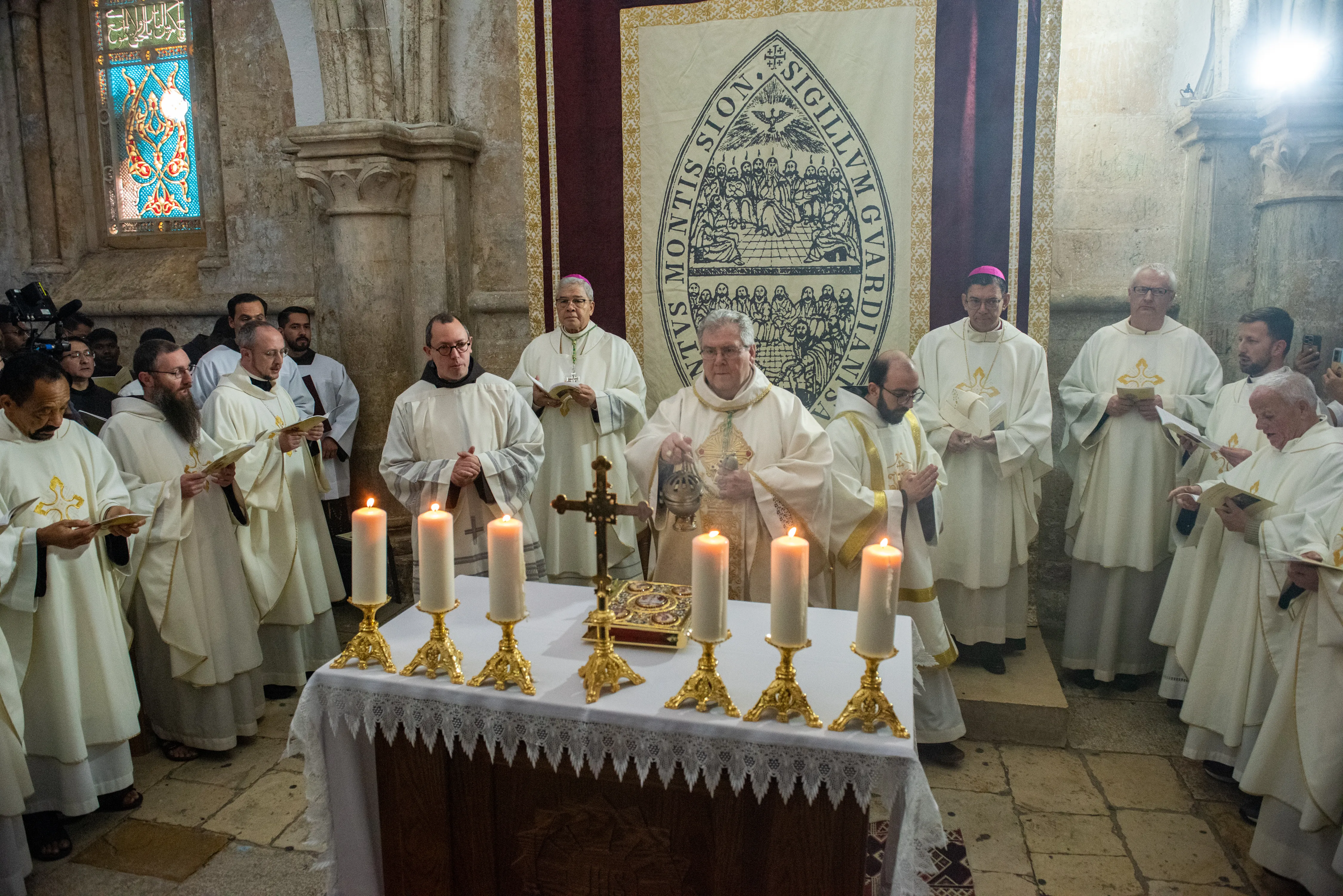
Father Francesco Patton, custos of the Holy Land, incenses the altar at the beginning of the Mass of the Lord’s Supper that the Franciscan friars celebrated inside the Cenacle in Jerusalem on Holy Thursday, March 28, 2024. This is the only day, along with Pentecost Sunday, that the Franciscans have the right to gather here to pray. Usually, it is a liturgy of the word, but since 2021 they have celebrated Mass. Credit: Marinella Bandini
In 1421, a rabbi submitted a petition to the local emirs, claiming the right for Muslims and Jews to this place due to the presence of King David’s tomb. One hundred years later, Klimas continued, “the Ottomans used this argument to gradually expel the Franciscans, until in 1551 the sultan decreed the total expulsion of the Franciscans from Mount Zion.” The Cenacle first became a mosque and later, in the lower part, also a synagogue.
“Since then,” Klimas recounted, “the Franciscans have never stopped attempting to regain possession of the Cenacle. The friars have always tried to ensure a presence, at least on Holy Thursday and Pentecost, sometimes even with methods that are not exactly orthodox (such as bribing the local guardian).”
Something began to change in the 19th century, during the time of the Ottoman Sultan Abdülmecid. Since then, the Franciscans have had the right to pray at the Cenacle on Holy Thursday and Pentecost. After a failed attempt in the 1930s to regain control of it, the friars managed to purchase adjacent land where they built the convent of San Francesco “ad Coenaculum” (next to the Cenacle).
In 1948, with the founding of the State of Israel, the entire Mount Zion came under Israeli control, and until today, the Israeli state owns the entire complex of the Cenacle. The neighborhood has a strong Jewish religious character and is characterized by the presence of synagogues and rabbinical schools.
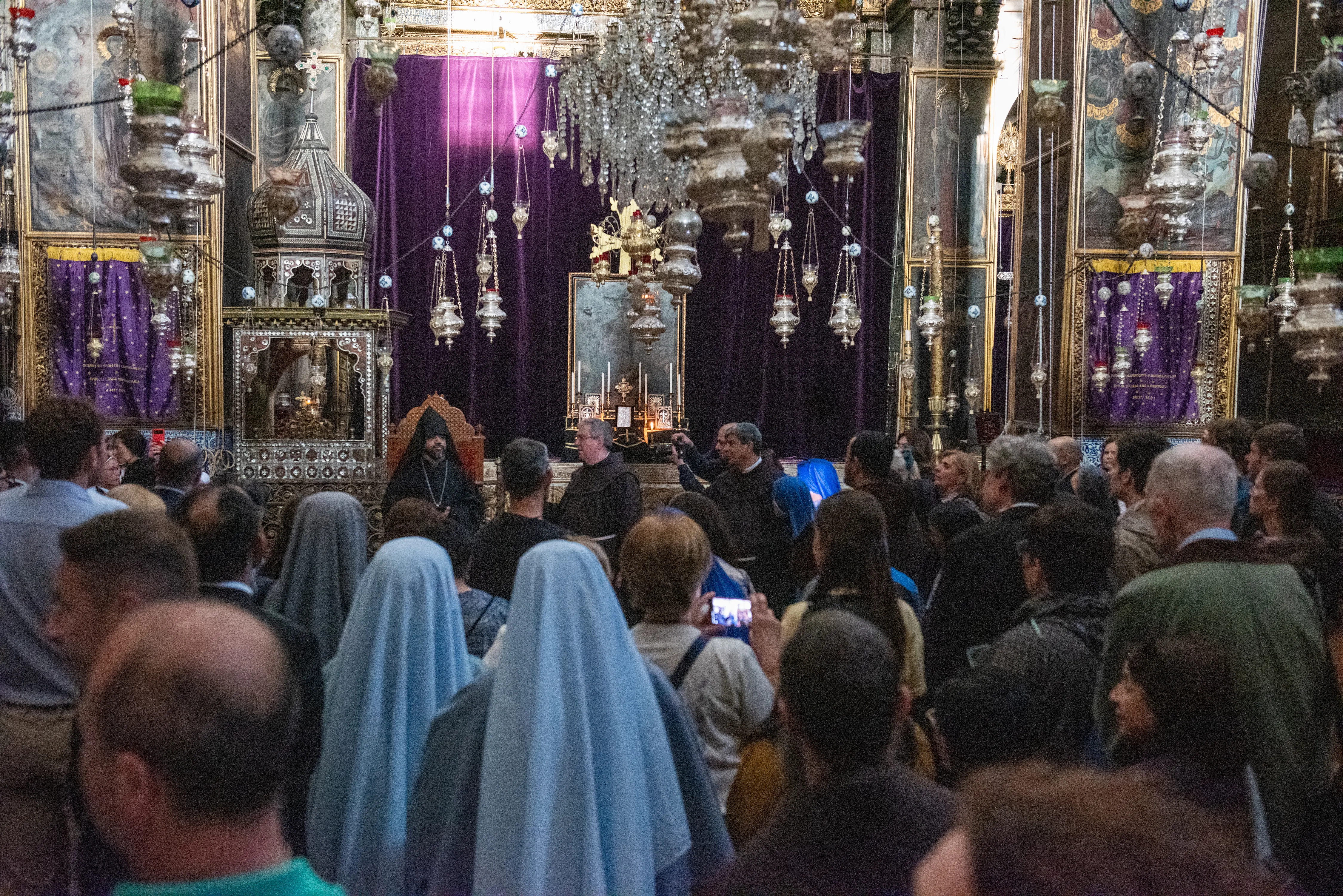
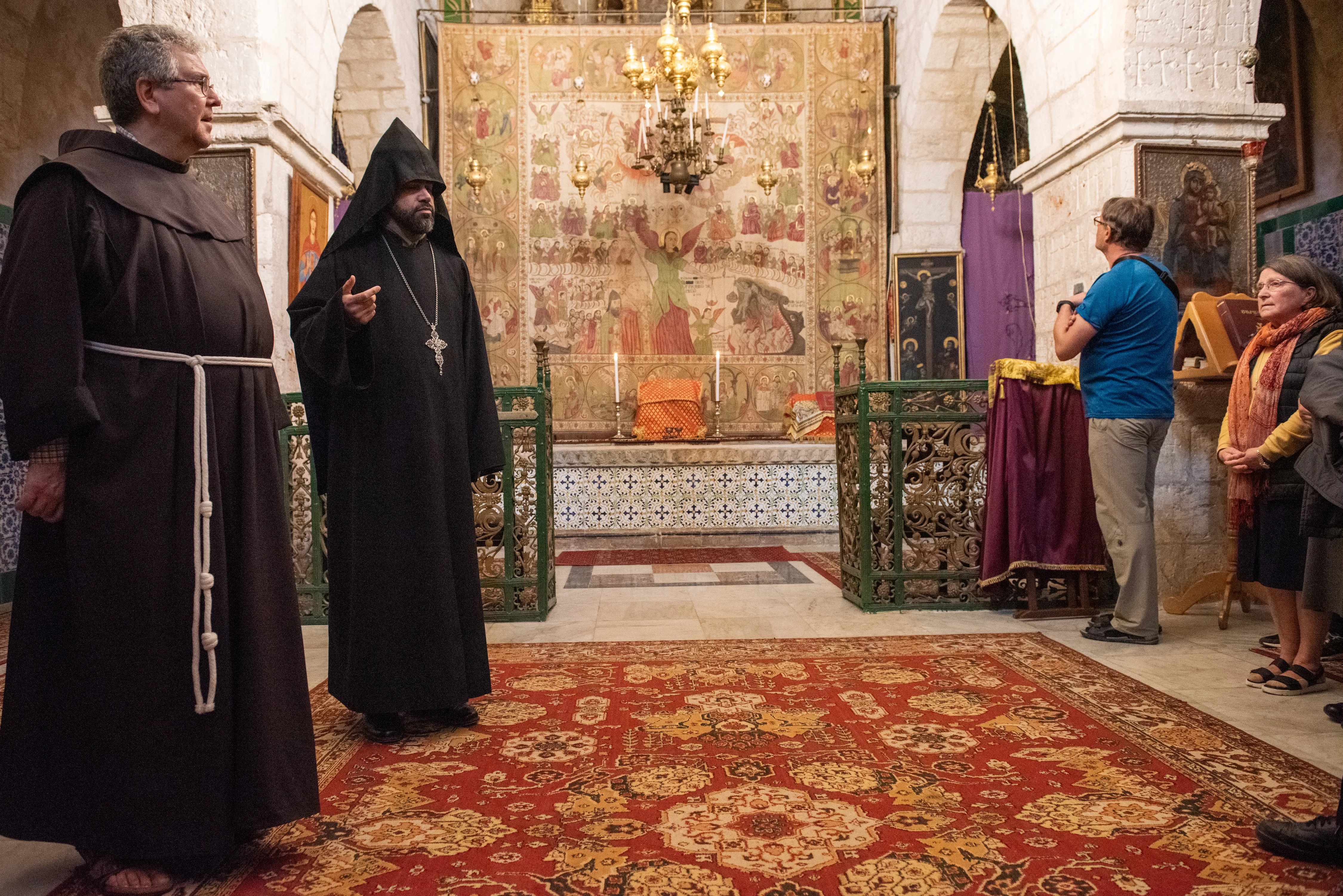
The Franciscan friars and the faithful in the Armenian Cathedral of St. James in Jerusalem after the Mass of the Lord’s Supper celebrated at the Cenacle. Here, the friars commemorate the hospitality they received here in the 16th century. After being expelled from the Cenacle, the Franciscans were welcomed by the Armenians for seven years while the convent of St. Saviour was purchased, to this day the headquarters of the Custody of the Holy Land. March 28, 2024. Credit: Marinella Bandini
“Even if the Cenacle cannot return to our hands,” Klimas explained, “we ask at least to celebrate regularly, even with pilgrims, without the need for special permits.”
Negotiations on these matters (taxation and property) have been ongoing for over 25 years between the Holy See and the State of Israel, following the signing of the Fundamental Agreement in 1993 and the agreement recognizing the legal personality of the Catholic Church in Israel in 1997.
Despite the slow pace of diplomatic negotiations, some practical progress can be observed informally. The ability to celebrate Mass on Holy Thursday at the Cenacle is among these developments. Permissions to access the site on other special occasions are usually granted without significant issues as well.
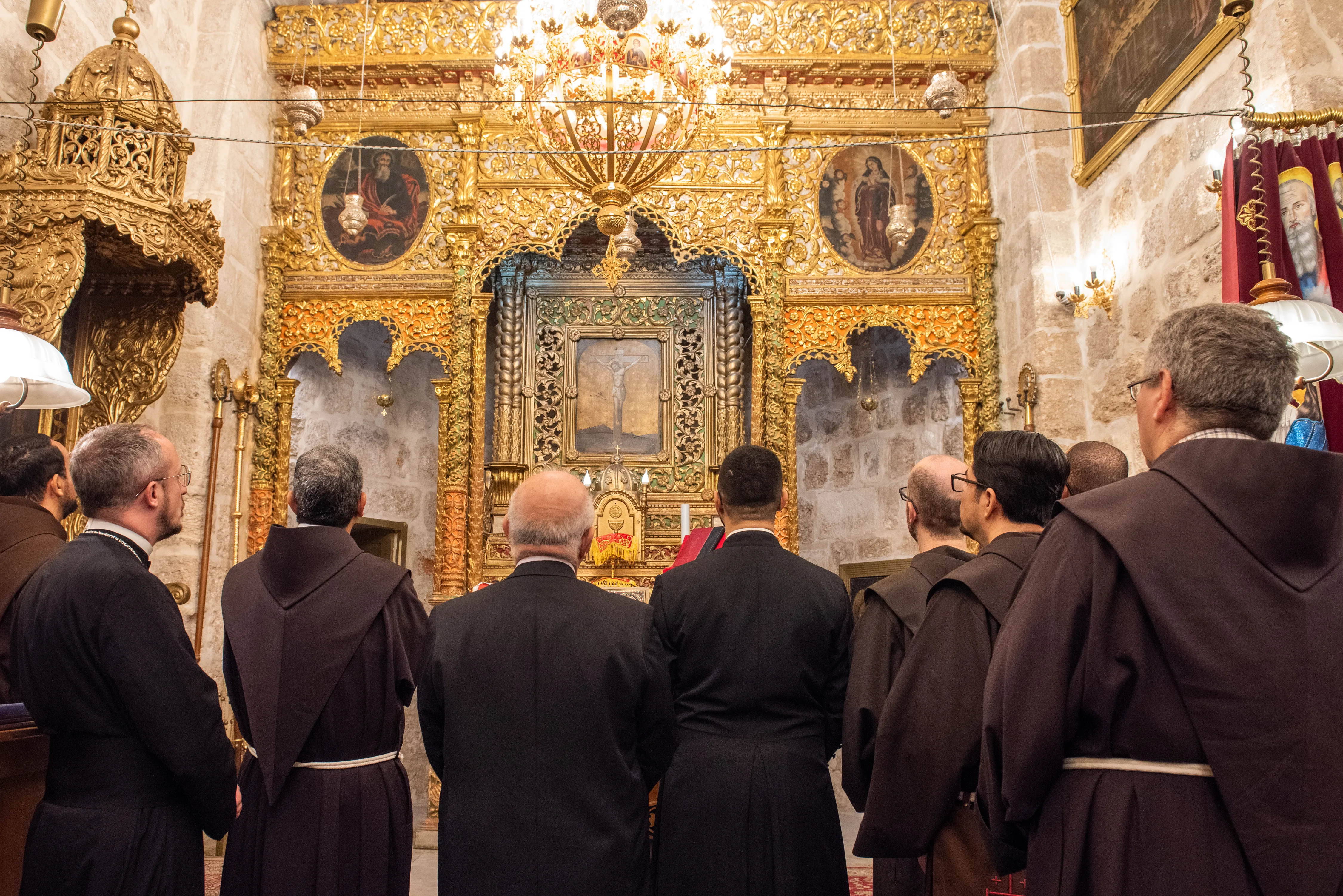
After the Mass at the Cenacle, as tradition dictates, the Franciscans proceeded in a procession to three churches in two other symbolic places: the Armenian churches of St. James and of the Holy Archangels (of the Armenian Apostolic Church), and the Syro-Orthodox Church of St. Mark.
The Franciscan friars and the faithful in the Armenian Church of the Holy Archangels in Jerusalem after the Mass of the Lord’s Supper celebrated at the Cenacle on March 28, 2024. Friars and faithful pray together and receive the blessing from the representative of the Armenian Apostolic Church. Credit: Marinella Bandini
This yearly visit commemorates the hospitality the friars received in the 16th century. After being expelled from the Cenacle, the Franciscans were welcomed by the Armenians for seven years while the convent of St. Saviour was purchased, to this day the headquarters of the Custody of the Holy Land. Friars and faithful prayed together and received the blessing from the representative of the Armenian Apostolic Church.
The Syriac Orthodox Church of St. Mark is said to be built on the house of Mary, the mother of the evangelist Mark. According to Syriac tradition, this is the place where Jesus had the Last Supper. Here as well, those present prayed together and were able to listen to the Lord’s Prayer sung in Aramaic by one of the monks, who then gave a blessing.
The Franciscan friars and the faithful in the Syro-Orthodox church of St. Mark in Jerusalem after the Mass of the Lord’s Supper celebrated at the Cenacle on March 28, 2024. According to Syriac tradition, this is the upper room where Jesus had the Last Supper. Here as well, those present pray together and listen to the Lord’s Prayer sung in Aramaic by one of the monks, who then gives the blessing. Credit: Marinella Bandini
The March for Life in Washington, D.C., January 22, 2016. / Jeff Bruno.
Baltimore, Md., Nov 15, 2022 / 17:04 pm (CNA).
Following the overturning of Roe v. Wade, the chair of the U.S. Catholic bishops’ Committee on Pro-Life Activities is encoura… […]
Pope Francis greets families in St. Peter’s Square before Mass for the World Meeting of Families 2022 on June 25, 2022 / Daniel Ibanez/CNA
Vatican City, Jun 25, 2022 / 12:00 pm (CNA).
Christ, through his passion and death, has set us free from the slavery of self-centeredness, so that we can better love others, Pope Francis said at Mass for the World Meeting of Families on Saturday.
“Freedom is something we receive. All of us are born with many forms of interior and exterior conditioning, and especially with a tendency to selfishness, to making ourselves the center of everything and being concerned only with our own interests,” the pope said on June 25. “This is the slavery from which Christ has set us free.”
Pope Francis delivered the homily at a Mass celebrated by Cardinal Kevin Farrell, the prefect of the Dicastery for Laity, Family, and Life, the Vatican office which co-organized the 10th edition of the World Meeting of Families with the Diocese of Rome.
Mass for the World Meeting of Families 2022 on June 25, 2022. Daniel Ibanez/CNA
The gathering, attended by around 2,000 families, had the theme: “Family Love: A Vocation and a Path to Holiness.”
In his homily, Francis reflected on a passage from St. Paul’s Letter to the Galatians: “Brothers and sisters: For freedom Christ set us free; so stand firm and do not submit again to the yoke of slavery. For you were called for freedom, brothers and sisters. But do not use this freedom as an opportunity for the flesh; rather, serve one another through love.”
“Freedom,” the pope said, “is one of the most cherished ideals and goals of the people of our time. Everyone wants to be free, free of conditioning and limitations, free of every kind of ‘prison,’ cultural prison, social or economic. Yet, how many people lack the greatest freedom of all, which is interior freedom.”
He also noted that the freedom given by God, as St. Paul says, is not the self-indulgent freedom of the world, but freedom “directed to love, so that — as the Apostle tells us again today — ‘through love you may become slaves of one another.’”
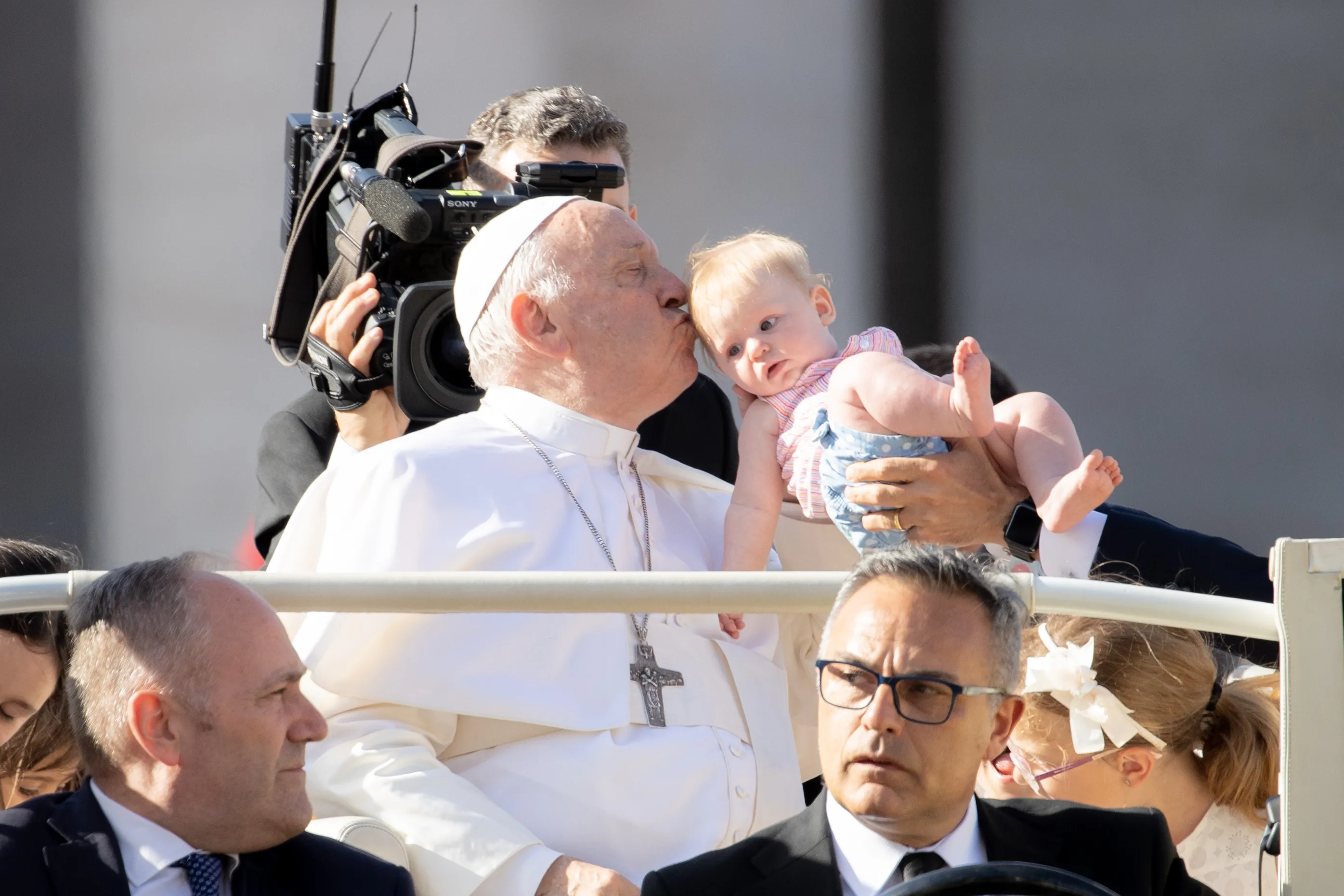
Pope Francis kisses a baby before Mass for the World Meeting of Families 2022. Daniel Ibanez/CNA
“All of you married couples, in building your family, made, with the help of Christ’s grace, a courageous decision: to use freedom not for yourselves, but to love the persons that God has put at your side,” Pope Francis said.
He advised parents “not to shield our children from the slightest hardship and suffering, but to try to communicate to them a passion for life, the passion to arouse in them the desire to discover their vocation and embrace the great mission that God has in mind for them.”
“Nothing,” he said, “can be more encouraging for children than to see their parents experiencing marriage and family life as a mission, demonstrating fidelity and patience despite difficulties, moments of sadness and times of trial.
“Don’t ever forget this: the family is the first place where you learn to love,” he emphasized.
“In praising the beauty of the family, we also feel compelled, today more than ever, to defend the family,” Pope Francis said. “Let us not allow the family to be poisoned by the toxins of selfishness, individualism, today’s culture of indifference and culture of waste, and as a result lose its very DNA, which is the spirit of acceptance and service.”






Leave a Reply