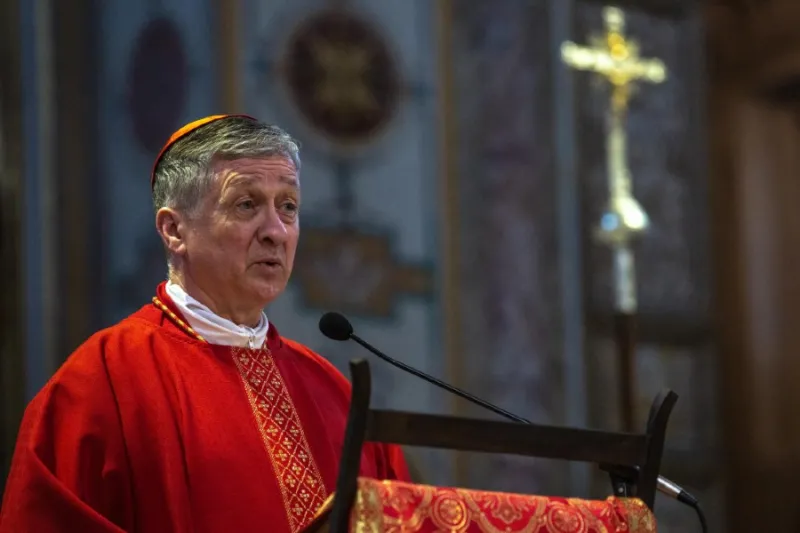
Cardinal Blase Cupich of Chicago. / Credit: Daniel IbanezCNA
Washington, D.C. Newsroom, Sep 7, 2023 / 10:30 am (CNA).
Cardinal Blase Cupich, the archbishop of Chicago, urged Catholics to shed any fears or concerns of the upcoming Synod on Synodality, declaring the gathering to be part of an ancient Catholic tradition that seeks how to “remain faithful to Christ’s own plan” for the Church.
A “synod” is a periodic gathering of bishops in the Catholic Church to address questions of the Church’s faith, morals, and practices. Next month’s synod, the first since 2018, will address synodality itself, which the Vatican defines in part as “the involvement and participation of the whole people of God in the life and mission of the Church.”
Some commentators have expressed concern that the bishops at the synod may move toward proposals for the Church that have been rebuked and discredited by Catholic authorities, including the ordination of women.
In an Aug. 30 letter published in the Chicago archdiocesan newspaper Chicago Catholic, Cupich accused synod critics of “stoking fears” by suggesting that the gathering could “radically alter Church teaching and practice.”
“History has shown that the use of fear tactics by those who resist any kind of renewal that involves change is not new,” the archbishop said.
He cited St. John XXIII’s warning, given at the outset of the Second Vatican Council, to beware of “prophets of doom who are always forecasting disaster” in the life of the Church.
Critics of the synod “totally mischaracterize” its aims and intentions, Cupich said. The bishops at the meeting will be primarily examining how Catholics are “to remain faithful to Christ’s own plan for the Church,” he argued.
Pope Francis’ calling of the synod, Cupich said, is “in keeping with the vision of his predecessors” and with Vatican II, the cardinal argued; the concept of “synodality” itself “speaks to an ancient reality” of the Catholic Church.
The archbishop cited the Vatican International Theological Commission’s argument that “making a synodal Church a reality is an indispensable precondition for a new missionary energy that will involve the entire people of God.”
“That surely is nothing ever to be feared,” Cupich said.
Cupich is among the delegates traveling to the Vatican next month for the synod, taking place Oct. 4–28.
Next month’s gathering is one part of the multiyear synod process called by Pope Francis in 2021. A second meeting at the Vatican will take place in October 2024.
The event had originally been scheduled to conclude this year, though last year Pope Francis announced the extension of the synod until 2024 “in order to have a more relaxed period of discernment.”
If you value the news and views Catholic World Report provides, please consider donating to support our efforts. Your contribution will help us continue to make CWR available to all readers worldwide for free, without a subscription. Thank you for your generosity!
Click here for more information on donating to CWR. Click here to sign up for our newsletter.
Sacramento, Calif., May 2, 2018 / 04:08 pm (CNA/EWTN News).- The leading cause of death for Americans under the age of 50 is not car accidents or cancer, but drug overdoses.
Suicide is not far behind, as the second-leading cause of death for adolescen… […]
Patrick Norton stands near Sister Annella Zervas’ grave, October 2022. / Credit: Patti Armstrong
St. Paul, Minn., Dec 10, 2023 / 06:00 am (CNA).
Pointing toward the Our Lady of Lourdes Grotto at the Saint Benedict Monastery cemetery in St. Joseph, Minnesota, 61-year-old Patrick Norton recounts the day 13 years ago when he was painting light posts in front of a statue of the Blessed Mother and encountered who he believes was Sister Annella Zervas, OSB.
Zervas, a Benedictine sister, died in 1926 at the age of 26 of a debilitating skin disease.
Norton, who was plucked from the streets of Bombay as a child by Mother Teresa and later adopted by an American family, had been hired by the College of Saint Benedict on Oct. 27, 2010, to do some painting. He told CNA that while finishing up the last light post in front of the grotto he thought to himself, “I wonder if the Blessed Mother thinks I am doing a good job?” When he looked down, there was a nun in full Benedictine habit.
“‘You are doing a good job,’ she told me. We talked a little, but I don’t remember what it was about. Then I watched as she disappeared,” he told CNA.
The encounter was so astonishing that Norton kept it to himself for a year. But in a chance conversation, he was told “there is a holy nun buried in that cemetery” and he came to learn it was Zervas. Eventually, he saw a picture of her and was certain that she was the one who had appeared to him.
Patrick Norton stands beside the lamp post he was painting near the Marian grotto when he saw a woman in full Benedict habit who he believes was Sister Annella Zervas. Credit: Patti Armstrong
An elderly religious sister at Saint Benedict Monastery — who also happened to be named Sister Annella — shared with Norton pictures of Zervas and a booklet about the young sister’s life called “Apostles of Suffering in Our Day” by Benedictine priest Joseph Kreuter, published in 1929.
“Why isn’t she a saint yet?’ Norton asked.
“Oh, I’m in my 80s and I’m the only one promoting her cause,” she replied.
“Sister, why can’t I help you out?” he replied.
Norton said she just looked at him. “I didn’t have any experience but felt compassion for her, and also, I did see Sister Annella, so I felt I had to promote her cause.”
He read in the booklet that Zervas entered the convent at age 15 and died from a painful, unsightly, and odiferous skin disease at age 26. She was also subjected to attacks from the devil and from a heartburn that made it hard to keep food down. At the time of her death, she weighed only 40 pounds. Yet, she asked God to allow her even more suffering and for the strength to bear it so she could offer it up for the Church.
Every week, Norton made 10 copies of the booklet to pass out. “I went to Sister Annella’s grave and told her, ‘If I am going to make more books, I need money.’”
A short time later he had a conversation with someone he had just met and told about Zervas. “How can I help?” the person asked him.
“Can you help me make 20 books a week instead of just 10?”
“How about 20,000?” the donor, who wanted to remain anonymous, replied.
The number of books Norton has now distributed is about 100,000. It was also previously published in French and Sri Lanken.
Another good Samaritan arranged for Norton to be interviewed for a video called “The Sanctity of Two Hearts.”
A friend of Norton’s located Joanne Zervas, a niece of Sister Annella’s, and Norton met with her. She gave him many of her aunt’s personal effects for safekeeping, including family letters, a silver spoon used to give holy Communion when Zervas was incapacitated, her rosary, a book stained with what is believed to be her blood, and candles that burned in her room when she died.
Word spread about the sister and there were reports of answered prayers through her intercession. Yet, it seemed unlikely that a cause for her canonization would open.
Norton recounted that Bishop Donald Joseph Kettler of the Diocese of St. Cloud encouraged him to keep telling his story but declined to take further steps in order to respect the wishes of the Benedictine sisters who were not interested in opening a cause for Zervas.
In a SC Times article in 2017, a spokesperson for the Sisters of the Order of St. Benedict in St. Joseph, Minnesota, said it was not the Benedictine way to promote one sister above another as it would “be contrary to humility.” A spokesperson from the diocese said that without their support, there would be no cause.
But Norton and a small group that had formed to pray that her cause be opened met monthly at the cemetery and kept praying.
After years of disappointment, Archbishop Bernard Hebda of St. Paul and Minneapolis informed Norton that he was appealing to the wrong diocese. Zervas had died in her parents’ home in Moorhead, Minnesota, which is in the Crookston Diocese. But again, there was no interest in opening a cause there.
“I went through darkness,” Norton admitted. “I would say, ‘Really Lord, are you hearing me?’ One day I said, ‘I’m not getting any younger you know.’”
Norton questioned if he was even the right person to promote Zervas. “I’m not a doctor or a lawyer; I’m just a painter,” he said. But he had told the Lord: “Let me live each day for you, and I will tell people about her through my nothingness.”
Patrick Norton speaks during event at the grotto in the cemetery during event where the bishop’s letter was read in October 2023. Credit: Patti Armstrong
Then in 2021, Bishop Andrew Cozzens was appointed to the Diocese of Crookston. Norton heard that Cozzens had known about Zervas since he was a boy. Then on Oct. 15 Norton heard — through a letter from the bishop that was read at the cemetery to the prayer group — that initial steps are being put in place by the diocese to begin an investigation into Zervas’ life, which will make it possible for a cause to be opened.
Norton has now been promoting Zervas’ story for more than a decade.
“I couldn’t fall asleep that night,” Norton told CNA. “I was overwhelmed. The first thing I did was to thank Our Lord and Our Lady. Before going to bed, every night, I always kiss the cheek of Our Lady of Fátima statue [in his home] and say, ‘Good night, Mother.’ And I kiss the feet of Our Lord on a big crucifix from a monastery in Spain and say, ‘You are my Lord and my God. There is no other God, and I love you.’”
“Even before Sister Annella appeared to me, every Mother’s Day, I brought roses to the grotto and would tell [Mary], ‘You are the best Ma in the whole world. Happy Mother’s Day, Ma.’ I’d sit there and look at the big crucifix and pray the rosary.”
Norton said he is at peace with his efforts over the years to make Zervas’ life and holiness known. “Since the diocese is taking over, I’m going to just be silent and do my best to live in humility and pray,” he said. “I will pray a lot and thank the Lord for the work he is doing.”
National Catholic Register, Jun 4, 2025 / 09:39 am (CNA).
The bishop of Charlotte, North Carolina, has delayed his plan to restrict the Traditional Latin Mass (TLM) in his diocese, pushing the date back by nea… […]
4 Comments
The cardinal cites the INTERNATIONAL THEOLOGICAL COMMISSION…
The ITC also said THIS: “…It is essential that, taken as a whole, the participants give a meaningful and balanced image of the local Church, reflecting different vocations, ministries, charisms, competencies, social status and geographical origin. The bishop, the successor of the apostles and shepherd of his flock who convokes and presides over the local Church synod, is called to exercise there the ministry of unity and leadership with the authority which belongs to him” (n. 79, italics added).”
The “authority which belongs to him” as an accountable Successor of the Apostles?
How does this square with the muzzling of bishops “primarily as facilitators,” with the synodal collage of flip-chart concerns to be sorted out only later by a buffer of “experts,” and then by bishops now voting together with laity on even matters of innate and universal morality and internal Catholic ecclesiology?
The cardinal also cites the SECOND VATICAN COUNCIL, which warned against the laicization of the clergy and the clericalization of the laity:
“Though they differ from one another in essence [!] and not only in degree, the common priesthood of the faithful and the ministerial or hierarchical priesthood are nonetheless interrelated” (Lumen Gentium, n. 10). The legitimate doubts would not persist, had not the Holy Father offered only silence to the dubia—that is, to the part in the magisterium retained by innate natural law and, therefore, reflected in the Catechism, and Veritatis Splendor (nn. 95, 115).
The respectful concern disdained by the cardinal, precisely is NOT that the synod will “radically alter Church teaching and practice,” but rather that the synod will BOTH retain Church teaching at one level AND then enable practices which are contradictory (an schizophrenic evolution foreseen and addressed, clearly, in Veritatis Splendor, n. 56).
Perhaps the “relaxed period of discernment” before 2024, promised by the cardinal, will inspire and even require synodalists of, yes, good intention to engage more in actual listening—LISTENING that is less polarizing, less selective, less inattentive and less agenda-driven (?). And, as is required every day by plain ol’ marriage counselors dealing with couples having similar marital communication problems?
Or, maybe the Cardinal & Co. intend to keep hogging the microphone the way he did at the USCCB meeting when he butted the president, Cardinal DiNardo, aside? Parsing a dead white dude named Shakespeare, “The fault is not in our stars, but in our adolescent and exploitable institutional architecture, and in our eagerness to bend the Eighth Commandment.”
The problem with the Synods of Pope Francis is they are leaving Sacred Scripture, Tradition and all previous pontificates to make stuff up, like the toleration of concubinage. And the IL says it plans to open us up to all manner of heteropraxy, like inviting a “blessing” for same-sex unions.
For a decade the Emperor has no clothes. Cardinal Cupich says: “Nothing to see here. Move along.”
The cardinal cites the INTERNATIONAL THEOLOGICAL COMMISSION…
The ITC also said THIS: “…It is essential that, taken as a whole, the participants give a meaningful and balanced image of the local Church, reflecting different vocations, ministries, charisms, competencies, social status and geographical origin. The bishop, the successor of the apostles and shepherd of his flock who convokes and presides over the local Church synod, is called to exercise there the ministry of unity and leadership with the authority which belongs to him” (n. 79, italics added).”
The “authority which belongs to him” as an accountable Successor of the Apostles?
How does this square with the muzzling of bishops “primarily as facilitators,” with the synodal collage of flip-chart concerns to be sorted out only later by a buffer of “experts,” and then by bishops now voting together with laity on even matters of innate and universal morality and internal Catholic ecclesiology?
The cardinal also cites the SECOND VATICAN COUNCIL, which warned against the laicization of the clergy and the clericalization of the laity:
“Though they differ from one another in essence [!] and not only in degree, the common priesthood of the faithful and the ministerial or hierarchical priesthood are nonetheless interrelated” (Lumen Gentium, n. 10). The legitimate doubts would not persist, had not the Holy Father offered only silence to the dubia—that is, to the part in the magisterium retained by innate natural law and, therefore, reflected in the Catechism, and Veritatis Splendor (nn. 95, 115).
The respectful concern disdained by the cardinal, precisely is NOT that the synod will “radically alter Church teaching and practice,” but rather that the synod will BOTH retain Church teaching at one level AND then enable practices which are contradictory (an schizophrenic evolution foreseen and addressed, clearly, in Veritatis Splendor, n. 56).
Perhaps the “relaxed period of discernment” before 2024, promised by the cardinal, will inspire and even require synodalists of, yes, good intention to engage more in actual listening—LISTENING that is less polarizing, less selective, less inattentive and less agenda-driven (?). And, as is required every day by plain ol’ marriage counselors dealing with couples having similar marital communication problems?
Or, maybe the Cardinal & Co. intend to keep hogging the microphone the way he did at the USCCB meeting when he butted the president, Cardinal DiNardo, aside? Parsing a dead white dude named Shakespeare, “The fault is not in our stars, but in our adolescent and exploitable institutional architecture, and in our eagerness to bend the Eighth Commandment.”
More bovine effusion. 🤮
The problem with the Synods of Pope Francis is they are leaving Sacred Scripture, Tradition and all previous pontificates to make stuff up, like the toleration of concubinage. And the IL says it plans to open us up to all manner of heteropraxy, like inviting a “blessing” for same-sex unions.
For a decade the Emperor has no clothes. Cardinal Cupich says: “Nothing to see here. Move along.”
“The [cardinal] doth protest too much, methinks”.
Would you give this man all your life savings and ask him to hold onto it for you?