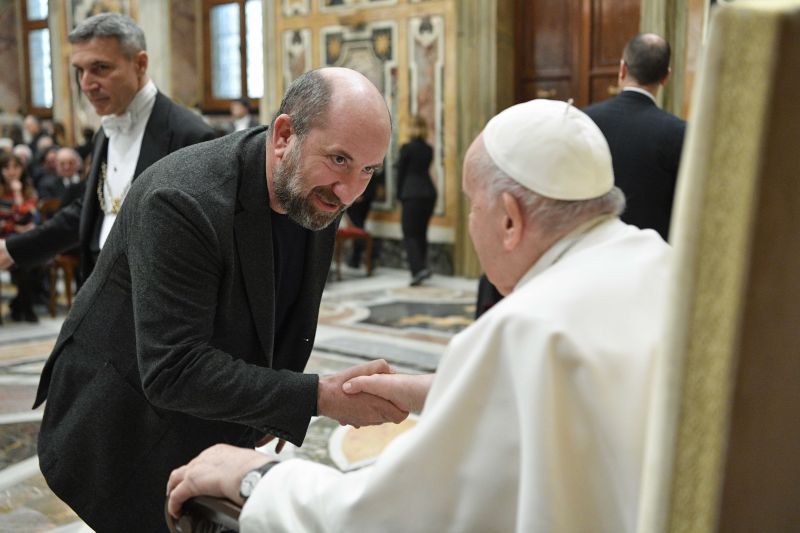
Pope Francis met with members of a film foundation established by the Italian bishops’ conference on Feb. 20, 2023. / Vatican Media. See CNA article for full slideshow.
Vatican City, Feb 20, 2023 / 06:10 am (CNA).
A good movie has the power to inspire wonder and to evangelize by reflecting the beauty of God’s creation, Pope Francis told filmmakers at the Vatican on Monday.
“Dear friends, the world troubled by war and so many evils needs signs, works that inspire wonder and that reveal the wondrousness of God who never ceases to love His creatures and to be amazed by their beauty,” Pope Francis said in a message to an Italian film foundation on Feb. 20.
“In an increasingly artificial world, where man has surrounded himself with the works of his own hands, the great risk is to lose a sense of wonder. I share this reflection with you, entrusting you with the task to reawaken wonder.”
In an audience at the Vatican’s Apostolic Palace, the pope met with members of Fondazione Ente dello Spettacolo, a film foundation established by the Italian bishops’ conference in 1947 to promote Christian values in entertainment.
For more than 75 years, the foundation has supported filmmakers through education, workshops, reviews, and film festivals.
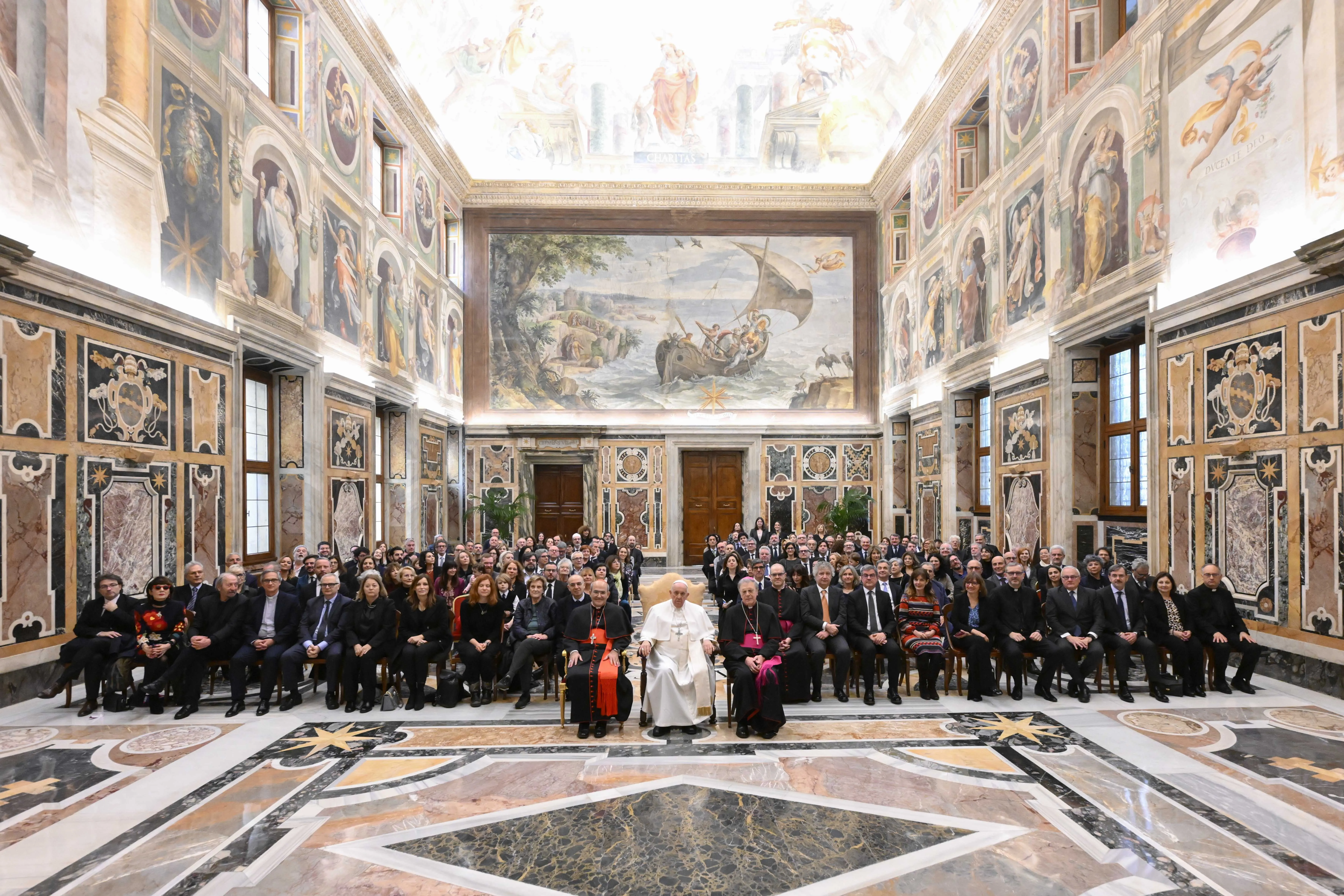
Pope Francis met with members of a film foundation established by the Italian bishops’ conference on Feb. 20, 2023. Vatican Media
Pope Francis gave a short off-the-cuff speech to the group about how creating a film that is a “work of beauty” can be “a great expression of God.”
“Beauty is that work of the Holy Spirit which creates harmony out of everything,” he said.
The pope also distributed a written message to the foundation members in which he described how God, after creating the sky, the earth, the stars, and all living things, became “a spectator of his work” after his creative actions.
“He contemplates what he has created and expresses his judgment: He ‘saw that it was good,’” Pope Francis said, quoting the Book of Genesis.
“In this sacred page, dear friends, directors, actors, women and men who work in cinema, we can also find the meaning of your cultural work,” he said.
If you value the news and views Catholic World Report provides, please consider donating to support our efforts. Your contribution will help us continue to make CWR available to all readers worldwide for free, without a subscription. Thank you for your generosity!
Click here for more information on donating to CWR. Click here to sign up for our newsletter.
Vatican City, Jul 3, 2018 / 04:51 am (CNA/EWTN News).- The Vatican announced Tuesday that Pope Francis has named three new auxiliary bishops for the Archdiocese of Chicago, appointing Fr. Ronald Hicks, Fr. Robert G. Casey and Fr. Mark Bartosic to the positions.
The July 3 announcement of the priests’ appointments coincided with the news that two of Chicago’s six current auxiliary bishops, George Rassas and Francis Kane, would be retiring. With Hicks, Casey and Bartosic, there will now be seven auxiliaries serving in the archdiocese.
Born in Chicago in 1967, Hicks has until now served as the archdiocese’s vicar general.
In 1985 he graduated from Quigley Seminary South, and obtained a bachelor’s degree in philosophy four years later from the University of Chicago. He also has a master of divinity degree and a doctor of ministry degree from the University of St. Mary of the the Lake in Mundelein.
Hicks was ordained a priest in 1994 for the Archdiocese of Chicago, after which he served in various pastoral roles throughout the diocese.
After a stint as dean of formation at St. Joseph College Seminary from 1999-2005, the bishop-elect received permission from his then-archbishop, the late Cardinal Francis George, to move to El Salvador, where he served a 5-year term as regional director of the Nuestros Pequeños Hermanos home for orphaned and abandoned children.
From 2010-2014 he served as dean of formation at Mundelein Seminary, while also helping with weekend Masses at St. Jerome Parish in Rogers Park. He was named vicar general for the archdiocese by the current archbishop, Cardinal Blase Cupich in 2015.
Casey, also a Chicago native, was born Sept. 23, 1967, and is currently serving as pastor of St. Bede the Venerable Church in Chicago.
After obtaining a bachelor’s degree in English from Niles College of Loyola University Chicago in 1989, Casey went on to pursue a master of divinity, which he received from the University of St. Mary of the Lake in Mundelein in 1994.
The bishop-elect was ordained a priest in 1994, after which he served as associate pastor of St. Ita parish in Edgewater until his 1998 appointment by Cardinal George as the part-time, associate director of Casa Jesus. In 1999, he was named the organization’s full-time director.
After a 40-day pilgrimage to Santiago de Compostela in Spain in 2003, Casey began serving as pastor of Our Lady of Tepeyac in the Little Village neighborhood of Chicago. In 2008, he co-founded the Taller de José ministry, which is sponsored by the Congregation of St. Joseph and provides accompaniment to those in need.
Casey then served in a number of other pastoral roles before being named to the Placement Board of the archdiocese, a role in which he helps assign priests to parishes.
The only non-Chicago native of the new appointments, Bartosic was born in Neehah, Wis., in 1961, and is currently serving as pastor of Assumption of the Blessed Virgin Mary Church in Chicago and as director and chaplain of the Kolbe House, Cook County Jail.
Raised in Ashland, Ohio, Bartosic obtained a bachelor’s degree in theater from Ashland University in 1983, and went on to earn a both a master of divinity degree and a licentiate degree in sacred theology from the University of St. Mary of the Lake.
He was ordained a priest for the Archdiocese of Chicago by Cardinal Joseph Bernardin in 1994, and has served in several pastoral roles since, including his position as chaplain of the Kolbe House jail ministry.
An exorcist is warning about the dangers of a Ouija-board-like product promising users that they will be able to "communicate directly with Jesus Christ." / Holy Spirit Games YouTube
Washington D.C., Mar 31, 2023 / 08:37 am (CNA).
Cat… […]
Pope Francis meets with the United States bishops at St. Matthew’s Cathedral in Washington, D.C., Sept. 23, 2015. / L’Osservatore Romano.
Rome Newsroom, Nov 28, 2022 / 08:01 am (CNA).
Pope Francis has emphasized the difference between bishops’ conferences and bishops in a new interview with America Magazine.
“The bishops’ conference is there to bring together the bishops, to work together, to discuss issues, to make pastoral plans. But each bishop is a pastor,” the pope said in a lengthy interview conducted at his Vatican home on Nov. 22 and published Nov. 28.
“Let us not dissolve the power of the bishop by reducing it to the power of the bishops’ conference.”
The conversation with the Jesuit publication covered a wide range of topics, including the role of bishops, racism, polarization, sexual abuse, the Vatican-China deal, and whether he has any regrets from his time as pope.
In the interview, Pope Francis was told about a 2021 America Magazine survey that found that Catholics in the United States consider the U.S. Conference of Catholic Bishops to be the least trustworthy out of the groups listed — 20% of U.S. Catholics surveyed found the USCCB to be “very trustworthy.”
Francis was asked: “How can the U.S. Catholic bishops regain the trust of American Catholics?”
“The question is good because it speaks about the bishops,” he responded. “But I think it is misleading to speak of the relationship between Catholics and the bishops’ conference. The bishops’ conference is not the pastor; the pastor is the bishop. So one runs the risk of diminishing the authority of the bishop when you look only to the bishops’ conference.”
“Jesus did not create bishops’ conferences,” he added. “Jesus created bishops, and each bishop is pastor of his people.”
The U.S. bishops met in Baltimore for their annual fall general assembly on Nov. 14-17. Katie Yoder
Pope Francis said the emphasis should be on whether a bishop has a good relationship with his people, not on administration.
He gave the example of Bishop Mark Seitz of El Paso, Texas: “I do not know if he is conservative, or if he is progressive, if he is of the right or of the left, but he is a good pastor.”
In the U.S., the pope said, there are ‘some good bishops who are more on the right, some good bishops who are more on the left, but they are more bishops than ideologues; they are more pastors than ideologues. That is the key.”
“The grace of Jesus Christ is in the relationship between the bishop and his people, his diocese,” he said.
A bishops’ conference, instead, is an organization meant to “assist and unite.”
Pope Francis was also asked whether the USCCB should prioritize the fight against abortion over other issues.
To which he said: “this is a problem the bishops’ conference has to resolve within itself.”
The pope pointed out that the activity of a bishops’ conference is on the organizational level, and in history, conferences have at times gotten things wrong.
“In other words, let this be clear: A bishops’ conference has, ordinarily, to give its opinion on faith and traditions, but above all on diocesan administration and so on,” he said, again emphasizing the sacramental nature of the pastoral relationship of a bishop to his diocese and its people.
“And this cannot be delegated to the bishops’ conference,” he added. “The conference helps to organize meetings, and these are very important; but for a bishop, [being] pastor is most important.”
In the interview, Pope Francis also denounced polarization as “not Catholic,” and said the Catholic way of dealing with sin is “not puritanical” but puts saints and sinners together.
He also said in the U.S., where there is a Catholicism particular to that country, something he called “normal,” “you also have some ideological Catholic groups.”
Pope Francis arrives at the Basilica of the National Shrine of the Immaculate Conception, Sept. 23, 2015. CNA
On the topic of sexual abuse in the Catholic Church, Pope Francis was asked about the apparent lack of transparency when it comes to accusations against bishops, compared with the handling of accusations against priests.
The pope called for “equal transparency” going forward, adding that “if there is less transparency, it is a mistake.”
To a question about Black Catholics, Francis said he is “aware of their suffering, that he loves them very much, and that they should resist and not walk away” from the Catholic Church.
“Racism is an intolerable sin against God,” he added. “The Church, the pastors and laypeople must continue fighting to eradicate it and for a more just world.”
Asked if he has any regrets, or if he would change anything he has done in nearly 10 years as pope, Francis said in English, as he laughed, that he would change “all! All!”
“However, I did what the Holy Spirit was telling me I had to do. And when I did not do it, I made a mistake,” he added.
On his seeming constant joyfulness, the pope said he is not “always like that,” except when he is with people.
“I would not say that I am happy because I am healthy, or because I eat well, or because I sleep well, or because I pray a great deal,” he explained. “I am happy because I feel happy, God makes me happy. I don’t have anything to blame on the Lord, not even when bad things happen to me. Nothing.”
He said the Lord has guided him through both good and difficult moments, “but there is always the assurance that one does not walk alone.”
“One has one’s faults,” he said, “also one’s sins; I go to confession every 15 days — I do not know, that is just how I am.”
Directors, actors, women and men who work in cinema have the potential to be changemakers.
