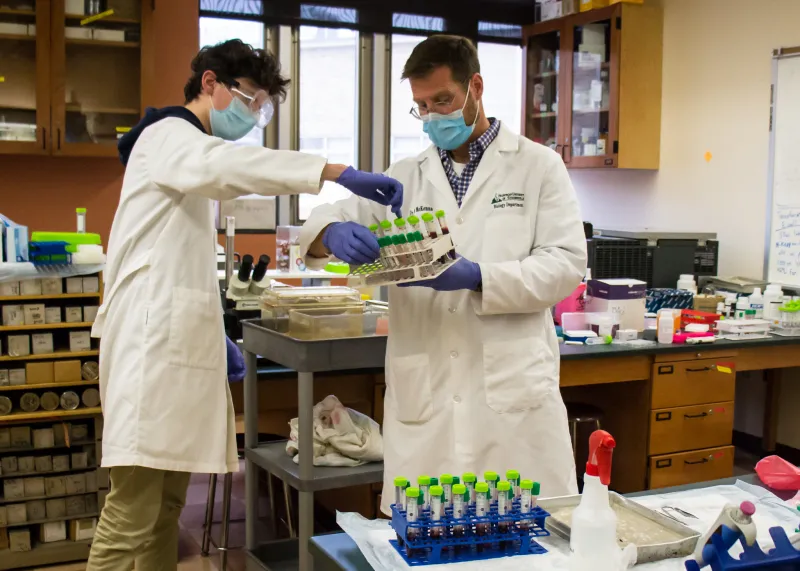
Biology major Michael Rohall and Franciscan University biology professor Dr. Kyle McKenna prepare to analyze blood samples for coronavirus specific antibodies. Photo courtesy of the Franciscan University of Steubenville.
The Franciscan University of Steubenville is conducting a research study to better understand COVID-19 and herd immunity.
Through its School of Natural Applied Sciences, the university plans to evaluate 500 students and faculty by the end of April. The study is led by biology professor Dr. Kyle McKenna.
The Biology Department and the Franciscan Institute of Science and Health provided for the initial costs of the study, but it recently received a grant by the American Life League.
According to a university statement, McKenna said senior nursing majors have already drawn blood from 200 individuals. The blood is then analyzed for coronavirus antibodies.
“We want to know what percentage of people on campus demonstrate an immune response to SARS-CoV-2 virus,” said McKenna.
“To achieve herd immunity which limits transmission of the virus, you need at least 60 to 70 percent of a given population to be resistant to infection, either through exposure to the virus or vaccination.”
McKenna said the study also has a pro-life component. She said the study has modified a commercially available antibody test so that the test’s cell lines were not derived from aborted fetal tissue.
The decision was announced after the university declined at the end of March to offer a COVID-19 vaccination site on campus.
Franciscan University president Fr. David Pivonka issued a video April 14 cautioning that the university faced a similar situation as last year, when in-person education was shut down due to rising pandemic levels. He said “the present trend is not sustainable.”
If you value the news and views Catholic World Report provides, please consider donating to support our efforts. Your contribution will help us continue to make CWR available to all readers worldwide for free, without a subscription. Thank you for your generosity!
Click here for more information on donating to CWR. Click here to sign up for our newsletter.
Pope Francis meets members of the First Nations at the Vatican on March 31, 2022. / Vatican Media
Vatican City, Apr 1, 2022 / 05:50 am (CNA).
Pope Francis has said that he will travel to Canada in the summer, possibly for the feast of St. Anne … […]
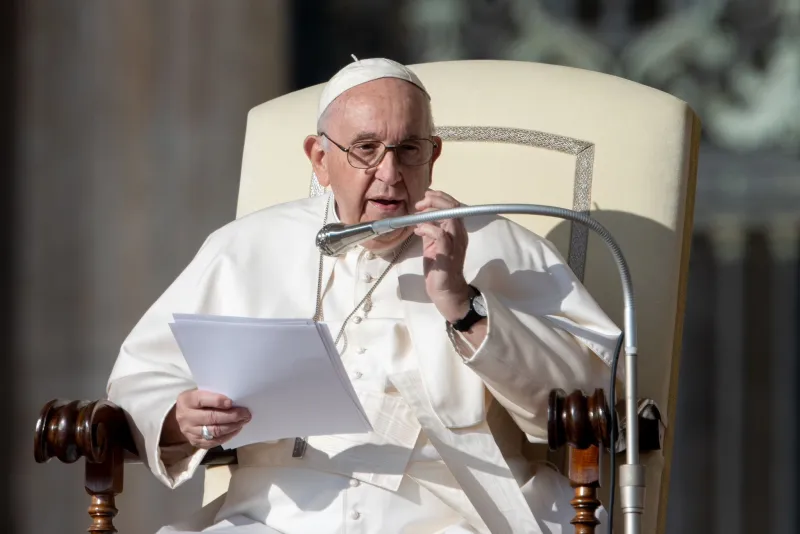
Pope Francis speaking on St. Peter’s Square, Vatican, Oct. 12, 2022 / Daniel Ibáñez / CNA
Rome Newsroom, Oct 12, 2022 / 03:35 am (CNA).
At his public audience on Wednesday, Pope Francis spoke about the role desire plays in spiritual discernment, comparing it to a compass that points one in the right direction.
“Desire is not the craving of the moment. No. The Italian word, desiderio, comes from a very beautiful Latin term, desidus, literally ‘the lack of the star,’” Pope Francis said in St. Peter’s Square on Oct. 12.
“Desire is ‘the lack of the star,’ of the reference point that orients the path of life,” he continued. “It evokes a suffering, a lack, and at the same time a tension to reach the good that is missing.”
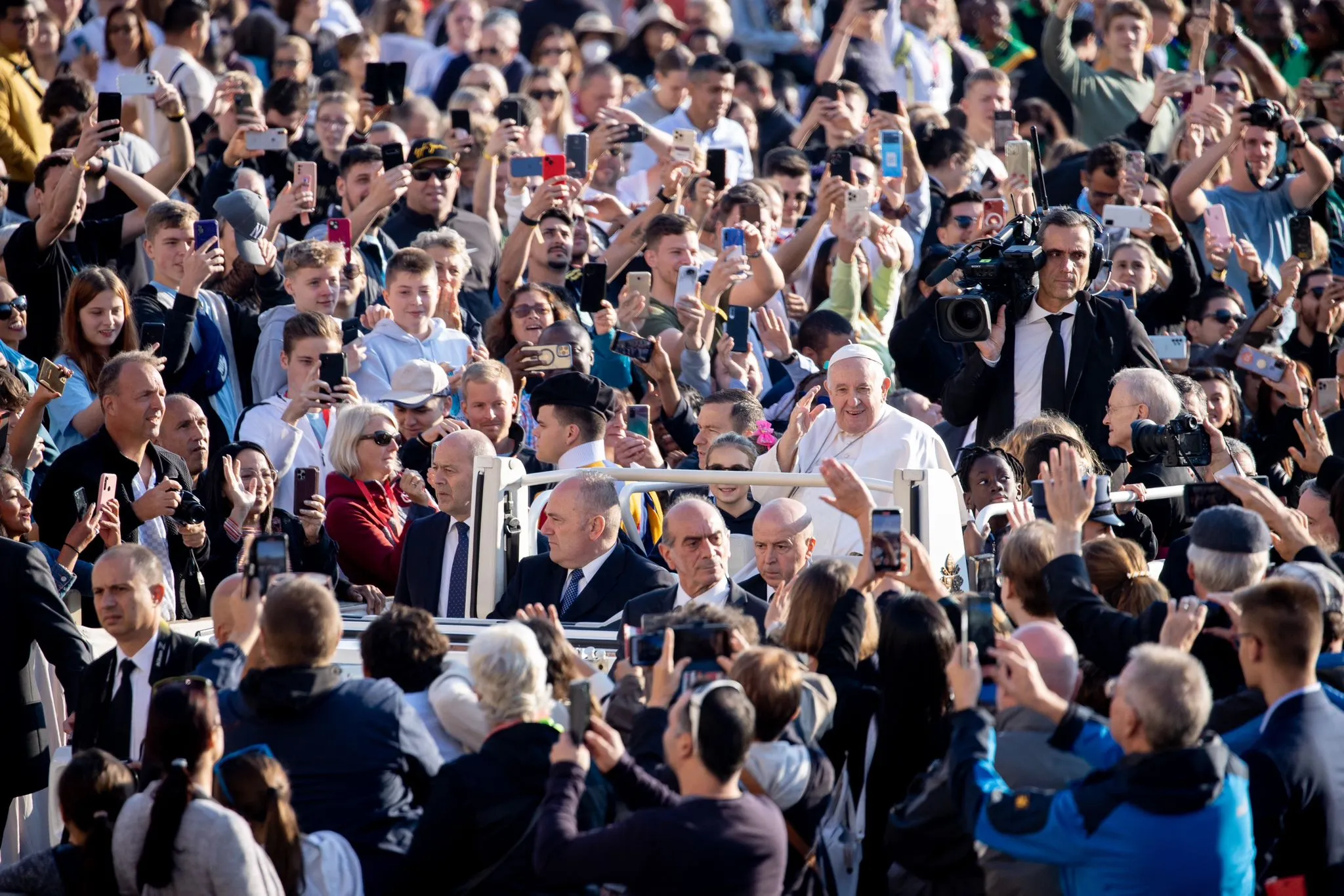
Pope Francis greeting pilgrims on St. Peter’s Square, Oct. 12, 2022. Daniel Ibáñez / CNA
On Aug. 31, Francis began a series of weekly catecheses, or messages, on discernment, which he described as “an exercise of intelligence, and also of skill and also of will, to seize the opportune moment” in order to make a good choice about one’s life.
“Desire, then,” he said in the live-streamed address on Wednesday, “is the compass to understand where I am and where I am going. Actually, it is the compass for whether I am standing still or going.”
Pope Francis addressed how someone can recognize desire within themselves in his message. “A sincere desire,” he said, “knows how to touch deeply the chords of our being, which is why it is not extinguished in the face of difficulties or setbacks.”
“Unlike a momentary craving or emotion, desire lasts through time, even a long time,” he explained.
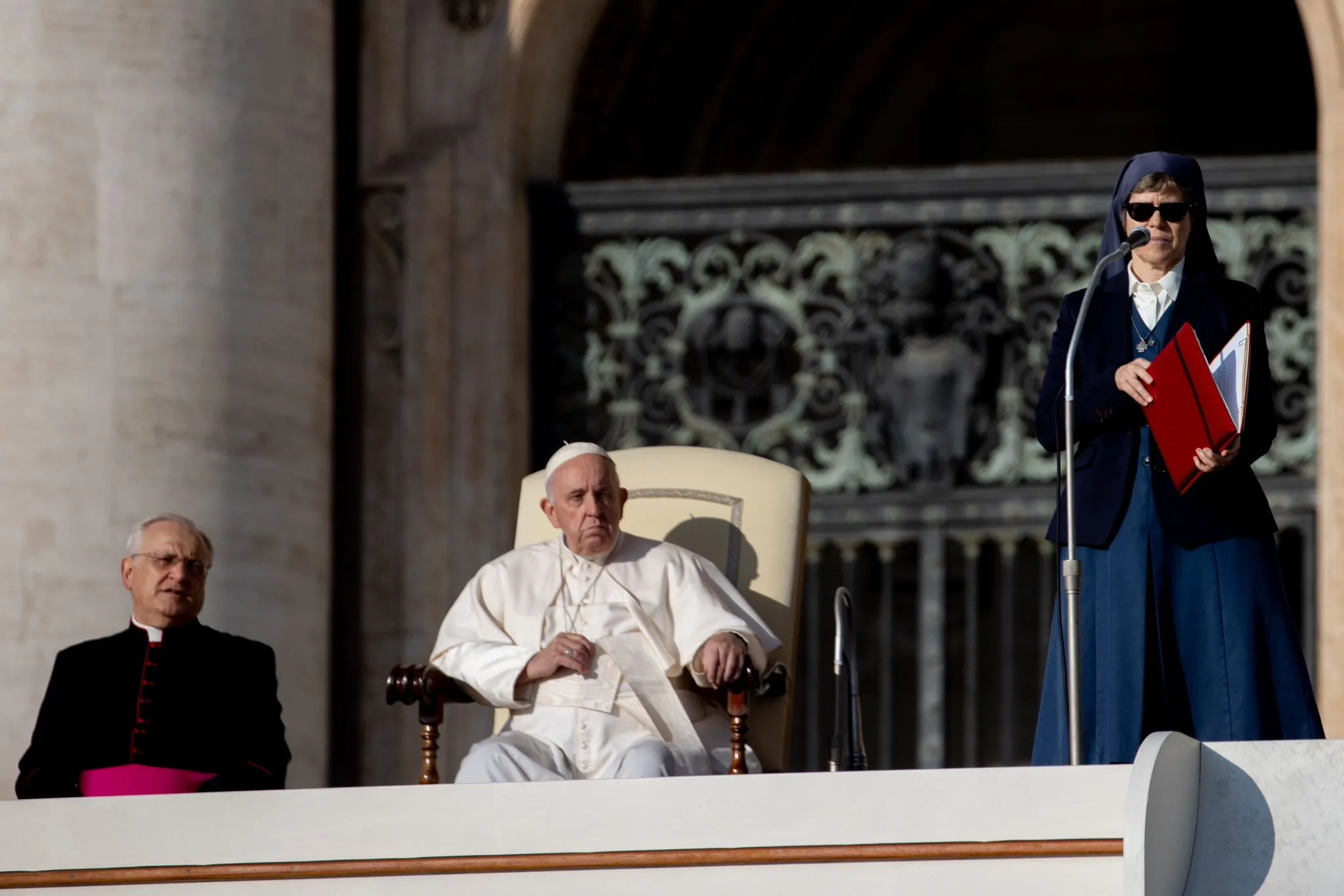
General audience on St. Peter’s Square, Oct. 12, 2022. Daniel Ibáñez / CNA
Pope Francis pointed to some of the pitfalls to knowing the desires of one’s heart; for example, society’s promotion of “the maximum freedom of choice,” while those “choices” are mostly reduced to just what is wanted most in the moment, not what will truly satisfy over the long term.
“We are bombarded by a thousand proposals, projects, possibilities, which risk distracting us and not permitting us to calmly evaluate what we really want,” the pope said, adding that many people go around “with their cell phones in their hands and they are searching, looking,” but never stopping to think or reflect.
“Desire cannot grow like that,” he said. “You live in the moment, satiated in the moment, and desire does not grow.”
Francis said that distraction can cause people a lot of suffering “because they do not know what they want from their lives; they have probably never got in touch with their deepest desire.”
Another pitfall the pope mentioned was the knowledge that one wants to do something but never actually takes action.
“And so certain changes, though desired in theory, when the opportunity arises are never implemented,” he said.
“Often,” he said, “it is indeed desire that makes the difference between a successful, coherent and lasting project, and the thousands of wishes and good intentions with which, as they say, ‘hell is paved with.’”
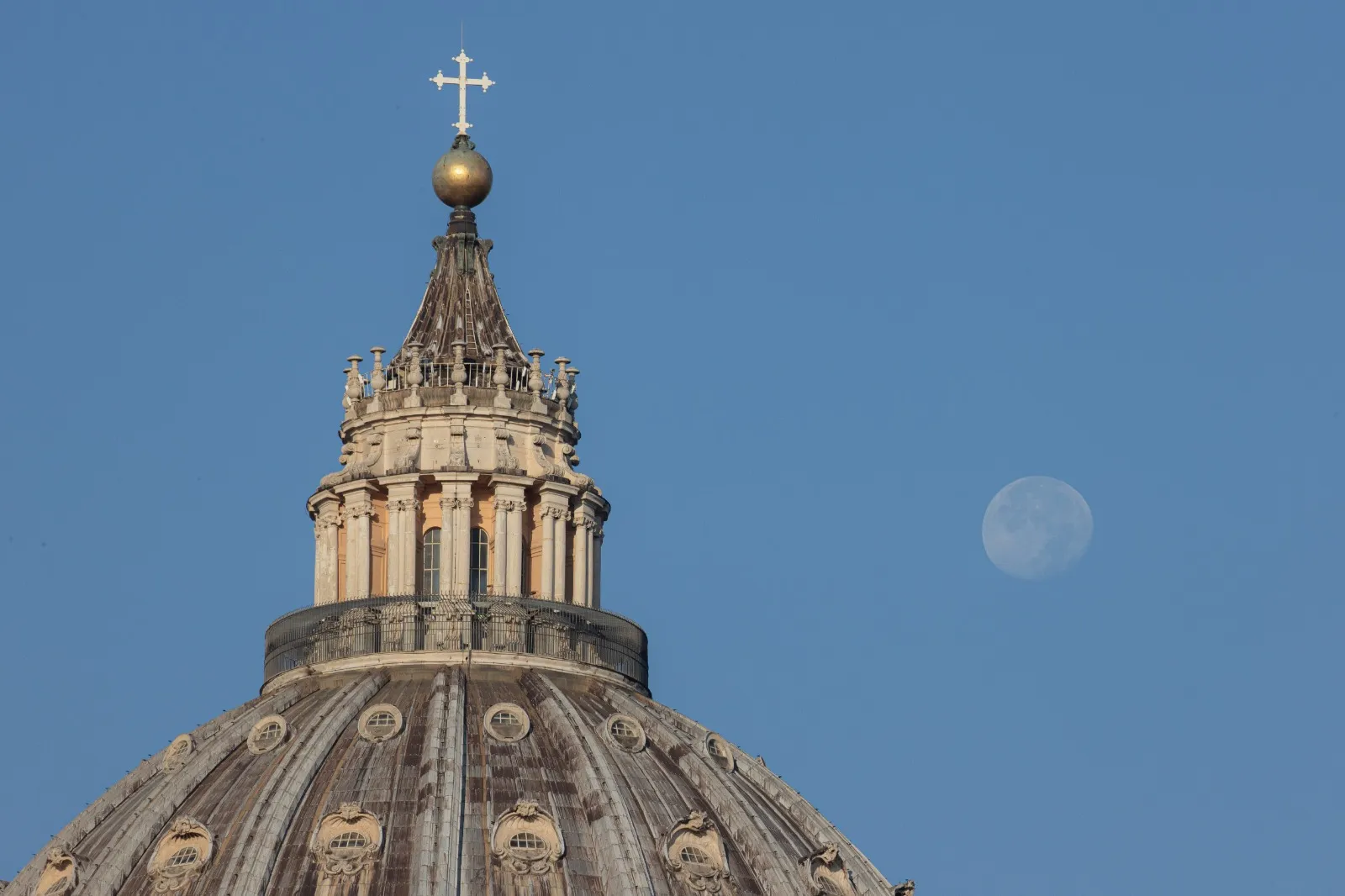
The moon was visible over St. Peter’s Basilica, Vatican, on the morning of Oct. 12. 2022. Daniel Ibáñez / CNA
He recalled that Jesus, before performing a miracle, often questions a person about his or her desires, like he does with the paralytic at the pool of Bethesda in chapter five of the Gospel of John.
“Jesus asks him: ‘Do you want to be well?’ How come?” the pope said.
He explained that “Jesus’ question was an invitation to bring clarity to his heart, to welcome a possible leap forward: to no longer think of himself and his own life ‘as a paralytic,’ transported by others. … By engaging in dialogue with the Lord, we learn to understand what we truly want from life.”
The paralytic, he continued, is an “example of people [who say,] ‘Yes, yes, I want, I want,’” but in the end, never do anything.
Instead of taking action, we find excuses or complain: “But be careful,” he said, because “complaints are a poison, a poison to the soul, a poison to life because they don’t make you grow the desire to move forward.”
“If the Lord were to ask us, today, the question he asked the blind man in Jericho: ‘What do you want me to do for you?’ how would we answer?” the pope said. “Perhaps we could finally ask him to help us know his deepest desire, that God himself has placed in our heart.”
CNA Staff, Aug 7, 2024 / 06:00 am (CNA).
A recent U.S. Supreme Court decision on bankruptcy law will “absolutely” have a significant effect on U.S. Church abuse lawsuits, one legal expert says, with the highe… […]




Leave a Reply