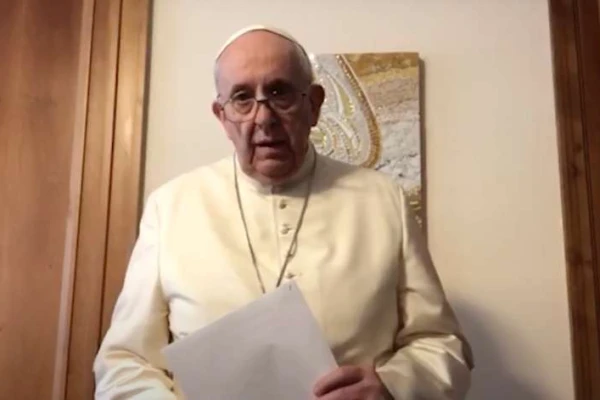
Pope Francis’ video message to CELAM sent Jan. 24, 2021. YouTube Screenshot.
Vatican City, Jan 25, 2021 / 05:30 am (CNA).- Pope Francis sent a video message Sunday to Latin American Church leaders organizing a “synodal” regional assembly, in which he asked them not to be ideological elites, but to remain close to the people of God.
“We have much to learn,” Pope Francis said in the video sent to the organizers of the first Ecclesial Assembly of the Church in Latin American and the Caribbean Jan. 24.
“This [will be] a meeting of the people of God: lay men and women, religious men and women, priests, bishops. All the people of God walking together: praying, speaking, thinking, discussing, and seeking the will of God,” the pope said.
The regional Ecclesial Assembly is scheduled to take place in Mexico City Nov. 21-28 with the theme: “We are all missionary disciples on the move.”
In his video message, Pope Francis said: “I want to accompany you with my prayers” ahead of the Ecclesial Assembly. He added that this assembly will be something distinctive from the previous regional meeting of the Latin American bishops’ conference (CELAM) in Aparecida, Brazil — a conference in which he played a role as archbishop of Buenos Aires.
“May this Assembly not be an elite group separated from the holy, faithful people of God,” the pope said. “Together with the people. Do not forget it. We are all part of the people of God.”
“Out of the people of God an elite group crops up, an elite illumined by one ideology or another, but this is not the Church. The Church is found in the breaking of the bread. The Church gives herself to all, without exclusion.”
According to a press release from the Latin American bishops’ conference, the goal of the Ecclesial Assembly is to “contemplate the reality of our peoples and the deepening challenges of the continent” while “reviving pastoral commitment and seeking new paths with a synodal key.”
Archbishop Miguel Cabrejos Vidarte of Trujillo, Peru and president of the Latin American bishops’ conference took part in the launch of the Ecclesial Assembly, together with the president of the Brazilian bishops’ conference Bishop Walmor Oliveira de Azevedo and Archbishop Rogelio Cabrera López of Monterrey, the president of the Mexican bishops’ conference.
Cardinal Marc Ouellet, president of the Pontifical Commission for Latin America, also participated in the virtual event. The launch culminated with a Mass in the Basilica of Our Lady of Guadalupe presided over by the archbishop of Mexico City, Cardinal Carlos Aguiar Retes.
Pope Francis said that prayer is essential in preparation for this assembly. He added: “The Lord is among us. May the Lord make himself heard.”
If you value the news and views Catholic World Report provides, please consider donating to support our efforts. Your contribution will help us continue to make CWR available to all readers worldwide for free, without a subscription. Thank you for your generosity!
Click here for more information on donating to CWR. Click here to sign up for our newsletter.

At his first general audience in St. Peter’s Square on May 21, 2025, Pope Leo XIV appeals for peace and the entry of humanitarian aid into Gaza, where, he said, children and elderly are suffering. / Credit: Daniel Ibanez/CNA
Vatican City, May 21, 2025 / 08:05 am (CNA).
Pope Leo XIV in the first general audience of his pontificate on Wednesday appealed for an end to hostilities in Gaza and for the entrance of humanitarian aid into the Gaza Strip.
Speaking before tens of thousands of attendees on an overcast day in St. Peter’s Square, the new pope ended his remarks by calling the situation in the Gaza Strip “increasingly worrying and painful.”
“I renew my heartfelt appeal to allow the entry of decent humanitarian aid and to end the hostilities whose heartbreaking price is paid by children, the elderly, and the sick,” he added.
The pope’s appeal comes as the numbers of dead and injured in the Gaza Strip continue to rise under Israel’s attacks. According to reports, while some humanitarian aid has been allowed to enter Gaza, it has not yet been released for distribution.
One month to the day since Francis’ death, Pope Leo also recalled with gratitude the “beloved Pope Francis, who just a month ago returned to the house of the Father.”
Leo closely followed his written remarks, only adding the comment on Gaza, during the May 21 public audience, which he began by taking a turn around the square in the popemobile to cheers, banners, and waving flags. Some people stood on their chairs to try to catch a glimpse of the new pope, who paused often to bless babies of all ages held out to him in outstretched arms.
Pope Leo XIV pauses to bless a baby during his trip around St. Peter’s Square in the popemobile before the start of his first general audience on May 21, 2025. Credit: Vatican Media
The inaugural catechesis of the first U.S.-born pope picked up the theme begun by Francis for the 2025 Jubilee Year: “Jesus Christ our hope.”
Reflecting on the Parable of the Sower, Leo noted the unusual behavior of the sower in the story, who “does not care where the seed falls. He throws the seeds even where it is unlikely they will bear fruit: on the path, on the rocks, among the thorns.”
“The way in which this ‘wasteful’ sower throws the seed is an image of the way God loves us,” he said, echoing a part of his first message from the loggia of St. Peter’s Basilica after his election on May 8, that God “loves us all unconditionally.”
“First and foremost in this parable Jesus tells us that God throws the seed of his Word on all kinds of soil, that is, in any situation of ours,” Leo underlined.
He continued: “God is confident and hopes that sooner or later the seed will blossom. This is how he loves us: he does not wait for us to become the best soil, but he always generously gives us his word. Perhaps by seeing that he trusts us, the desire to be better soil will be kindled in us. This is hope, founded on the rock of God’s generosity and mercy.”
The theme of personal transformation was also repeated later in the catechesis, when Leo said, “Jesus is the Word, he is the Seed. And the seed, to bear fruit, must die. Thus, this parable tells us that God is ready to ‘waste away’ for us and that Jesus is willing to die in order to transform our life.”
Chuma Asuzu, who is Nigerian-born and living in Canada, is happy to have attended Pope Leo XIV’s general audience on May 21, 2025 with his wife and children. Credit: Kristina Millare/CNA
Husband and father Chuma Asuzu from Canada came to the square early in the morning with his family to attend the pope’s first general audience.
“It was good and I think it was interesting how he explained the seeds and how it’s the word of God,” Asuzu shared with CNA. “I really appreciate it.”
“He made the point to drive around a lot because it was his first audience and he looked emotional at the beginning,” he added.
Instead of taking an example from literature or philosophy, as Pope Francis often did, Pope Leo used Vincent Van Gogh’s painting, “The Sower at Sunset,” to prompt a meditation on hope.
Vincent Van Gogh’s “The Sower at Sunset”. Public Domain.
“That image of the sower in the blazing sun also speaks to me of the farmer’s toil,” he said. “And it strikes me that, behind the sower, Van Gogh depicted the grain already ripe. It seems to me an image of hope: one way or another, the seed has borne fruit. We are not sure how, but it has.”
“At the center of the scene, however, is not the sower, who stands to the side; instead, the whole painting is dominated by the image of the sun, perhaps to remind us that it is God who moves history, even if he sometimes seems absent or distant,” the pope noted. “It is the sun that warms the clods of earth and makes the seed ripen.”
The pontiff’s final thought was to remind those present to ask the Lord for the grace to welcome the seed of his Word: “And if we realize we are not a fruitful soil, let us not be discouraged, but let us ask him to work on us more to make us become a better terrain.”
Leo closed the audience in the customary way, singing the “Our Father” prayer in Latin and then giving his apostolic blessing.
Among the pilgrims present on Wednesday was Father Rolmart Verano, who is leading a group of jubilee pilgrims from the Diocese of Surigao, Philippines.
“I never thought that one day I will come here [to Rome],” he told CNA. “It is one of my wildest dreams that came true!”
Father Rolmart Verano, from the Diocese of Surigao, Philippines, tells CNA at the general audience on May 21, 2025, that it was a dream come true for him to travel to Rome and see the pope. Credit: Kristina Millare/CNA
“The striking point of Pope Leo XIV’s general audience is when he said that the Word of God should take root in each one of our hearts,” he said. “It should serve as a guide for our daily lives no matter that it be ordinary or difficult circumstances.”
As one of 40 members of a pilgrim group from the Diocese of Mumbai, India, Sandesh Almeida said he was immediately impressed by the kindness shown by the new pontiff at the audience.
“Peace is a good message from him,” he said. “Now with India and Pakistan … we should go for peace and the pope is mostly focusing on peace.”
A new coin minted by the Vatican City State depicts a woman carrying the earth in her womb. The artist who designed the coin, which commemorates Earth Day, has said the design was his response to th… […]
Vatican City, Sep 15, 2019 / 07:00 am (CNA).- Pope Francis said Sunday that God forgets sins absolved within the confessional.
“How do you defeat evil? Accepting God’s forgiveness … It happens every time we go to confession; there we receive the love of the Father who overcomes our sin. It is no longer there, God forgets it,” Pope Francis said in his Angelus message Sept. 15.
“God, when He forgives, loses His memory. He forgets our sins, forgets. God is so good with us,” he added in a departure from his prepared remarks.
In the sacrament of confession, God completely erases the evil confessed, making one new inside, reborn in joy, Pope Francis explained.
“Brothers and sisters, have courage. With God, no sin has the last word,” the pope said.
Pope Francis reflected upon Sunday’s Gospel from Luke in which the Pharisees complain that Jesus “welcomes sinners and eats with them.”
“Jesus ‘welcomes sinners and eats with them.’ This is what happens to us, in every Mass, in every church: Jesus is happy to welcome us to his table, where he offers Himself for us,” Pope Francis said.
“It is a phrase that we could write on the doors of our churches: ‘Here Jesus welcomes sinners and invites them to his table,’” he added.
The pope focused on the lessons of God’s mercy and justice contained within Jesus’ parable of the prodigal son. He said that the elder brother’s rejection of the father’s mercy for the prodigal son contains an important warning.
“The eldest son, who does not accept the mercy of his father … makes a worse mistake: he is presumed to be just … and judges everything on the basis of his thought of justice,” he said. “It is also a risk for us: to believe in a more rigorous than merciful god, a god who defeats evil with power rather than forgiveness.”
“We are also wrong when we believe ourselves to be right, when we think that the bad ones are the others. Let us not believe ourselves good because alone, without the help of God who is good, we do not know how to overcome evil,” Pope Francis said.
“Our Lady, who unties the knots of life, frees us from the pretense of believing we are righteous and makes us feel the need to go to the Lord, who is always waiting for us to embrace us, to forgive us,” he said.
After praying the Angelus, Pope Francis expressed his joy because of two beatifications this weekend. Benedetta Bianchi Porro, an Italian laywoman, who died in 1964 of a lifelong illness at the age of 28, was declared blessed on the Feast of the Exaltation of the Holy Cross.
At her beatification Sept. 14, Cardinal Giovanni Angelo Becciu called Porro a shining example of “what the cross can and must be for us Christians.”
On Sept. 15, Father Richard Henkes will be beatified in Limburg, Germany. Henkes was a Pallottine priest, who died a prisoner in the Nazi concentration camp in Dachau in 1945 while caring for sick prisoners in the camp.
“The example of these two brave disciples of Christ also supports our journey to holiness,” Pope Francis said.
“Don’t be afraid: God loves you, loves you as you are,” the pope said. “Only His love can change your life.”
From the Holy Father speaking to the upcoming Latin Ecclesial Assembly: “The Church is found in the breaking of the bread [not any elitist ideology]. The Church gives herself to all, without exclusion.” As very much of an aside, what does this valuable reminder mean today in the different context of the Church in the United States?
We read from the Constitution on the Sacred Liturgy: “Every liturgical celebration, as an activity of Christ the priest and of his body, which is the Church, is a sacred action of a PREEMINENT kind.” In the northern context, the dissent by Cardinal Cupich from the USCCB and its President Archbishop Gomez–who clarify that with regard to President Biden: abortion remains the “preeminent” moral concern–we might discern that what the Cupich faction rejects is NOT simply this or that particular preeminence, but the whole idea of “preeminence”!
Instead, “equality” (!), whereby some things might or might not be more equal than others, but all things remain within the one category of equality. Why else would one accept the cardinal’s hat except to be able to evasively play-off one moral “highlighting” (Cardinal Gregory’s term) against the others, all of which have their day in the sun as non-preeminent matters of social justice? Pick a day of the week!
Why moral clarity when you can have politics? Why the non-demonstrable principle of non-contradiction when you can have it all? A culture that replaces even binary sexual complementarity (irreducible preeminence of both male and female) with Uncle McCarrick, then gay “marriage,” and now across-the-board gender theory?
Why not “anthropological cultural change” (the “new paradigm” of Cardinal Parolin in 2016, but not recently) instead of the innate sense of hierarchy and of true and false? Why not only the People of God instead of, also, the distinct and preeminently sacramental Mystical Body of Christ? Why not admit abortion/gender-theory Biden to the Eucharist, deferring to his bubble-universe ideology: “Look, I have the great advantage of my faith, the Catholic social doctrine, and my political views COINCIDE.”
Without at least the humbling acceptance of “preeminence”–versus solvent equality in its legion forms–no dialogue is possible, unless the USCCB first concedes even the right of the Church to self-government (the 12th-century Investiture Crisis all over again).
From the Holy Father speaking to the upcoming Latin Ecclesial Assembly: “The Church is found in the breaking of the bread [not any elitist ideology]. The Church gives herself to all, without exclusion.” As very much of an aside, what does this valuable reminder mean today in the different context of the Church in the United States?
We read from the Constitution on the Sacred Liturgy: “Every liturgical celebration, as an activity of Christ the priest and of his body, which is the Church, is a sacred action of a PREEMINENT kind.” In the northern context, the dissent by Cardinal Cupich from the USCCB and its President Archbishop Gomez–who clarify that with regard to President Biden: abortion remains the “preeminent” moral concern–we might discern that what the Cupich faction rejects is NOT simply this or that particular preeminence, but the whole idea of “preeminence”!
Instead, “equality” (!), whereby some things might or might not be more equal than others, but all things remain within the one category of equality. Why else would one accept the cardinal’s hat except to be able to evasively play-off one moral “highlighting” (Cardinal Gregory’s term) against the others, all of which have their day in the sun as non-preeminent matters of social justice? Pick a day of the week!
Why moral clarity when you can have politics? Why the non-demonstrable principle of non-contradiction when you can have it all? A culture that replaces even binary sexual complementarity (irreducible preeminence of both male and female) with Uncle McCarrick, then gay “marriage,” and now across-the-board gender theory?
Why not “anthropological cultural change” (the “new paradigm” of Cardinal Parolin in 2016, but not recently) instead of the innate sense of hierarchy and of true and false? Why not only the People of God instead of, also, the distinct and preeminently sacramental Mystical Body of Christ? Why not admit abortion/gender-theory Biden to the Eucharist, deferring to his bubble-universe ideology: “Look, I have the great advantage of my faith, the Catholic social doctrine, and my political views COINCIDE.”
Without at least the humbling acceptance of “preeminence”–versus solvent equality in its legion forms–no dialogue is possible, unless the USCCB first concedes even the right of the Church to self-government (the 12th-century Investiture Crisis all over again).
Walking together, leaving no one behind, is an act in constructive world-building.