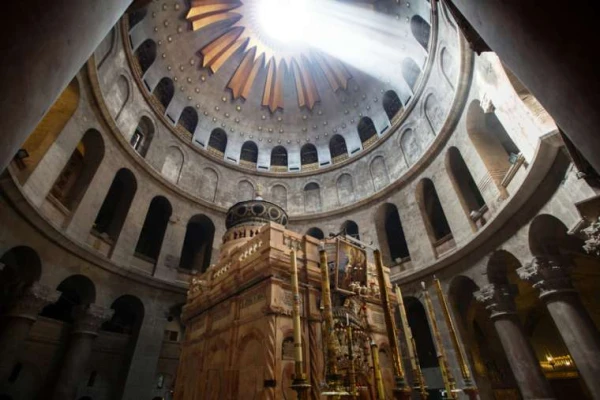
CNA Staff, Mar 30, 2020 / 02:30 pm (CNA).- The Church of the Holy Sepulchre will remain closed until further notice. It is the first time in nearly 700 years that the holy site has closed for an extended period due to disease.
The church building, which houses the tomb of Christ and the site of the crucifixion, was first closed to pilgrims and other visitors on Wednesday, March 25. Initially, the closure was only expected to last for one week, but religious and Israeli government officials agreed that due to the ongoing COVID-19 pandemic, the global pilgrimage destination should not reopen.
“The initial understanding is that this order is valid for one week, although nobody knows how long this crisis will take,” Wadie Abu Nassar, a spokesperson for the Assembly of Catholic Ordinaries of the Holy Land, told Reuters.
Nassar said that if the church is still closed to the public at Easter, some sort of celebration will be arranged in line with the governmental guidelines and restrictions. Easter is celebrated on April 12 for Latin Rite Catholics and April 19 for Eastern Churches using the Julian calendar– both dates are observed within the Church of the Holy Sepulchre.
If this were to happen, said Nassar, pilgrims would still not be allowed in, but the denominations that share custody of the church would coordinate to ensure that there are no more than 10 people gathered at one time.
The Church of the Holy Sepulchre is unique among religious sites as it is partially controlled by several different Christinan Churches. The Roman Catholic Church, Greek Orthodox Church, and Armenian Apostolic Church each share control of the building, and other Orthodox Churches also celebrate divine liturgy at the site.
The last time the Church of the Holy Sepulchre was closed for an extended amount of time was 1349, during an outbreak of the Black Death in Jerusalem.
The church, which was first consecrated in the year 335, has been closed for short periods of time in the subsequent millennia due to war or other disputes. In 2018, to protest a proposed tax increase on churches, the site was closed to the public for about three days before reopening.
Other religious sites, including the Western Wall and the Dome of the Rock, have also closed due to the Israeli government’s new restrictions aimed at preventing people from catching COVID-19.
Authorities in Bethlehem, in the West Bank, closed the Church of the Nativity in early March after four cases of COVID-19 were diagnosed in the town. The Church of the Nativity was built over the birthplace of Jesus Christ. All tourists were subsequently banned from entering Bethlehem.
Israel has taken a proactive approach in its attempts to contain the spread of COVID-19. On March 9, Prime Minister Benjamin Netanyahu announced that anyone entering the country would be forced to quarantine for a 14-day period. That announcement resulted in the cancelation or abrupt end to many pilgrimages, as travelers scrambled to secure flights back to the United States.
Israel has recorded more than 4,000 cases of COVID-19, with 15 deaths.
If you value the news and views Catholic World Report provides, please consider donating to support our efforts. Your contribution will help us continue to make CWR available to all readers worldwide for free, without a subscription. Thank you for your generosity!
Click here for more information on donating to CWR. Click here to sign up for our newsletter.

Ho Chi Minh City People’s Court building. / Credit: Duc Huy Nguyen/Shutterstock
ACI Africa, Mar 23, 2025 / 07:00 am (CNA).
The African branch of the global Catholic activist organization CitizenGo is urging the government of Kenya to pursue dip… […]
Harare, Zimbabwe, May 2, 2019 / 10:24 am (CNA).- The bishops’ conference of Zimbabwe approved Wednesday the opening of the cause for canonization of John Bradburne, a lay missionary to the area in the 1970s, according to a report.
Bradburne was born in 1921 in England, the son of an Anglican clergyman. He served in the British army in World War II, and he converted to Catholicism in 1947 after staying with the Benedictines of Buckfast Abbey.
He wished to become a monk at Buckfast, but had not been long enough in the Church, and he became a wanderer throughout Europe and the Middle East. He was a prolific poet. He stayed at other Benedictine abbeys, with Carthusians, the Congregation of Our Lady of Sion, tried living as a hermit on Dartmoor in England, and became a Third Order Franciscan in 1956.
Through a Jesuit friend in the British colony of Southern Rhodesia (present-day Zimbabwe), Bradburne came to serve at the Mutemwa Leper Settlement, spending the last 10 years of his life there.
Southern Rhodesia declared independence in 1965, and the Rhodesian Bush War was fought from 1964 to 1979 among the white minority government, the Marxist Zimbabwe People’s Revolutionary Army, and the Zimbabwe African National Union (ZANU).
As ZANU forces approached Mutemwa, Bradburne was urged to leave, but he insisted on remaining. He was kidnapped, and murdered Sept. 5, 1979.
He had confided in a Franciscan priest that his wishes were to serve leprosy patients, to die a martyr, and to be buried in the habit of St. Francis.
According to Independent Catholic News, two people have claimed miraculous cures through Bradburne’s intercession: a woman in South African who regained the use of her legs, and a man in Scotland cured of a brain tumor.
The Jonn Bradburne Memorial Society is supporting the an investigation into his life and viritues. It wishes to raise GBP 20,000 ($26,600) for the investigation. The group was led by Bradburne’s niece, Celia Brigstocke, until her death in August 2018. Brigstocke’s eldest daughter, Kate Macpherson, now leads the efforts.
Monica Biboso and her employer, Ester Rot, while celebrating Rosh Hashanah (the Jewish New Year) in the dining room of Kibbutz Be’eri in 2022. “I don’t feel like a hero because I saved Ester” during the Oct. 7, 2023, massacre, Biboso told CNA. “I would do anything to save her. I just treated her like my mother. Every child would do the same.” / Credit: Photo courtesy of Monica Biboso
Jerusalem, Oct 7, 2024 / 05:00 am (CNA).
One year has passed since Monica Biboso, a 36-year-old Filipino woman who has worked as a caregiver in Israel for over 10 years, was suddenly awakened by the noise of bombs and gunfire in Kibbutz Be’eri, close to the Gaza border.
In a conversation with CNA, Biboso’s eyes moistened as she recalled that day. Hamas fighters surrounded the house, shattered the windows, and set the home ablaze. She still has nightmares and jumps whenever someone knocks on the door of her room at the David Dead Sea Resort by the Dead Sea, where she has been displaced for the past year.
An outing in Sderot of the caregivers who worked at Kibbutz Be’eri on Sept. 5, 2023. Biboso and her employer were transferred to a hotel on the Dead Sea, along with the surviving residents of Kibbutz Be’eri, after the attack on Oct. 7, 2023. About 10 of Biboso’s colleagues joined them, while two died in the attack and five returned to the Philippines. Credit: Monica Biboso
During the Oct. 7, 2023, massacre in Israel that took the lives of almost 1,200 people, 101 civilians were killed in Be’eri and 30 hostages were taken to Gaza, 11 of whom are still being held in captivity.
Biboso not only survived, but she also managed to protect the elderly lady she was caring for — Ester Rot, who is 81 and has dementia. They were the only two survivors from their neighborhood.
“I have never stopped praying because I have always believed that God was there,” Biboso, a Catholic, told CNA. “All the time, I prayed to God and asked him that if my time had come, he would at least protect my children. But God did not want to call me yet, and I survived.”
Biboso is married to a fellow countryman she met in Israel who had returned to the Philippines just a few days before Oct. 7. The couple has two children, ages 7 and 5, who are growing up in the Philippines under the care of Biboso’s sister.
Monica Biboso with her family in the Philippines in April 2024: her husband, Roberto; her daughter, Sofya; and her son, Clarence. In the first few hours of the Oct. 7, 2023, massacre by Hamas, she managed to stay in touch with them, then her cellphone ran out of power. “When I was able to turn my phone back on, I found video messages from my children, crying, kissing and telling me to take care of myself.” Credit: Photo courtesy of Monica Biboso
In the first few hours of being locked in the house’s safe room, Biboso stayed in touch with her family, her Filipino colleagues in the kibbutz, and Rot’s children, but then her cellphone battery died.
“When I was able to turn my phone back on, I found video messages from my children, crying, kissing, and telling me to take care of myself,” she recalled.
Biboso, who was locked in the shelter with Rot for 16 hours, has been trying to forget the experience, but from the start it was clear it would never be possible.
“All the time, I carry my bag with my documents and important things. I am afraid of losing them again. Every night before going to sleep, I need to check outside and lock the door.”
For the past year, Biboso has been undergoing psychological therapy, which is helping her cope with the memories, fear, anguish, and nightmares — and to talk about what she went through.
“When I heard the sirens, I woke Mrs. Ester up, changed her, and dressed her quickly. I gave her her medicine and something to help her sleep, and we took refuge in the safe room of the house. I understood that the situation was serious, as I could hear the gunshots getting closer and closer,” Biboso recounted to CNA.
The closed caption television cameras that Rot’s children had previously installed in the house showed Hamas militants coming and going until they managed to break into the house.
Screenshot of camera footage from Ester Rot’s home at 10:51 a.m. on Oct. 7, 2023, in Kibbutz Be’eri, where Monica Biboso lived and worked as a caregiver for the elderly woman. Two armed men can be seen in the lower left of the screen near the home. Around 11 a.m., Hamas fighters managed to break into the house by blasting a hole with explosives. Shortly afterward they set fire to the house. Credit: Courtesy of Monica Biboso
“For the entire time I was locked in the shelter, I kept praying and saying to God, ‘Help us, I know it’s impossible to save us, but I know you can save us.’”
Around 11 a.m., the Hamas fighters broke into the house by blasting a hole with explosives.
“Maybe God heard me because they couldn’t open the shelter door. I was holding the handle from the inside. He gave me incredible strength.”
The door to the shelter where Monica Biboso and her employer, Ester Rot, were barricaded for 16 hours during the Hamas attack on Kibbutz Be’eri, Oct. 7, 2023. The photo was taken by Biboso when she had the chance to return and check the situation in January 2024. “For the entire time I was locked in the shelter, I kept praying and saying to God, ‘Help us, I know it’s impossible to save us, but I know you can save us,’” Biboso told CNA. “Maybe God heard me because they couldn’t open the shelter door. I was holding the handle from the inside. He gave me incredible strength.” Credit: Photo courtesy of Monica Biboso
Then they set fire to the house.
“We could barely breathe, it was so hot. We had no water, no food, nothing. I thought we were going to die, but I kept praying.”
When asked how she was able to survive, Biboso said: “God saved me. No one was able to help us. I was weak, I couldn’t breathe, my body was shaking, and I was lying on the floor, but I kept praying. Because of him, I survived. I truly believe that. He was with me the entire time I was in the shelter. I could feel it. Without God, I wouldn’t be here.”
The living room of Ester Rot’s home in Kibbutz Be’eri, where Monica Biboso lived and worked as a caregiver for the elderly woman. The house was completely burned down during the Hamas attack on Oct. 7, 2023. The photo was taken by Biboso when she had the chance to return in January 2024. Credit: Photo courtesy of Monica Biboso
Biboso and Rot spent a day in the hospital, then they were transferred to a hotel on the Dead Sea along with the surviving residents of Kibbutz Be’eri. About 10 of Biboso’s colleagues were among them. (Two others died in the attack and five returned to the Philippines.)
“Together with my husband, we decided it was best for me to stay, at least for the time being. I could never have left Mrs. Ester or allowed her to end up in a nursing home after surviving all this. She is like a mother to me,” said Biboso, who lost her own mother at the age of 16.
“I don’t feel like a hero because I saved Mrs. Ester,” Biboso added. “I would do anything to save her. I just treated her like my mother. Every child would do the same.”
“I knew that if I wanted to have any chance of healing and overcoming this trauma, I could only do it here,” she said. “In Israel, psychologists could help me because they understand the context.”
Ultimately, economic reasons also motivated Biboso to stay. Currently, her salary is the only stable income for her family, whom she was able to reunite with for some weeks in April.
Life at the hotel follows a fairly regular routine. “When we get up, I help Mrs. Ester with breakfast, give her a bath, take her for a walk, and do exercises. After lunch, we rest. When I can’t sleep, I crochet. It helps me relax.” Sometimes the two walk along the sea, take a swim, and spend time with friends.
Four months after Oct. 7, Biboso visited Kibbutz Be’eri together with Rot’s children. “It was very hard. I couldn’t stay there for long.” The house was completely destroyed by the flames.
“All my things were burned, everything was reduced to ashes,” Biboso recounted, “But my rosary didn’t burn. I found it beside my bed. It was a little burnt, but the beads were intact, and the cross was still a cross. My husband gave it to me and I used to pray with it every day before sleeping. I know I’m safe because of it.”
Monica Biboso’s rosary, the only one of her belongings left intact after the home of Ester Rot, the elderly woman she cared for and where she also lived in Kibbutz Be’eri, was set on fire by Hamas fighters during the Oct. 7, 2023, attack. “All my things were reduced to ashes,” Biboso recounted, “but my rosary didn’t burn. My husband gave it to me and I used to pray with it every day before sleeping. I know I’m safe because of it.” Credit: Photo courtesy of Monica Biboso
To this day, every night, Bibosa prays the rosary before bedtime. “In the Philippines, when my mother was alive, every day at 6 o’clock we prayed the rosary together before having dinner. I kept doing it.”
After Oct. 7, a nun living in Tel Aviv called Biboso every day, and they prayed together. “She’s helped me a lot. If I can’t sleep, I call her, and we pray together over the phone.”
“Prayer is a big help to me in healing, lightening the burden on my heart, and freeing my mind from negative thoughts,” Biboso said.
Ester Rot, the elderly woman with whom Monica Biboso works as a caregiver, on the shore of the Dead Sea. After surviving the massacre carried out by Hamas on Oct. 7, 2023, the two were displaced to the David Dead Sea Resort along with the other surviving residents of Kibbutz Be’eri. Credit: Photo courtesy of Monica Biboso
In mid-October, Biboso and Rot are expected to move to Kibbutz Hatzerim, where new housing units have been built for the Be’eri survivors.
“First, you need to have faith in God and be thankful for everything,” Biboso said. “You just need to trust him, and he will make a way to save you. This war will also end because of him. He will find a way to bring good out of it all.”
Leave a Reply