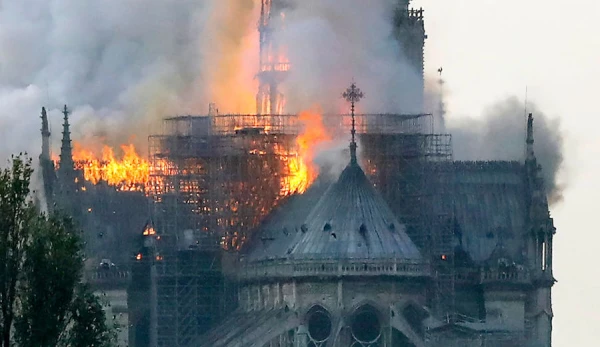
Paris, France, Apr 15, 2019 / 11:33 am (CNA).- The Cathedrale Notre-Dame is on fire, according to the Paris fire department. Multiple eyewitnesses shared photos and videos of the cathedral with visible plumes of smoke and flames across the cathedral’s roof.
Firefighters responded to an alarm rasied shortly before 7pm, according to the newspaper Le Monde.
Paris mayor Anne Hidalgo issued a series of brief statements via Twitter saying that emergency responders are fighting to control the flames and appealing to local residents to keep the area clear to assist their efforts.
Officials have not yet determined what caused the fire, which is still burning.
The landmark cathedral in the French capital is one of the most recognizable churches in the world. The fire comes after several weeks of vandalism and arson attacks on church buildings across France.
If you value the news and views Catholic World Report provides, please consider donating to support our efforts. Your contribution will help us continue to make CWR available to all readers worldwide for free, without a subscription. Thank you for your generosity!
Click here for more information on donating to CWR. Click here to sign up for our newsletter.
Major Archbishop Sviatoslav Shevchuk, leader of the Ukrainian Greek Catholic Church, on Dec. 9, 2022 / Oleksandr Sawranskij / Major Archbishopric of the Ukrainian Greek Catholic Church
St. Louis, Mo., Feb 10, 2023 / 14:15 pm (CNA).
Marking near… […]
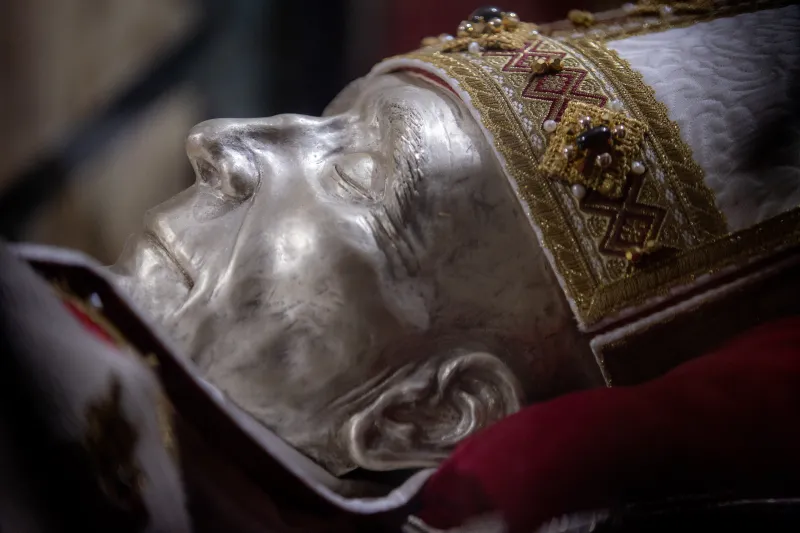
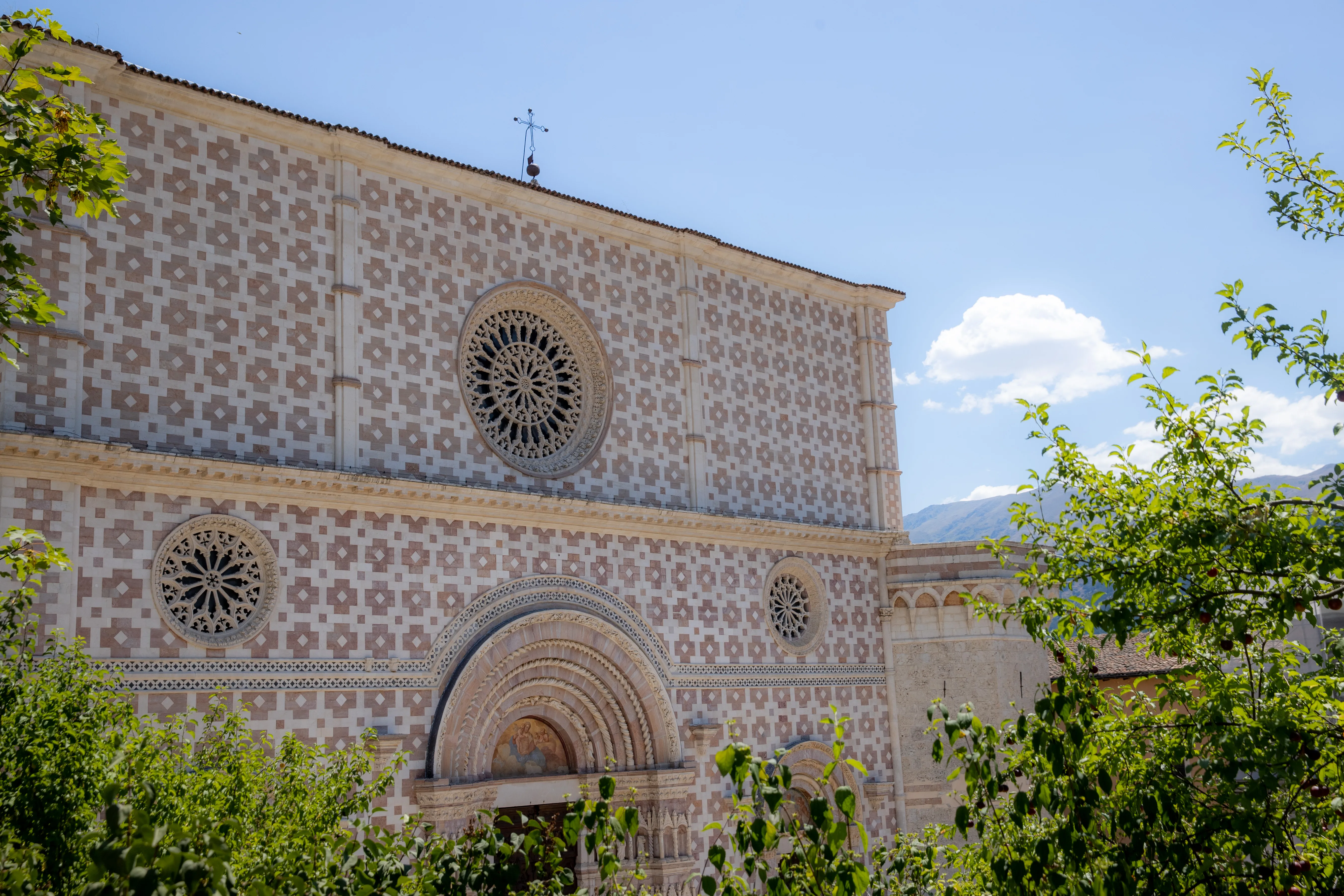
Pope Celestine V was canonized in 1313 and since 1327 has been buried in the Basilica of Santa Maria di Collemaggio in L’Aquila. / Daniel Ibáñez / CNA
Rome Newsroom, Aug 21, 2022 / 03:38 am (CNA).
Peter of Morrone was an unusual choice for pope.
He was not a cardinal, for one, but a Benedictine monk and hermit living in a remote mountainous cave. He was also around 80 years of age.
But the Church’s 11 living cardinals had spent more than two years in a stalemate over the new pope’s election. So when the saintly Peter delivered to the cardinals the message that God would punish them for any further delays — his name was put forward, and soon after, on Jul. 5, 1294, a consensus was reached.
Bishops carried to Peter’s mountain hermitage the news of his election to the papacy. He reportedly was reluctant to accept, even trying to flee. Still, on Aug. 29, 1294, he was crowned Pope Celestine V in the Basilica of Santa Maria di Collemaggio in the city of L’Aquila.
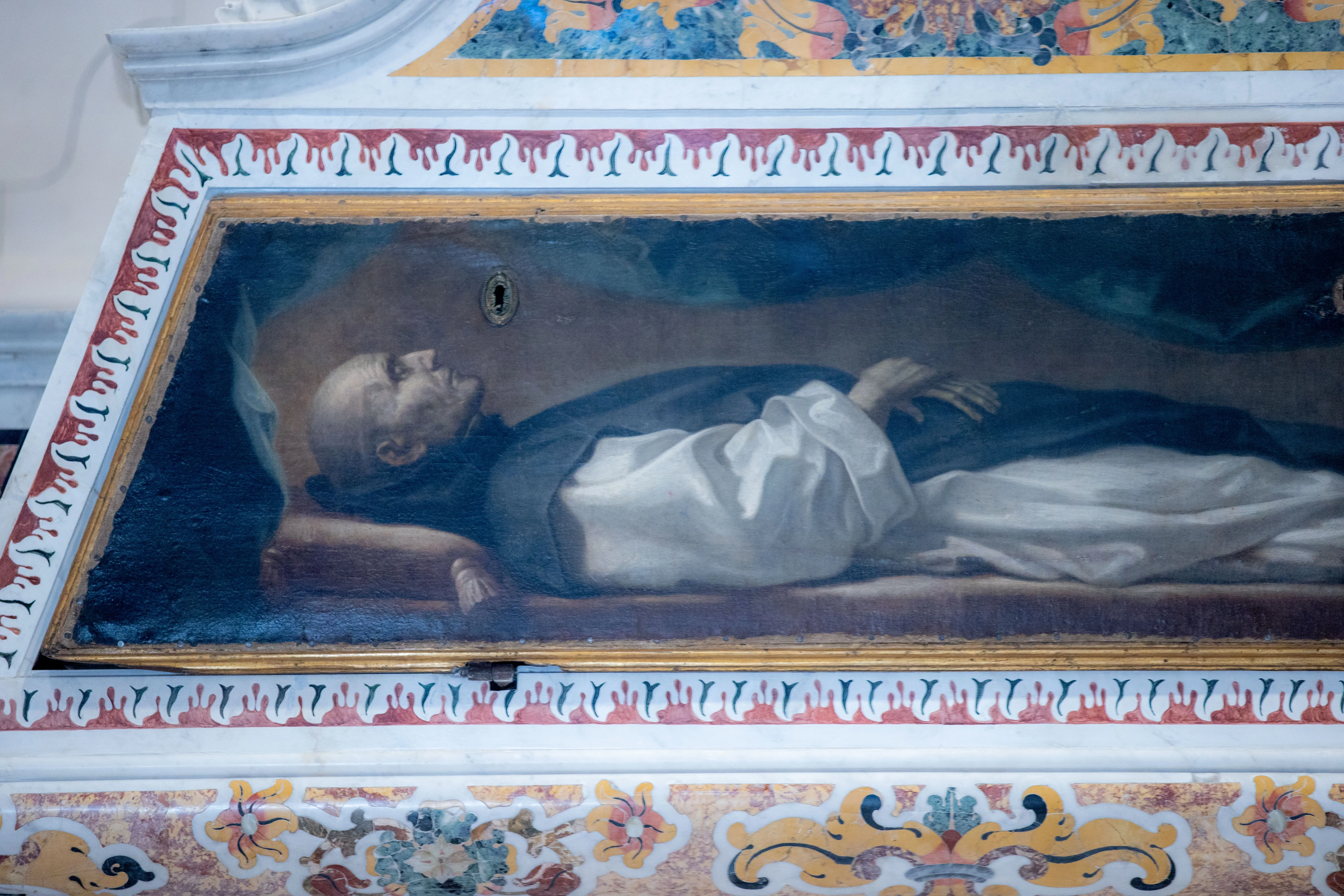
Peter of Morrone is depicted inside the basilica of L’Aquila. Daniel Ibáñez / CNA
According to historical sources, besides kings, nobles, and cardinals, more than 200,000 people attended the ceremony, a grand moment of celebration.
One month later, one of Celestine’s first actions as pope was to declare the possibility for anyone to receive a plenary indulgence who, having confessed his or her sins and sincerely repented of them, devotedly visited the Basilica of Santa Maria di Collemaggio between sunset on Aug. 28 and sunset on Aug. 29, the feast of the martyrdom of St. John the Baptist.
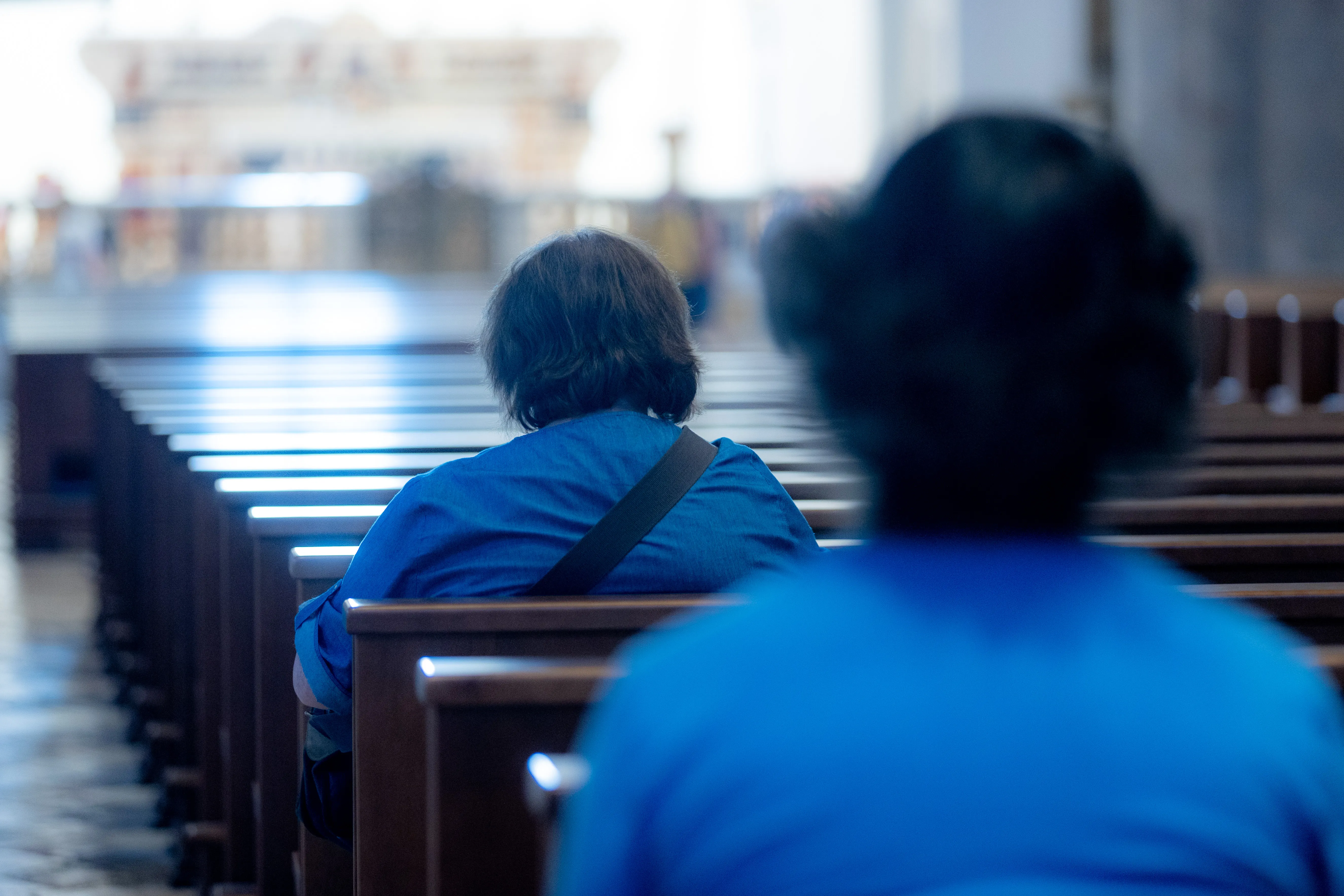
Women are praying in the basilica in L’Aquila in August 2022. Daniel Ibáñez / CNA
A plenary indulgence is a grace granted by the Catholic Church through the merits of Jesus Christ, Mary, and all the saints to remove the temporal punishment due to sin.
Celestine’s indulgence was exceptional at the time, given it was available to anyone, regardless of status or wealth, and cost nothing except personal repentance at a time when indulgences were often tied to almsgiving. For this reason, some consider the Celestinian Forgiveness, as it came to be called, history’s first jubilee.
Unfortunately, Pope Celestine V did not reign long enough to see the legacy of his indulgence. As pope in 1294, he was also the ruler of the Papal States, but he soon proved to be an ineffectual political leader.
On Dec. 13, five months after his election, he resigned from the papacy.
Pope Boniface VIII, Celestine’s successor, imprisoned the former pope out of fear that opponents to the resignation might try to install Celestine as an antipope. Celestine V died a prisoner ten months later.
Peter of Morrone was canonized in 1313 and since 1327 has been buried in the Basilica of Santa Maria di Collemaggio in L’Aquila.
The Basilica of Santa Maria di Collemaggio in L’Aquila. Daniel Ibáñez / CNA
According to Johannes Grohe, a professor of Medieval History, the Celestinian Forgiveness was the precursor to the Holy Years, or Jubilees, which the Church typically celebrates every 25 years.
In 1300, Pope Boniface VIII issued a bull of indulgence proclaiming that Christians who confessed their sins, received the Eucharist and made a pilgrimage to Rome could receive a plenary indulgence.
Boniface VIII “was inspired” by Celestine V’s own “Jubilee” in L’Aquila, which started in 1294 and continued after his papal abdication and death, Grohe told EWTN News in an interview last month. “This indulgence of Pope Celestine V was the precursor, one could say, to the first great Jubilee.”
Both traditions continue to this day. In L’Aquila, the Celestinian Forgiveness, or Perdonanza Celestiniana as it is called in Italian, will celebrate its 728th year with a visit from Pope Francis on Aug. 28 to open the Holy Door.
Now a week-long festival, the Forgiveness has come to be an essential cultural, as well as spiritual, event.
Jubilee years in the Church, also called Holy Years, have continued throughout the centuries. A critical aspect of a Holy Year is the indulgence attached to walking through the Holy Door of one of Rome’s four major basilicas, including St. Peter’s.
Preparations are already underway in Rome and the Vatican for the next ordinary jubilee in 2025.
Cardinal Vincent Nichols at the Red Mass at Westminster Cathedral, London, England, Oct. 1, 2021. / Credit: Diocese of Westminster via Flickr
London, England, Nov 8, 2024 / 15:25 pm (CNA).
Catholics across England and Wales are urged to unite i… […]
8 Comments
The Cathedral was a monument to Our Lady by a civilization that believed in, trusted her, and paid her homage. This fire is surely a sign to the civilization which does her little honor and indeed pays her little homage and even less belief. In this Holy Week, let us faithful ones beg her protection.
It’s incredibly painful to watch the cathedral burning. But however beautiful it was, it was only rock, wood, glass and metal, and whatever those before us made we can make again if we try.
But maybe a good time to remember the rain falls on us all, good and wicked and in between. Let’s not suggest we can escape hardship through thoughts and deeds.
I am grateful that nobody, it seems, has been killed, but I am heartbroken by the destruction. Would it be wrong to pray that God would miraculously restore it?
When I was 6 years old, I prayed that God would miraculously restore my dog to life. We need to learn that this is not how God normally works. And frankly (an apt word), our prayers are better spent asking for a restoration of the Faith that built the building rather than for the building itself.
I am aware that that is not how God normally works. Miracles, especially of that sort, are not common. But as Ramjet says below, a miraculous restoration might aid in the restoration of lost faith. So many people were praying publicly last night – perhaps some of whom normallly don’t.
Yes, they did. “Etienne Loraillère, an editor at France’s KTO Catholic Television, reported that “Fr. Fournier, chaplain of the Paris Firefighters, went with the firefighters into Notre-Dame cathedral to save the crown of thorns and the Blessed Sacrament.”



The Cathedral was a monument to Our Lady by a civilization that believed in, trusted her, and paid her homage. This fire is surely a sign to the civilization which does her little honor and indeed pays her little homage and even less belief. In this Holy Week, let us faithful ones beg her protection.
It’s incredibly painful to watch the cathedral burning. But however beautiful it was, it was only rock, wood, glass and metal, and whatever those before us made we can make again if we try.
But maybe a good time to remember the rain falls on us all, good and wicked and in between. Let’s not suggest we can escape hardship through thoughts and deeds.
I am grateful that nobody, it seems, has been killed, but I am heartbroken by the destruction. Would it be wrong to pray that God would miraculously restore it?
When I was 6 years old, I prayed that God would miraculously restore my dog to life. We need to learn that this is not how God normally works. And frankly (an apt word), our prayers are better spent asking for a restoration of the Faith that built the building rather than for the building itself.
We don’t know how God works.
A restoration of the Cathedral may be instrumental in bringing a few lost souls back to Faith.
I am aware that that is not how God normally works. Miracles, especially of that sort, are not common. But as Ramjet says below, a miraculous restoration might aid in the restoration of lost faith. So many people were praying publicly last night – perhaps some of whom normallly don’t.
Please, does anyone know if they saved the Eucharist?
Yes, they did. “Etienne Loraillère, an editor at France’s KTO Catholic Television, reported that “Fr. Fournier, chaplain of the Paris Firefighters, went with the firefighters into Notre-Dame cathedral to save the crown of thorns and the Blessed Sacrament.”