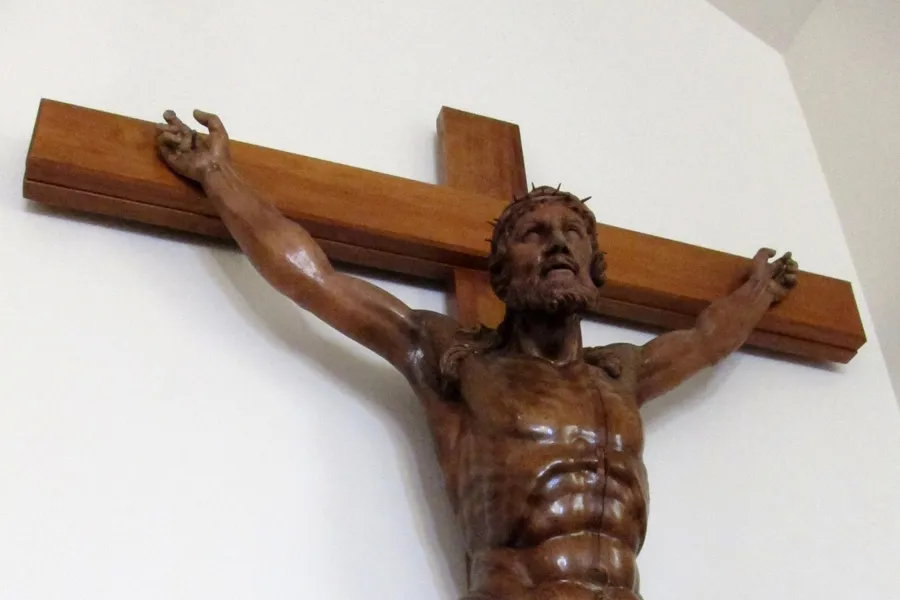
Rome, Italy, Jul 24, 2018 / 12:08 pm (CNA/EWTN News).- A bill has been introduced in the Italian parliament which would require the visible display of crucifixes in public buildings, Italian news magazine L’Espresso reported Monday.
The bill, “Dispositions concerning the display of the crucifix in schools and in offices of public administration,” proposes crucifixes be visibly hung in places such as schools, universities, prisons, public offices, consulates, embassies, and ports.
The proposal would also order a fine of up to 1,000 euros ($1,169) for non-compliance. The bill now waits to be scheduled for discussion in the Chamber and Senate.
It was introduced by the country’s Lega Nord party, headed by Matteo Salvini, the newly-made interior minister and deputy prime minister alongside the leader of the Five Star Movement, Luigi di Maio.
Italy’s general election, held in May, resulted in a coalition government led by Lega Nord and the Five Star Movement, both of which are center-right populist parties.
A similar decision was made by the government of Bavaria, a German state.
Bavarian premier Markus Söder announced April 24 that the entrances to state building would be required to display a cross by June 1. Söder’s office said the decision was meant to “express the historical and cultural character of Bavaria” and to present “a visible commitment to the core values of the legal and social order in Bavaria and Germany.”
If you value the news and views Catholic World Report provides, please consider donating to support our efforts. Your contribution will help us continue to make CWR available to all readers worldwide for free, without a subscription. Thank you for your generosity!
Click here for more information on donating to CWR. Click here to sign up for our newsletter.
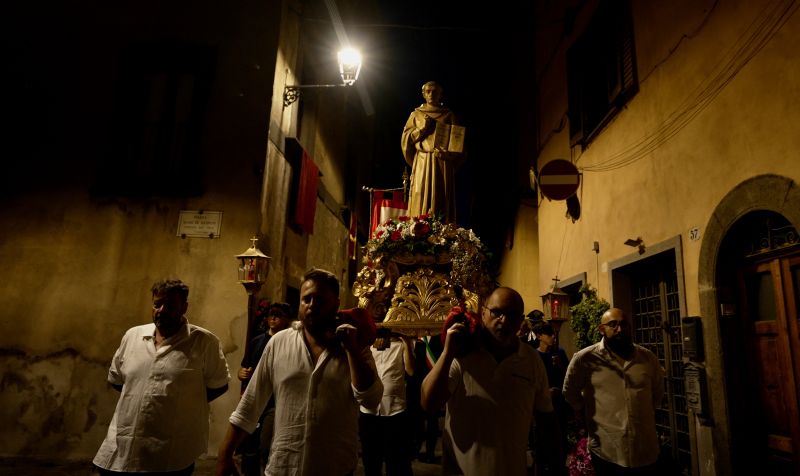
Four men carry a statue of St. Bonaventure during a candlelight procession on July 14, 2023, in Bagnoregio, Italy, his birthplace, on the vigil of the saint’s feast day. / Patrick Leonard/CNA
Bagnoregio, Italy, Jul 15, 2023 / 12:15 pm (CNA).
The birthplace of St. Bonaventure, a 13th-century intellectual giant now revered as a doctor of the Church and the “second founder” of the Franciscans, paid homage to its patron Friday night on the vigil of his feast day with music, prayers, and a candlelight procession.
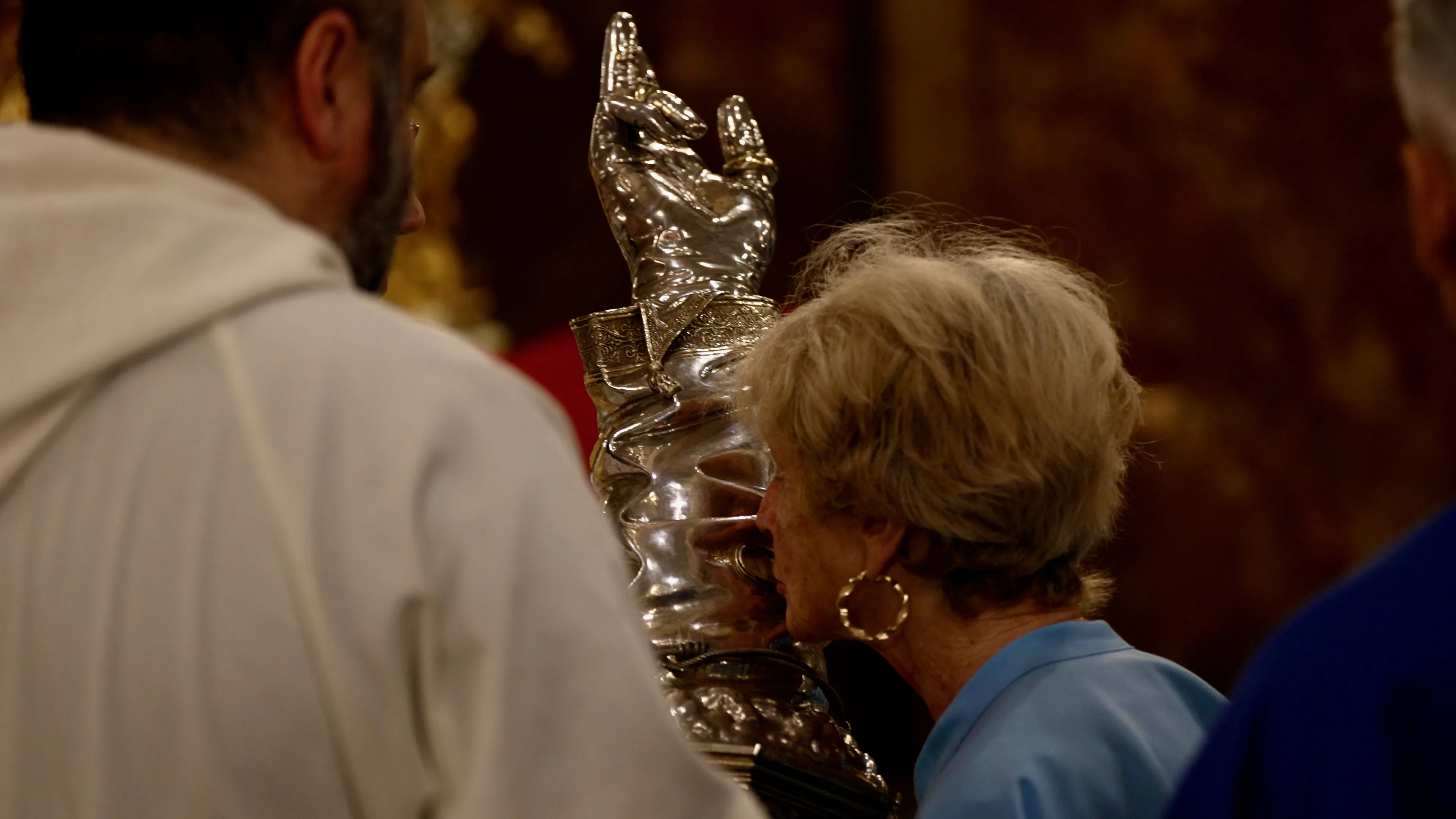
For the citizens of Bagnoregio, an idyllic town nestled in Italy’s Lazio region about a 1½ drive north of Rome, the July 15 feast is both a solemn holy day and a wellspring of civic pride. Bonaventure’s “braccio santo,” or holy arm — the only surviving relic of the saint — is kept in a silver, arm-shaped reliquary housed in a side chapel of Bagnoregio’s Cathedral of San Nicola and San Donato.
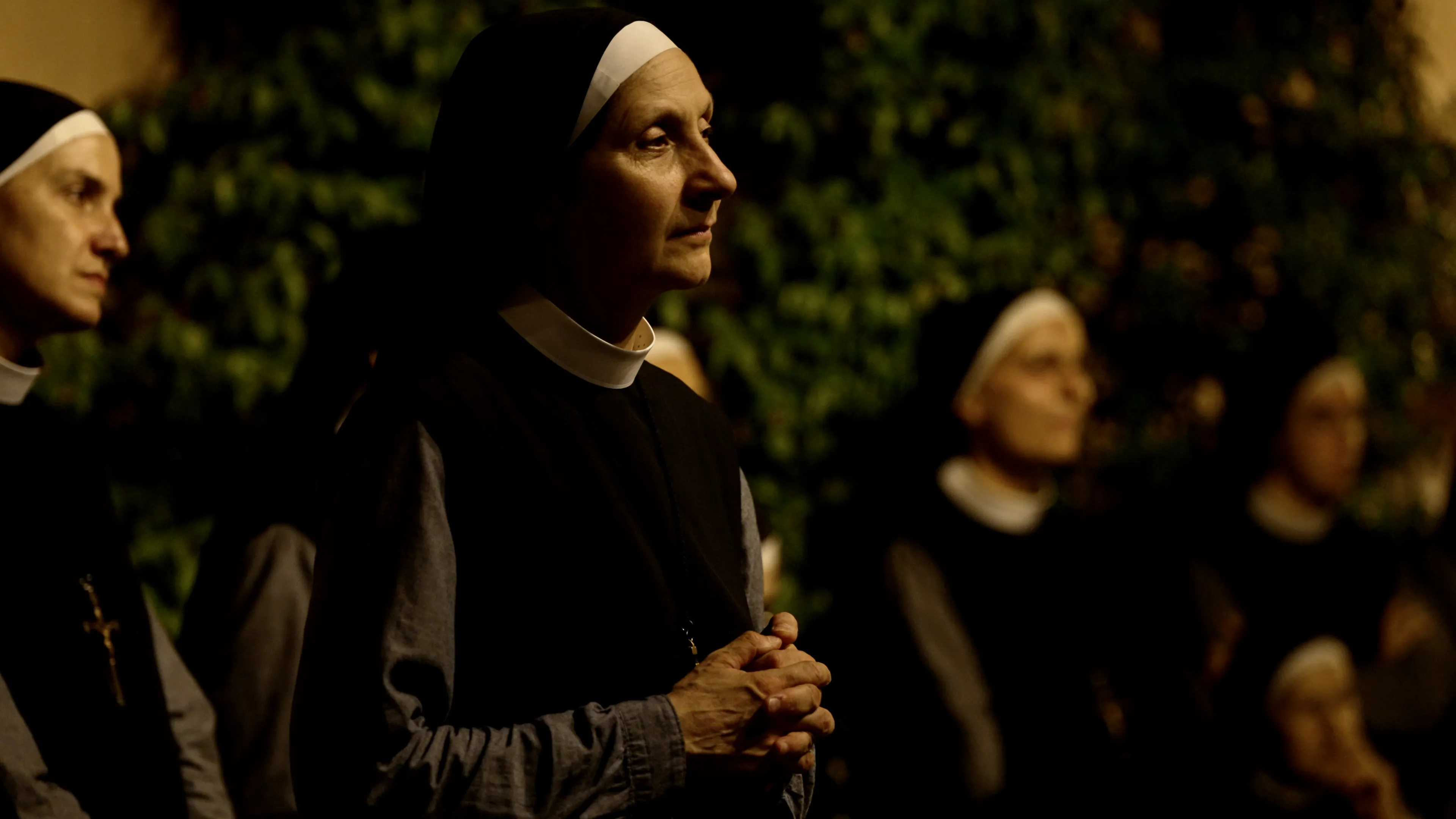
Religious sisters participating in a candlelight procession on July 14, 2023, in Bagnoregio, Italy, in honor of the town’s patron saint and native son, St. Bonaventure. Patrick Leonard/CNA
Friday’s procession, which commenced at the cathedral, was led by the town’s confraternities of the Most Blessed Sacrament, St. Francis, and St. Peter. Following them were a brass band, a statue of the saint adorned with flowers and carried by four men, and a priest carrying the holy arm. Then came Cardinal Fortunato Frezza, numerous priests, and this year’s first communicants, followed by other religious and residents.
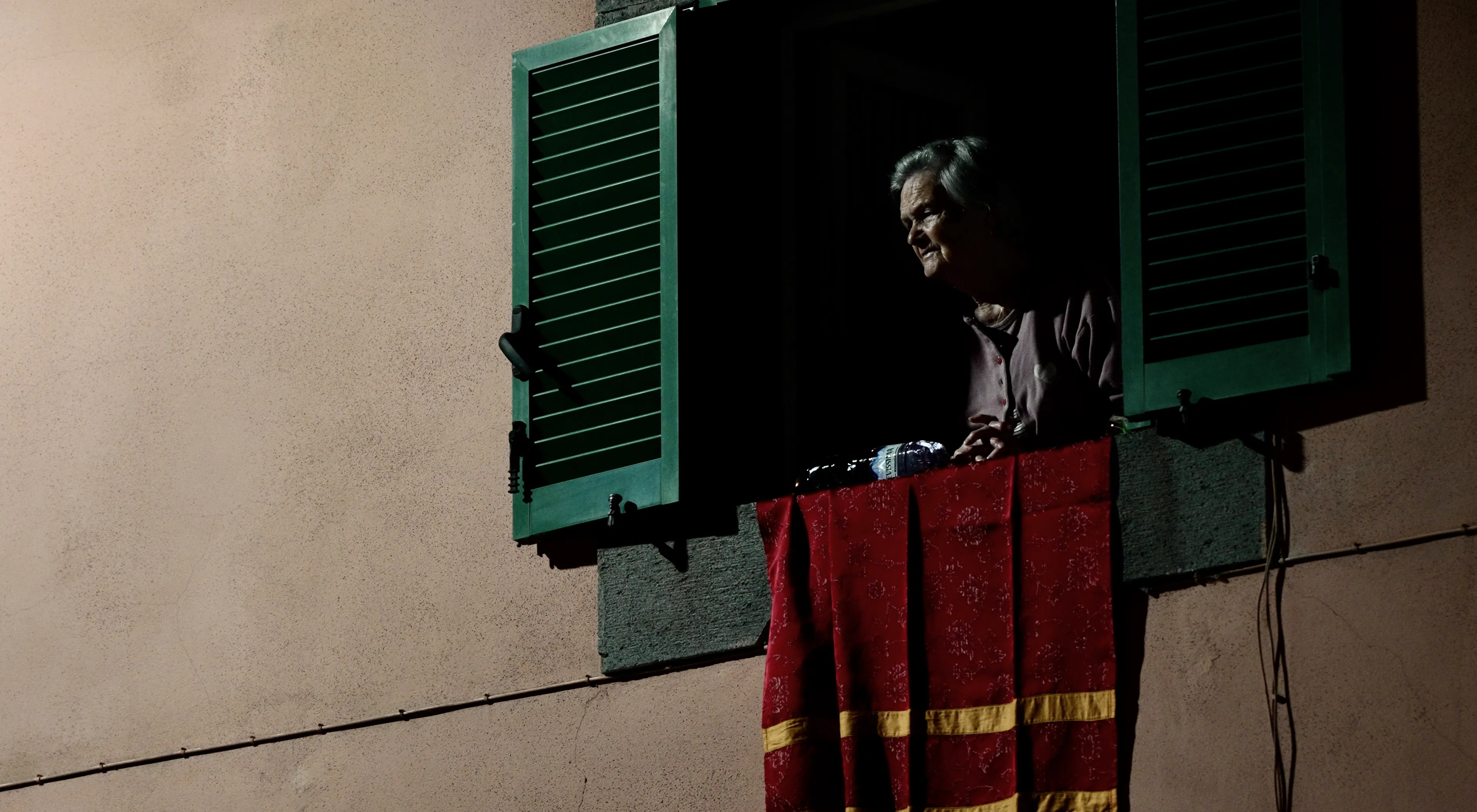
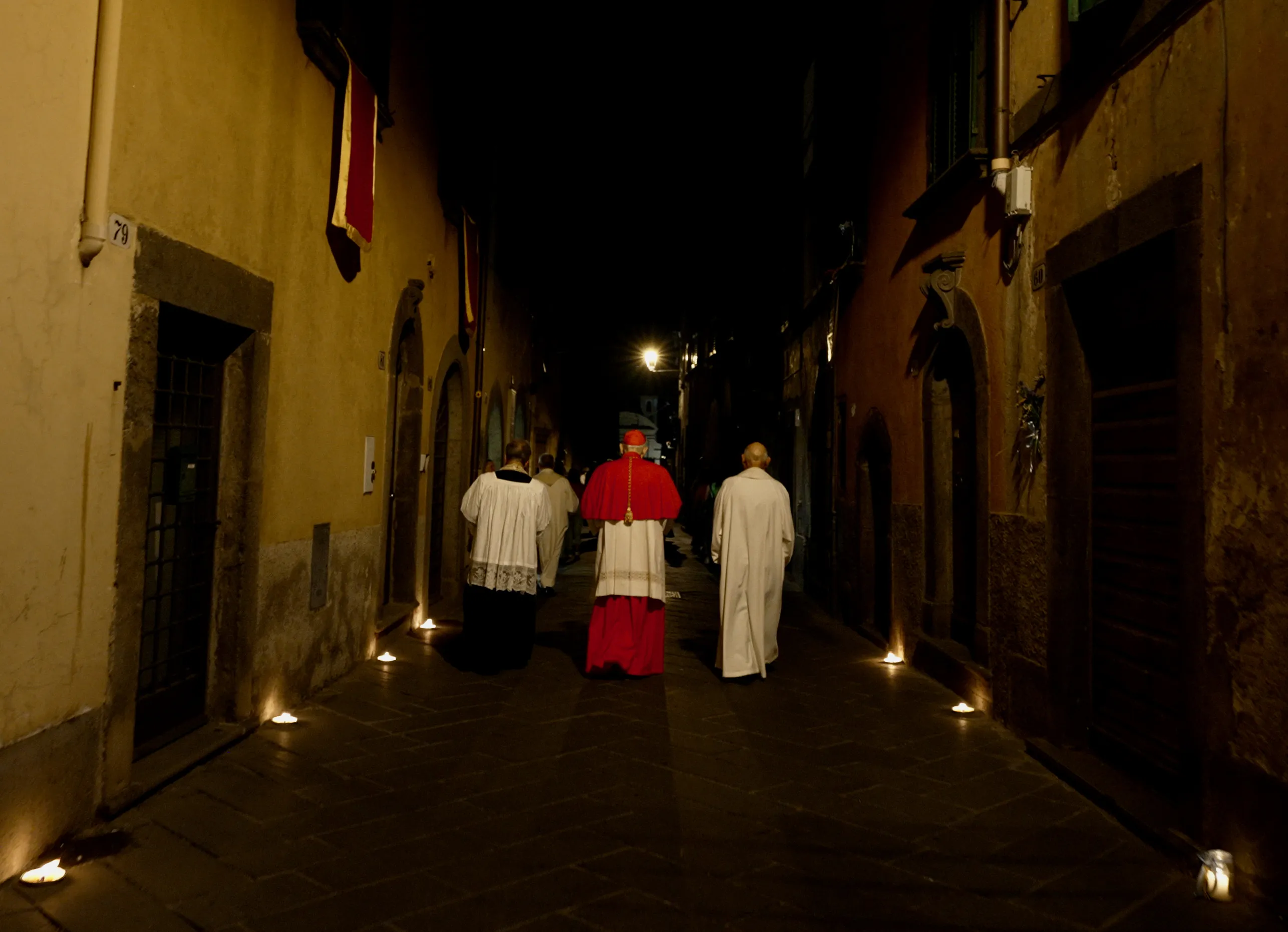
As the participants made their way down the candlelit Via Roma, onlookers watched from windows, balconies, and restaurants bustling with patrons on a warm summer evening.
A resident of Bagnoregio, Italy, watches a candlelight procession through the streets of the town in honor of its patron saint, St. Bonaventure, on July 14, 2023. Patrick Leonard/CNA
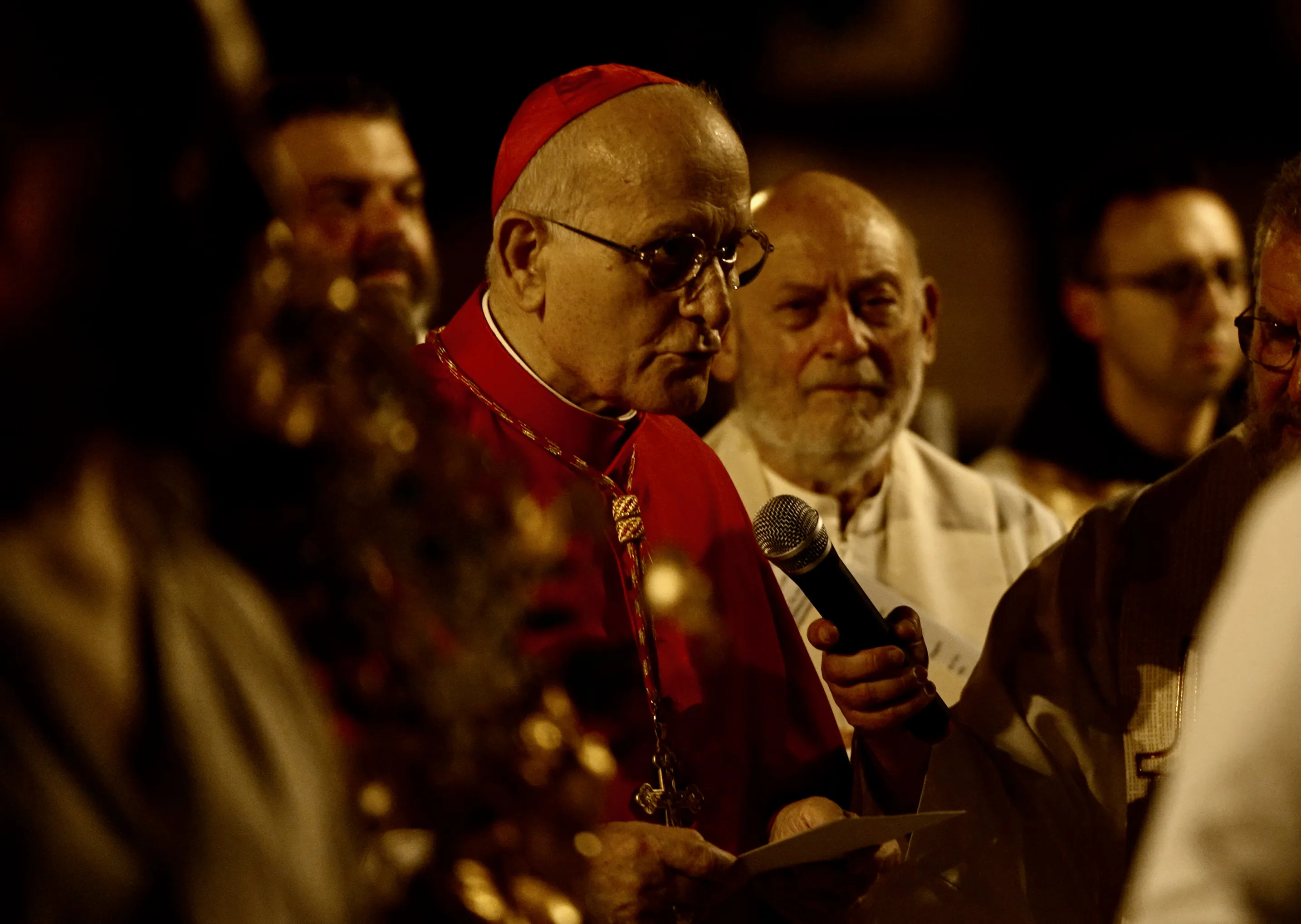
Arriving at the piazza Sant’Agostino, Cardinal Frezza, standing beneath a monument of Bonaventure, offered a brief reflection on the importance of the saint and of procession as a form of popular devotion.
The relic “gives us strength to sustain our weakness … It is a relic that is alive and active,” observed the cardinal, a noted biblical scholar. It is “an arm that teaches,” he said, the very right arm that “wrote his works of great intellect and wisdom.”
The cardinal closed his brief catechesis by saying “our life is a holy procession, an itinerary of the mind towards God.” Here he was playing on the title of one of Bonaventure’s most important theological works, Itinerarium Mentis in Deum, “The Journey of the Mind to God.” Following a benediction with the relic, the procession continued down Via Fidanza, looping around the main gate and then back up Via Roma to the cathedral. The faithful entered and Cardinal Frezza imparted the final blessing, again with the relic.
Cardinal Fortunato Frezza leads a prayer service on July 14, 2023, in Bagnoregio, Italy, in honor of the town’s patron saint and native son, St. Bonaventure. Patrick Leonard/CNA
The Franciscans’ ‘second founder’
Born in 1217 (or 1221, according to some accounts) as Giovanni Fidanza in Civita di Bagnoregio (then in the territory of the Papal States), he displayed great acumen and intellectual curiosity. He was, however, plagued by ill health in his youth. His mother called upon the intercession of St. Francis of Assisi, and he was, according to the legend, miraculously cured.
The young Bonaventure studied at the nearby Franciscan convent. Given his great talent, at 18 he left Bagnoregio to study in Paris, then the intellectual capital of Europe.
He joined the Franciscan Order of Friars Minor in 1243. At the University of Paris, he studied under the renowned Franciscan theologian Alexander de Hales; in 1257 he earned his teaching license (magister cathedratus) in theology there. Bonaventure was a contemporary of St. Thomas Aquinas, whom he met as they were both teaching at the university. The two future doctors of the Church were united in defending the then-nascent Franciscan and Dominican orders, whose orthodoxy was called into question by the secular clergy.
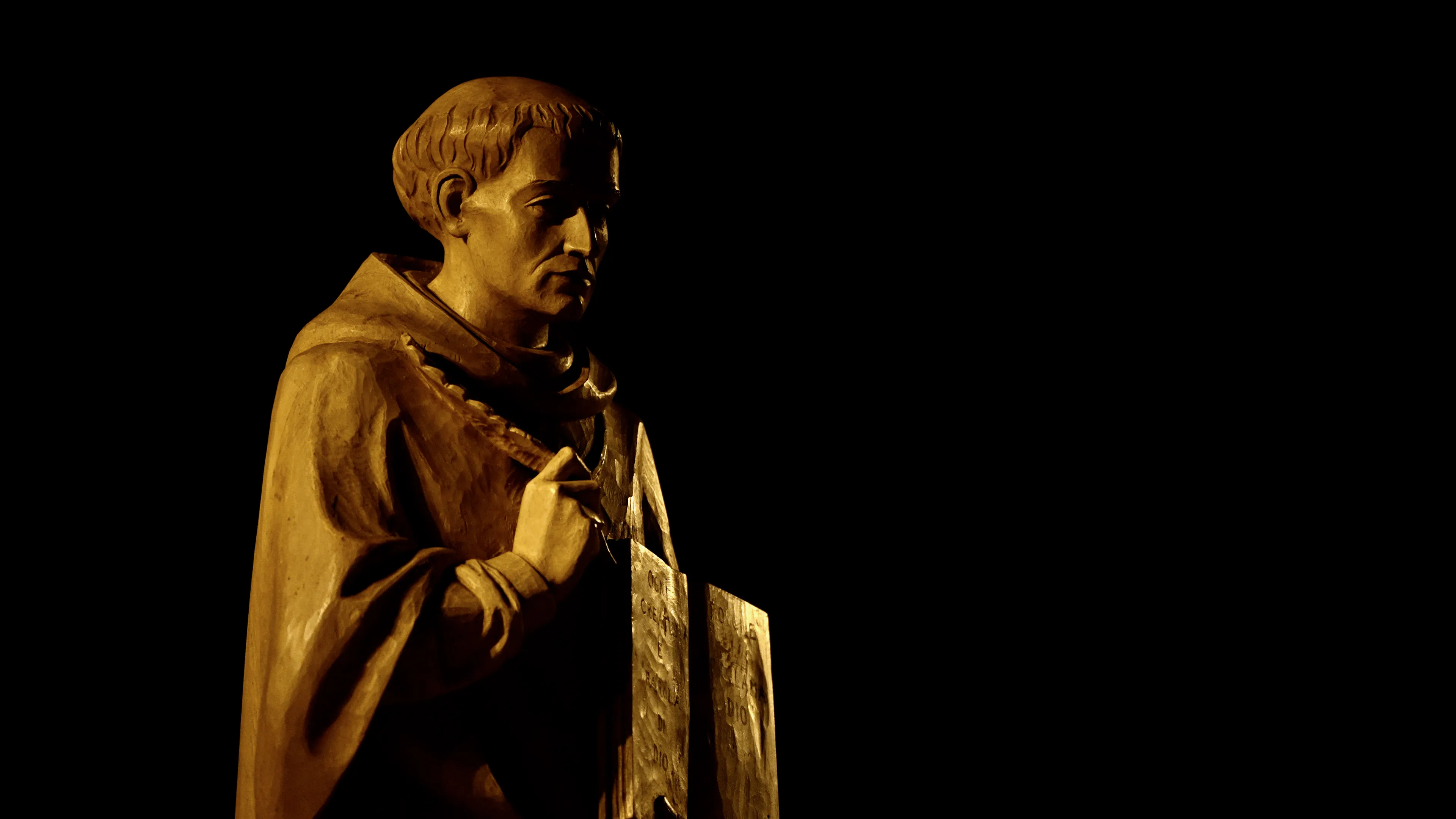
A statue of St. Bonaventure is shown during a candlelight procession on July 14, 2023, in Bagnoregio, Italy, his birthplace, on the vigil of the saint’s feast day. Patrick Leonard/CNA
Bonaventure’s teaching career was cut short; in 1257 when he was appointed minister general of the Franciscan order, which was then plagued by internal factionalism due to divergent understandings of Francis’ spirituality following his death.
To rectify this, Bonaventure spent much time traveling around Europe to help maintain the unity of the order. In 1260 went to Narbonne, France, to solidify the rule of the order and that same year he started writing (which was completed three years later in 1263) the Legenda Maior, “The Major Legend,” considered the definitive biography of St. Francis. For Bonaventure, the key to righting the order lie in Francis’ ideals of obedience, chastity, and poverty, which he re-established as the Franciscans’ guiding principles.
A woman venerates the “braccio santo,” or holy arm, of St. Bonaventure on July 14, 2023, the vigil of the saint’s feast day, at the Cathedral of San Nicola and San Donato in his hometown, Bagnoregio, Italy. Patrick Leonard/CNA
Enduring influence
In addition to his contributions as the “second founder” of the Franciscans, Bonaventure had a profound impact on the papacy. Following the chaos of the three-year conclave in Viterbo that elected Gregory X in 1271 (the longest papal election in the history of the Church), the new pontiff, also a Franciscan, entrusted Bonaventure with preparing many of the key documents for the Second Council of Lyon (1272-1274) which sought to unify the Latin and Greek Churches.
He was made a cardinal in the consistory of May 28, 1273. He did not, however, see the end of the council, as he died on July 15, 1274. He was canonized in 1482 by Pope Sixtus IV and proclaimed Doctor of the Church by Pope Sixtus V in 1588.
A candlelight procession through the streets of Bagnoregio, Italy, on July 14, 2023, honors the town’s native son and patron saint, St. Bonaventure. Patrick Leonard/CNA
In 2009, Pope Benedict XVI, who was a great admirer of Bonaventure, visited the saint’s birthplace to venerate the relic and address the faithful. In 2010 he dedicated three consecutive Wednesday audiences on the saint, outlining the importance of his governance of the Franciscans and his theological, philosophical, and mystical works. Bonaventure’s writings, Benedict observed, demonstrate that “Christ’s works do not go backwards, they do not fail but progress.”
“For St. Bonaventure, Christ was no longer the end of history, as he was for the Fathers of the Church, but rather its center; history does not end with Christ but begins a new period,” Benedict said.
“The following is another consequence: Until that moment the idea that the Fathers of the Church were the absolute summit of theology predominated, all successive generations could only be their disciples,” Pope Benedict explained.
“St. Bonaventure also recognized the Fathers as teachers forever, but the phenomenon of St. Francis assured him that the riches of Christ’s word are inexhaustible and that new light could also appear to the new generations,” he said. “The oneness of Christ also guarantees newness and renewal in all the periods of history.”
London, England, Jan 31, 2020 / 02:04 pm (CNA).- The Church of England will not be withdrawing its recent pastoral guidance affirming that sex is reserved for married, heterosexual partners, despite an apology over the statement from two of the ecclesial community’s bishops.
The guidance, “Civil Partnerships – for same sex and opposite sex couples. A pastoral statement from the House of Bishops of the Church of England”, was issued last month after civil partnerships were first made available to heterosexual couples.
The guidance draws a clear distinction between marriage and civil partnerships, noting that sexual relations are not proper to the latter.
“Sexual relationships outside heterosexual marriage are regarded as falling short of God’s purposes for human beings,” says the guidance on the issue. “The introduction of same sex marriage, through the Marriage (Same Sex Couples) Act 2013, has not changed the church’s teaching on marriage or same sex relationships.”
Civil partnerships were created in 2004 for same-sex couples but are legally distinct from marriage. Same-sex couples were given the legal right to marry in the England and Wales in 2013, but civil partnerships had been available to same-sex couples only.
In the guidance, the Church of England states that because of the “ambiguity” regarding sexual activity in civil partnerships, combined with its teaching on the nature of marriage, it does “not believe that it is possible for the church unconditionally to accept civil partnerships as unequivocally reflecting the teaching of the church.”
Although the Church of England acknowledges that “many of the provisions in the legislation on civil partnerships are, however, similar to, or identical with, those in marriage law,” the nature of the commitment in a civil partnership is different than that of a marriage.
“In particular, [civil partnerships are] not predicated on the intention to engage in a sexual relationship,” says the guidance.
“There is likely to be a range of circumstances in which people of the same sex or opposite sex choose to register a partnership, including some where there is no intention for the relationship to be expressed through sexual activity.”
Some pairs of people who are not romantically involved have entered civil partnerships for tax or benefit purposes.
The Church of England does not conduct or recognize same-sex marriages as marriage. In December 2012, the Church of England permited same-sex attracted clergy in civil partnerships to become bishops, provided they observe continence.
Justin Welby and John Sentamu, the Anglican archbishops of Canterbury and York, said Jan. 30: “We as archbishops, alongside the bishops of the Church of England, apologise and take responsibility for releasing a statement last week which we acknowledge has jeopardised trust. We are very sorry and recognise the division and hurt this has caused.”
They added that the Church of England’s College of Bishops is continuing its study on human sexuality, which they said “is intended to help us all to build bridges that will enable the difficult conversations that are necessary as, together, we discern the way forward for the Church of England.”
The College of Bishops have voted against a proposal to withdraw the guidance.
Bavaria a happy surprise. Italy miraculous. Restoring the Cross in public will hopefully pass Govt muster in Italy and begin the impossible. Restoration of Christian European culture.



Bavaria a happy surprise. Italy miraculous. Restoring the Cross in public will hopefully pass Govt muster in Italy and begin the impossible. Restoration of Christian European culture.