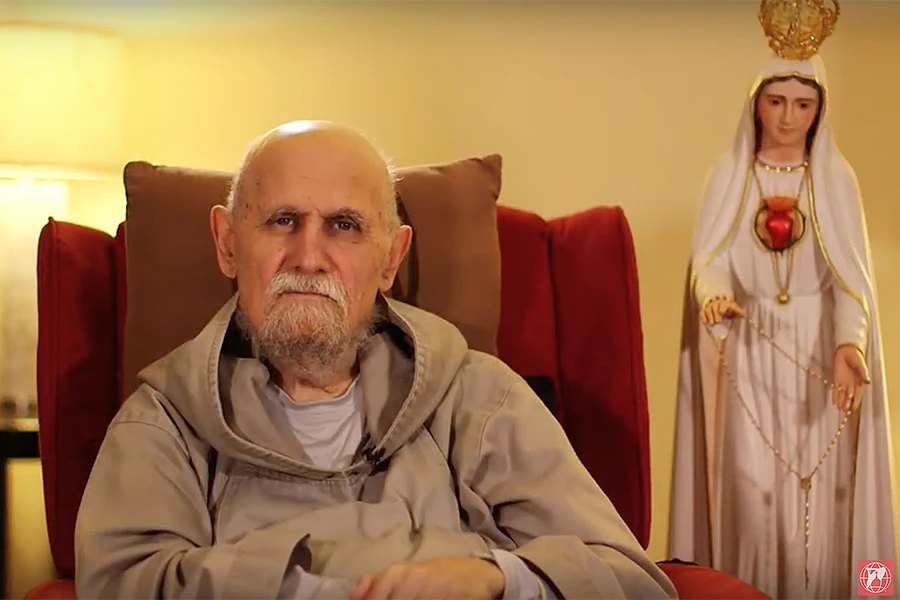
New York City, N.Y., Dec 13, 2017 / 09:45 am (CNA/EWTN News).- Franciscan friar and EWTN host Fr. Andrew Apostoli, CFR, passed away on the morning of Dec. 13, his community has confirmed.
Fr. Apostoli was a founding member of the Franciscan Friars of the Renewal and was a regular on EWTN programming, most recently as the host of “Sunday Night Prime.”
He also authored numerous books and was considered one of the leading experts on the Our Lady of Fatima apparitions.
“All of us at EWTN are saddened by the loss of our dear friend Father Andrew Apostoli, CFR. Father Andrew was a constant presence on the Network for nearly twenty-five years, particularly as the host of ‘Sunday Night Prime’ for the past five years,” said Michael P. Warsaw, Chairman of the Board and CEO of the EWTN Global Catholic Network.
Fr. Apostoli was born Joseph Dominic Apostoli on July 3, 1942 in Woodbury, New Jersey, and was the second of four boys. He first encountered Capuchin Franciscan friars at his parish in 8th grade and was inspired by their joy.
“I felt that the brothers were joyful and I wanted the joy that I saw,” he told the Catholic Herald in 2015.
He met Archbishop Fulton Sheen while attending high school seminary, and would later be ordained a priest by Archbishop Sheen on March 16, 1967. He would eventually become the Vice Postulator for Sheen’s cause for canonization.
Fr. Apostoli was a founding member of the Franciscan Friars of the Renewal in 1988, and was also influential in the founding of the Franciscan Sisters of the Renewal.
During his time in active ministry, Fr. Apostoli served as a teacher, retreat leader and spiritual director. He also wrote many spiritual books on subjects including Our Lady of Fatima and the Holy Spirit. His most recent book, “Answering the Questions of Jesus,” is a book designed to lead readers into deeper reflection on each of the personal questions Jesus asks in the Gospel.
Fr. Apostoli first appeared on EWTN on the “Mother Angelica Live” program in July of 1993, together with Fr. Benedict Groeschel, and taped his own series for the network in 1994, which first aired in 1995.
In 2012, Fr. Apostoli took over as host for EWTN’s “Sunday Night Prime” which had previously been hosted by Fr. Benedict Groschel, a fellow Franciscan Friar of the Renewal.
On November 10, Fr. Apostoli announced on the CFR’s website that due to declining health, he could no longer maintain a public schedule. Over the past month, the brothers have been posting brief health updates about the priest and asking for prayers.
In the morning of Dec. 13, the brothers confirmed that he had passed away.
“We always looked forward to his many visits to Irondale to produce programs,” Warsaw said.
“He was such a kind and holy man who always brought joy to the EWTN Family and who was a constant witness to the Franciscan spirit. We will certainly miss him.”
If you value the news and views Catholic World Report provides, please consider donating to support our efforts. Your contribution will help us continue to make CWR available to all readers worldwide for free, without a subscription. Thank you for your generosity!
Click here for more information on donating to CWR. Click here to sign up for our newsletter.
Bishop Kevin C. Rhoades of Fort Wayne-South Bend, Indiana, was tabbed as the next chair of the Committee for Religious Liberty on Nov. 16, 2022, in Baltimore. / Credit: Shannon Mullen/CNA
CNA Staff, Apr 19, 2024 / 16:30 pm (CNA).
The U.S. Confe… […]
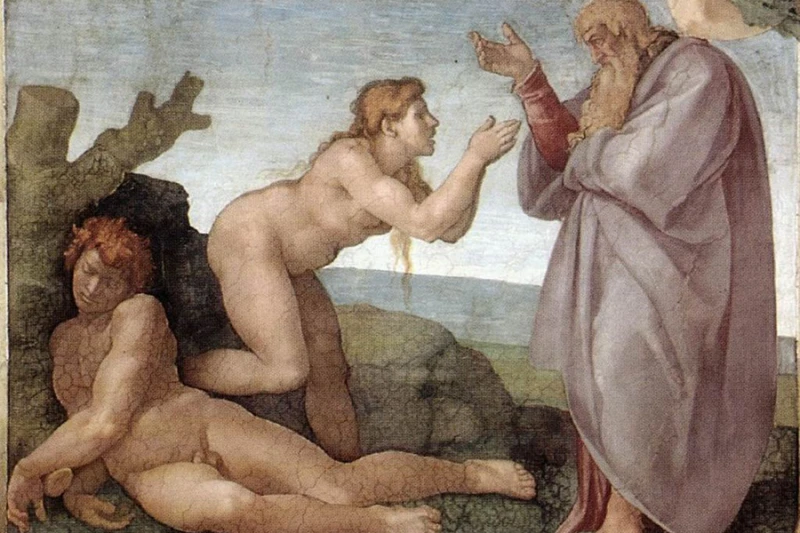
Michelangelo’s The Creation of Eve, from the Sistine Chapel ceiling, c. 1510. / null
Denver, Colo., Nov 15, 2022 / 09:00 am (CNA).
Michelangelo’s artistic masterpiece in the Sistine Chapel broke new ground in portraying the dynamic creative acts of God, but his work also depicts the combined importance of men and women through all of sacred history, art historian Elizabeth Lev has said.
“The spirit of artistic adventure led the artist to experiment with a completely new vision of creation,” Lev said Nov. 12. “He took a book that had been painted, sculpted, mosaiced, and illuminated over and over again in the history of art and created something completely new.”
She spoke at the closing keynote Saturday evening at the fall conference of the University of Notre Dame’s de Nicola Center for Ethics and Culture. Lev teaches at the Rome campus of Duquesne University and the Pontifical University of St. Thomas Aquinas. Her speech, “Creation, Complementarity, & St. John Paul II in Michelangelo’s Sistine Ceiling,” focused on one of the key artistic treasures of Vatican City.
The 16th-century Florentine artist Michelangelo was commissioned by Pope Julius II to paint the Sistine Chapel’s ceiling and the upper section of its walls. This was the artist’s focus from 1508 to 1512. He later finished the Last Judgment above the chapel altar from 1535 to 1541.
The ceiling frescoes show the creation of the heavens and the earth, the creation of Adam and Eve, their expulsion from the Garden of Eden, the great flood, and the rebirth of humankind through Noah.
Lev cited St. John Paul II’s description of Michelangelo’s work in his poem “Meditations on the Book of Genesis at the Threshold of the Sistine Chapel.”
“It is the book of the origins — Genesis,” the pope said. “Here, in this chapel, Michelangelo penned it, not with words, but with the richness of piled-up colors. We enter in order to read it again, going from wonder to wonder.”
Lev reflected on the first three panels depicting the creation of the world. These show “the mighty dynamic figure of God the Father at work.”
“It’s not what God creates, it’s that God creates,” she said. Michelangelo broke ground in portraying God as “physically engaged in creation.” For Lev, this offers “a preview of the Incarnation.”
Turning to Michelangelo’s famous depiction of the Creation of Adam, Lev noted that the artist depicts “just God and the creature formed in his likeness.” Adam is shown as “somewhat listless” in contrast with God’s energy. Adam is “sentient and awake but he has no will or strength or purpose to rise,” she said. “He looks completely passive and dependent despite that incredibly beautiful form.”
“It’s God who reaches towards man,” she continued. For Lev, the outstretched finger of God makes the viewer “almost lean forward in his seat waiting for that final Act of Creation, the divine spark, the Breath of Life that will release that latent energy and allow Adam to take his place as the greatest of creations.”
“This is the joy in humanity that permeates the Renaissance,” Lev said.
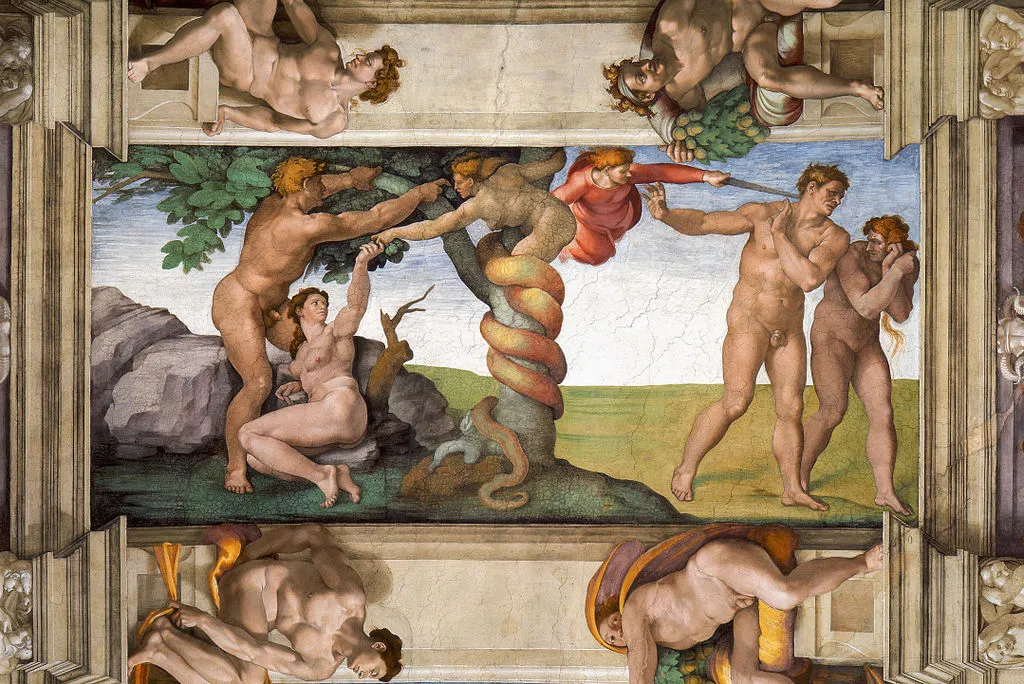
Michelangelo’s The Fall and Expulsion from Paradise from the Vatican’s Sistine Chapel (1508-12).
There is academic debate over a female figure shown in the Creation of Adam. As God the Father stretches out one arm to Adam, his other arm curls around a female figure. Some have identified this figure as Wisdom, some as Mary.
Lev suggested it is best to identify this figure as Eve, both because the figure provides visual balance to Adam and because her gaze “connects her more intimately with Adam.”
The creation of Eve from Adam, depicted next on the chapel ceiling, shows Eve emerging from Adam’s side with her hands clasped in prayer, an image of the Church and the personification of Mary, the “Second Eve.”
Lev cited St. John Paul II’s 1999 homily inaugurating the newly restored Sistine Chapel, after centuries of grime and soot were removed. The pope called the chapel the “sanctuary of the theology of the human body,” alluding to his catecheses offered from 1979 to 1984. The pope suggested that Michelangelo allowed himself to be guided by the Book of Genesis’ depiction of mankind in Eden: “the man and his wife were both naked and they felt no shame.”
Before the fall, Lev commented, Michelangelo depicted Adam and Eve in the state of grace as “two of his most beautiful figures.”
“They are filled with dynamism. They’re buoyant. They’re luminous,” Lev said, adding that their bodies “suggest immortality.” After the fall, however, both of their bodies “lose their luminosity” and appear heavier, like a burden. Adam’s shoulder seems to force Eve into the background, “subjugating her.”
For Lev, the artistic depiction of the genealogy of Jesus Christ also deserves attention. The portrayal of the ancestors of Jesus Christ shows “a genealogy of men and women struggling from generation to generation.” These figures seem “more approachable” and “much more similar to candid family photographs.” Even though 22 women in Jesus’ genealogy are not named, Michelangelo pairs them with their husbands.
Lev noted that Michelangelo broke with artistic convention both by including mothers and by showing them as busy, everyday women “tending to toddlers, toilettes, and tasks.” His style of painting them with “incredible immediacy” adds observations of human nature: Eleazar’s wife holds the purse strings and the key to the house, and her husband looks “startled” as she surveys their son. Other depictions are “tender and intimate,” like the portrayal of the wife of Manasseh, who cradles a swaddled son while rocking an infant’s cradle.
Here, Lev drew on John Paul II’s 1995 “Letter to Women.” He wrote that womanhood and manhood are complementary at the physical, psychological, and even ontological level.
“It is only through the duality of the masculine and the feminine that the human finds full recognition,” the pope said. “To this unity of the two, God has entrusted not only the work of procreation and family life but the creation of history itself.”
Lev noted that the passing of generations “necessarily emphasizes the begetting of children.” This means that the complementarity of the sexes is essential for a population to form and for creation to continue.
In Michelangelo’s portrayal of the Last Judgment, the artist still looks back to creation but also breaks new ground. He placed Mary next to Christ, as “a foil to Christ’s sternness.”
“She is the picture of mercy gazing down towards the elect, placed by the wound in Christ’s side whence the Church sprang,” Lev said. “Mary is transfigured into the Bride of Christ, for whom he gave his life and to whom he cannot say no. She is the conduit to Christ, as Eve was the link between God and man in the creation of woman.”
For Lev, the Sistine Chapel shows the “incredible gift of creation” from the beginning of the world down through the generations, “through which all of us today are a part of that continuation of creation.”
The trailer of the upcoming Russell Crowe movie “The Pope’s Exorcist” indicates that the film might not do justice to the Italian exorcist Father Gabriel Amorth or the rite of exorcism as practiced in the Catholic Church, according to an exorcist organization Amorth himself helped to found.
The International Association of Exorcists on March 7 voiced concern that the film seems to fall under the category of “splatter cinema,” which it calls a “sub-genre of horror.”
The Vatican, the statement said, is filmed with a high-contrast “chiaroscuro” effect seen in film noir.
This gives the film a “‘Da Vinci Code’ effect to instill in the public the usual doubt: Who is the real enemy? The devil or ecclesiastical ‘power’?” the exorcists’ association said.
While special effects are “inevitable” in every film about demonic possession, “everything is exaggerated, with striking physical and verbal manifestations, typical of horror films,” the group said.
“This way of narrating Don Amorth’s experience as an exorcist, in addition to being contrary to historical reality, distorts and falsifies what is truly lived and experienced during the exorcism of truly possessed people,” said the association, which claims more than 800 exorcist members and more than 120 auxiliary members worldwide.
“In addition, it is offensive with regard to the state of suffering in which those who are victims of an extraordinary action of the devil find themselves,” the group’s statement added. The statement responded to the release of the movie trailer and promised a more in-depth response to the film’s April 14 theatrical release.
Father Gabriele Amorth, chief exorcist of Rome, speaks to CNA on May 22, 2013. Steven Driscoll/CNA
Amorth, who died at age 91 in 2016, said he performed an estimated 100,000 exorcisms during his life. He was perhaps the world’s best-known exorcist and the author of many books, including “An Exorcist Tells His Story,” reportedly an inspiration for the upcoming movie.
Several of Amorth’s books are carried by the U.S. publisher Sophia Institute Press. The publisher’s newly released book “The Pope’s Exorcist: 101 Questions About Fr. Gabriele Amorth” is an interview in which the priest addresses many topics ranging from prayer to pop music.
Michael Lichens, editor and spokesperson at Sophia Institute Press, voiced some agreement with the exorcist group.
“The International Association of Exorcists is right to be concerned and I’m thankful for their words,” Lichens told CNA. “My hope is that audiences will remember that Father Amorth is a real person with a great legacy and perhaps a few moviegoers will look up an interview or pick up his books.”
“This was a man who included St. Padre Pio and Blessed Giacomo Alberione as mentors, as well as Servant of God Candido Amantini, who was his teacher for the ministry of exorcism,” he said. “Father Amorth fought as a partisan as a young man and grew to fight greater evil as an exorcist. His life is an inspiration and I know that his work and words will still reach many.”
Amorth was born in Modena, Italy, on May 1, 1925. In wartime Italy, he was a soldier with the underground anti-fascist partisans. He was ordained a priest in 1951. He did not become an exorcist until 1986, when Cardinal Ugo Poletti, the vicar general of the Diocese of Rome, named him the diocesan exorcist.
The priest was frequently in the news for his comments on the subject of demonic forces. In an interview with The Sunday Telegraph in 2000, he said: “I speak with the devil every day. I talk to him in Latin. He answers in Italian. I have been wrestling with him, day in, day out, for 14 years.”
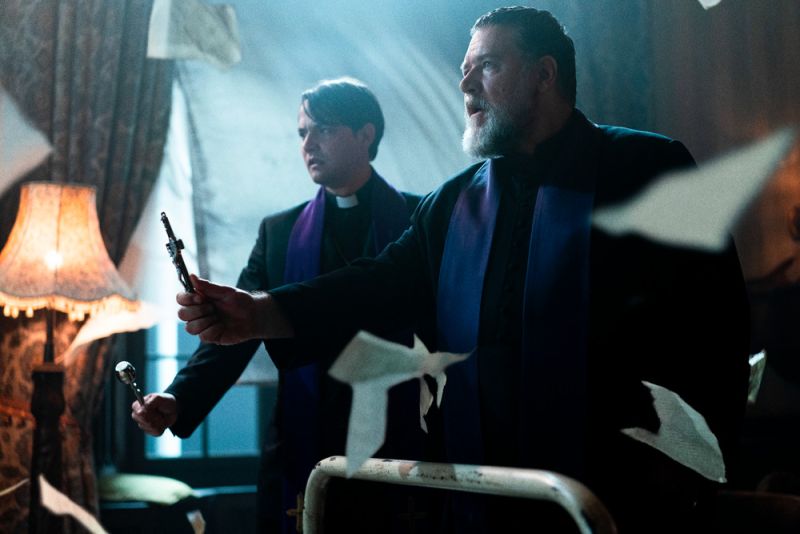
The movie “The Pope’s Exorcist” claims to be “inspired by the actual files of the Vatican’s chief exorcist.” The Sony Pictures movie stars the New Zealand-born actor Russell Crowe as Amorth. Crowe’s character wears a gray beard and speaks English with a noticeable accent.
“The majority of cases do not require an exorcism,” the Amorth character says in the movie’s first trailer. A cardinal explains that Crowe’s character recommends 98% of people who seek an exorcism to doctors and psychiatrists instead.
“The other 2%… I call it… evil,” Crowe adds.
The plot appears to concern Amorth’s encounter with a particular demon. Crowe’s character suggests the Church “has fought this demon before” but covered it up.
“We need to find out why,” he says.
The trailer shows short dramatic scenes of exorcism, including a confrontation between Amorth and a girl apparently suffering demonic possession.
The International Association of Exorcists said such a representation makes exorcism become “a spectacle aimed at inspiring strong and unhealthy emotions, thanks to a gloomy scenography, with sound effects such as to inspire only anxiety, restlessness, and fear in the viewer.”
“The end result is to instill the conviction that exorcism is an abnormal, monstrous, and frightening phenomenon, whose only protagonist is the devil, whose violent reactions can be faced with great difficulty,” said the exorcist group. “This is the exact opposite of what occurs in the context of exorcism celebrated in the Catholic Church in obedience to the directives imparted by it.”
CNA sought comment from Sony Pictures and “The Pope’s Exorcist” executive producer Father Edward Siebert, SJ, but did not receive a response by publication.
Amorth co-founded the International Association of Exorcists with Father René Laurentin in 1994. In 2014 the Catholic Church recognized the group as a Private Association of the Faithful.
The association trains exorcists and promotes their incorporation into local communities and normal pastoral care. It also aims to promote “correct knowledge” about exorcism ministry and collaboration with medical and psychiatric experts who have competence in spirituality.
Exorcism is considered a sacramental, not a sacrament, of the Church. It is a liturgical rite that only a priest can perform.
Hollywood made the topic a focus most famously in the 1973 movie “The Exorcist,” based on the novel by William Peter Blatty.
“Most movies about Catholicism and spiritual warfare sensationalize,” Lichens of Sophia Institute Press told CNA. “Sensationalism and terror sell tickets. As a fan of horror movies, I can understand and even appreciate that. As a Catholic who has studied Father Amorth, though, I think such sensationalism distorts the important work of exorcism.”
“On the other hand, ‘The Exorcist’ made the wider public more curious about this overlooked ministry. That is a good thing that came out, despite other reservations and concerns,” he continued. “Still, I would love it if a screenwriter and director spoke to exorcists and tried to show the often-quotidian parts of the ministry.”
An unhealthy curiosity can be a problem, Lichens said.
“When I work as a spokesperson for Amorth’s books, I am always concerned about inspiring curiosity about the demonic,” he told CNA. “As Christians, we know we have nothing to fear from the demonic but curiosity might lead some to want to seek out the supernatural or the demonic. Father Amorth has dozens of stories of people who found themselves afflicted after party game seances.”
Lichens encouraged those who are curious to read more of Amorth’s writings, some of which are excerpted on the Catholic Exchange website. Sophia Institute Press has published “Diary of an American Exorcist” by Monsignor Stephen Rosetti and “The Exorcism Files” by the American lay Catholic Adam Blai.
“First and foremost, Father Amorth was involved in a healing ministry,” Lichens said. “Like other exorcists, his work often involved doctors in physical and mental health because the goal is to bring healing and hope to the potentially afflicted.”
“Those of us who read Amorth might have been excited to read firsthand accounts of spiritual warfare, but readers quickly see a man whose heart was always full of love for those who sought his help,” he added.
The International Association of Exorcists, for its part, praised the 2016 documentary “Deliver Us,” saying this shows “what exorcism really is in the Catholic Church and “the authentic traits of a Catholic exorcist.” It shows exorcism as “a most joyful event,” in their view, because through experiencing “the presence and action of Christ the Lord and of the Communion of the Saints,” those who are “tormented by the extraordinary action of the devil gradually find liberation and peace.”




A deeply holy man. I read somewhere that he daily said all 15 (20?) decades of the Holy Rosary.
A model of faith and humility. Father Andrew was an effective communicator of Catholic Truth. Requiescat in pace.