


 By
By 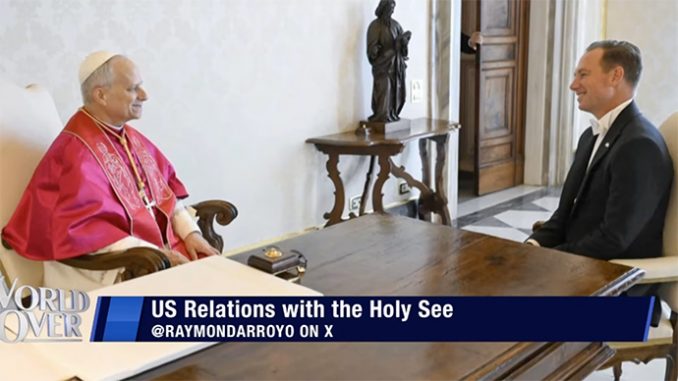
After the Vatican reframed statements that U.S. Ambassador to the Holy See Brian Burch made to The New York Times, the ambassador has clarified that he understands Pope Leo XIV’s role as a head of state is “inseparable” from his role as the universal shepherd of the Church.
During a July 23 interview with the EWTN News program “The World Over with Raymond Arroyo,” Burch clarified that his July 9 comments to the Times were not meant to imply that Leo’s statements about Iran war policy should be seen as simply diplomatic — rather than spiritual — guidance.
“I think thereʼs a misunderstanding,” Burch explained. “… [The role of] the pope as the universal sovereign of the Holy See and as the universal pastor — a pastor of the universal Church — is inseparable.”
The controversy stemmed from a quotation in the Times article in which Burch said: “When the pope acts as the sovereign leader of the Holy See, he is coequal with world leaders.” The article also paraphrased Burch’s position by saying the ambassador argued that the pope’s comments about the Iran war were not made as the vicar of Christ but rather as the political leader of the Vatican City State.
Without naming Burch, the Editorial Director for the Vatican Dicastery for Communication, Andrea Tornielli, subsequently wrote a July 13 op-ed saying that “even when he speaks about war and peace … the Successor of Peter remains, above all, a spiritual leader.” Even though Leo is a head of state, he wrote, this “does not mean that he acts or speaks as a politician when addressing issues concerning the affairs of humanity.”
In his interview with Arroyo, Burch disputed the Times’ characterization of his views, saying the outlet “doesnʼt exactly understand the nuances of Catholic social teaching and how to apply it.”
“The pope has this dual role,” Burch said. “He is both the head of the sovereign territory of the Holy See, which has diplomatic relations with the world, but inseparable from that is his role as the universal pastor of the Catholic Church. And when he acts, he certainly acts in such a way to call the world to these high moral principles, to the ideals of … how [humanity] ought to live together.”
At the same time, Burch insisted that “there are some very difficult, contingent, practical matters” that play into decisions about going to war, which he said “is the responsibility of the prudential wisdom of those responsible for the common good,” which are political leaders like President Trump.
“I tried to explain [to the Times] where there are certain prudential questions,” Burch said. “For example, what does the intelligence information tell us about the situation in Iran? Where is the dialogue at? What [do] the regional alliances look like? What [does] the war game scenario implicate?”
“These are very contingent, prudential questions that inform this question on the legitimate use of force,” he added. “And I think, to the Holy Fatherʼs credit, he is the universal shepherd that is calling humanity to this high ideal to try to resolve these sorts of conflicts without violence, without the use of force.”
Burch told Arroyo that he does not see disagreement between Trump and Leo on the intended end goal: “Thereʼs no disagreement on peace, on disarming Iran, on the need for interreligious dialogue, for religious freedom.”
“Where the challenge comes is the means to get there,” Burch said. He added that it’s not “a surprise, nor a shock, nor an unwelcome message from the Holy Father that we ought to seek peace, that we ought to seek ways to resolve these sorts of conflicts without the use of force.”
“But as you know, original sin exists, and there are evil people in this world with evil intentions that, if they arenʼt stopped, certainly could do enormous damage, catastrophic damage, in the world,” the ambassador emphasized.
If you value the news and views Catholic World Report provides, please consider donating to support our efforts. Your contribution will help us continue to make CWR available to all readers worldwide for free, without a subscription. Thank you for your generosity!
Click here for more information on donating to CWR. Click here to sign up for our newsletter.

We read: “…And when he acts, he certainly acts in such a way to call the world to these high moral principles, to the ideals of … how [humanity] ought to live together.”
Clarifying the clarification, the principles are moral imperatives of the natural law, not quite the same as “ideals” in the possibly Kantian sense.
Pope St. John Paul II restores the distinction: “…the commandment of love of God and neighbor does not have in its dynamic any higher limit [ideals?], but it does have a lower limit, beneath which the commandment is broken” (Veritatis Splendor, 1993, n. 52).
Burch is such an embarrassment. Imagine considering yourself a ‘serious Catholic’ and then having a dark night of the soul over whether you should adhere to the witness of MAGA or the bishop of Rome.
Then again, not surprising for a guy who would try to ignore pro-abortion aspects of Trumpworld (ex: Melania’s rabid embrace of abortion in her book) while he was editor of Catholic Vote.
Burch is pure MAGA. Trump could say literally anything and Burch would enthusiastically go along. It’s like North Korea. Can anyone in MAGA demonstrate independent thought?
Well, what you describe is exactly what progressives like yourself do, so are you in any position to judge?
I’m not a “progressive” but rather a classic conservative. MAGA is right wing,not true conservative. Mussolini was not a conservative. Look it up.
You’re a uniparty RINO, not a conservative. Conservatives would not have a problem with Trump’s policies regarding religious liberty, election integrity, and border security, for starters. You’re not fooling anyone here, though nice try.
Athanasius, you keep using the word “progressive”. I don’t think that word means what you think it means.
The Pope needs to stay in his own lane. Politics is not his bailiwick nor his expertise. He should spebd his time dealing with the scandal of Rupnick and the Jesuits.
How’s that Iranian War going? Regime change yet? Will we be any better off after the war than before? No. This war is a colossal mistake, and we will be worse off because of it. Do you actually believe the lies of the Administration? How naive.
Well, you believed the lies of the Obama administration, and shame on you for that, so we’ll call it even.
Answer the question. How is the war going? It was supposed to end months ago. Keep drinking the Kool Aid.
William: yours is a severe case of TDS. Confine yourself to an institution for treatment.
We continue to pour billions into a loser war. Not acknowledging the obvious is the definition of deranged.
So you believe in Trump after all that has happened? Incredible.
It’s not either or but both and. Don’t you understand that he wears two hats?
James, the Pope only has one hat and one mark on his soul placed by the Holy Spirit.
Burch serves at the will, wish, and whim of the president of the US, with the American taxpayers paying his salary. Nevertheless, Burch clarifies the clarification according to the Vatican and “to the Holy Father’s credit.” Whether Burch spoke incorrectly, whether the pope spoke as the Vicar of Christ, whether the pope spoke as head of state or inseparably, what difference does it make? The pope will have Burch’s American hot dog and apple pie exactly as and when the pope does want them. Aye, aye, Your Holiness!
I was saying Trump says he listens to folks.
‘ This fight against a shared ideological enemy – one hostile to traditional societies, national identities, and ordered liberty – offers common ground. Powers such as China and Russia, with their own experiences managing ideological extremism and emphasis on domestic order, might stand to benefit from – and contribute to – practical cooperation in safeguarding stability and development. ‘
https://www.rt.com/news/643395-trump-far-left-terrorism/
James O’Connor: don’t you understand that the pope is not an elected politician?
The killing of Khomeini, Iran’s religious leader and head of state plus a large percentage of his governmental, military leadership in a military strike suggested and led by Israel with U.S. approbation was immoral.
So far the outcome of this war with Iran justifies Pope Leo’s opposition.
Leo is doing a lousy job governing the Church. He’s foolish to think he’s competent to run world affairs?
You may be right on both counts. Although the general Church policy against war except in self defense seems to hold true with Iran. We can argue they are a nuclear threat if they succeed in developing the capacity.
From that perspective a policy of containment by targeting nuclear sites like Fordow seems now to have been a better option – that in light of the growing inclusion of other nations, terrorist groups like the Houthis.
Diogeneso, I KNOW YOU MEAN WELL, BUT you usually dive deep with innuendo. Remarkably, you seem to ignore the STARK reality BEING PERPETED BY ONE EVIL MAN. Trump blew my socks off at the White House Correspondents’ Dinner, where he went crazy for more than one hour, pounding his chest and voicing his accomplishments, fiercely denouncing the press and former presidents with his childlike narcissism.
Please be specific with your responses to me. Yes, there is much to unpack here. I won’t speak for WILLIAM GIVEN, THAT YOU HAVE DUBBED US WITH THE NEED FOR COUNSELING. Funny, I DID RECEIVE COUNSELING recently WITH THE MAN in a box BEHIND A SCREEN.
Regardless, your responses can be taken out of context. Or, maybe not.
Be well
And Trump is competent to run world affairs.?
Throughout history, the position of the Pope has been political. The emphasis of political over spiritual has flip-flopped or merged according to the times. Today we see when the Pope talks, two sides are formed.. We forget there are no political yard signs on the narrow road to heaven.
No Burch, no misunderstanding at all, but ears that don’t hear and a mind controlled by others.
If only this Pope would say what he means and means what he says while clearly differentiating between a prudential personal opinion and a dogmatic teaching of the Church. He should not share his prudential (Sophist) opinion as dogmatic teaching from his bully pulpit which is simple misrepresentation of the teaching of the Church which this Pope apparently desires and plans to implement, to reduce to practice in the modern Church of Brussels or Peking.
The Pope always speaks as the Vicar of Christ. His opinions are those of the Church.
WOW! Pope Leo has NO DISAGREEMENT with a convicted criminal sitting at the Resolute Desk with walls covered in gold leaf. He started the Iran war; he calls it a “skirmish, not war?” The Trump war had no strategic exit plan. His Secretary of Defence, War, testosterone Hethaseg, is totally unqualified. Both he and Trump are a clear and present danger to the republic. Trump’s administration is visibly corrupt. MAGA is a Trump cult now showing signs of exhaustion.
Excerpt: “Burch told Arroyo that he does not see disagreement between Trump and Leo on the intended end goal: “Thereʼs no disagreement on peace, on disarming Iran, on the need for interreligious dialogue, for religious freedom.”
The worldwide economic disaster caused by the Iran war is evident. I just bought a small cauliflower that cost $6.00. Fuel prices in NY are $410 per gallon. It cost me $80.00 to fill my tank.
Let’s hope the war with Iran will come to an end soon.
I am a Republican seeking sanity in politics. Cudos to Pope Leo.
motganD: your treatment for TDS failed. Return to treatment…quickly
Always defending Trump, no matter what. How is that war going? How about actually defending your position with facts and reasoned debate instead of insults? Or are you even capable of reasoned debate?
” Fuel prices in NY are $410 per gallon. It cost me $80.00 to fill my tank.”
Your tank is that small??
Gas prices in Seattle are $5/gallon. Count your NY blessings.
maga does not equal Catholic
MAGA and Catholic are an oxymoron.
I’m a Catholic and a President Trump supporter. I also support Pope Leo XIV. I don’t love everything about President Trump; voting for him doesn’t make him your spouse. Kamala was, and is, a terrible politician. She wouldn’t have been able to lead a thirty horse to water, much less lead the world’s most powerful nation.
Meant a thirsty horse.
Diogeneso, I KNOW YOU MEAN WELL, BUT you usually dive deep with innuendo. Remarkably, you seem to ignore the STARK reality BEING PERPETED BY ONE EVIL MAN. Trump blew my socks off at the White House Correspondents’ Dinner, where he went crazy for more than one hour, pounding his chest and voicing his accomplishments, fiercely denouncing the press and former presidents with his childlike narcissism.
Please be specific with your responses to me. Yes, there is much to unpack here. I won’t speak for WILLIAM GIVEN, THAT YOU HAVE DUBBED US WITH THE NEED FOR COUNSELING. Funny, I DID RECEIVE COUNSELING recently WITH THE MAN in a box BEHIND A SCREEN.
Regardless, your responses can be taken out of context. Or, maybe not.
Be well
“I’m not a “progressive” but rather a classic conservative.”
That assessment that could only be the result of some seriously impaired political proprioception. Your comment history has a lot more in common with “BS” Bernie Sanders than Edmund Burke.
Oh, so if you do not agree 100% with everything Trump says and does, you are then a “progressive?” Do you actually think that this war was carefully planned and conducted?
What ever happened to that “regime change” nonsense? Or that “unconditional surrender” business? Do we actually think that bombing alone will do the job? It won’t.
The self described “very, stable genius” really “misunderestimated” (thanks George W Bush) the Iranians and here we are in a quagmire. He really did not think this out. Netanyahu played him.
You are a progressive because of your obsession with OPM (other people’s money).
Dear Pitch, “Your comment history…” gives me hope that you are taking the time to reflect on my accomplishments and failures. Most likely the latter.
It would make my day if you begin with my name; “YOU” don’t work. Sometimes the work isn’t worth the effort.
Keep it sane. Thanks.
The only army the Pope has is right persuasion as Shepherd. These political idiot commenters have wishes that evil will simply go away. The Vatican “helpers’ to the Pope are full of similar idiots. However, it is also full of smart shepherd-like people who understand the difference, and the nuances which not today, but time-line, actually work together to achieve the peace goal amidst what has been allowed to fester and present an existential threat to so many more lives. The actual struggle is dealing with the ‘I need my gas and cauliflower price down now’ ignoramuses. Would have loved to see them giving up their copper and nylons in the 1940s, and hiding under the nuclear ‘protective’ student desk in the 1960s. Today, they simply yap, and give nothing, and don’t realize they have nowhere to hide if a nuclear weapon were to be unleashed by ‘true-believers.’
The issue is not if you believe in Christ and His words not to fight your enemies. The issue is that this current president ran on starting no wars and lowering prices. He then has done the polar opposite without apology or shame. Giving up nylons in the 1940s and tales from the Cold War are ignorant, irrelevant distractors. Iran doesn’t have a nuclear weapon per both the president, his DNI and the IAEA so Islamo-phobic threats of annihilation are just so much “yap-yap” as well
And Obama ran on lowering the seas and lowering healthcare costs. I’m not sure what Biden ran on, I’m pretty sure he didn’t know either. If you are only disappointed with one politician or party, then you are just a shill.