


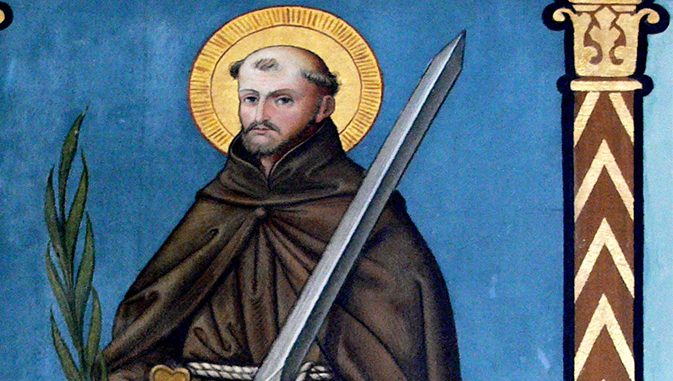
April 24th is the feast day of Saint Fidelis of Sigmaringen (1577-1622), priest and martyr. St. Fidelis was baptized Markus Rey, born at a time when the Protestant Reformation in Europe was little over fifty years old, and his life was marked by that fact in many ways even before it began.
His mother had been Protestant and converted to the Catholic Faith in order to marry his father, and his life would largely center around German-speaking parts of Europe that had been touched by the theological and civil unrest unleashed by the Reformation. He was the fifth of six children and received a sound piety from his parents that carried him well into his days at the University of Freiburg, where he studied first philosophy and then law.
After serving as a tutor and chaperone for a period of six years for three young men of noble birth, he took up the practice of law in a city of the Alsace region, where he quickly became known as the “lawyer of the poor” for his tendency to take the cases of those most in need. He refused to impugn the good name of his opponents, even when they were in the wrong. Several bad experiences with his colleagues and his distaste for the practice at the time of lawyers adjusting the settlements of lawsuits so that they could pocket more money for themselves led him to reject his profession. He felt called to the religious life and, inspired by an older brother, he eventually joined the Capuchin Franciscans in 1613.
The Capuchin Order was founded in 1525 as a movement on a part of a few professed Franciscans to return to the simple poverty and life of penance of Saint Francis. This movement was not without its difficulties, including one of its early leaders converting to Calvinism and becoming a Protestant leader. Despite its rocky start, by the seventeenth century, the Capuchin Order had become a solid bastion of missionaries and Counter-Reformation preachers. Their commitment to radical poverty and to the apostolic example of St. Francis gave lie to many of the Protestant criticisms of religious life. When Markus Rey joined the Capuchin order at about 34 years of age, he was joining a movement that took seriously Our Lord’s words to St. Francis: “Rebuild my Church.”
When he professed his vows, his superiors gave him the name Fidelis, and his biographers see an especially strong connection between his new name and Revelation 2:10: Esto fidelis usque ad mortem, et dabo tibi coronam vitae. “Be faithful unto death, and I will give you the crown of life.” Fidelis strove to be faithful to his name and to his Lord. We still have (to the best of my knowledge, only in Latin) a sequence of prayers and spiritual exercises he wrote for himself during his early religious life, written to keep his fervor alive. One of the practices was to meditate on a specific virtue each day of the week, connecting that virtue to Christ’s Passion so that Fidelis might better understand how to live that virtue in his own life.
Fittingly enough, given his preferences when he was still a lawyer, his priestly ministry began among the poor: preaching, hearing confessions, tending to their wants as best he could. He was soon prior of his local community, and his order and the broader Church seem to have seen in him a special gift to touch the hearts and minds of the common people, urging them to remain solid in the Catholic faith amid the errors and confusion of the day. He wrote pamphlets against Protestant errors (none of which appear to have survived).
By the end of the 1610s, he had been given a mission by the Congregation of the Doctrine of the Faith (and under the protection of the Habsburgs) to preach in Eastern Switzerland, in an effort to win the people there back from the errors of Calvinism and especially Zwinglianism. As often happened at that time, politics and religion were intermingled, with Protestants in Habsburg lands required to listen to Catholic preachers at set times and their ministers sent into exile. Fidelis was insistent, however, that no Protestant be forced to attend Mass or embrace the Catholic faith.
Toward the end of April in 1624, Fidelis was preaching (according to one tradition, on Ephesians 4:5-6, which insists on there being only one faith and one baptism) to a mixed crowd within a church. The Protestants had had enough. A riot broke out in the church, with the Protestants killing a couple of the Austrian soldiers standing guard at the event and even shooting at Fidelis. He left by a side door in an effort to leave town, to travel to his next preaching engagement.
The mob soon discovered his flight and surrounded him, demanding that he abandon the Catholic Faith, to which he is reported to have answered, “I have been sent to refute your heresy, not embrace it. The Catholic religion is the faith of all ages; I fear not death.” At this, one of the Protestants struck him with a sword. After asking God to forgive his attackers, his last words were “Jesus, Mary. O God, come to my aid.” Even after his death, the crowd continued to stab and bludgeon his body until it was dispersed.
He died on April 24, by an odd coincidence, the eve of the Feast of Saint Mark, whose name Fidelis had received at his baptism. Pope Benedict XIV canonized him in 1746.
Today’s feast may be observed with Readings proper to the day, rather than the Readings for a weekday in the season of Easter. The proper Readings chosen by the Church provide a very striking commentary on the Saint’s importance and some of his lessons for us today.
The first reading comes from Colossians 1:24-29, which opens with the striking words of St. Paul, “I rejoice in my sufferings for your sake, and in my flesh I am filling up what is lacking in the afflictions of Christ on behalf of His Body, which is the Church.” From the very first martyrdom in St. Stephen, we find that the martyrs make Christ present in a special way, turning their very deaths into an Eucharistic oblation that nourishes and strengthens the whole Church, and St. Fidelis is no different.
The responsorial Psalm comes from Psalm 34, which includes the phrase “My soul will glory in the Lord, that the poor may hear and be glad,” which should call to mind St. Fidelis’ own love for the poor. The fear of the Lord will deliver us from all other fears, even the fear of death. And then the Gospel for today comes from John 17:20-26, the high priestly prayer of Jesus, where He prays to the Father that all His disciples be one.
St. Fidelis died in witness to this unity. There is only one Faith, to which all are called. But there is no point in preaching this truth if the witness of our lives does not match our words. St. Fidelis’ love, especially for the sick and poor, his choice to follow Jesus Christ as a Capuchin, and his desire to win souls back to the truth of the Catholic Faith are all part of the same witness (martyria), to which his death was only the final crown.
May we all strive to be as faithful as Fidelis and, like him, win the crown the Lord has for us.
If you value the news and views Catholic World Report provides, please consider donating to support our efforts. Your contribution will help us continue to make CWR available to all readers worldwide for free, without a subscription. Thank you for your generosity!
Click here for more information on donating to CWR. Click here to sign up for our newsletter.

Leave a Reply