


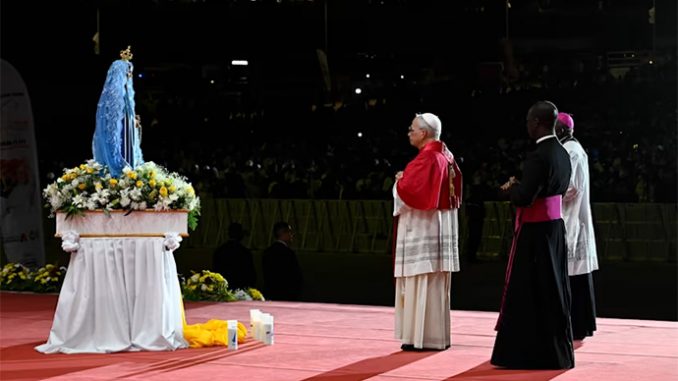
In a stirring homily delivered April 19, the Third Sunday of Easter, Pope Leo XVI drew a direct parallel between the biblical road to Emmaus and the tumultuous history of Angola, urging a nation still haunted by a 27-year-long civil war to break free from the “paralysis of discouragement.”
Celebrating his first Mass in Angola in the city of Kilamba, located some 20 miles from the capital, Luanda, the Holy Father reflected on the disciples who fled Jerusalem in despair after the crucifixion of Jesus Christ.
He described their hearts as “murdered and sad,” a sentiment he immediately applied to the Angolan people, whom he called inhabitants of a “magnificent and murderous country” that remains thirsty for hope, peace, and fraternity.
“I see in this opening scene of the Gospel the reflection of the history of Angola,” Pope Leo told some 100,000 faithful who turned out for Sunday’s Mass.
“The conversation of the two disciples … recalls the pain that marked your country: a long civil war, with its procession of hostility and division, wasted resources and poverty,” the Supreme Pontiff said.
A long history of ethnic tensions, violence, and deaths
Angola obtained independence from Portugal on November 11, 1975, but the hard-won victory was marred by deep-seated ethnic tensions. The three predominant liberation movements, the People’s Movement for the Liberation of Angola (MPLA), the National Liberation Front of Angola (FNLA), and the National Union for the Total Independence of Angola (UNITA), have been engaging in a bitter struggle for political control.
Although a power-sharing agreement was initially reached, the reluctance of these factions to cooperate within a multi-ethnic society and the sudden departure of Portuguese forces caused the accord to collapse.
Abandoning their shared anti-colonial goal, the groups turned on one another, with UNITA formally declaring war on the MPLA on August 1, 1975.
The war that lasted until 2002 left an estimated 500,000 people dead and displaced millions more. While the guns have fallen silent, the legacy of the conflict remains palpable in the country’s infrastructure and the collective psyche of its citizens.
Pope Leo warned that after being immersed for so long in such a history of pain, there is a risk of remaining “frozen” on the events that occurred… closed to hope.”
He noted that, like the disciples of Emmaus, many Angolans still speak of their suffering “with the pain of those who do not know how to start again, or even if it is possible.”
However, the Pope centered his message on the “good news” that the resurrected Jesus walks alongside the people on this path of bitterness. He urged the congregation to recognize the Lord’s presence not just in prayer and the Scriptures, but in acts of solidarity.
“The history of your country, the still difficult consequences you endure, the social and economic problems, demand the presence of a Church that knows how to accompany you,” he said.
Pope Leo XVI challenged the country’s leadership and social structures, calling for the construction of a society where “the scourge of corruption will be healed by a new culture of justice and sharing.”
Emphasizing that the Eucharist signifies unity, the Supreme Pontiff noted that it must translate into a political reality where “old divisions will be permanently overcome” and “hatred and violence will disappear.”
Saying “No!” to the logic of “extractivism
On Saturday, Pope Leo XVI met with the country’s President Joao Lourenco, as well as political, civic, and diplomatic authorities, during which he delivered his first speech to Angola’s political authorities.
He condemned the pillaging of the country’s natural resources by Western capitalist groups and greedy politicians.
“I desire to meet you in the spirit born of peace and to affirm that your people possess treasures that cannot be bought or stolen,” Leo said.
“There dwells within you a joy that not even the most adverse circumstances have been able to extinguish.”
Angola is Africa’s fourth-largest oil producer and is among the world’s top 20 producers. It is also the world’s third-largest diamond producer and holds significant deposits of critical minerals.
But the vast mineral resources contrast sharply with the excruciating poverty of the people. According to the World Bank, about 30 percent of Angola’s estimated 39 million people live on less than $2.15 a day.
The Pontiff condemned the continued plundering of the nation’s resources, both by foreign interests and corrupt leaders.
“It is necessary to break this cycle of interests, which reduces reality, and even life itself, to mere commodities,” the Pontiff said.
“How much suffering, how many deaths, how many social and environmental disasters are brought about by this logic of extractivism! At every level, we see how it sustains a model of development that discriminates and excludes, while still presuming to impose itself as the only viable option.”
The late former President of the Southern African country, Jose Eduardo dos Santos, who ruled for 38 years (1979-2017), was accused of plundering billions of dollars from the state coffers to his family account.
After taking office, President Lourenco’s administration reported that at least $24 billion had been stolen or misappropriated under the dos Santos regime.
Consequently, his government has vowed to crack down on corruption and actively work to recover the embezzled funds.
Despite these efforts, critics maintain that Angola still faces deep-seated corruption and have questioned whether Lourenco’s actions are truly about accountability or rather a political strategy to target rivals and consolidate his power.
Citing Pope Paul VI, the Holy Father warned that societies must resist the illusion of a civilization fueled only by consumption. He praised Angola’s ancient wisdom for recognizing creation as a harmony of diversity but noted that this balance is often broken by exploitation and arrogance.
“Your people have suffered time and again when this harmony was violated,” he stated.
“Dialogue is the first step…”
The Pope urged dialogue, saying it remains the only viable path toward overcoming the country’s social and political tensions.
“Only in an encounter does life flourish. Dialogue is the first step,” Pope Leo XIV said. He said conflict can either destroy societies or become an opportunity for renewal—if they are addressed constructively.
He warned the country’s leaders against the temptation to suppress dissent and urged them to learn “how to manage conflicts by transforming them into paths of renewal.”
He also urged Angolans to harness their rich and diverse human and cultural resources towards the common good, and by doing so to turn the country into “a project of hope.”
Pope Leo underscored the readiness of the Catholic Church to help in Angola’s course for development, saying that the Catholic Church “… desires to be leaven in the dough and to foster the growth of a just model of coexistence.”
This, he said, requires removing the obstacles to development and also involving those people that society has discarded.
“Let us remove the obstacles to integral human development, working and hoping together alongside those whom the world has discarded but whom God has chosen,” he said.
Before journeying to Angola, Pope Leo XVI had also visited Algeria and Cameroon, and will end his ten-day visit to Africa in Equatorial Guinea.
If you value the news and views Catholic World Report provides, please consider donating to support our efforts. Your contribution will help us continue to make CWR available to all readers worldwide for free, without a subscription. Thank you for your generosity!
Click here for more information on donating to CWR. Click here to sign up for our newsletter.

Was this a homily that could well have been given by the pastor/archbishop òf that place?
We need to end the ultramontanism that is so damaging the Catholic Church. The Bishops of Rome, “Popes” we call them, are ‘primus inter pares’.
They need to end the Magical Mystery Tours, remain in their diocese, care for their flock and attend to the administration of the Church at the Vatican.
We don’t need peripatetic popes; we need Vicars of Christ who quietly lead the Church from the precincts of the Vatican. And, please God, let them lead all souls to heaven and stay out of politics.
Absolutely! Surely a diocesan deacon has more call to pontificate on an international Catholic website than the pope, as universal pastor of the Catholic Church, has a call to visit the international flock, in Africa or anywhere else outside of the Vatican city-state.
Thank you.
And yet, your point is well taken. Thank you also…
As an amateur and back-bleacher spectator, I speculate about the globe-trotting Pope John Paul II—who in 105 trips visited 129 countries!—that he chose between either draining the local swamp OR evangelizing globally, and, in the process, even helped to take down the Marxist Soviet Union (1991).
An historic decision, when compared to the earlier historic restriction of the papacy as a “Prisoner of the Vatican” (1870-1929), by the powers of Italian secularist unification…the triumvirate of Garibaldi, Cavour, and King Victor Emmanuel II. We do look forward to a new historic trend in reformed leadership and governance, and the fading of a few amateur court jesters in red hats (another triumvirate?), and maybe some long-awaited justice for those nuns exploited by Rupnik.
All this, while also co-existing (or hopefully better) with Marxist China, expansionist Islam, and a post-Christian West.
Corrupt leaders and their corrupt overseas allies are fellow pilgrims marching headlong in the same direction. Evangelizing corrupt leaders on the home front and their corrupt allies on the foreign front has the potential to create a win-win situation.
Seriously. Listen to this pope preach! “… manage conflicts by transforming them into paths of renewal”
We read: The Pope urged dialogue, saying it remains the only viable path toward overcoming the country’s social and political tensions.
So, WHAT IS “dialogue”?
Real dialogue takes place between real persons, not between generalized factions or tribes or ethnic or other communal groups. Yes? Might we be reminded of the motto selected by Cardinal Newman (“the father of Vatican II”): “Cor ad cor loquitur”—meaning “heart speaks to heart”? And, in a way that, from within intact human nature, does not exclude the light touch of God.
We hear that the stalled 1978 Camp David Accord led to the 1979 Egypt-Israel Peace Treaty largely because President Carter delivered to Israeli Prime Minister Menachem Begin a stack of books—all signed by Carter and inscribed by name to each of Begin’s living grandchildren—and wishing them a world marked by greater peace. Begin returned to the table.
Bridge-building means acting personally and intergenerationally—as if “families” still matter. Working personally within family memories ALSO of the future, rather than group memories trapped in our incomprehensibly wretched past.
SUMMARY: The solution to disruptive modernity is found more in freshly renewed memory than in more and stale modernity.
War is a terrible constant. Like Pete Seeger’s aphorism When will we ever learn, in song Where have all the Flowers Gone, we have never learned. The Red Steed in John’s Apocalypse keeps dashing across our happy settledness. Leo XIV rightly continues to address wars, deficiently referencing their causes, as well as their existential remedy.
Served in Malawi adjacent to Mozambique during the murderous 1974 fighting between Portuguese soldiers and Portuguese insurgents against colonial rule. Dutch ‘White Fathers’ [now Missionaries of Africa] had to leave Mozambique arriving with tales of horror, photos of smirking bare chested soldiers cigarette in mouth holding decapitated African heads.
António de Spínola, a general during that war realized the futility and inhumanity and sought the right solution. He was elected to the presidency of Portugal and ended the war granting Mozambique freedom. We’re now faced with something similar, if not in soldiers holding severed heads, the annihilation of a proud, ancient people. The birthplace of Ibn Sina.
Intelligence experts say Iran holds two caches of enriched uranium deep underground in tunnels beneath the mountains of Isfahan and Natanz. That Iran remains capable of producing and delivering nuclear warheads. From the limited perspective of this writer, locating and destroying them is unlikely. Nor is the Iranian Revolutionary Guard now in command prepared to surrender them to us.
A costly ground operation might prevail. Otherwise, containment including the blockade of resources would suffice. That, including much prayer along with the Pope who would likely prefer the lesser evil.
Correction: Served in Malawi adjacent to Mozambique during the murderous 1974 fighting between Portuguese soldiers and [African] insurgents against colonial rule.
Insofar as a lesser evil, the total blockade in effect from the Strait of Hormuz to international banking, prohibition of armaments, strategic goods will inevitably cause internal collapse.
As to the question of an extended papacy, the travel, visiting, preaching is a good thing. Message needless to say is vital. We need only recall John Paul II visiting Communist Poland and the effect that it had contributing to the collapse of the Soviet Union. Paul VI and the encounter with Athenagoras. Papal visits also create a needed effect of unity, concern and awareness with the universal Church. We’ve moved beyond the confinement of the Pope to the Vatican.
Absolutely! Surely a diocesan deacon has more call to pontificate on an international Catholic website than the pope–as universal pastor of the Catholic Church–has a call to visit the international flock, in Africa or anywhere else outside of the Vatican city-state.
We would not have a Catholic Church today if this man had been Pope during the sieges of Vienna, or the battle of Lepanto, or the Battle of Belgrade, or the Battle of Navas de Tolosa, or the First Crusade, or…. Please read historian Raymond Ibrahim’s book Defenders of the West: the Christian Heroes Who Stood Against Islam:
https://www.amazon.com/Defenders-West-Christian-Heroes-Against/dp/1642938203