

As Pope Leo XIV prepares to embark on his apostolic journey to Africa, the shadow of regional conflict and the plight of migrants loom large over the continent’s northern shores.
Algeria, the first stop of the papal tour, is not only the land of St. Augustine—a figure who profoundly shaped the Holy Father’s spirituality—it is also a frontline for the humanitarian crises stemming from the Middle East and a critical transit zone for those seeking a better life.
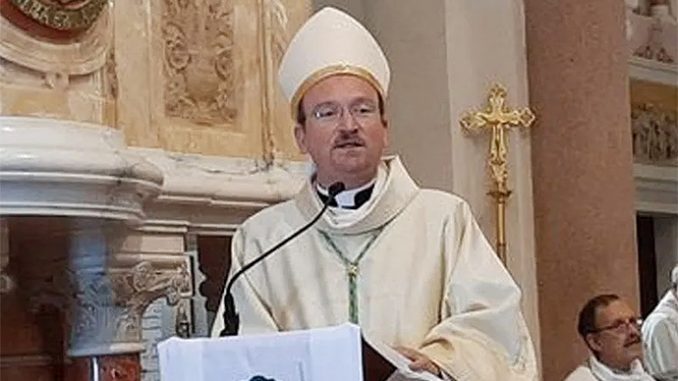
In an exclusive interview with Catholic World Report, Archbishop Nicolas Lhernould of Tunis, President of the Regional Episcopal Conference of North Africa (CERNA), discusses how the Pope’s message will navigate these complex realities.
From the ruins of Hippo to the daily “dialogue of life” in local villages, Archbishop Lhernould explains why the Church in North Africa is prioritizing religious freedom as the cornerstone of a just society and how a small, “fragile” flock can bear witness to hope in a time of fear.
CWR: Pope Leo XIV begins his African visit to Algeria. What is the spiritual significance of a return to the roots and homeland of one of the greatest Doctors of the Church: Saint Augustine?
Archbishop Lhernould: Algeria will be the first stop on Pope Leo XIV’s apostolic journey to Africa. This was a desire he himself had expressed upon his return from a trip to Lebanon. As he had also said from the balcony of St. Peter’s Basilica on the evening of his election: “I am a son of Saint Augustine”—a figure and a spirituality that have long nourished his personal experience and deeply inform his pastoral ministry.
This will be the third time Leo XIV has visited Algeria, the first as pope. The purpose of his trip is, of course, among other important elements, to return to Hippo, but above all to meet the Algerian people and the Christians living in Algeria. It is not a matter of returning to past roots, but of experiencing an encounter in the present.
It is clear that Augustine’s thought, transcending borders and ages, will resonate at the heart of this encounter as a universal and shared point of reference.
CWR: How does the life of Saint Augustine, who tirelessly sought the truth, resonate with the Pope’s message of dialogue and encounter in the modern world?
Archbishop Lhernould: Augustine was a tireless seeker of God. What profoundly marked his life was not primarily the subtlety of his theology, the breadth of his thought, or the pastoral acumen he demonstrated in his time, in a difficult context. … All of this is, of course, remarkable. But even more precious is the discovery he made of God’s inner presence, as the answer to his most intimate questions, to his deepest thirst.
The modern world thirsts for encounter, for the absolute, for God. Augustine is one of those great spiritual masters whose experience is capable of accompanying us in this discovery of the “inner guest” who answers these longings; not merely because he reflected on it, but because he lived it, and because this experience of “inner illumination” transformed his life.
Augustine continues to invite us to this discovery, not by forcing it but by bearing witness to it, while respecting the experience of the other, their search, their journey, and the mystery of their life.
CWR: This visit also includes a stop at the Episcopal Conference of North Africa (CERNA). How have the bishops and the faithful of the region prepared spiritually for this meeting, and what specific graces does the Church in North Africa hope to receive?
Archbishop Lhernould: CERNA comprises the Apostolic Vicariates of Tripoli and Benghazi, the Archdiocese of Tunis, the Archdiocese of Algiers, the Dioceses of Constantine and Hippo, Oran and Laghouat-Ghardaïa, the Archdioceses of Tangier and Rabat, and the Apostolic Prefecture of Laayoune.
When a pope visits one of our countries—John Paul II in Morocco in 1985, in Tunisia in 1996, Francis in Morocco in 2019, Leo XIV in Algeria in 2026—all the communities in the region rejoice, keep the visit in their prayers, and experience it in the fraternal communion that characterizes them. Our churches naturally look forward to the encouragement and guidance that the Holy Father deems appropriate to offer them, but above all, they wish to be open to whatever God Himself wishes to give through this event.
For in reality, beyond the figure of the pope, it is the encounter with God that will be most important, and He alone knows the graces He wishes to bestow.
CWR: The Church in North Africa is often described as a “minority flock.” How would you describe the health and vitality of the Catholic community in the region? Is the emphasis on growth in numbers or on deepening the witness?
Archbishop Lhernould: Our churches are small, very much in the minority, fragile in many ways, but also, through their diversity, a living image of the universal Church. Called, as everywhere, to bear witness to the Gospel and to give an account, with gentleness and respect, of the hope that dwells within them, they experience daily the joy of encounter, striving to build bonds of brotherhood with all, in the name of the One who became the first of a multitude of brothers (cf. Rom 8:29).
The emphasis is not on efficiency that quantifies, but on fruitfulness that begets. Though poor in resources, our Churches experience that it is through the fraternal love their members have for one another that they are recognized as disciples of Jesus (cf. Jn 13:35); and that fraternity lived in the name of Jesus, with respect for differences, forges deep bonds, builds lasting peace, and sustains an effective commitment to the service of all, beginning with the least among us.
CWR: You are a staunch advocate of interreligious dialogue. Beyond formal exchanges, how does the Church live out this dialogue on a daily basis in neighborhoods and villages? Do you see genuine mutual respect growing between religions?
Archbishop Lhernould: It is not religions that engage in dialogue with one another, but believers—real people. This dialogue is first and foremost a dialogue of life. As Augustine liked to say, “We know no one except through friendship” (83 Questions, 71.5). This mutual knowledge is sometimes simply the joy of encounter, sometimes acting together, emulating one another in goodness, and visiting one another.
By entering into dialogue with the world, the Church becomes “word, message, conversation” (cf. Paul VI, Ecclesiam suam, n. 67). By also accepting to receive from others, so that something of the Face of Jesus may come to light and be given without imposing itself: “Every Christian generation must, on its own behalf, make this discovery of the Face of Christ that corresponds to the questions and needs of the people of its time (CERNA, The Meaning of Our Encounters, III.2, 1979). This experience fosters mutual growth and indeed bears fruit in mutual respect among people whenever it is lived in truth.”
CWR: How is the Church addressing the challenge of religious tolerance in the region, and what message might the Pope’s visit send on this issue?
Archbishop Lhernould: In every context where it shares the destiny of the peoples who welcome it and of whom it is a part, the Church recalls the centrality of religious freedom as a constituent element of human dignity: “There is a fundamental right that must not be forgotten on the path to fraternity and peace. It is religious freedom for believers of all religions” (Pope Francis, Fratelli tutti, n. 279, 2020).
It is worth recalling that the essential principle that there must be “no compulsion in religion” is common to our various traditions (cf. Quran 2:256; Tertullian, Apologeticus 6). Since conscience is “the most secret core of the human person, the sanctuary where he is alone with God and where God’s voice is heard” (Vatican II, Gaudium et spes, n.16), freedom of conscience must be promoted and respected so that the human person may be fully human.
The Pope arrives in every country he visits inspired by this conviction, which he reiterates in the footsteps of his predecessors: “Religious freedom is the cornerstone of every just society, for it preserves the moral space in which conscience can be formed and exercised” (Audience with ACN, October 10, 2025).
CWR: The war in the Middle East has sent shockwaves around the world. What impact is the conflict having on the social fabric of North Africa?
Archbishop Lhernould: Many analyses highlight the economic and social consequences of the war, which are also affecting our countries: inflationary pressures, rising energy and fertilizer costs, pressure on foreign exchange rates. …
Above all, war means men, women, and children who are threatened, who suffer, who die, who live in fear… It is confidence in the future that is being shattered, for generations to come. The spirit of our peoples is torn apart by the conflicts raging across the world, particularly in the Middle East. At the same time, a spirit of resilience is emerging, born of the realization that no one can solve the world’s challenges alone, but that it is by drawing on the best in each of us, and by listening to one another’s suffering, that we can truly rebuild hope.
CWR: North Africa is a major transit route for migrants seeking a better life in Europe, who often face tragic circumstances. How is the Church in North Africa responding to this humanitarian crisis, and is this an issue you expect the Pope to address forcefully?
Archbishop Lhernould: The Pope is already speaking out forcefully on this issue. With their limited resources, and in accordance with the laws of our countries, our churches strive to embody the Good Samaritan’s compassion toward those who are hungry, thirsty, sick, or suffering; to sit with people to help them discern the direction of their lives; to remind them that in all circumstances, “the righteous must be humane” (Wis 12:19); to fight against all forms of trafficking that exploit people and destroy human lives; to collaborate, as much as possible, in facilitating voluntary return with dignity despite the obstacles; to encourage a clear-eyed analysis of the reasons that drive people to migrate; to view migration not as an abstract phenomenon but as the concrete faces of human beings who are first and foremost persons, and often also “messengers of hope” (Leo XIV, Message for the 111th World Day of Migrants and Refugees, July 25, 2025).
(Editor’s note: This interview has been edited for length.)
If you value the news and views Catholic World Report provides, please consider donating to support our efforts. Your contribution will help us continue to make CWR available to all readers worldwide for free, without a subscription. Thank you for your generosity!
Click here for more information on donating to CWR. Click here to sign up for our newsletter.

May the people of the African continent be blessed with peace, prosperity, and harmony.
Thanks to CWR for this report.
“It is worth recalling that the essential principle that there must be ‘no compulsion in religion’ is common to our traditions (e.g. Quran 2:256; Tertullian, Apologeticus 6).”
No compulsion? Have I been misled about Islam?
Cleo, understanding this sura requires context. The verse is regarded as a Medinan revelation, revealed when Muslims had established political authority, enabling them to uphold the principle of voluntary faith. This is often observed in many Muslim nations, where other religions may be tolerated but under challenging conditions. For example, a Christian may live in a Muslim nation and attend their church, yet is prohibited from sharing their faith. Commonly faces difficulties in constructing church buildings, and may commonly encounter conflict with Muslims. When Islam lacks political control, this verse is frequently disregarded, with jihad historically serving as the predominant means of spreading Islam, often through forceful conversion.
Not unlike Qur’anic Islam on the point of “compulsion”, the atheistic state can also speak to religious tolerance in an intolerant and overarching sort of way:
“On the principle of freedom of religious belief, all religions are tolerated in the Chinese liberated areas. Protestantism, Catholicism, Mohammedanism, Buddhism and all other religions will be protected by the people’s government so long as [!] the believers abide by the laws of the government. Everybody is free to believe or not to believe in a religion; neither compulsion nor discrimination is allowed” (Mao Tse-Tung, “On Coalition Government” [Peking: Foreign Language Press, 1955], 109).
That went well…
We read: “The modern world thirsts for encounter, for the absolute, for God [….] the Church recalls the centrality of religious freedom as a constituent element of human dignity: “There is a fundamental right that must not be forgotten on the path to fraternity and peace…” (Pope Francis, Fratelli tutti, n. 279, 2020).
With an eye to Hormuz, however, are we still confronted with ships passing in the night?
What happens when the predisposition of the also pre-modern(!) world is to define the encounter with God in a way very unlike St. Augustine–such that the universal experience of estrangement due to original sin–and of redemption within universal human history–is denied? And, instead, projected externally upon infidels? As under Iran’s jihad and the House of War? In such an alternative universe, what, then, of the “constituent elements of human dignity”…and “fraternity and peace”?
How to encounter self-insulated others, at the level of unquestioned, ideological and well-armed predispositions–where jihad is the pre-modern definition of a just war?