


FCC Rating: PG-13
Reel Rating: 4 out of 5 reels
Note: Some spoilers ahead!
There are few things as remote, extreme, or beautiful as outer space, despite it comprising most of our universe. Space has no air, water, food, or other resources, so any narrative set in this location unfolds like a castaway narrative.
Recently, there have been quite a few good “stuck in space” films, including Moon, Interstellar, Passengers, and The Martian. Project Hail Mary not only exceeds these fine films but is probably the best science fiction movie of the decade so far, combining hard technology and entertaining writing with Spielbergian wonder. It’s the first good contender for Best Picture of the year and may even remain so by December.
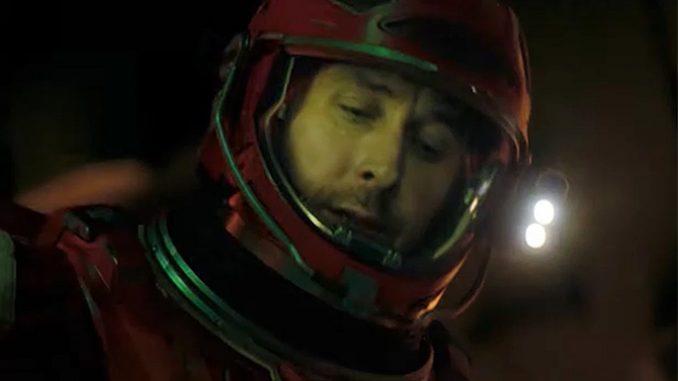
Dr. Ryland Grace (Ryan Gosling) wakes up from a decade-long coma in a spaceship with a limited memory of his identity or purpose. As he combs his interstellar vehicle for food and clues, he gradually starts to piece together how he arrived in this situation.
After failing as a serious researcher in microbiology, he became a middle school science teacher. One day, his monotonous schedule is interrupted by Eva Stratt (Sandra Huller), a powerful government bureaucrat who informs him that the Sun is mysteriously losing energy and recruits him to help unearth the reason before humanity dies in a global cooling. Grace discovers a new lifeform hanging out between Venus and the Sun that he calls “astrophage,” which is eating the Sun’s fuel and converting it to electromagnetic energy.
Their scientific team discovers that every star in our neighborhood also has these parasites except for one: Tau Ceti. They initiate Project Hail Mary, a journey to this star eleven light-years away to discover why it is not being eaten, and then relay the information back to Earth.
In a film with many incredible qualities, the performances of the two lead characters steal the show. Grace is one of the best character arcs in recent memory. He starts as a sad, pathetic shell of a man who, despite his obvious talents, is sure he will fail at everything he tries. This stems from the lack of recognition of his initial research and a broken relationship with an ex-girlfriend. As the film progresses and he manages to solve problems, he gains more confidence, not just in his own abilities but in the necessity of acting “brave” in the face of adversity.
He is helped by the second performance. which, for the sake of huge spoilers, will have to remain somewhat vague. Suffice to say, he is fun, eager, and brings out the best in Grace when he feels overwhelmed or impotent. He’s the wingman that everyone needs. They work in tandem to solve the mystery of Tau Ceti’s immunity, and their mutual work provides some of the best movie banter in years.
While the film is largely absent of explicit religiosity, it thoroughly promotes a theistic worldview and ethic in a way that was common in cinema sixty years ago. One virtue is mankind’s God-given ingenuity. Creative work predates the Fall when Adam was commanded to “dress and keep the garden.” Humans have always been problem solvers. God does not give us an easy world but one filled with danger and the opportunity for heroism.
Grace’s efforts are continually frustrated, but as he makes the decisions while seeking new avenues, he learns the value of persistence. Solving one problem often creates another, but if you keep solving enough problems, you can make real progress and eventually reach a conclusion. Ultimately, it’s God’s decision when you have done enough and can finally rest; our portion is to keep working in the world.
The film also highlights the most distinctly Christian quality of all: self-sacrificial love. Both Grace and his companion make incredibly brave decisions at their own expense to save each other and their people back home.
There’s one particularly horrifying scene where Grace’s friend experiences his own “passion” as his body is horribly mangled in a desperate attempt to save his friend. People often forget that this perspective and belief, now assumed in most societies, is a direct gift of Christianity.
All of these lessons are packaged in a magnificently entertaining movie that never feels dull or haphazard. Directors Phil Lord and Christopher Miller are masters of fast editing, humorous situations, and funky musical backgrounds. Unlike the still silence of 2001, Project Hail Mary contains rapid-fire dialogue that echoes locker-room talk between twentysomething college students at an Ivy League school and blaring sound design in the vein of Inception and Interstellar. The art direction of the spaceship combines the technical gadgetry of Apollo 13 with the punk ethos of a college dorm room. It’s a weird combination, but it works incredibly well.
Project Hail Mary is an experience of pure joy: an exciting, funny space story that is deep and sticks with you after the lights come up. The film has only one brief throwaway line about the divine, but His handiwork is evident throughout. The crazy mess of things and the random coincidences that must go right clearly point to divine providence, yet it comes about through the free action of individuals.
This feels, to me, like the first truly post-COVID film, where the audience can relax and breathe freely, trusting that our problems can be solved both by our own creative power properly directed by God’s love.
If you value the news and views Catholic World Report provides, please consider donating to support our efforts. Your contribution will help us continue to make CWR available to all readers worldwide for free, without a subscription. Thank you for your generosity!
Click here for more information on donating to CWR. Click here to sign up for our newsletter.

Leave a Reply