


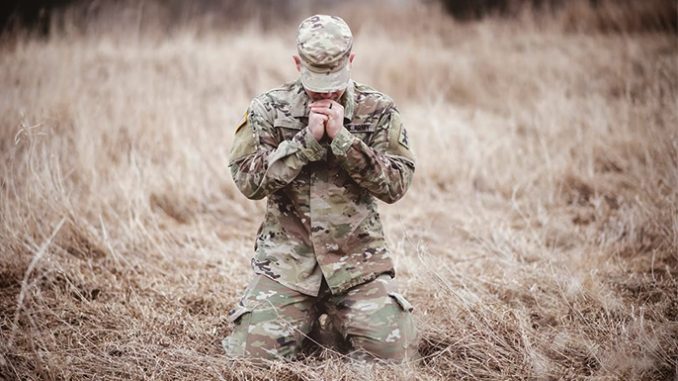
Many are abuzz about Pope Leo XIV’s Palm Sunday homily. In order to provide some context, let’s consider what Pete Hegseth prayed at the Pentagon last Wednesday, March 25th. In leading a Pentagon Christian service, the U.S. Secretary of Defense prayed for “overwhelming violence of action against those who deserve no mercy,” asked that “every round find its mark,” and called for justice to be executed “swiftly and without remorse.”
A few days later, Pope Leo XIV preached on Palm Sunday that Jesus is the “King of Peace,” and then declared, “He does not listen to the prayers of those who wage war.” In some sense, he might have been evoking Isaiah 1:15. That language is in the official Vatican text. The Italian original reads, “non ascolta la preghiera di chi fa la guerra,” which closely means that God does not hear the prayer of those who make or wage war.
First, let us leave aside the guessing game over whether the Holy Father was addressing Hegseth in particular. Several news reports framed the homily as a direct rebuke. Sure, the timing was striking, and the language was severe, yet Pope Leo named no official and offered no explicit reference to Hegseth or to the Pentagon service. Speculation here produces heat and very little light.
The more urgent issue is that of virtue.
Was Hegseth’s prayer a fitting Christian prayer? I believe the answer is no.
A man entrusted with public authority, especially over the armed forces of a great nation, should pray with trembling reverence because prayer is an act of worship before the all-holy God. Public prayer from such a man should ask for wisdom, protection of the innocent, and repentance of the wicked. Instead, Hegseth’s language seemed to relish in destruction and an exaltation of lethal force. Even when one grants the grave duties of national defense, such words fall beneath the standards of Christian prayer.
Scripture certainly includes war. Scripture also includes cries for deliverance against violent enemies. David inquired of the Lord before battle and received direction to go up against the Philistines. Jehoshaphat proclaimed a fast and sought the Lord when invasion loomed over Judah. Judas Maccabeus called his men to cry to Heaven and remember the covenant before battle.
These texts show that Scripture has never treated every act of armed defense as intrinsically evil. Yet those same texts also reveal something deeper. The Lord of hosts is never a mascot for bloodlust. He is Judge. And He is also the One who sees every widow, every child, every father lost in battle, every field soaked in grief.
That is why Jonah matters here. God sent judgment toward Nineveh, and God also revealed His pity for a great city full of image bearers who could scarcely discern their right hand from their left. The biblical God is holy beyond words, and He is merciful beyond measure. Therefore, a statesman who invokes His name during war must do so with careful discernment.
In that sense, some of Hegseth’s words, I believe, bordered on scandal. That kind of language can potentially deform the conscience of a nation, especially in a land shaped by natural law reasoning and by Christian moral inheritance. Public officials must be better than this, and Christian officials most especially.
Now to Pope Leo’s homily.
In one sense, his Palm Sunday line needs careful handling. The Catechism teaches that legitimate defense by military force is morally permissible, and it also teaches that those responsible for the lives of others may bear a grave duty of defense. Paragraph 2309 lays out the classic just war criteria, and paragraph 2265 teaches the duty of those charged with the common good to repel unjust aggressors.
So if someone were to read Leo’s sentence as a flat denial that God hears any prayer from any soldier or any ruler engaged in any war whatsoever, that reading would collide with the Church’s own moral tradition. The Allied struggle against Hitler and Imperial Japan would then become morally unintelligible within Catholic thought, and so would the defense of innocent peoples from invasion.
Church history itself reinforces this point. Pope St. Pius V organized the Holy League in the face of Ottoman expansion, and the Christian victory at Lepanto in 1571 became linked with papal calls to prayer and thanksgiving, eventually giving rise to the feast now associated with Our Lady of the Rosary. In 1683, Pope Innocent XI aided the defense of Vienna against the Ottoman siege, a battle widely recognized as a decisive defense of Christian Europe. A Catholic reading of history simply cannot erase the legitimacy of defensive war.
Still, I strongly doubt Leo intended a doctrinal rupture from the pulpit on Palm Sunday. The homily as a whole is a meditation on Christ entering Jerusalem as the meek King who renounces vengeance, rebukes the sword in Gethsemane, and embraces the Cross for the salvation of the world. His dominant register is spiritual and biblical.
He is preaching Christ crucified. He is not issuing a technical revision of just war doctrine in his homiletic statement.
The official Italian text also matters. Leo said, “chi fa la guerra,”, which literally refers to those who make or wage war. That phrasing is nuanced. Read that way, the line seems more aimed at the abuse of religion by violent political power.
So, in this nuanced sense, the Holy Father is certainly correct. Christ truly is the Prince of Peace. Christ truly rejects the deification of violence. Palm Sunday teaches that the Messiah enters the city on a donkey, and Zechariah says He shall banish the war horse and command peace to the nations. In Gethsemane, Jesus says, “Put your sword back into its place.” In Ephesians, St. Paul says of Christ, “He is our peace.”
That is why our path forward requires moderation and measured reason. Catholics should resist the urge to weaponise every papal sentence for factional gain. Protest against Hegseth’s prayer and the Trump administration should avoid hysteria. Put another way: read Leo ecclesially, not ideologically. The Vatican may well clarify the line in the coming days, especially since so many readers have heard it through media filters and political anxiety. For now, the wiser course is to receive the homily as a summons to examine our own conscience.
Personally, I am no pacifist, and I do believe that there are times when war becomes tragically necessary for the defense of the innocent, the preservation of order, and the restraint of grave evil. Yet I also believe that reason and truth must govern how we speak about it and how we wage it, because every missile is sent into a world made by God, every bullet passes through a human life, and every battlefield leaves behind graves and widows.
Which is why a Christian leader may at times rightly authorize force and a Christian soldier may at times rightly bear arms under just authority, while neither should ever delight in bloodshed or speak of violence with a kind of gleeful disposition unbecoming of those who know that even necessary war is still a terrible thing.
Hence, Holy Week directs our gaze to a different throne. Christ reigns while hanging on the Cross. Therefore, let rulers pray for wisdom and restraint. Let soldiers pray for purity of conscience and the protection of the innocent. Let the faithful refuse both bloodthirsty piety and sentimental confusion.
And above all, let us center our hearts on Jesus Christ, the true King of Peace, because the Church has always taught that peace is far more than the temporary silencing of weapons. Peace is rightly ordered love under God, a justice shaped by truth that compels man to be reconciled to the Father through the Blood of the covenant. In a biblical covenantal worldview, every human life must finally kneel before the Lamb who was slain and who alone makes men brothers.
Until then, the Church must keep saying to princes and peoples alike: repent, seek wisdom, and come under the lordship of Jesus. Perfect peace is only possible in Heaven, but let us strive for the reasonable and grace-filled peace of our Lord in our conduct this Holy Week.
If you value the news and views Catholic World Report provides, please consider donating to support our efforts. Your contribution will help us continue to make CWR available to all readers worldwide for free, without a subscription. Thank you for your generosity!
Click here for more information on donating to CWR. Click here to sign up for our newsletter.

Leave a Reply