


Distribution Service: Fox Nation
Reel Rating: 2 out of 5 reels
Martin Scorsese is not only one of the greatest film directors in history but also has a clear affinity for complex and profound spiritual narratives. This makes him easy to love for a faith-based reviewer like myself (though his best film, Hugo, was light on explicit religiosity and body count).
However, he also tends to hold his religious subjects just out of reach, keeping them at a safe distance. His recent episode on Mary for The Saints demonstrates this well; it is an informative and competent production rendered with a veneer of faith but without any sense of her active and loving intercession on our behalf.
The production fits a great deal of Mary’s life into only forty-five minutes, beginning with the betrothal to Joseph and working its way through the Nativity, the Wise Men, the Wedding Feast at Cana, Jesus’ ministry, and finally the Assumption. It is narrated by Scorsese himself. He draws on his experience growing up in New York City among Italian immigrants. Mary was everywhere. He points out that many people find her more accessible, whereas her Son is God, and so seems more distant. But this is indeed the point of Mary: to bring people to her Son. By starting before the birth of Jesus and ending after his Ascension, Scorsese also shows that Mary is the chief witness to Jesus, the only one who was there from the beginning until the very end, faithful and devout the entire time.
There are small moments that represent that great “Scorsese flair” and make the story far more dynamic. The betrothal of Mary and Joseph is done in a long and continuous take that goes backward and forward. When Mary is assumed into Heaven, the camera stays on her face from above, while the background falls away like an elevator.
My favorite is the transition from the flight to Egypt to the start of Jesus’ public ministry, in which the frame stays on her eyes, then dissolves from young to old, then zooms out to show Mary in her fifties with her fully grown Son. Yet most scenes are unremarkable, with people sitting and talking while Scorsese comments in the pauses.
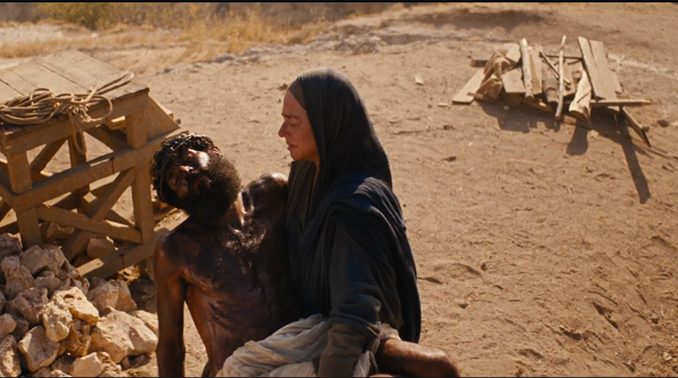
The life of Jesus usually happens offstage, with Mary experiencing the aftermath. The audience, for example, does not see the Passion at all, only Mary holding Jesus after being taken down from the cross. This is fitting to some degree, however, as Mary is the subject of this film and her role is always supportive of her Son.
Scorsese clearly has high respect for Mary and her role in the life of Jesus. He challenges certain beliefs and ideas about Mary to highlight her suffering and humanity. For example, it is a long-standing tradition that Mary felt no pain in childbirth, yet here Mary cries out in anguish common to ordinary women.
More problematic is a throwaway line in her conversation with Joseph where she says, “I know I am not without sin, but not this [Jesus’ conception].” The Catechism of the Catholic Church, in remarking on Mary’s sinless state, says, “Mary remained free of every personal sin her whole life long” (CCC 493).
There is a beautiful scene where Mary, tired and alone after the Passion, suddenly sees her resurrected Son, though framed in a way that might not be literal.
Scorsese is now in his mid-eighties but shows no sign of slowing down, having been nominated for a Best Director Oscar twice in the last seven years. He has also shown a warmer and more gentle attitude towards religion, even approaching sincere faith. I personally attribute this to the care he has given his wife, Helen, who suffers greatly from Parkinson’s Disease (the director has been married five times). His sacrificial love for her, helping her with even the most basic tasks like eating or dressing, comes across clearly in the Apple+ series Mr. Scorsese.
My great hope is that when the end of his life comes, as it must for all of us, he will seek Mary’s prayers and be with her and all the saints forever.
If you value the news and views Catholic World Report provides, please consider donating to support our efforts. Your contribution will help us continue to make CWR available to all readers worldwide for free, without a subscription. Thank you for your generosity!
Click here for more information on donating to CWR. Click here to sign up for our newsletter.

Leave a Reply