

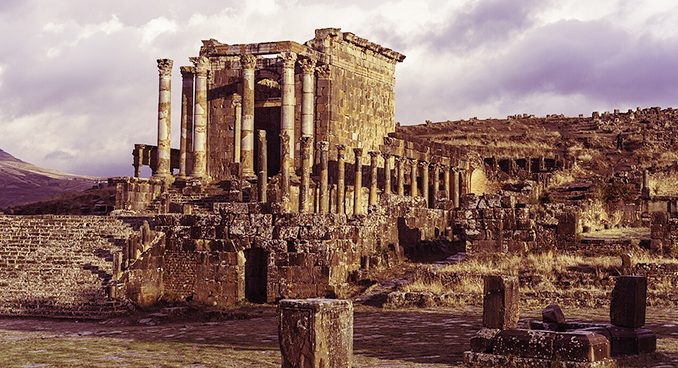
The Vatican has announced that, as part of his upcoming African tour, Pope Leo XIV will visit Algeria on April 13-15. No acting pontiff has ever visited Algeria, a former stronghold of ancient Christianity whose current population of 48 million is about 99% Muslim.
Though this papal visit is unprecedented, it is not a complete shock. The pontiff had a meeting with Algeria’s President Abdelmadjid Tebboune on July 24, 2025. Among the reported discussion topics was interfaith dialogue.
It’s a sensitive subject: This year marks the 30th anniversary of the 1996 attack on an Algerian monastery in which seven monks were kidnapped and decapitated. Three decades later, multiple reports speak to a decline in freedom for the country’s small Christian minority. Algeria is currently ranked as the 20th most oppressive nation on earth for Christians.
Amid these issues, Pope Leo XIV—a longtime Augustinian priest—will head to the onetime land of St. Augustine.
Though Islamic conquest came to the region in the 7th century, Christianity was not expunged for another several-hundred years.
Algeria’s French colonial period, which began about 1830, saw a resurgence in Christianity. Established in 1838, the Diocese of Algiers was elevated to an archdiocese in 1866.
At its highest point during the colonial period, Algeria’s Christian population exceeded one million, the vast majority of whom were Catholic.
“The monks and nuns played a vital role in providing health care,” said Moh-Christophe Bilek via email. Born as a Muslim in Algeria, Bilek has lived in France since the early 1960s and was baptized a Catholic in 1970. He also has established Notre Dame De Kabylie, an online community for Algerian Christians, and has authored such books as Saint Augustine as Told to My Daughter.
Bilek fondly remembers the dedication of the White Fathers and White Sisters in his northern Algerian home region of Kabylia. “My mother walked to the nuns’ house, carrying me on her back, twice in 1956 to receive medical care,” he recalled.
Though there were some converts among the native population, most Christians in colonial-era Algeria were of European heritage. The overwhelming majority of them left the country soon after Algeria attained independence in 1962.
Three years before this exodus, in 1959, the Archdiocese of Algiers had 350,000 Catholics. By 2022, that number had dropped to 4,000.
Most estimates place Algeria’s current Catholic population, across four dioceses, at less than 10,000.
Bilek said about 80% of Catholics in Algeria are either of sub-Saharan or European origin. There are also smaller numbers of Asian Catholics and some Algerian converts. But there are basically no native-born Algerian Catholic clergy.
By contrast, the Protestant faith saw many homegrown pastors surface during the final years of the 20th century.
“This is how Protestants rapidly increased in number among the population,” said Bilek. “In towns and villages, they remained in contact with the people they were evangelizing.”
After decades of having a tiny presence, Protestant churches began gaining popularity in the 1980s. The flip side was that such success would eventually attract the attention of authorities, who were undoubtedly less than pleased that the majority of Algerian Protestants were converts from Islam. This sensitive aspect is a main reason why the Catholic Church is more accepted than Protestant worship in Algeria.
Bilek explained that another reason why the Catholic Church has a less fragile status is because most Catholic churches in Algeria are well-established venues that date back to the colonial era. In contrast, Protestants had “only two or three churches” from that period.
“They managed to secure enough places of worship, sometimes with outside help,” he said. “But lacking the necessary building permits, the Algerian state did not register them as places of worship and was able to easily close them down starting in 2017.”
Authorities have shut down dozens of Protestant churches and ordered others to cease operation. As a result, there are currently no officially operating Protestant churches in the entire country, said Bilek. (Some sources say one Protestant church remains open.)
Additionally, in late 2024, Algerian authorities purged a Christian social media group that had over 50,000 members.
Bilek said Algerian authorities exploited COVID to increase the degree of control over most citizens, while “dictating policies to the politicians they had installed.” He added that, although the current president has no military background, the Algerian regime is comprised “primarily of military personnel who have always held the real decision-making power.”
Though no Catholic churches have been shut down, the Church has not gone completely unscathed, as Algeria’s government has targeted the Catholic humanitarian charity Caritas.
When authorities shut down Caritas Algeria in October 2022, the response of the Archbishop of Algiers was striking in its acquiescent tone, saying that the Church will “continue to do good without making noise” and does not want to “come into conflict with the authorities.” As of March 2026, Caritas Algeria remains shut down.
Bilek said the archbishop “has no choice but to compromise with the authorities.” In this lack of real options, Algerians of all faiths share common ground.
The misuse of authority in Algeria goes far beyond anti-Christian animosity. Truly independent media has become an endangered species in the country. Dissenting opinions are increasingly unwelcome, and freedom of speech can be a fragile concept.
“The prisons are overflowing,” said Bilek, who added that some Algerians are hoping the upcoming papal visit could result in freedom for a number of incarcerated writers and journalists who fell afoul of the authorities.
In anticipation of the papal sojourn, Bilek circulated a survey among his prayer group of Muslim-background converts. Out of 20 persons who responded to the survey, slightly more than half expect positive results for Algeria because of the visit. And almost half believe the visit could help conditions for Christians specifically.
Bilek personally feels the pope’s arrival will be good for Algeria’s image. He added that the atmosphere during the visit should be sufficiently upbeat as long as “Algerians who have converted to Christianity do not make themselves too visible.”
If you value the news and views Catholic World Report provides, please consider donating to support our efforts. Your contribution will help us continue to make CWR available to all readers worldwide for free, without a subscription. Thank you for your generosity!
Click here for more information on donating to CWR. Click here to sign up for our newsletter.

Leave a Reply