

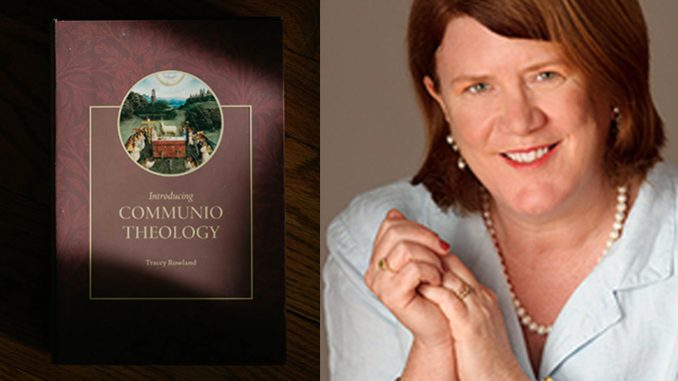
Editor’s note: The following address was given in Sydney, Australia, on February 5th, at the launch of Introducing Communio Theology, written by Professor Tracey Rowland and published by Word on Fire Academic.
The late Holy Father, Pope Francis, once described female theologians as “strawberries on the cake”.1 I am confident that he intended this as a term of endearment. Nevertheless, it obviously invited misunderstandings, implying that the “feminine genius” is merely a decorative addition to the otherwise “masculine” substance of Catholic intellectual life. But in this happy context–the launch of a marvellous new book, Introducing Communio Theology–the cake analogy, at least to my mind, proves rather useful.
Let me begin by saying that its esteemed author is no silk-soft “strawberry”—someone added ad ornamentum to the theological enterprise. Professor Rowland is a globally respected scholar of remarkable theological breadth. More pertinently, she is one of a select few within the academy who understands the suppressed theological aberrations that quietly animate “modernity” and “post-modernity—precisely because she is familiar with the influential layers of the German philosophical cake, which have been baked and, I would say, burnt over the last five centuries.
And, most important of all, Professor Rowland loves God, loves the Catholic faith, and cares deeply about the future.
It is this rare combination that enables this work on communio to make such a timely and needed contribution within our present cultural and ecclesial moment. The intended audience reflects this. As Professor Rowland herself acknowledges, one might assume that such a book would be pitched principally at those already familiar with the writings of the so-called “founding-trio” of communio–Henri de Lubac, Hans Urs von Balthasar, and Joseph Ratzinger.
However, Rowland’s target audience is actually the “younger generations of Catholics”.2
Disillusioned by the crisis, confusion, and contradiction that pervades public discourse (particularly on issues like identity, meaning, and purpose), young people today are far more theologically curious—wondering whether there is a via tertia (a “third way”) between cultural nihilism, on the one hand, and what one might call, ecclesial nostalgia, on the other. (The idea that all we need to do is “reboot” to 1958, before the “fall” that was Vatican II.) Rowland believes that a deeper discovery of communio scholarship might help Catholics to discern that third way/via tertia since it can help “separate the wheat from the chaff in post-conciliar theology.”3
As the book notes well, “communio” is not so much a theological school–like “Thomism or Scotism”–but, rather, a theological and cultural sensibility; borne out of a friendship between the “founding-trio” and finding its most powerful literary expression in the international journal of the same name. Its guiding motivation is best summarised as “unity and communion among Catholics” that flows from, rather than in opposition to, the “entire treasury of the Catholic intellectual tradition”. 4
Rowland’s book follows this same instinct. It is not a history of communio so much as a demonstration of how it can work as a grammar capable of clarifying and illuminating some of the most pressing issues of our time–from feminism to the priesthood, from ecological stewardship to secularism.
I will not pursue these topics here. It is enough to say that what Professor Rowland offers is a relevant and compelling way of navigating the present and of envisaging reform in continuity with the tradition. Instead, I thought to highlight, briefly, three recurring themes that I found particularly stimulating and encouraging throughout the book.
The first is the critique of anthropological extrinsicism, also known as the two-tiered ‘cup-cake’ approach to nature and grace; the second is its engagement with Immanuel Kant; and the third is its theological understanding of the bureaucratisation and what I would refer to as the “agencification” of the Church.5
Against Extrinsicism
One of the book’s most important claims is that the crises we face today should not be viewed as primarily moral or existential; they are intrinsically theological. Perhaps one helpful way to begin to open the door here is by asking a question that I do not think gets asked often enough: Why do we keep losing the culture wars? And why is it that, despite decades spent discerning a supposedly “secular” lingua franca, we continue to struggle to communicate—and defend—the intellectual credibility of the Church’s teaching?
The issue here, once again, is not tactical but theological. A hallmark of the communio approach is its insistence on asking what vision of reality is actually adequate to understand the Church’s present crisis. On that score, it was the work of Maurice Blondel and, more famously, Henri de Lubac, that has led to a greater appreciation for how theological assumptions about nature and grace have quietly shaped modern notions like the “secular”, “public reason”, and “sociological neutrality.”
Theological extrinsicism views nature (including human nature) as possessing its own, ontologically distinct, telos apart from grace. To return to the cup-cake analogy, “grace”, as Rowland puts it, is viewed as “merely a kind of icing or decorative ‘topper’ on the cake of nature that does not penetrate its substance…”6 As such, it became a theological commonplace in recent centuries to reject the Augustinian insight that human beings possess a natural desire for God and to decouple (ontologically) realities that “ought to be held in tension”: nature and grace, faith and reason, Scripture and Tradition, philosophy and theology.7
Rowland argues that a hallmark of communio theology is a rejection of these “bastard dualisms”, and an ardent call to Christians to stop breathing life into the idea of the secular by treating it as something philosophically neutral instead of a theological heresy. For as the Second Vatican Council famously declared in what could be considered a motto of communio: “The truth is that only in the mystery of the incarnate Word does the mystery of man take on light.”8 In other words, instead of trying to engage the world on its “own terms” by seeking some kind of correlationism with “fashionable philosophies”, we will get further if we put our faith in an explicitly Christocentric and Trinitarian vision that refuses to separate “Christian values” from “Christian sacraments”.
The Kantian Anxiety
If extrinsicism names the theological mistake, its most influential philosophical articulation can be found in the dualistic view of reality of Immanuel Kant. Rowland refers to Kant throughout the book more than any other modern philosopher.
When I arrived at the University of Cambridge in 2014 to read for an MPhil in the Philosophy of Religion, I was struck by the extent to which the metaphysics paper was structured around Kant’s First Critique. Moreover, I was even more surprised by the fact that I was often asked, particularly as a man of faith, to declare my hand as to whether I believed Kant was my “metaphysical hero”–the one who, although denying knowledge of God, made room for faith in the realm of practical (moral) reasoning–or my “metaphysical villain”–the thinker who reduces religion to nothing more than a wispy transcendentalism, void of dogma and doctrine. Such was the significance of this question that it virtually determined who you would (or could) work within the faculty.
Tracey Rowland’s book wasn’t available in 2014, though I wrote to ask her advice on how to approach Kant. Even then, she pointed me to the communio scholars, especially von Balthasar. I remember arguing–in suitably Cambridge fashion—that Kant functioned as an “epiphenomenal prophylactic”, a polite way of meeting Kantian obtuseness with my own rhetorical manoeuvring.
Rowland makes clear that another strength of the communio scholars lies in their willingness to engage seriously with figures such as Kant and Hegel. even finding reasons to respect the philosophical provocations of Nietzsche. This, to my mind, is a genuinely Catholic—and indeed Thomistic—instinct. Nevertheless, in Chapters Five and Six, Rowland shows how the Kantian notion of “pure reason” has underwritten much of the impoverished exegesis of Scripture (associated with an exclusive recourse to the historical-critical method), as well as repeated attempts to reduce Christianity to little more than a moral code/set of autonomous values.
Here she helpfully cites the words of Joseph Ratzinger, who said that: “If the door to metaphysical knowledge remains barred, if we cannot pass beyond the limits to human perception set by Kant, then faith will necessarily atrophy simply for lack of breathing space.”9
Bureaucracy and Agencification
Once faith is deprived of the metaphysical breathing space described by Ratzinger, it is no longer allowed to live as mystery and truth but is increasingly treated as something to be “managed”. This leads me to a third recurring theme I really appreciated in the book—its willingness to engage with the meteoric rise of a bureaucratic and an agencified mentality in the life of the Church.
Yet, the question that Professor Rowland presses, even if at times implicitly, is the fundamental one: What kind of theological assumptions or attitudes must already be in place for a “purely organisational or bureaucratic concept of Church” to have emerged?
This question is particularly urgent if it is indeed the case that younger generations are willing to see whether the Church can offer authentic leadership amid the confusion, grounded upon a truer vision of the human person. If so, what will they find when they arrive? A prophetically Christocentric-Trinitarian Church or a beige-boring-bureaucratic Church?
On this point, Rowland is characteristically witty and accurate, even if blunt. The latter (beige, boring, bureaucratic) is arguably the most bitter consequence of an underlying extrinsicist anthropology; haunted, even if unknowingly, by a pseudo-Kantian disavowal of sacred knowledge—preoccupied, instead, with appearances, procedures, risk-assessments, and the generation of endless committees. (What exactly these committees and agencies do often remains noumenal knowledge–only God knows–but they do, at least, give the appearance of productivity and life.) Nevertheless, “Committees [tend to] generate lowest common denominator documents and policies.” This is because “bureaucratic control”, as St John Paul II said, stifles and kills “initiative and creativity”.10 The Church and its pastoral plans begin to look and sound no different from that produced by a corporate entity.
Against this trajectory, Rowland encourages us all (though, I think, special consideration is given here again for young people and seminarians) to take inspiration from the example of the likes of Lubac, Balthasar, and Ratzinger. “One reason why the trio is so important”, she writes, “is simply that they were the best and brightest of their generations”, and, thus, they could have “so easily have sought the honours and baubles” of secular academies or ecclesiastical safe spaces.11
The reason their theology remains profound and prolific is that they refused to be “company men in beige cardigans”, imbued by an equally beige (and boring) institutional personality; always smiling but deeply concerned not to say anything that might rock the ‘episcopal-ecclesial boat’. Ratzinger “never forgot that the strongest opponents of the Nazi regime were strong-minded individuals…who were not afraid to be different…”12
Catholic theology, Catholic leadership, and Catholic cultural engagement should never be beige or boring; in fact, they should always be the most generative and prophetic discourse in existence because they are inspired by prayer (communion with God). The communio scholars insisted that the Church “must never lose sight of our eternal destination, and together with theology it must develop an anthropology which gets to the heart of the matter.”13 This is what Rowland’s book does and what the world is looking for — not a bureaucratic, agencified Leviathan, but a courageous, counter-cultural communion.
Concluding Thanks
To return, finally, to the strawberry: if the analogy ever invited misunderstanding, this book corrects it decisively. Professor Rowland’s work is not an ornament added to Catholic theology, but yet another contribution to its very substance.
On a personal note, I count it as a tremendous honour to have been asked to launch such a book. I remember that in my fifth year in the seminary, I received feedback on an essay that said my paper “relied too much on the works of Tracey Rowland” and directed me to “re-read the articles from Karl Rahner and Joseph Komonchak.” If you had told me, now some 17 years ago, that I would one day be asked to launch a book by Australia’s leading theologian, I would have laughed hysterically. But, as Ratzinger also said, “where humour dies, the spirit of Jesus Christ is assuredly absent.”14
So, on that note, I invite you to join me in congratulating the wonderful–and most decidedly non-strawberry–Professor Tracey Rowland.
Endnotes:
1 Pope Francis made this remark at a gathering of the International Theological Commission, held December 5th, 2014.
2 Tracey Rowland, Introducing Communio Theology (Elk Grove Village, IL: Word on Fire Academic Press, 2025), 8. To those less attuned to our cultural and ecclesial moment, it might be tempting to assume that such an audience scarcely exists, or, even if it does exist, it would largely be disinterested in what this text has to offer. Such an assumption–irrespective of how widespread it might be–is demonstrably false. Without question, a growing number within the next generation are open to giving God and, in particular, the Catholic faith, a second look. Various studies and statistics support this, and, in a certain respect, the collapse of things like the New Atheist movement has helped occasion it.
3 Ibid., 9.
4 As is well known, communio emerged, in part, as a response to the Concilium movement established in the 1960s, which became associated with the likes of Rahner, Congar, Schillebeeckx, and Kung. In certain influential strands, Concilium also became associated with attempts to apply Critical Theory, drawn from the Frankfurt School, to desacralize the Church’s structures in the name of “progress”. But it soon became clear that the “progress some such scholars envisaged “no longer represented a unified concept” and, more troubling still, “it was perilously close to dissociating itself from the core of the Christian tradition.” Joseph Ratzinger, Principles of Catholic Theology, 388, quoted in Rowland, Introducing Communio Theology, 15.
5 Agencification refers to the way in which large bureaucracies (especially governments) have tended to create semi-autonomous “agencies”; established with the hope of increasing things like efficiency, flexibility, and expediency. Yet, it has been argued that multiplying structures often produces the opposite effect. As responsibilities become fragmented across specialised offices, coordination grows more burdensome, and the original vision of the institution’s mission becomes harder to maintain. Although this is obviously a “secular” phenomenon, there are signs that a similar dynamic might also be at work in the contemporary church. c.f. Sjors Overman & Sandra van Thiel, “Agencification and Public Sector Performance: A Systematic Comparison in 20 Countries”, Public Management Review, 18:4, 611-635.
6 Rowland, Introducing Communio Theology, 214.
7 In other words, epistemological distinctions should not lead to ontological separations.
8 Second Vatican Council, Gaudium et Spes, 22.
9 Joseph Ratzinger, Truth and Tolerance, 135, quoted in Rowland, Introducing Communio Theology, 135.
10 John Paul II, Centesimus Annus, no. 25, quoted in Rowland, Introducing Communio Theology, 290.
11 Rowland, Introducing Communio Theology, 75.
12 Ibid., 69.
13 Joseph Ratzinger, “Communio: A Program”, quoted in Rowland, Introducing Communio Theology, 61.
14 Ratzinger, Principles of Catholic Theology, 84.
If you value the news and views Catholic World Report provides, please consider donating to support our efforts. Your contribution will help us continue to make CWR available to all readers worldwide for free, without a subscription. Thank you for your generosity!
Click here for more information on donating to CWR. Click here to sign up for our newsletter.
This is a wonderful, clear, thoughtful review of a magnificent book by a brilliant theologian, a winner of the Ratzinger Prize. Communio, as both Rowland and Father Morgan note, is not yet another choice, a “school” such as neo-Thomism or whatever, but a sensibility or grammar, a way of seeing that is entirely orthodox, faithful, Christocentric, and Trinitarian. It sees everything through the “both/and” of the Incarnation rather than any sort of dualism (especially unconscious ones, so easily fallen into even by faithful theologians due to the ubiquity of those dualisms). There are Communio people who are Dominicans, Jesuits, Franciscans, etc. Its thinkers, especially those like Balthasar and Przywara, had a deeper understanding of St. Thomas Aquinas, a deeper understanding of the Church Fathers, and a deeper understanding of what modernity and postmodernity has presented and where their errors lie, than many others who claim to be scholars in those areas.
Sadly, it is also radically misunderstood. However faithful to tradition Communio is, some “traditionalists” see them as modernist enemies, while modernists see them as nostalgic throwbacks, meaning neither side understands. Also, people latch onto a soundbite and run with it (a college professor in New Jersey once said he didn’t need to read a word of Balthasar since he titled a book, “Razing the Bastions” – although the bastions were NOT dogma, sacraments, or the structure of the Church!) Anyway, ALL of Tracey Rowland’s books are highly, highly recommended. She is a treasure.
Interesting read. With priests such as Father Morgan and theologians such as Dr. Rowland, there is much to be hopeful for in ecclesial life.
P.S. It is not good form to lead off an article on Communio theology with references of any kind to the previous pontiff.
Dear DR: maybe its also: “not good form” where Prof. Roland, Chapter 1, designates ‘Communio Theology’ as an additional gift of the Holy Spirit? Working to divinize the doctrines & distinguished advocates of this movement, and white-wash some heretical unitarian and universalist novelties, etc.?
Though ‘Concillium’ was far worse than ‘Communio’.
This type of strategy has become familiar where philosopher theologians attempt to disguise a range of anti-Apostolic (even blasphemous) novelties that they want The Church to embrace. Troubled times indeed!
Good Catholics will be unpersuaded that we must add to the gifts The Holy Spirit reveals in Romans 12:6-8; 1 Corinthians 12:4-11; & Ephesians 4:7-13.
Scepticism regarding the exaggerated claims of ‘Communio’ should not be taken as resistance to friendship and cooperation between theologians. Actually: if philosopher theologian ‘aristocrats’ were less of a self-serving silo and more friendly and cooperative with all the other theologians – especially with New Testament and Pastoral theologians they, and The Church, would gain much.
Always in the grace & mercy of King Jesus Christ; love & blessings from marty
The Kantian Anxiety, Fr Morgan underlines the central cause for a theoretically subdued Christian theology:
“If the door to metaphysical knowledge remains barred, if we cannot pass beyond the limits to human perception set by Kant, then faith will necessarily atrophy simply for lack of breathing space” (Ratzinger). This was the centrifugal issue perceived when studying at the Angelicum that distanced speculative thought from its correspondence with reality.
It reduces to a simple, profound fact, that sensible perception is not a reflective awareness of the external drawn from a physically produced image. Rather, the image, called phantasm by Aquinas, describes the immaterial conveyance of the external to the intellect. It’s a ‘quasi reflection’, meaning like but not. There is no two step knowledge first sense then intellectual. Rather sensible perception is one coherent act of knowing the external world.
Kant [who invents the known phenomenon as distinct from the actual noumenon] offers no more than after the fact conjecture. Imaginative constructs that have bedevilled philosophy and theology. As such Aquinas in Quaestiones Disputandae de Veritate quotes Ibn Sina that what the intellect first perceives are beings.
“The truth is that only in the mystery of the incarnate Word does the mystery of man take on light”, Communio’s suggested motto acquires greater brilliance, the ineffable truth that God is revealed in Jesus of Nazareth.
Against this trajectory, Rowland encourages us all (though, I think, special consideration is given here again for young people and seminarians) to take inspiration from the example of the likes of Lubac, Balthasar, and Ratzinger.
Respectfully, I hope that young people and especially seminarians do not follow the examples of these men. It would be better to read sacred scripture (with a good Catholic commentary), with classics like St. Augustine’s Confessions and St. Thomas’s Summa. By my reading, the above referenced men perhaps unintentionally or with good intentions are most noteworthy for imposing their pet theological causes on the Church. The results have left the state of the Church much worse off compared to the one they inherited. Afterwards they even seemed to have acknowledged a problem but they and their modern disciples seem incapable of acknowledging their role in it and have proved incapable of putting the genie back into the bottle. Ratzinger was one of the “Young Turks” in the 1960s who seemed to try to right the ship later in life only to then suddenly resign. Look what came after. No, the lessons we should learn here are what not to do again and to not allow ourselves to be trapped in the increasingly ossified 20th century theology of the Communio School.
Dear ‘Mortain’, if that’s not serious enough, how about this –
balthasar_and_speyr_first_steps_in_a_discernment_of_spirits_angelicom_2_2014_pp273_301.pdf
WHY are our hierarchs so often suckers for academic cookies laced with spiritist communications and intellectual speculations that plainly subvert or even contradict the basics of Apostolic Catholic Christian Revelation?
How come these so-called ‘philosopher theologians’ have wangled such an influential position in our seminaries, universities, & colleges . . ? They’ve built a self-sustaining, ever expanding, mutually-congratulative cabal, who award higher degrees to one another for very shallow work.
And, yes there is a distinct odor of Masonry & worse . . .
Hopefully, good priests and lay Catholics will find protection in the wisdom of 1 Corinthians 1:20 and Colossians 2:8.
With the mention together of Kant and Bureaucracy, it’s almost as if hybrid “synodality” was a Rahnerian-flavored attempt to politicize and replace Communio.
typo: Peter D. Beaulieu
It’s always great to read what dear Professor Tracey Rowland writes so well; especially for academics who follow the tidal ebbs & flows, and occasional tsunamis, of debates & disputes among philosophers of religion. A nice, supportive review by dear Fr Gregory Morgan – an in-group philosopher.
Yet, philosophical Catholicism has always been a contentious (rarely, even murderously violent) discipline, with many unresolved propositions and perspectives. It’s main sources originate in pagan Greek thinking that was and is still today in a different world to that of carpenter Jesus Christ and His faithful fisherfolk disciples; despite centuries of effort by aristocratic, philosophic intelligentsia in & outside The Church to reconcile the two. This rabbit-hole is seeded with landmines . . !
Surprisingly, such a manifest disconnect has never persuaded philosophers that they are less than THE leading lights of The Church!
Happily, there are other disciplines within Theology; which more profoundly influence the lives of us ordinary Catholics.
For example:
Biblical Theology: seeking to find consensus among theological concepts from Genesis to Revelation, to illuminate our understanding of The Holy Trinity and our complex human relationship with God.
Historical Theology: investigating how historical context, culture, & personalities have shaped our beliefs.
Systematic Theology: explicating how Scripture, tradition, & logic have shaped our faith.
Practical (Pastoral) Theology: applying theological perspectives to everyday life and church development.
Scientific (Natural) Theology: correlating the ever-growing fund of material data with our revealed & experiential knowledge of God (my specialty).
Christology: explicating the wonders of The Incarnation and how it impacts us individually & collectively.
Pneumatology: researching our past & present anointing with God’s mighty Holy Spirit.
This treasury of theologies somewhat overshadows philosophical theology’s (sometimes anti-Apostolic) speculations about God & religion.
Sadly: when a student admits to being a theologian, they too often are taken to mean philosopher-theologian, and tarred with all the contentious, confusticating (and not rarely heterodox) baggage people associate with that discipline.
We need to rejoice that THEO-LOGY is actually a richly diverse & splendidly Jesus-focussed discipline; generally accessible and rewarding to study, far beyond the (inevitably politically-slanted) propositions of the deeply self-doubting, cognitively-dissonant, jungle of philosophical theology.
So, if you meet a philosopher-theologian give them a hug; they need it!
My apologies to the indispensable ‘Worship Theologians’ who should have headed the list! Just as the singing dancing King David led the people . . .
Very many more Catholics & other Christians gain key theological insights from the praise & worship songs of Matt Maher, Taya, Matt Redman, and other theologically-informed musicians, than from HUvB, HdL, etc.
And, I’m glad about that!
In Sydney, Australia we have a bunch of unpaid volunteer musicians (medics, teachers, technicians, etc.) whose musical presentation of theological truth educates many millions around the world. Just one recent example:
https://www.youtube.com/watch?v=wRf25AoMxvY&list=RDkHLUvUtbp2I&index=4
This is a ridiculous comment and woefully misinformed regarding Catholic philosophy.
“It’s [sic] main sources originate in pagan Greek thinking that was and is still today in a different world to that of carpenter Jesus Christ and His faithful fisherfolk disciples; despite centuries of effort by aristocratic, philosophic intelligentsia in & outside The Church to reconcile the two.”
Apparently, you’ve not heard of St. Thomas Aquinas.
Dear ‘philosoraptor’: has anyone “not heard of Saint Thomas Aquinas.”?
A notable critic was Saint Bonaventure, who warned us that Aquinas was compromising his Augustinian roots by adopting Aristotelian philosophy.
[Am assuming you’ve heard of the pagan Greek Aristotle . . ?]
Critics point to issues in Aquinas’s First and Second Ways, which argue for the existence of an ‘unmoved mover’. Since even if these arguments successfully establish a first cause, they don’t mandate a conclusion that this cause is our personal, omnibenevolent God of Love. Renowned phiosopher, J.L. Mackie has challenged Aquinas’s reasoning that a chain of causes couldn’t exist without needing a first cause.
Aquinas’s cosmological arguments are criticized for their contradictions. Aquinas claims everything has a cause, he posits God as an exception, which some see as self-contradictory. And so on, and so on . . .
Despite all the useful bits, Aquinas’s frigid scholasticism is criticized from both within and outside The Church. Many philosophers view his approach as too dogmatic. Maybe pagan Greek Aristotlianism was not such a good place to reason from, after all . . ?
Ever in the grace & mercy of King Jesus Christ; love & blessings from marty
Seriously?
I believe he seriously believes what he writes. Marty may not see that a first cause can be nothing other than the/our Creator who needs no cause or reason (particularly reasons from the likes of creatures) to be anything but what He is.
In effect, atheistic ‘Catholicism’ rears its head like Revelation’s beast from the sea.
In reply to Meiron February 14, 2026 at 3:36 pm.
Dear Meiron, you’ve misunderstood me:
personally I’d never dream of contradicting Doctor Angelicus.
My reponse to the query of the anonymous ‘philosoraptor’ [great ‘nom de plume’] was to assure him that Saint Thomas’ wonderful work was greatly influenced by a pagan Greek philosopher & that, among Aquinas’ contemporaries and among current philosopher theologians, some see this influence as leading to weaknesses in some of his arguments.
With Thomism, despite its excellence, one has to be careful to avoid worshipping Aristotle!
Remember that in his elder years Saint Thomas himself described all his prior work as ‘mere straw’.
As regards PROVING a primary cause, many follow J. L. Mackie in thinking that it is possible to have an infinite chain of cause-and-effect; showing that Thomas’ conclusion is not a logical necessity. It might still be true!
Way off, dear Meiron, to imply they are guilty of: “In effect, atheistic ‘Catholicism’ rear{ing} its head like Revelation’s beast from the sea.”
My own published position is: Before GOD created space-time/energy-matter (i.e. the universe we are part of) He knew that humans would betray His trust and obey that ancient serpent, satan. This is well supported in The New Testament, where The Holy Spirit reveals that Christ, The Lamb, was slain from before the creation of the cosmos.
In other words, GOD made our universe in full knowledge of human iniquity; and, from the very start had chosen His Son to be the Way for humans to find our way out from under the rule of the father of lies, the devil, the prince of this world (& his collaborator principalities, powers, dominions, rulers, authorities, governments, thrones, and evil in high places).
This approach is largely Thomistic except that it rejects the myth that GOD created and was then surprised when humans first betrayed Him.
Maybe GOD is never surprised.
Appreciating that creation began with an ethical encounter in the spirit, between the eternity of perfect love of GOD in Christ WITH the fallen selfishness of satan & prolepsis of human disobedience, gives us a sort of ‘Ethical Big Bang’. Saint Paul’s astonishing revelation of the Cosmic Christ (see Colossians 1:15-16; etc.) correlates perfectly with this EET tenet
(EET = ‘Ethical Encounter Theology’).
A theological advantage is that this worldview explains why natural evil was inherent in the universe from its start, a problem that has exercised many great minds. Why was there selfishness, destruction, decay, diseases, cruelty, & death millions of years before humans appeared on Earth . . ?
Scientist theologians might understand EET as reflected in the ‘Physical Big Bang’ understood by cosmologists to mark the beginning of space-time/energy-matter. It might also add meaning to the discovery that our universe depends on really VERY extraordinary ‘Anthropic Fine Tuning’.
If Saint Thomas Aquinas were here in the flesh, I’m sure he’d be the first to appreciate the advantages of this sound scriptural exegis finding deep consonance with established scientific observations on the natural world.
Maybe he would specially appreciate that there is no ‘warfare’ between GOD and satan. From the start, The Lamb’s universe works to progressively actualise & exhaustively expose the totality of evil, so He can, in all justice, judge it and dispose of it for ever.
Christ in GOD has always had the whole pictue!
So, in our LORD Jesus Christ we are in eternally safe hands.
It’s not an exaggeration to say that science, theology, & Catholic faith find no better fit than in the worldview of ‘Ethical Encounter Theology’.
This inter-disciplinary consonance provides the basis for evangelization and apologetics of our tech-savvy generation, without compromising the eternal truths set out so well in The Catechism of the Catholic Church.
Hoping that this somewhat lengthy reply helps you Meiron to see my faith is apposite and not appostate!
Ever in the love of King Jesus Christ; blessings from marty
You say we must be careful not to worship Aristotle. Why do you seem to assume that a Thomist may do that?
We consider Aristotle’s method and writing as having been based on REASONING. Reason and intellect are powers of the soul, given to each human by GOD. God does not discriminate. Our Trinitarian God is a jealous God, causing rain to fall for the benefit of all men. Yet men will discriminate against gifts given and used by Aristotle and St. Thomas; perhaps such men are unaware of their own envy, jealousy, and pride. These inclinations will display unenlightened intellect for a bit of internet glory.
Who worships Aristotle? Aristotle, pagan though he was, reasoned and recognized a being outside time and space who needed no reason or cause to be. Chipping away at Aristotle’s power of reasoning reflects poorly on those who would use non-arguments against it.
https://copilot.microsoft.com/chats/5tgewbd4h1PT29W7LpUGT
Dear Meiron, thanks for your reply, even though it does not address the matters I raised with you. Am wondering if you have read or have access to this excellent account? R.G. Collingwood’s book ‘The Idea of Nature’ (CT: Martino Publishing, 2014), where we find the kernel of offence against the Apostolic revelation of GOD in Christ;
“Aristotle denies that God knows the world, and a fortiori denies that He created it by an act of will or has any providential plans for its history or the life of anything in it. Such a denial no doubt relieves the mind of many embarrassments; it relieves us of the necessity to think of God as beholding and tolerating, or still worse as deliberately causing, the evils of which the world is full, which is always a grave moral difficulty to the popular Christian theology ; and it relieves us of the necessity to think of Him as seeing colours, hearing sounds, and so forth, which would imply His having eyes and ears, or alternatively as knowing a world so different from ours that we can no longer call it by the same name. But although these are great gains, they are offset by what we cannot but feel to be greater losses. The thought of God as watching over the life of the world, directing the course of its history, judging its actions, and bringing it ultimately back to unity with Himself, is a thought without which we can hardly care to think of God at all. ”
Maybe this is the revelation that the mature Saint Thomas Aquinas said caused him to regard all his previous work as ‘straw’ – clearly referring to Saint Paul at 1 Corinthians 3:12.
Scientist philosophers today have little time for the convoluted intricacies of hybrids between Aristotelian propositions and sound Christian dogma. Plato is another matter altogether. Check the work by Christian zoologist, Professor Simon Conway Morris, adducing evidence that unseen forms are repeatedly influential in the progress of life on Earth – such as his: ‘Life’s Solution: Inevitable Humans in a Lonely Universe’.
I think Thomas would thoroughly enjoy that book.
{By-the-Way, dear Meiron: if you’re willing to accept it, I forgive the hurtful gratuitous insults.}
Ever seeking to hear & lovingly follow King Jesus Christ; every blessing from marty