

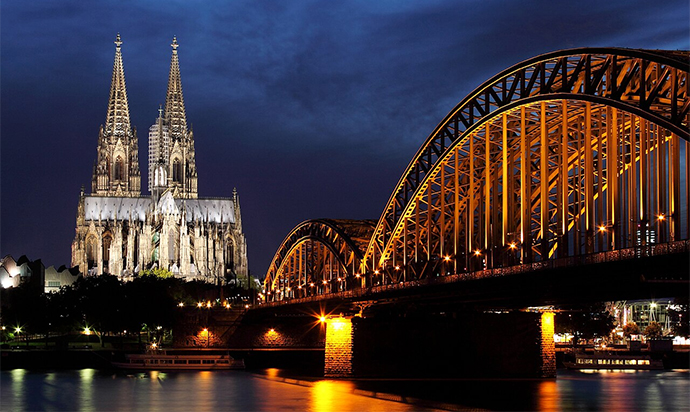
In all my travels, I have beheld few if any more impressive sights than the breathtaking Gothic behemoth of Kölner Dom, “Cologne Cathedral,” illumined at night, bathed in golden-white light, with its twin towers rising above the Hohenzollern Bridge that stretches across the Rhine.
It is Germany’s most visited landmark. Twenty thousand tourists and worshippers alike come daily to marvel at this masterpiece of Gothic architecture. It took an astounding 632 years to complete. More impressive than its grandiose facade—the largest of any church in the world—is the uniformity of its design. Across seven centuries, the cathedral’s successive builders never deviated from the original master plan. All were animated by the same vision.
Cologne’s archbishop had received the relics of the magi, known locally as “the relics of the three kings,” as a gift. The vision that transcended centuries was to glorify God by building a fitting final resting place for the relics of these three saints who journeyed so far to honor him at his birth.
The Feast of the Epiphany is a most fitting time, then, to learn how the relics of the magi came to be enshrined in Cologne, along with the history of the city’s grand cathedral.
What happened to the Three Kings after Christmas?
After the account of St. Matthew’s Gospel, later traditions developed about these mysterious Christmas pilgrims that have colored popular culture’s view of their story. Although the evangelist never specifies the number of kings who came to Bethlehem, it became widely accepted that there were three on account of the number of gifts presented. In Ravenna, Italy, a sixth-century mosaic commissioned by the Byzantine emperor Justinian (527–565) can still be seen that portrays three kings presenting gifts to the Christ child. They are depicted wearing pointed Phrygian caps of Persian origin, which shows that the belief that the kings came from Persia became the dominant tradition.
Indicated above each figure on Justinian’s mosaic in Ravenna are the names that the three kings came to be called: Caspar, Melchior, and Balthasar. The earliest known source for these names is a late fifth-century chronicle in Greek from Alexandria. These names now dominate the popular Christian tradition in the West. But early Syrian, Ethiopian, and Armenian sources referred to the three by other names.1
An early pious tradition embraced by the Christian West holds that the apostle Saint Thomas later passed through Persia before ultimately establishing his local see in India, and the three kings then heard his preaching. They recognized in his words what became of the child that the star had led them to all those years ago. At Thomas’s hand, they were baptized into the Christian faith and spent the rest of their lives sharing the truths of the gospel. Other related traditions maintain that Thomas not only baptized but also ordained the three kings as bishops and that they died as martyrs for preaching the faith.
These traditions were further expanded upon in the popular fourteenth-century work Historia Trium Regum (“History of the Three Kings”), by the Carmelite friar John of Hildesheim (1310–1375). According to that account, the three kings were from separate countries, but all followed the same star and met at Jerusalem. After adoring the Christ child and returning to the East, they decided to build a chapel at the Hill of Vaws (or Hill of “Victory”) in the “Land of Ind.” They then departed for their own countries but agreed to meet at this same place once a year to worship together the one true God they had come to know. They also ordained that this would be the place of their burial in a common tomb.2
How the relics of the Three Kings came to Cologne
The medieval legend goes on to detail how Saint Helena (246–330), in her pilgrimage to the Holy Land to erect basilicas upon the holy sites and to collect relics, began to think of the bodies of the three kings from the Christmas story. After inquiries, she was led to the Land of Ind, where she discovered the tomb of Saints Caspar, Melchior, and Balthasar. She placed the bones of the three kings in a richly ornamented chest and brought them to the church of the Hagia Sophia, built by her son in his new capital city of Constantinople.3
The medieval tale continues to state that when Saint Eustorgius was elected bishop of Milan in 343, he traveled to Constantinople to have his election confirmed by the emperor, Constantius II (reign: 337–361). While there, he accepted the gift of the relics of the three kings on behalf of his prominent see, which he brought or “translated” to Milan by oxcart.
Eight centuries later, Frederick Barbarossa “Redbeard” (reign: 1152–1190) was elected king of Germany in Frankfurt in 1152 and was later that year crowned in Aachen. He was eager to restore the Holy Roman Empire to the position it held under Charlemagne (reign: 768–814) and embarked upon multiple military expeditions in Italy. In 1165, Pope Adrian IV (reign: 1154–1159) crowned him Holy Roman emperor in Saint Peter’s Basilica. He still had to contend with repeated rebellions, however, especially in Milan.
The city of Milan surrendered to Frederick in 1162, and much of it was destroyed on his orders. The Milanese suffered a further indignity in 1164 when Frederick ordered the relics of the three kings removed from the Basilica of Saint Eustorgius and taken to Cologne as a gift to the city’s archbishop, Rainald of Dassel (1120–1167), who served as his archchancellor and close advisor.
Cologne Cathedral
The city soon became a popular pilgrimage destination, making a larger space necessary to accommodate the crowds. The clergy and citizens of Cologne decreed that a new cathedral be built.
While the western part of the old cathedral was to remain in use for services, the eastern part was to be demolished to make way for the construction of the new church. Careless demolition of the eastern choir, however, caused a fire that destroyed the whole cathedral. With this unfortunate moment came the opportunity to expand the vision to build one of the grandest pilgrimage churches in the world, a new cathedral that would become a symbol of the German nation.4
The official name of the cathedral is Hohe Domkirche St. Peter und Maria (“High Cathedral Church of Saint Peter and Mary”), but it is popularly known as Cologne Cathedral. The foundation stone for this present-day church was laid on August 15, 1248, by Archbishop Konrad von Hochstaden (term: 1238–1261). The church was initially called the Cathedral Church of Saint Peter. This was eighty-four years after Barbarossa gifted the relics of the kings to the city. By 1265 (seventeen years after construction began), the Mass was able to be celebrated, and by September 27, 1322 (fifty-seven years after the first Mass), enough was completed for the building to be solemnly consecrated.
Political unrest caused work to progress slowly. Construction came to a halt altogether in 1560 after the southern spire was brought to 195 feet. This unfinished spire with the crane above it became the symbol of Cologne until 1869.
French revolutionary forces arrived in Cologne in 1794. Church services at the Cathedral Church of Saint Peter were severely restricted, and for a time, the cathedral was used as a storehouse for the French army and was used to accommodate Austrian prisoners of war who, in the winter of 1797–1798, used some of the wooden interior for firewood.
When Napoleon Bonaparte rose to power (reign: 1804–1814 and 1815), he suppressed the archbishopric of Cologne, reducing Saint Peter’s to a mere parish church and no longer a cathedral. In these challenging times, the Germans rallied to the cause of completing the church, seeing its sorry state as a blow to their national identity.
Napoleon was defeated in 1814 by a coalition of European powers, and Cologne became a part of Prussia, which was a German state. An accord between Pope Pius VII (reign: 1800–1823) and the king of Prussia, Frederick William III (reign: 1797–1840), restored the Archbishopric of Cologne in 1821. Before this accord, the Protestant Prussian state had confiscated all of Saint Peter’s church property while at the same time supporting the completion of the cathedral for several reasons.
In addition to improving relations with Catholic subjects, nineteenth-century Germany was the center of the Romantic movement’s enthusiasm for the Middle Ages. Germanic companies regarded the construction as a symbol of German nationhood and joined together to form a fund for the completion of the cathedral. The Prussian state supplied all remaining costs.
Work, which had come to a halt in 1560, was able to resume in 1842. By 1869, the northern spire was the same height—516 feet—as its southern twin, with its old crane that had marked Cologne’s skyline for three hundred years. Its facade was and still is the largest of any in the world. Over the course of six centuries, each architect remained faithful to the original medieval plan, and the result upon completion in 1880 was what is often called the “perfect cathedral.”5
The Relics of the Three Kings
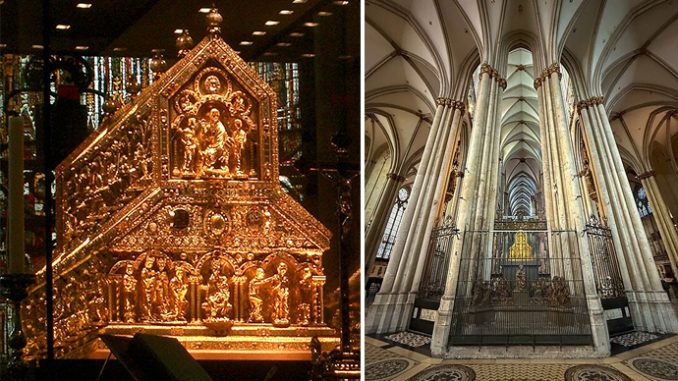
On the high altar is the resting place of the three kings. The task of creating a worthy sarcophagus for the biblical figures was assigned to one of the most famous craftsmen of his time, Nikolaus de Verdum (1130–1205). He arrived with his team from Vienna in 1180. The shrine he began is made of oakwood covered in gold and silver plate along with precious stones, filigree, and enamel fittings.
Some of the stones are said to have been brought from the Near East during the Crusades, donated by King Otto IV (reign: 1198–1209).6 It took forty years to complete the shrine in the form of a basilica, which is five feet high, seven feet long, and three and a half feet wide.
After their coronations in Aachen, the German kings were eager to come to Cologne to seek the intercession of the first monarchs to be recognized by Christ. After his coronation in 1198, Otto IV donated three gold crowns to adorn the skulls inside. On the Feast of the Epiphany on January 6 each year, the front panel of the shrine is removed, and through the gold mesh, pilgrims can see the outline of the three skulls adorned with Otto’s crowns.
The calling of the gentile nations
Epiphany marks and celebrates the wonderful moment in salvation history when the Three Kings bowed before the King of heaven and earth because it marked a great “theophany” (or “epiphany”)—the manifestation of the Son of God to the gentile world.
At the very time the old covenant was established between God and Abraham, the Lord promised that the gentiles, too, would one day be his own chosen people through their faith and baptism. God said this to Abraham: “I will make of you a great nation . . . and in you all the families of the earth shall be blessed” (Gen. 12:2–3).
Today, this promise is fulfilled. As Saint John Chrysostom writes: “The Magi therefore were the first from the Gentiles chosen for salvation, so that through them a door might be opened to all the Gentiles.”7
We can understand, then, why the citizens of Cologne were so greatly moved by the gift of the relics of the three kings that they committed to building a cathedral in their honor that would take over six hundred years to complete. As we contemplate all this, let us ask God for the grace to respond generously to the inspirations he places in our hearts, which call us to a deeper faith, just like the Three Kings did in following the star.
Endnotes:
1 Dwight Longenecker, Mystery of the Magi: The Quest to Identify the Three Wise Men (Washington, D.C.: Regnery History, 2019), 30-32.
2 Mark Rose, “The Three Kings & the Star,” Archaeology, December 21, 2004.
3 Mark Rose, “The Three Kings & the Star.”
4 Jakob Schlafke, The Cathedral of Cologne (Florence: Casa Editrice Bonechi, 1984), 4; Arnold Wolff, Cologne Cathedral (Stuttgart: Greven Verlag, 2016), 6-7.
5 Information on the construction of Cologne Cathedral was taken from Schlafke, The Cathedral of Cologne, 4, and Wolff, Cologne Cathedral, 5-10.
6 Joan Carroll Cruz, Relics (Huntington, Indiana: Our Sunday Visitor, 1984), 154.
7 John Chrysostom, “Sermon for the Epiphany” in The Sunday Sermons of the Great Fathers, ed. and trans. M.F. Toal (Chicago: Henry Regenery, 1960), 1:222.
If you value the news and views Catholic World Report provides, please consider donating to support our efforts. Your contribution will help us continue to make CWR available to all readers worldwide for free, without a subscription. Thank you for your generosity!
Click here for more information on donating to CWR. Click here to sign up for our newsletter.

I hope that I do not come across as too cynical, but I find it hard to believe that these are actually the bones of the Magi. Also, I don’t believe that the Bible uses the number 3 for the Magi. We seem to assume that number because of the 3 gifts.
The epiphany is the oldest feast in the liturgical calendar. The Church father Origen suggests “there were three magi since three gifts were offered”. The names of the three are first recorded in the 6th century. Grzegorz Gorney* tends to conclude that there was some Christian mythmaking in the names. Each name stems from the word King in three different languages. Casper derived from Latin Caesar, Melchior from Hebrew melech, Balthasar from Greek basileus.
(Note that these are the exclusive liturgical languages of the Church down to the 9th century… a symbolism which reminds us of the three languages declaring Jesus King on the cross later in the gospels.)
*Three Kings, ten mysteries
No obligation to believe—nor cynicism to disbelieve—in the three bones, and even less plausible is the moving star…But wait! Hear three points (!) about the mysterious Magi and the more mysterious Star:
FIRST, there’s the proposition that the pagan Magi were truly looking for a messiah because they had heard of the Hebrew expectation. When the northern Kingdom fell to the Assyrians in 721 B.C., the Hebrews were dispersed into exile, likely with some of the exiles to carry the prophetic tradition too lands where their story still would be heard centuries later by the magi class.
SECOND, the star might well be explained by an astronomer, Michael R. Molnar, author of “The Star of Bethlehem: The Legacy of the Magi,” Rutgers University Press, 1999. Here’s a snap shot of a complicated story involving details of history and of modern science.
Molnar was an astronomer and former manager of the Physics Instructional Labs at Rutgers. He was also a collector of rare coins. Of coins within only a few years of Christ’s birth, some depict the star Aries. By computer simulation of the sky, Molnar winds back to the same period, maybe 6 B.C. and discovers a conjunction between the distant star, Ares, and the aligned and much closer planets of Jupiter and Saturn. Combined, the three as a bright “star.”
The computer simulation and overhead projection shows that the conjunction first appeared in the west but then dispersed and disappeared. Because of the earth’s rotation around the sun, the same conjunction reappeared six months later, this time more overhead and again stationary, as over the village of nearby Bethlehem–after the magi had made their journey. This six-month period allows time to consult and agree about the star, and then to organize a caravan, and then travel the 1,300 miles or so. (“Stationary” because at either end of the earth’s circular path around the sun, the parallax alignment of the convergent two planets and Aires is seen from the two opposite ends of the earth’s rotational cycle. Molnar supplies the needed diagrams.)
THIRD, so, in our modern minds do we tend too much to separate the book of nature and Creation from the book of Scripture?
What if God combines the two, such that the conjunction, that’s been in the works for billions years (the twinkling of an eye), coincides with the coming of Christ at a distant Roman outpost in the time of Pontius Pilate? What if God looks at diminutive Man and says, well, if 200 billion galaxies each with 200 billion stars don’t get Man’s attention, what about only two planets and one star? Never quench a smoldering wick! After all, if we don’t cry out, says the incarnate Christ, then even these nearby stones will cry out (Luke 19:40). Or maybe a conjunction of two nearby planets and a single star in the near infinite cosmos.
Did the infinite Creator—Lord above (!) and yet pervading all creation—design our entire and moving galaxy to cause the conjunction of two planets and a star to coincide in earth time with the entry of the Second Person into His creation? Nice touch, that! Our wonder is turned to the design of a galaxy in the same way that the attention of the British poet Alfred Lord Tennyson (1809-1892) was drawn to the design of a single flower! The mere “flower in the crannied wall” (title of the poem) led him to think that if he knew all about it “root and all,” then he would also be able to search the mysteries of God and man.
I agree that the remains in the Cologne reliquary are most unlikely to come from the Biblical Magi. But when the shrine was opened in the last century for restoration, it was found to contain fragments of Late Antique silk damask dyed with real murex purple so it appears to have been actually packed up in the century of St. Helen. What body parts were enshrined have not survived and there’s no way to prove whose they were.
The Three Kings are, of course, an important part of local culture in Cologne. Their crowns appear in the heraldry of the city and the archdiocese. (The Kings themselves have heraldic emblems, too: a crescent moon, all-seeing Eye, and a star.) Their shrine was one of the most popular pilgrimage sites in Europe. Today, following German custom, I wrote their intials, three crosses, and the date in chalk in the front of my house to ask their protection in the coming year. C+M+B+ also stands for Christus Mundum Benedicat (“Christ Blesses the World”)
Happy Epiphany to all!