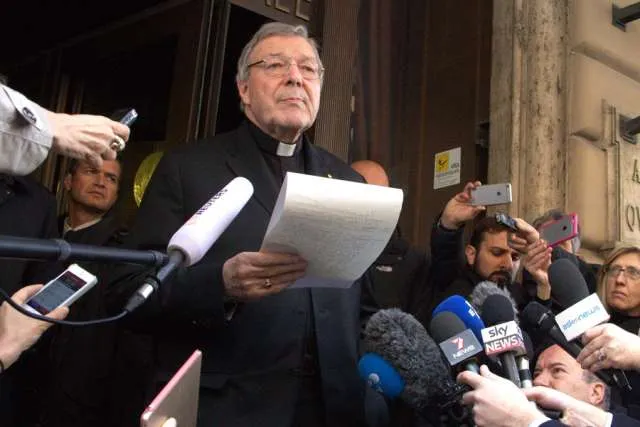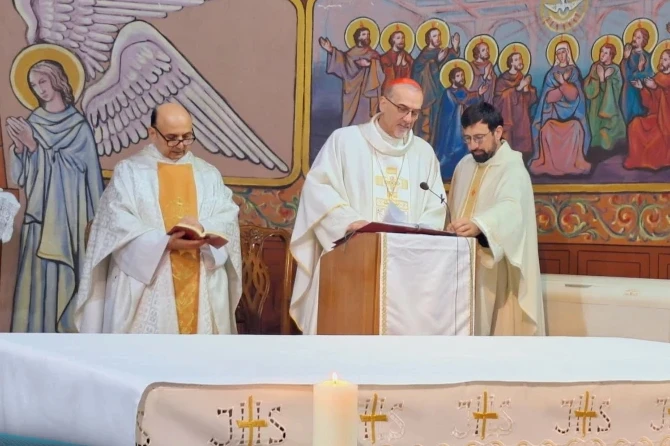
Father Gabriel Romanelli with Cardinal Pierbattista Pizzaballa, Latin Patriarch of Jerusalem, celebrating Christmas Mass at Holy Family Parish in Gaza, in December 2024. / Credit: Courtesy of the Latin Patriarchate of Jerusalem.
Vatican City, Jul 17, 2025 / 15:00 pm (CNA).
The Holy Family Church in Gaza was hit Thursday amid a new wave of Israeli bombings, leaving several people dead and injured, including the church’s pastor, Gabriel Romanelli, a native of Argentina.
The Latin Patriarchate of Jerusalem confirmed the incident in an official statement. The attack left three dead, according to Caritas Jerusalem.
One of the victims was Saad Issa Kostandi Salameh, 60, the parish’s maintenance manager who was in the courtyard at the time of the explosion. The other two fatalities were Foumia Issa Latif Ayyad, an 84-year-old woman, and Najwa Abu Daoud, 70, who were receiving psychological care at the time inside the tent of Caritas’ psycho-social support project.
According to Avvenire, the Italian Bishops’ Conference newspaper, Romanelli suffered injuries to his leg and was hospitalized, although his condition is not reported as critical. In addition to the Argentine priest from the Institute of the Incarnate Word, eight other people were injured and rushed to Al Mamadami Hospital, just one kilometer (.62 miles) from the church.
The parish building, the only Catholic church in the Gaza Strip, was converted at the beginning of the war into a makeshift shelter where more than 500 people now live. The majority are Orthodox Christians, Protestants, and Catholics, but it also serves as a refuge for more than 50 Muslim children with disabilities and their families.
For weeks, the 541 people sheltering in the parish complex have endured the daily roar of bombs falling in the surrounding area, especially in the residential neighborhood of al-Zaytun in Gaza City.
Despite the insecurity, the priest of the Institute of the Incarnate Word (IVE) has remained in Gaza accompanying the local Catholic community in the midst of the conflict. In 2023 (when the Israel-Hamas war started) he was evacuated to Jerusalem, but decided to return in a gesture that demonstrates his pastoral commitment and spiritual resilience.
Italian Prime Minister Giorgia Meloni condemned the incident. “The Israeli attacks on Gaza also hit the Holy Family church,” she wrote on X. “The attacks against the civilian population that Israel has been carrying out for months are unacceptable. No military action can justify such deportment,” she added.
This is not the first time that Holy Family parish, which has been a location for humanitarian assistance since the start of the war in October 2023, has been attacked. In December of that same year, two women were killed by an Israeli sniper inside the compound.
This latest attack on a place of worship raises new concerns about the situation of civilians and religious communities trapped in the conflict. The Catholic Church in the Holy Land has repeatedly called for respect for sacred sites and the protection of the civilian population, regardless of faith.
A United Nations delegation made a surprise visit to the parish on July 1, the only Latin-rite Catholic church in Gaza, which houses hundreds of people displaced by the war.
According to Servizio Informazione Religiosa (SIR), the news agency of the Italian Bishops’ Conference, representatives of the United Nations Office for the Coordination of Humanitarian Affairs (OCHA) visited the church to assess the current situation there.
This story was first published by ACI Prensa, CNA’s Spanish-language news partner. It has been translated and adapted by CNA.
If you value the news and views Catholic World Report provides, please consider donating to support our efforts. Your contribution will help us continue to make CWR available to all readers worldwide for free, without a subscription. Thank you for your generosity!
Click here for more information on donating to CWR. Click here to sign up for our newsletter.
Vatican City, Mar 22, 2018 / 11:47 am (CNA/EWTN News).- The United States delegates to a pre-synod gathering in Rome this week have said they think young Catholics in the nation need – and desire – faithful and authentic accompaniment in order to live the faith and to form a relationship with Christ.
“The common thread that we kept going back to… was the need for companionship for young people, and how there’s this real desire to meet authentic people who are authentic witnesses,” delegate Katie Prejean McGrady told CNA.
“That word [authentic] came up frequently. And then the whole concept that it didn’t matter where you were from, and it didn’t matter what the state of the Church was, young people respond far better to personal relationships and one-on-one interactions with people of faith.”
Prejean McGrady, a wife, mother, youth minister, and speaker from Louisiana, is one of four representatives – all in their 20s – who were chosen by the U.S. bishops as delegates to the Vatican’s pre-synod gathering happening ahead of the October Synod of Bishops on young people.
Prejean McGrady spoke to CNA March 21 alongside Br. Javier Hansen, FSC, a LaSallian Brother who teaches religion in El Paso; Nick López, a single young adult who is the director of campus ministry for the University of Dallas; and Chris Russo, a Byzantine Catholic who works as a research technologist at a hospital in Boston.
The pre-synod gathering has included discussion among young people from all over the world as they help to prepare and edit a document which will serve as a guide for bishops during the synod. The final document will be presented Saturday, and given to the Pope at Palm Sunday Mass.
Speaking to CNA, all four delegates said that the growing number of young Americans not practicing the faith they were given is one of the major concerns they brought to the meeting, and something they would like to see addressed.
Prejean McGrady said that she thinks one reason for the disaffiliation is that many Catholics in the US were catechized in a way that merely presented “bullet points to learn or these things to do”, rather than integrating these as part of the basis for a relationship with Christ.
She also noted that it is her belief that having “companions on the journey” makes it “much easier to build that relationship.”
Delegates also expressed frustration at feeling that older generations often place the blame of youths’ disengagement from the faith on the young people themselves, and do not admit their own share in the responsibility.
Russo said that people to whom he’s spoken are “very distressed about disaffiliation in the Church,” but those “who ask why young people are no longer involved in the Church, are the same people who then criticize, saying, ‘oh, well, you’re too young to understand or to express an opinion.’”
Lopez agreed that it often feels like older generations think young people “don’t care” or are “too distracted,” but he takes hope in the fact that bishops are making an effort to listen to young people. He also expressed his desire that adults outside the hierarchy will also be inspired to listen more.
The four acknowledged that disaffiliation is also a problem in other parts of the world, and that it is not the only challenge young Americans have in common with youth in other parts of the globe.
They noted the increase in mental illness, the effects of media, and pornography use, in particular.
Because the meeting’s participants come from different backgrounds, including different religions, Prejean McGrady said that not everyone in attendance has had a positive view of the Church. But in general, the discussions have been instructive and focused on cooperating with the Church, not tearing it down.
She said that she thinks there’s great hope “because we were already brought to the table. I think that’s the bishops appealing to us, saying we want to know how to meet you face-to-face.”
Br. Javier expressed the desire that the same sort of discussions happening at the pre-synod meeting could take place on a national or local level, creating a conduit for communication with young people.
In the end, the delegates all emphasized that young people are both the future of the Church and the Church now.
Russo also requested that the world continue to pray for everyone involved in the Synod. “This is only an initial step – this isn’t the be-all-end-all,” he said. “This isn’t ending, this is something so, so much bigger. We have to talk to our communities… we’re the Church.”
Pope Francis speaks at the general audience in Vatican City’s Paul VI Hall on Feb. 22, 2023. / Vatican Media
Rome Newsroom, Mar 11, 2023 / 05:20 am (CNA).
Pope Francis has said that gender ideology is “one of the most dangerous ideological colonizations” today.
In an interview with journalist Elisabetta Piqué for the Argentine daily newspaper La Nación, Pope Francis explained the reasoning behind his strong statement.
“Gender ideology, today, is one of the most dangerous ideological colonizations,” Francis said in the interview published on the evening of March 10.
“Why is it dangerous? Because it blurs differences and the value of men and women,” he added.
“All humanity is the tension of differences. It is to grow through the tension of differences. The question of gender is diluting the differences and making the world the same, all dull, all alike, and that is contrary to the human vocation.”
Pope Francis has frequently used the term “ideological colonization” throughout the 10 years of his pontificate, particularly to describe instances when aid money for developing countries has been tied to contraceptives, abortion, sterilization, and gender ideologies.
In a conversation with Polish bishops in 2016, Pope Francis said: “Today children — children — are taught in school that everyone can choose his or her sex. Why are they teaching this? Because the books are provided by the people and institutions that give you money. These forms of ideological colonization are also supported by influential countries. And this is terrible!”
The pope told Piqué that he was not currently writing a new encyclical and denied that he had been asked to write a document on the subject of gender.
While he is not writing something on gender ideology, the pope said that he talks about the subject “because some people are a bit naive and believe that it is the way to progress.”
He said that they “do not distinguish what is respect for sexual diversity or diverse sexual preferences from what is already an anthropology of gender, which is extremely dangerous because it eliminates differences, and that erases humanity, the richness of humanity, both personal, cultural, and social, the diversities and the tensions between differences.”
The pope noted that he always distinguishes “between what pastoral care is for people who have a different sexual orientation and what gender ideology is.”
“They are two different things,” he added.
When Piqué asked Pope Francis if he knew that in Argentina people are asked to indicate on official forms if they are male, female, or non-binary sex, the pope said that it reminded him of the “futuristic” novel, “Lord of the World,” written by Monsignor Robert Hugh Benson in 1907.
He said that the book presents the idea of “a future in which differences are disappearing and everything is the same, everything is uniform, a single leader of the whole world.”
In the interview with La Nación— the third papal interview published on March 10 — Pope Francis also reflected on the 10 years of his pontificate, his concern for the war in Ukraine, and why he has not traveled to his native Argentina.
Days ahead of the 10th anniversary of his pontificate on March 13, the pope said that he was especially happy about the legacy of his “pastoral line of forgiveness and understanding of the people, to make room in the Church for everyone.”
Asked to identify any mistakes he might have made in the past 10 years, the pope regretted times when he had lost his patience.
“More than once. It did not appear in the newspapers, but more than once,” he added with a laugh.
Bishops process into St. Peter’s Basilica for the closing Mass of the first assembly of the Synod on Synodality on Oct. 29, 2023. / Vatican Media
Rome Newsroom, Jul 9, 2024 / 06:00 am (CNA).
The guiding document for the final part of the Synod on Synodality, published Tuesday, focuses on how to implement certain of the synod’s aims, while laying aside some of the more controversial topics from last year’s gathering, like women’s admission to the diaconate.
“Without tangible changes, the vision of a synodal Church will not be credible,” the Instrumentum Laboris, or “working tool,” says.
The six sections of the roughly 30-page document will be the subject of prayer, conversation, and discernment by participants in the second session of the 16th Ordinary General Assembly of the Synod of Bishops, to be held throughout the month of October in Rome.
Instead of focusing on questions and “convergences,” as in last year’s Instrumentum Laboris, “it is now necessary that … a consensus can be reached,” said a FAQ page from synod organizers, also released July 9, answering a question about why the structure was different from last year’s Instrumentum Laboris.
The guiding document for the first session of the Synod on Synodality in 2023 covered such hot-button topics as women deacons, priestly celibacy, and LGBTQ outreach.
By contrast, this year’s text mostly avoids these subjects, while offering concrete proposals for instituting a listening and accompaniment ministry, greater lay involvement in parish economics and finances, and more powerful parish councils.
“It is difficult to imagine a more effective way to promote a synodal Church than the participation of all in decision-making and taking processes,” it states.
The working tool also refers to the 10 study groups formed late last year to tackle different themes deemed “matters of great relevance” by the Synod’s first session in October 2023. These groups will continue to meet through June 2025 but will provide an update on their progress at the second session in October.
The possibility of the admission of women to the diaconate will not be a topic during the upcoming assembly, the Instrumentum Laboris said.
The new document was presented at a July 9 press conference by Cardinals Mario Grech and Jean-Claude Hollerich, together with the special secretaries of the synodal assembly: Jesuit Father Giacomo Costa and Father Riccardo Battocchio.
“The Synod is already changing our way of being and living the Church regardless of the October assembly,” Hollerich said, pointing to testimonies shared in the most recent reports sent by bishops’ conferences.
The Oct. 2-27 gathering of the Synod on Synodality will mark the end of the discernment phase of the Church’s synodal process, which Pope Francis opened in 2021.
Participants in the fall meeting, including Catholic bishops, priests, religious, and laypeople from around the world, will use the Instrumentum Laboris as a guide for their “conversations in the Spirit,” the method of discussion introduced at the 2023 assembly. They will also prepare and vote on the Synod on Synodality’s advisory final document, which will then be given to the pope, who decides the Church’s next steps and if he wishes to adopt the text as a papal document or to write his own.
The third phase of the synod — after “the consultation of the people of God” and “the discernment of the pastors” — will be “implementation,” according to organizers.
Prominent topics
The 2024 Instrumentum Laboris also addresses the need for transparency to restore the Church’s credibility in the face of sexual abuse of adults and minors and financial scandals.
“If the synodal Church wants to be welcoming,” the document reads, “then accountability and transparency must be at the core of its action at all levels, not only at the level of authority.”
It recommends effective lay involvement in pastoral and economic planning, the publication of annual financial statements certified by external auditors, annual summaries of safeguarding initiatives, the promotion of women to positions of authority, and periodic performance evaluations on those exercising a ministry or holding a position in the Church.
“These are points of great importance and urgency for the credibility of the synodal process and its implementation,” the document says.
The greater participation of women in all levels of the Church, a reform of the education of priests, and greater formation for all Catholics are also included in the text.
Bishops’ conferences, it says, noticed an untapped potential for women’s participation in many areas of Church life. “They also call for further exploration of ministerial and pastoral modalities that better express the charisms and gifts the Spirit pours out on women in response to the pastoral needs of our time,” the document states.
Formation in listening is identified as “an essential initial requirement” for Catholics, as well as how to engage in the practice of “conversation in the Spirit,” which was employed in the first session of the Synod on Synodality.
Pope Francis and delegates at the Synod on Synodality at the conclusion of the assembly on Oct. 28, 2023. Credit: Vatican Media
The document says the need for formation has been one of the most universal and strong themes throughout the synodal process. Interreligious dialogue also is identified as an important aspect of the synodal journey.
On the topic of the liturgy, the Instrumentum Laboris says there was “a call for adequately trained lay men and women to contribute to preaching the Word of God, including during the celebration of the Eucharist.”
“It is necessary that the pastoral proposals and liturgical practices preserve and make ever more evident the link between the journey of Christian initiation and the synodal and missionary life of the Church,” the document says. “The appropriate pastoral and liturgical arrangements must be developed in the plurality of situations and cultures in which the local Churches are immersed …”
How it was drafted
Dubbed the “Instrumentum Laboris 2,” the document released Tuesday has been in preparation since early June when approximately 20 experts in theology, ecclesiology, and canon law held a closed-door meeting to analyze around 200 synod reports from bishops’ conferences and religious communities responding to what the Instrumentum Laboris called “the guiding question” of the next stage of the Synod on Synodality: “How to be a synodal Church in mission?”
After the 10-day gathering, “an initial version” of the text was drafted based on those reports and sent to around 70 people — priests, religious, and laypeople — “from all over the world, of various ecclesial sensitivities and from different theological ‘schools,’” for consultation, according to the synod website.
The XVI Ordinary Council of the General Secretariat of the Synod, together with consultants of the synod secretariat, finalized the document.
According to the working tool, soliciting new reports and feedback after the consultation phase ended is “consistent with the circularity characterizing the whole synodal process.”
“In preparation for the Second Session, and during its work, we continue to address this question: how can the identity of the synodal People of God in mission take concrete form in the relationships, paths and places where the everyday life of the Church takes place?” it says.
The document says “other questions that emerged during the journey are the subject of work that continues in other ways, at the level of the local Churches as well as in the ten Study Groups.”
Expectations for final session
According to the guiding document, the second session of the Synod on Synodality can “expect a further deepening of the shared understanding of synodality, a better focus on the practices of a synodal Church, and the proposal of some changes in canon law (there may be yet more significant and profound developments as the basic proposal is further assimilated and lived.)”
“Nonetheless,” it continues, “we cannot expect the answer to every question. In addition, other proposals will emerge along the way, on the path of conversion and reform that the Second Session will invite the whole Church to undertake.”
The Instrumentum Laboris says, “Synodality is not an end in itself … If the Second Session is to focus on certain aspects of synodal life, it does so with a view to greater effectiveness in mission.”
In its brief conclusion, the text states: “The questions that the Instrumentum Laboris asks are: how to be a synodal Church in mission; how to engage in deep listening and dialogue; how to be co-responsible in the light of the dynamism of our personal and communal baptismal vocation; how to transform structures and processes so that all may participate and share the charisms that the Spirit pours out on each for the common good; how to exercise power and authority as service. Each of these questions is a service to the Church and, through its action, to the possibility of healing the deepest wounds of our time.”
A sad event. May the souls of those who were murdered rest in peace. Events like these might finally awaken certain Catholics to the fact that *Israel is not our friend.*
Israel is not our friend but Iran and Hamas are?
Did I say they were?