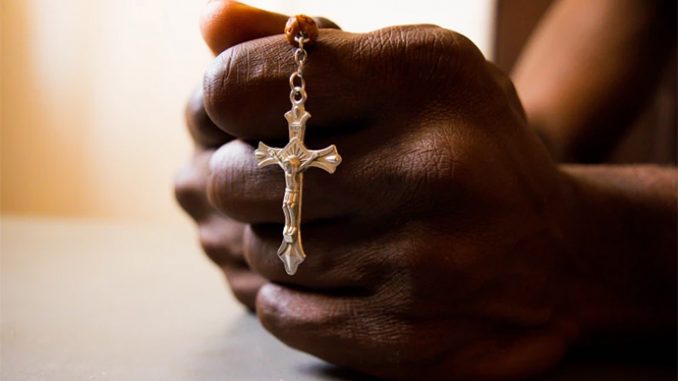
According to an August 10 report by Intersociety, at least 7,087 Christians were massacred across Nigeria in the first 220 days of 2025 (Image: Red Confidential/Shutterstock)
Washington, D.C. Newsroom, Jun 16, 2025 / 17:01 pm (CNA).
Islamist Fulani militants swooped into the town of Yelewata in Nigeria’s Benue state and killed up to 200 Nigerian Christians on Friday in what international aid organizations are calling the “worst killing spree” in the region yet.
The attackers targeted Christians living as internally displaced people in the June 13 attack, setting fire to buildings where families were taking shelter and assaulting with machetes anyone who attempted to flee, according to Aid to the Church in Need (ACN).
“Militants stormed in, shouting ‘Allahu Akhbar’ (‘God is great’), before killing people at will,” ACN reported, adding that the attackers “used fuel to set fire to the doors of the displaced people’s accommodation before opening fire in an area where more than 500 people were asleep.”
“What I saw was truly gruesome. People were slaughtered. Corpses were scattered everywhere,” Father Ukuma Jonathan Angbianbee, a local parish priest, told ACN shortly after the attack.
The priest, along with several other witnesses, affirmed that the Fulani herdsmen were behind the massacre. The militants attacked the town from several angles and used heavy rain as cover, he noted.
Angbianbee narrowly escaped being killed himself, dropping to the floor when the militants began firing shots. “When we heard the shots and saw the militants, we committed our lives to God,” he continued. “This morning, I thank God I am alive.”
The militants attempted first to attack a local parish, St. Joseph’s Church in Yelewata, where 700 displaced people were being sheltered earlier in the evening. However, after local law enforcement fought off the initial attack, the militants moved on to the town’s market square, where they carried out the brutal assault on several buildings that had been repurposed into housing for displaced people.
Although initial reports estimated nearly 100 deaths, data collected by the Diocese of Makurdi Foundation for Justice, Development, and Peace found that a total of 200 people were killed.
“The death toll makes it the single-worst atrocity in the region, where there has been a sudden upsurge in attacks and increasing signs that a concerted militant assault is underway to force an entire community to leave,” ACN stated.
Another clergy member, identified as a leading priest in the Diocese of Makurdi, criticized Nigerian law enforcement for failing to arrive on the scene until the next morning. “Where were they the previous evening when we needed them?” he asked, adding: “This is by far [the] worst atrocity we have seen. There has been nothing even close.”
“Most of the victims were internal refugees who were hosted by a local Catholic mission,” he lamented, adding that he would be praying for “security, peace, and justice,” especially for “rural Christian communities of the Benue state who have been relentless victims of violence.”
During Lent and Holy Week, Fulani herdsmen killed more than 170 Christians in Nigeria’s Middle Belt region, with 72 of the deaths reported in the Benue state alone during the Easter Triduum between April 18–20.
The ongoing attacks continue to raise serious concerns about religious persecution and government inaction in the West African nation.
If you value the news and views Catholic World Report provides, please consider donating to support our efforts. Your contribution will help us continue to make CWR available to all readers worldwide for free, without a subscription. Thank you for your generosity!
Click here for more information on donating to CWR. Click here to sign up for our newsletter.
The sisters Madeleine and Marie-Liesse together with Louis Antona at the entrance of Greece. The three young people covered the distance from Paris to Jerusalem on foot, arriving in mid-May 2024. “I needed to walk 4,500 kilometers to understand that Jesus is not just in Jerusalem, but was by my side every step of the way,” Antona told CNA. / Credit: Photo courtesy of French pilgrims Madeleine and Marie-Liesse
Jerusalem, Jun 18, 2024 / 06:00 am (CNA).
On Sept. 17, 2023, two sisters left Paris and walked for approximately eight months to Jerusalem. Madeleine and Marie-Liesse, 19 and 22, who grew up in a Catholic family, decided to become pilgrims to grow in their faith.
“We needed to make the faith our own,” they told CNA. “This pilgrimage was to discover God, to truly search for him and deepen our faith. We learned that we can trust God; he takes care of us in everything. The Gospel is not a joke.”
Two months later, in mid-November 2023, Louis Antona, 24, also left Paris on foot, bound for Jerusalem. The three young people met providentially in Albania, walked together through Turkey, then parted ways and reunited in Jerusalem. They shared the story of their pilgrimage with CNA.
“I needed to walk 4,500 kilometers to understand that Jesus is not just in Jerusalem but was by my side every step of the way,” Antona told CNA. He walked a total of 189 days and arrived in Jerusalem on May 18.
Madeleine and Marie-Liesse — who asked that their last name not be used to protect their privacy — left from the Basilica of the Sacred Heart of Montmartre in the center of Paris with the blessing of their parents and a priest.
“It was a calling from God,” Madeleine said of the decision she and her sister made to leave. “There’s no need for reasons when God calls; you simply need to follow what he tells you.”
Madeleine and Marie-Liesse during a moment of their journey, between Slovenia and Croatia. “The faith of the people struck us: during Advent, tradition dictates that Mass be attended every morning at 6, and every time we went, the church was packed with people,” they told CNA. The two sisters left Paris on September 17, 2023, and walked for about eight months to Jerusalem. Credit: Courtesy of French pilgrims Madeleine and Marie-Liesse
The sisters created a simple blog to keep friends and family updated on their pilgrimage. The photos and brief stories reveal all the freshness of two young people on a journey while not hiding moments of doubt and difficulty.
“We chose to embark on this journey as beggars,” Marie-Liesse told CNA. “We left with just a few clothes and nothing else — no food, no money. We wanted to surrender ourselves into the hands of providence. Every evening, we knocked on people’s doors asking for shelter, a bed, and food. The Lord always provided.”
Their days were marked by walking and prayer.
“We didn’t have a strict rule because we had to adapt every day to the people who hosted us, the place, and the situation,” Marie-Liesse explained. “But we had a framework: We knew we had to pray in the morning, at midday, at night… It was important for us to be faithful to God. Every day, we also recited a rosary, praying for the intentions entrusted to us.”
The most challenging moment was making the decision to continue the journey after hearing that war had broken out in the Holy Land. “We were in Germany and full of doubts about whether to go on.”
Their journey led them to cross Switzerland, Germany, Austria, Slovenia, and Croatia. In Croatia, “the faith of the people struck us: during Advent, tradition dictates that Mass be attended every morning at 6, and every time we went, the church was packed with people,” the sisters wrote on their blog.
They stopped for a month in Medjugorje (Bosnia and Herzegovina), where their family joined them for Christmas.
“It was a difficult time. Again, we didn’t know what to do. But after a period of discernment, we realized that Christ was calling us back on the road again,” Madeleine said.
Madeleine and Marie-Liesse crossed Montenegro and arrived in Albania, where they encountered Antona.
“I had just finished my studies and wanted to offer something to God,” Antona told CNA. “I wasn’t sure what, but I thought that the best thing I had at that time was time itself. So, I decided to offer God a year of my life by embarking on a journey. It was a challenge; I wasn’t sure if I would enjoy walking and being alone.”
Louis Antona, 24, during a moment of his journey. “I had just finished my studies and wanted to offer something to God,” he told CNA. “I thought that the best thing I had at that time was time itself. So, I decided to offer God a year of my life by embarking on a journey.” Credit: Photo courtesy of Louis Antona
Antona decided to leave, despite the war. “I believe the hardest part of a pilgrimage like this is deciding to start. I knew that if I gave up because of the war, I would never do it again. Anyway, I thought that by the time I arrived, the war would already be over.”
Madeleine and Marie-Liesse are filled with wonder at the manifestation of providence in every detail of their pilgrimage, in the beautiful weather and in the rain, in every small encounter — those who hosted them after seeing them at the bus stop, those who taught them how to make bread, the gentleman who opened his door just before a downpour. “If we had arrived a minute later, we wouldn’t have met him,” they said.
The encounter with Antona wasn’t coincidental either. The two sisters had prayed to God to give them a travel companion.
“We planned to not go through Turkey because we were two women alone, but we would have liked to go that way. So we asked God to meet one pilgrim, and we met him,” the sisters explained.
The three crossed Macedonia and Greece, arriving in Turkey on Palm Sunday. In this predominantly Muslim country, they celebrated Easter, warmly welcomed by the small French-speaking community there.
The sisters Madeleine and Marie-Liesse together with Louis Antona received a blessing from a priest during a Mass in Turkey. They arrived in Turkey on Palm Sunday 2024. In this predominantly Muslim country, they celebrated Easter, warmly welcomed by the small French-speaking community there. Credit: Photo courtesy of Louis Antona
“Every day of this pilgrimage was a miracle,” Antona said. “Every day we have met people who smiled or were nice to us. I have to say that in Turkey we found the most welcoming people.”
“It is not uncommon for the Turks to spontaneously lend us a hand,” Madeleine and Marie-Liesse wrote on their blog. “In Turkey, we encountered an infinite respect for passing strangers and for Christianity, even though Christians here are forced to protect themselves from regular attacks.”
The arrival of Madeleine and Marie-Liesse in Albania. In the photo, Marie-Liesse is in front of a statue of Mother Teresa, who was originally from this country. “Every evening, we knocked on people’s doors asking for shelter, a bed, and food. The Lord always provided,” they told CNA. Credit: Photo courtesy of French pilgrims Madeleine and Marie-Liesse
Upon leaving Turkey, the paths of the three pilgrims split again. The sisters’ route went through Cyprus but they could not find a way from there to Jerusalem by sea due to suspension of transportation because of the war. Providentially, they met someone in Cyprus who offered to pay for airfare, and the sisters arrived in Tel Aviv on May 6. Three days later, on the feast of the Ascension, they were in Jerusalem.
“Many times, we thought we couldn’t reach Jerusalem,” Madeleine said. “We learned that the journey is even more important than reaching the goal. Being here is a great gift, just to be here.”
“We unpacked our bags once and for all, knelt before this Holy Land, and prayed. What peace, what a moment of grace! As we admired the sunrise and the golden light that brought color to the roofs of the old city, we could reread the wonders of God and meditate on the Gospels. His infinite love overwhelmed us,” the two sisters wrote on their blog.
The sisters Madeleine and Marie-Liesse received a blessing from a Franciscan friar at the Basilica of the Holy Sepulcher after their arrival in Jerusalem. “The greatest gift is to be here and understand what happened here, to see with our own eyes, to witness the actual places,” Madeleine said. “We were able to pause in every place, to pray and meditate in silence.” Credit: Photo courtesy of French pilgrims Madeleine and Marie-Liesse
Madeleine has no doubts: “Prayer is what carried us. When you’re weak, that’s when you’re strongest because that’s when God can act in you; you don’t take up all the space. Trusting in God can be challenging, but when you understand that God only wants you to be happy and will give you everything you need, then you realize you have everything to be happy in this moment; you can trust him.”
Ten days later, on the eve of Pentecost, Antona also arrived in Jerusalem. “Even if I had to stop somewhere else, at least I would have aimed to reach Jerusalem. This is a very important city for Christians, but the journey you take to reach it is also very important.”
French pilgrim Louis Antona arrived in Jerusalem on May 18, at the vigil of Pentecost. “Every day of this pilgrimage was a miracle,” he said. Credit: Photo courtesy of Louis Antona
The three pilgrims are still in the Holy Land. They have had the opportunity to participate in various celebrations and to visit the holy places in addition to many other sites in the area.
“The greatest gift is to be here and understand what happened here, to see with our own eyes, to witness the actual places,” Madeleine said. “We were able to pause in every place, to pray and meditate in silence.”
A journey like this isn’t for everyone, but all three of the pilgrims agree that “if God calls you, go in peace. If God helps you, everything becomes possible.”
The French pilgrims rest under the portico of the Church of the Beatitudes on a hill overlooking the Sea of Galilee. In the photo is Louis Antona. A journey like this isn’t for everyone, but, the three young people said, “if God calls you, go in peace. If God helps you, everything becomes possible.” Credit: Photo courtesy of French pilgrims Madeleine and Marie-Liesse
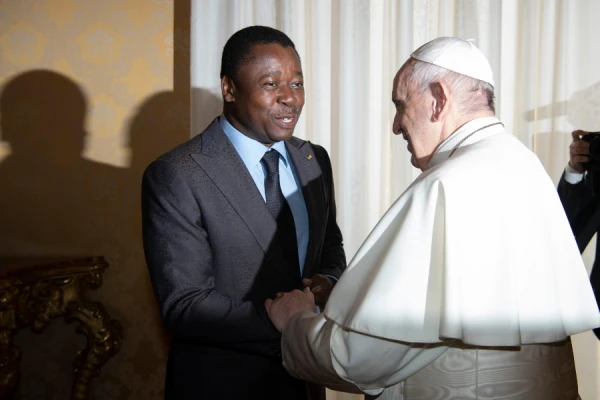
CNA Staff, Aug 5, 2020 / 02:01 pm (CNA).- Researchers based at the University of Toronto announced Monday that Bishop Benoît Alowonou of Kpalimé was among six targets of spyware in Togo last year. The country’s bishops have supported political reform and denounced the government’s injustice.
The spyware, known as Pegasus and which targets WhatsApp users, was made by NSO Group, an Israeli technology firm. It gives its operator access to the target’s mobile device.
Since 2005, Faure Gnassingbé has been president of Togo. His father, Gnassingbé Eyadéma, had ruled the country after a 1967 coup until his death in 2005.
Bishop Alowonou is president of the Togolese bishops’ conference, which in 2017 urged constitutional reform, and earlier this year decried the violent arrest of an opposition leader.
In May 2019 WhatsApp found that spyware from NSO Group could be injected on mobiles phones with a missed video call on the app. Some 1,400 of its users were targeted.
Citizen Lab, an interdisciplinary lab based at the University of Toronto’s Munk School of Global Affairs, said Aug. 3 that it “volunteered to assist WhatsApp to investigate the 2019 Incident as part of the Citizen Lab’s mandate to study digital threats against civil society.”
“During our investigation we identified multiple targets in Togo. These individuals were targeted between April and May, 2019 … We believe the infection attempts would have led to the infection of most targeted devices with NSO’s spyware,” Citizen Lab wrote.
In addition to Bishop Alowonou, Togolese targets of the spyware included Fr. Pierre Affognon, chaplain of the Association of Catholic Leaders of Togo; Elliott Ohin, a former government minister and an opposition leader; and Raymond Houndjo, a prominent member of the National Alliance for Change, an opposition party.
Fr. Affognon’s group had in late 2018 called for democratic reforms and organized protest marches that were barred by the government.
Bishop Alowonou told The Guardian that Pegasus’ use against dissidents in Togo is “dangerous for our freedoms and for democracy”, while Fr. Affognon said, “it’s a violation of the liberty of the citizens.”
According to Citizen Lab, the sole operator of Pegasus in Togo “appeared to be spying only in Togo,” and so it suspects it “was operated by an agency of the Togolese Government.”
Nevertheless, John Scott-Railton, a senior researcher at Citizen Lab, told The Guardian that “Citizen Lab is not conclusively stating which government is responsible for this attack. But the fact that these individuals are all either opposition party members or otherwise critical of the government is troubling.”
In October 2019 WhatsApp filed a lawsuit in the US against NSO Group , claiming it enabled the Pegasus attacks on its 1,400 users.
Pegasus is marketed to governments for crime fighting, but according to Citizen Lab “there are over 130 cases in which NSO Group’s hacking technology has been used to conduct abusive surveillance against civil society around the globe,” including journalists and human rights advocates.
NSO Group dispute’s WhatsApp’s claims.
In an Oct. 29, 2019 statement, it said that “the sole purpose of NSO is to provide technology to licensed government intelligence and law enforcement agencies to help them fight terrorism and serious crime. Our technology is not designed or licensed for use against human rights activists and journalists … We consider any other use of our products than to prevent serious crime and terrorism a misuse, which is contractually prohibited. We take action if we detect any misuse.”
There are allegations that Pegasus was used by Saudi officials to monitor Jamal Khashoggi, a Washington Post columnist assassinated at the Saudi consulate in Istanbul in October 2018.
Togo has seen political instability and widespread poverty in recent years. Protests in 2017 called for Gnassingbé’s resignation, and resulted in harsh crackdowns.
Gnassingbé won re-election for his fourth term in a February 2020 election, with more than 70% of the vote.
Opposition leaders asserted there was widespread fraud on the part of the authorities.
The Archbishop Emeritus of Lomé, Philippe Kpodzro, was briefly placed under house arrest in March for encouraging protests following the election.
In 2019 Gnassingbé secured constitutional changes to term limits that allow him to be able to remain in office until 2030.
A cloud of smoke erupts during an Israeli air strike on the village of Sujud in southern Lebanon on Sept. 25, 2024. Israel announced dozens of new air strikes on Hezbollah strongholds in Lebanon on Sept. 24, a day after 492 people, including 35 … […]
7 Comments
So evil. Have they no conscience? Where is the Muslim outrage?
“The hour is coming when whoever kills you will think he is offering service to God.“. (John 16:2)
The persecution of Christians by the religion of peace has been going on since the beginning. Even in the presumably golden age of its domination over Christian Spain, the reality was horrible. See below the reviews of a book by a Ph.D. from Harvard that exposes the reality; the first review is in the Brigham Young University Comparative Civilizations Review, the second is by a professor of Medieval History at the Spanish Catholic University of Navarra. Then see after that the link to historian R. Ibrahim coverage of the world-wide persecution of Christians just in April of 2025: https://scholarsarchive.byu.edu/cgi/viewcontent.cgi?article=1990&context=ccr
Virtually every society practiced slavery at some point in history. It’s true that North African pirates & others kidnapped & sold Europeans into slavery. Perhaps over a million were kidnapped. But how many non-Muslims participated in the slave trade during the Age of Exploration & beyond? It was a group effort.








So evil. Have they no conscience? Where is the Muslim outrage?
“The hour is coming when whoever kills you will think he is offering service to God.“. (John 16:2)
If there was true goodness behind Islam, would not the entire Moslem world be standing up to Hamas and to these and to so many others?
The persecution of Christians by the religion of peace has been going on since the beginning. Even in the presumably golden age of its domination over Christian Spain, the reality was horrible. See below the reviews of a book by a Ph.D. from Harvard that exposes the reality; the first review is in the Brigham Young University Comparative Civilizations Review, the second is by a professor of Medieval History at the Spanish Catholic University of Navarra. Then see after that the link to historian R. Ibrahim coverage of the world-wide persecution of Christians just in April of 2025:
https://scholarsarchive.byu.edu/cgi/viewcontent.cgi?article=1990&context=ccr
https://www.meforum.org/middle-east-quarterly/book-reviews/myth-of-the-andalusian-paradise
https://www.raymondibrahim.com/2025/06/16/you-infidel-will-meet-allah-the-muslim-persecution-of-christians-april-2025/
Radical Islam is demonic.
See also this scholarly interview on the centuries-long “Christian Slavery under Islam” conducted by Father Connolly of CWR. The illustrations alone are worth a look!
https://www.thepostil.com/author/dario-fernandez-morera/
https://www.catholicworldreport.com/2020/12/16/the-forgotten-history-of-christian-slavery-under-islam/
Virtually every society practiced slavery at some point in history. It’s true that North African pirates & others kidnapped & sold Europeans into slavery. Perhaps over a million were kidnapped. But how many non-Muslims participated in the slave trade during the Age of Exploration & beyond? It was a group effort.
The distinction is that, as the primary sources cited in the interview show, slavery by the religion of peace was dictated by its own religious texts. Please do read the interview and the primary sources cited that demonstrate this distinction, which is fundamental to understand even what is going on today. Again this is the scholarly interview conducted by Fr. Connolly of CWR:
https://www.thepostil.com/author/dario-fernandez-morera/
https://www.catholicworldreport.com/2020/12/16/the-forgotten-history-of-christian-slavery-under-islam/