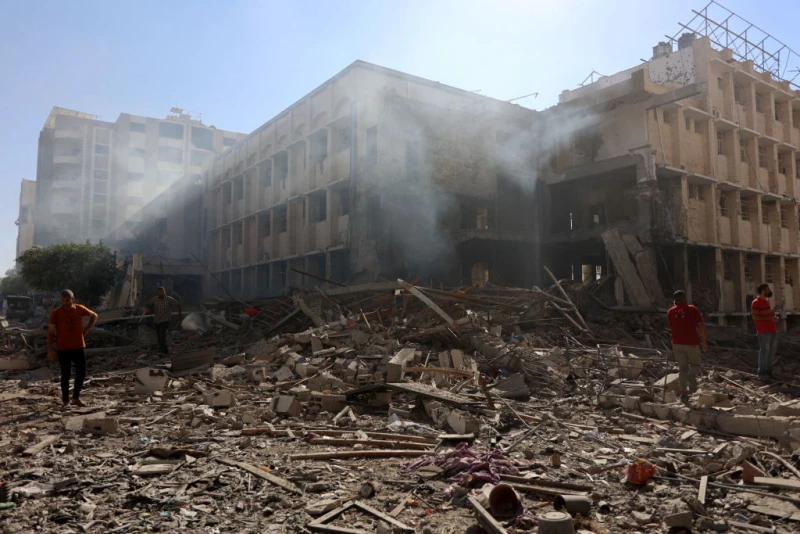
Palestinians stand on the rubble and debris of the Latin Patriarchate Holy Family School after it was hit during an alleged Israeli military bombardment in Gaza City on July 7, 2024, amid the ongoing conflict in the Palestinian territory between Israel and Hamas. / Credit: OMAR AL-QATTAA/AFP via Getty Images
CNA Staff, Jul 8, 2024 / 15:20 pm (CNA).
The Latin Patriarchate of Jerusalem on Sunday sharply condemned reports of an alleged Israeli raid against a Catholic school in Gaza over the weekend.
The patriarchate said in a Sunday press release that it was “monitoring, with grave concern, the news of the raids, apparently launched by the Israeli army” against the Holy Family School in Gaza City on Sunday morning.
Footage and media reports “include scenes of civilian casualties and of destruction in the compound,” the statement said. Caritas reported on X “the tragic loss of hundreds of innocent lives” from the raid.
Images circulated on social media on Sunday and Monday showing the destruction wrought at the facility.
The Holy Family School “has, since the beginning of the war, been a place of refuge for hundreds of civilians,” the patriarchate said in its statement. “No religious personnel reside in the school.”
“The Latin Patriarchate condemns in the strongest terms the targeting of civilians or any belligerent actions that fall short of ensuring that civilians remain outside the combat scene,” the statement read.
“We continue to pray for the Lord’s mercy and hope that the parties will reach an agreement that would put an immediate end to the horrifying bloodbath and humanitarian catastrophe in the region.”
Sami El-Yousef, the CEO of the Latin Patriarchate of Jerusalem, told CNA on Monday that officials have been unable to tally the full number of casualties at the school site.
“We don’t have accurate numbers because our own parish priest and members of the community could not get to the location, because there’s intensive fighting around the parish,” he said via phone.
“It’s too dangerous for anyone to actually leave. We cannot really with any certainty verify the number of people killed and injured.”
The school is located in the Remal neighborhood of Gaza City, El-Yousef said; the area was “practically destroyed” around the outset of the Israel-Hamas war in October 2023, he noted.
The Israeli military told the BBC that it carried out a strike on the area of a school building in Gaza City from which it says “terrorists were operating and hiding.”
The Holy Family Parish in Gaza was the site of a similar reported conflict late last year when in December it was alleged that an Israeli Defense Forces (IDF) sniper shot and killed two women at the church’s compound.
The IDF denied the allegations several times, while Pope Francis sharply criticized the reports after they became known, arguing that at the Catholic parish, there were “no terrorists, but families, children, sick and disabled people, nuns.”
“Yes, it’s war, it’s terrorism,” the pope said at the time.
If you value the news and views Catholic World Report provides, please consider donating to support our efforts. Your contribution will help us continue to make CWR available to all readers worldwide for free, without a subscription. Thank you for your generosity!
Click here for more information on donating to CWR. Click here to sign up for our newsletter.
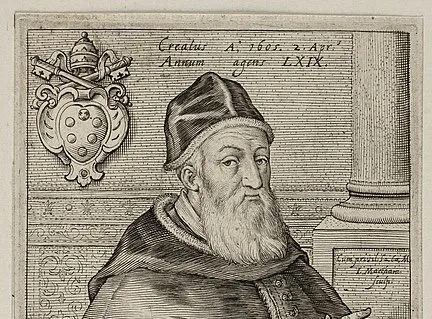
Jacob Matham’s portrait of Leo XI, who reigned April 1-27, 1605. / public domain
Denver Newsroom, Sep 18, 2022 / 14:00 pm (CNA).
Blessed John Paul I did not serve as Roman Pontiff for long, but 10 other popes had shorter pontificates than he did. Their stories are a microcosm of the history of the papacy. Some were friends of saints and worked for the good of the Church, while the qualifications of others might be a bit questionable. Through all these more or less flawed men who sat in the Chair of Peter, the Catholic Church teaches that the connection to St. Peter and his profession of faith in Christ endures.
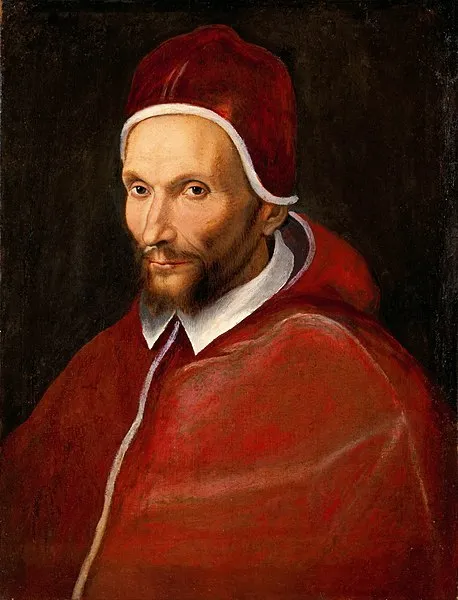
Urban VII was pope for 13 days, Sept. 15–27, 1590.
He was born Giambattista Castagna at Rome, the home city of his mother. His father was of Genoan nobility. His uncle was a cardinal, whom he served at points during his long career in the Church. He held doctorates in civil and canon law.
Castagna worked in government and diplomacy on behalf of the papacy, which at the time held civil power over parts of Italy. He led several commissions during the Council of Trent and helped organize the military alliance against the Ottoman Empire, according to the New Catholic Encyclopedia. He was appointed archbishop in 1553 and became a cardinal in 1583.
He had a reputation for genuine piety, intelligence, and ability to govern.
Jacopino del Conte’s portrait (c. 1590) of Urban VII. public domain
After his election as pope, he made sure to address the needs of the poor in Rome. His initial plans included expanded public works to employ the poor.
As God’s providence allowed, he did not have time to do much more than plan. He died of malaria at the age of 69. In his will, he left his personal fortune to support poor girls.
Celestine IV reigned for 15 days, Oct. 25–Nov. 10, 1241.
The future pope was born Goffredo da Castiglione in Milan. He spent time with the Cistercian religious order and was a cardinal bishop of Sabina. He was a nephew of Pope Urban III. He was already in poor health when he was elected, at a time when the papacy was a center of political conflict between backers and opponents of Holy Roman Emperor Frederick II.
Boniface VI reigned for 16 days, April 11–26, 896.
He was born in Rome. Not much is known about this pope, though records indicate that during his life he was canonically deprived of holy orders on two occasions: the first time as a subdeacon, and the second as a priest. His irregular past caused controversy over his election, the New Catholic Encyclopedia says.
Theodore II reigned for 20 days in December 897.
Another little-known pope, it is said that his clergy loved him, that he loved peace, and that he lived a life of chastity and charity to the poor. He came to power soon after a low point of the papacy. Pope Theodore annulled the acts of the “Cadaver Synod,” which had put on trial the corpse of his predecessor, Pope Formosus. He recovered the dead Roman Pontiff’s body from the River Tiber and gave it a proper burial. He also reinstated clergy who had been forced to resign.
Sisinnius was pope for 21 days, Jan. 15–Feb. 4, 708.
This pope was born in Syria. His health troubles included disabling arthritis, and he was unable to feed himself. The papacy was responsible for the military defense of Rome at this time, with Lombards invading from the north of Italy and Muslim armies advancing from the south. Sisinnius ordered the walls of Rome to be reinforced as his first act, the New Catholic Encyclopedia says. Before he died, Pope Sisinnius ordained one priest and consecrated a bishop for Corsica.
Marcellus II was pope for about 22 days in April and May, 1555.
He was born Marcello Cervini, at Montefano in Tuscany. Like the sainted Pope Marcellus of the fourth century, he kept his baptismal name as his papal name.
His father worked under several pontificates as a scribe and secretary.
Before Cervini was elected pope he served various roles as a secretary to popes and cardinals, including work to correct the Julian calendar. He was actively engaged with the “New Learning” of Renaissance humanism. He served as protector of the Vatican Library and helped improve and expand its collection. Cervini served the Vatican at the time of its response to the Protestant Reformation. He was a president at the Council of Trent, which continued through his short pontificate.
He gained a reputation as a Church reformer and had hoped to pursue this path during his papacy. He was not consecrated a bishop until the day after he was elected pope.
Pope Marcellus reputedly became sick from overwork during the celebrations of Holy Week and Easter, and the illness turned fatal.
The Missa Papae Marcelli of Giovanni Pierluigi da Palestrina was composed in his honor.
Damasus II reigned for 24 days in July and August, 1048.
This pontiff was named Poppo. He was born in Bavaria and was of German extraction. He served as Bishop of Brixen in Tyrol, in what is now western Austria.
Popes at the time could be nominated in an unusual manner. Pope Damasus II was named by Holy Roman Emperor Henry III. The pope, however, soon died of malaria.
Pius III was pope for 27 calendar days, Sept. 22–Oct. 18, 1503.
He was born Francesco Todeschini in Siena. He was the nephew of Pope Pius II, a famous Renaissance-era pope. His uncle took him into his household and became his patron, allowing the young man to add the pontiff’s family name Piccolomini to his own last name.
Francesco studied canon law. His uncle named him to become administrator of the Archdiocese of Siena and later made him a cardinal-deacon.
The future Roman Pontiff had a reputation of living an upright life as a cultured, gentle man, the New Catholic Encyclopedia reports. He took part in several conclaves of his time, including that which elected Alexander VI.
His service to the papacy included several diplomatic appointments to Germany, France, and Perugia.
Francesco’s own papal election took place amid ruling Italian families’ disputes over control of Rome and included an unsuccessful power play by the Borgia family.
Pius III was known to be in poor health. At the time of the papal coronation he was already suffering from a diseased leg, which developed into a septic ulcer. He died at the age of 64.
Leo XI was pope for 27 days, from April 1–27, 1605.
The Florentine-born Alessandro de Medici was a member of the famous Medici family. He was grand-nephew to Pope Leo X. He sought to become a priest from an early age, but because his mother objected he was not ordained until after she died, according to the New Catholic Encyclopedia. He served as an ambassador to Rome on behalf of Tuscany, before he began to advance in the Church. He would eventually become a bishop, then archbishop of Florence, before being named a cardinal.
He served as a papal legate to France and was head of the Congregation of Bishops.
Among his great friends was St. Philip Neri, founder of the Oratorians.
He was elected pope at the age of 69 and became sick almost immediately.
Benedict V served as pope for 33 days, May 22–June 23, 964.
He was born in Rome and had a reputation for great learning.
He reigned at a time of great turmoil in the Church. Holy Roman Emperor Otto I had interfered with the pontificates of his predecessors. The emperor had forcibly deposed a pope and installed his own nominee on the See of Peter. There were rival claimants to the papacy under Benedict V and Otto again interfered, laying siege to Rome and taking the pope away from Rome by force. Benedict either renounced the papacy or was forcibly deposed. He lived in exile in Hamburg for another year.
John Paul I served as Roman Pontiff from Aug. 26–Sept. 28, 1978, 33 calendar days.
His beatification on Sept. 4 renewed attention to his life. He had a reputation for humility and for teaching the faith in an understandable way.
The future John Paul I took part in the Second Vatican Council and was named patriarch of Venice.
As a cardinal, Luciani published a collection of “open letters” to historic figures, saints, famous writers, and fictional characters. The book, “Illustrissimi,” included letters to Jesus, King David, Mark Twain, Charles Dickens, and Christopher Marlowe, as well as Pinocchio and Figaro, the barber of Seville.
He was the first pope to have two names. He took his papal name from his immediate predecessors, Sts. John XXIII and Paul VI.
The European Parliament in Strasbourg, France. / fotogoocom via Wikimedia (CC BY 3.0).
Rome Newsroom, Jul 7, 2022 / 02:20 am (CNA).
Legal experts have called “inaccurate and misleading” a proposed resolution by the European Parliament to includ… […]
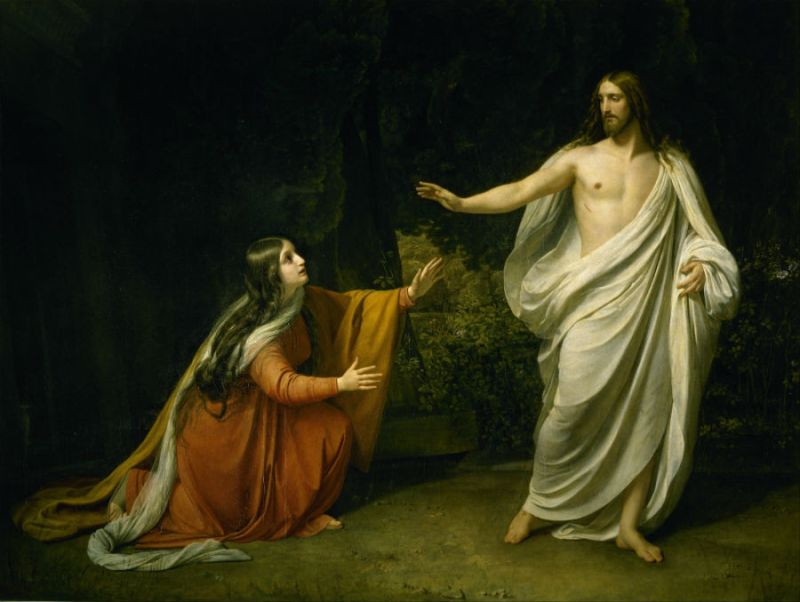
Christ’s Appearance to Mary Magdalene after the Resurrection / / Alexander Ivanov
ACI Prensa Staff, Apr 10, 2023 / 05:00 am (CNA).
On Easter Monday, the Catholic Church celebrates what’s called “Monday of the Angel.” In many countries in Europe and South America, this day, also known as “Little Easter,” is a national holiday.
In a Vatican Radio recording in 1994, Pope John Paul II gave an explanation for Monday of the Angel:
“Why is it called that?” the pope asked, highlighting the need for an angel to call out from the depths of the grave: “He is risen.”
These words “were very difficult to proclaim, to express, for a person,” John Paul II said. “Also, the women that were at the tomb encountered it empty but couldn’t tell ‘he had risen’; they only affirmed that the tomb was empty. The angel said more: “He is not here, he has risen.”
The Gospel of St. Matthew puts it this way: “Then the angel said to the women in reply, ‘Do not be afraid! I know that you are seeking Jesus the crucified. He is not here, for he has been raised just as he said. Come and see the place where he lay. Then go quickly and tell his disciples, ‘He has been raised from the dead, and he is going before you to Galilee; there you will see him.’ Behold, I have told you” (Mt 28:5-7).
Angels are servants and messengers of God. As purely spiritual beings, they have intellects and wills. They are personal and immortal. They surpass all visible beings in their perfection.
Christ himself gives testimony to the angels when he said: “The angels in Heaven always see the face of my father who is in Heaven!” (Mt 18:10).
Christ is the center of the universe and angels belong to him. Even more so, because he made them messengers of his plan of salvation: an angel announced his conception to the Blessed Mother at the Annunciation and an angel proclaimed his Resurrection to Mary Magdalene.
From Easter Monday until the end of Easter at Pentecost, the Church prays the Regina Caeli instead of the Angelus at the noon hour.
On Monday of the Angel in 2008, Pope Benedict XVI said the text of the Regina Caeli “is like a new ‘Annunciation’ to Mary, this time not made by an angel but by us Christians who invite the Mother to rejoice because her Son, whom she carried in her womb, is risen as he promised.”
He continued: “Indeed, ‘rejoice’ was the first word that the heavenly messenger addressed to the Virgin in Nazareth. And this is what it meant: Rejoice, Mary, because the Son of God is about to become man within you. Now, after the drama of the Passion, a new invitation to rejoice rings out: ‘Gaude et laetare, Virgo Maria, alleluia, quia surrexit Dominus vere, alleluia’ — Rejoice and be glad, O Virgin Mary, alleluia. Rejoice because the Lord is truly risen, alleluia!”
Regina Caeli (English)
V. Queen of Heaven, rejoice, alleluia.
R. For he whom you did merit to bear, alleluia.
V. Has risen, as he said, alleluia.
R. Pray for us to God, alleluia.
V. Rejoice and be glad, O Virgin Mary, alleluia.
R. For the Lord has truly risen, alleluia.
V. Let us pray. O God, who gave joy to the world through the resurrection of Thy Son, our Lord Jesus Christ, grant we beseech Thee, that through the intercession of the Virgin Mary, His Mother, we may obtain the joys of everlasting life. Through the same Christ our Lord.
R. Amen.
Regina Caeli (Latin)
V. Regina caeli, laetare, alleluia.
R. Quia quem meruisti portare, alleluia.
V. Resurrexit, sicut dixit, alleluia.
R. Ora pro nobis Deum, alleluia.
V. Gaude et laetare, Virgo Maria, alleluia.
R. Quia surrexit Dominus vere, alleluia.
V. Oremus. Deus, qui per resurrectionem Filii tui, Domini nostri Iesu Christi, mundum laetificare dignatus es: praesta, quaesumus; ut per eius Genetricem Virginem Mariam, perpetuae capiamus gaudia vitae. Per eundem Christum Dominum nostrum.
R. Amen.
This article was originally published by ACI Prensa, CNA’s Spanish-language news parter. It was translated and adapted by Jeanette De Melo at the National Catholic Register on March 4, 2021, and updated April 6, 2023.




Leave a Reply