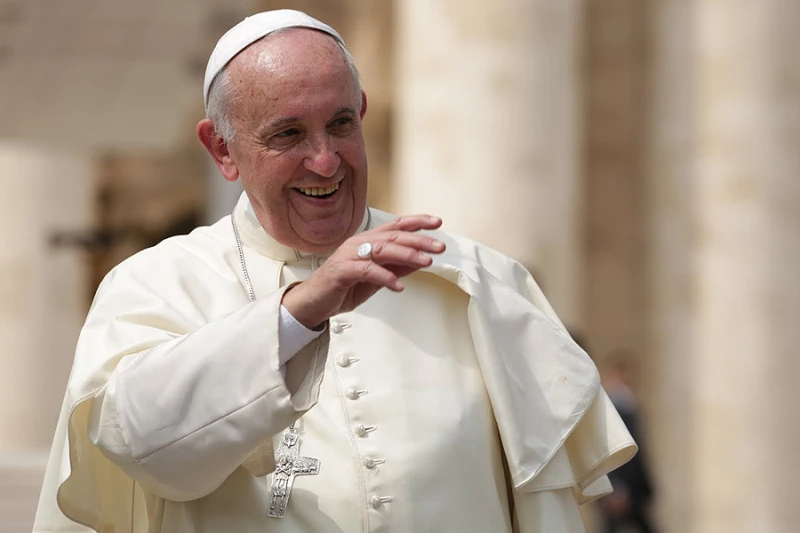
Pope Francis waves during his Sunday Angelus on Dec. 31, 2023. / Credit: Vatican Media
Rome Newsroom, Dec 31, 2023 / 10:21 am (CNA).
In his final Angelus address of 2023, Pope Francis paid tribute to Pope Benedict XVI on the one-year anniversary of his predecessor’s death, saying that the late pontiff continues to bless and aid the Church from heaven.
Speaking Dec. 31 from the window of the Apostolic Palace and following a longer discourse on the Holy Family’s secret to enduring hardships, Francis said that Benedict XVI “lovingly and wisely” served the Church.
“We feel so much affection for him, so much gratitude, so much admiration. From heaven he blesses us and accompanies us,” said Pope Francis on the Feast of the Holy Family, as pilgrims gathered in St. Peter’s Square below applauded.
Benedict died on Dec. 31, 2022, at the age of 95. The Bavarian prelate had served as pope from 2005-2013, and is considered by many to be one of the most important theologians of contemporary times. He had lived the last nine years of his life as “pope emeritus” at the Vatican’s Mater Ecclesiae Monastery after resigning from the Petrine office on February 11, 2013, the first pope to do so in 600 years.
Earlier in the day, a special Mass in honor of Benedict XVI had been celebrated in St. Peter’s Basilica, part of a two-day conference on the late pope’s life, teaching, and legacy, sponsored by EWTN and others.
During his Angelus address, Pope Francis also reflected on how the Holy Family experienced hardships but endured them by marveling at God’s presence in their lives.
The pope noted the “surprising” fact that Jesus was born into a family that was “expert in suffering,” as evidenced by today’s Gospel reading: when Mary and Joseph present Jesus at the temple, they offer the lowliest prescribed sacrifice, a pair of birds, and Mary is told by Simeon that “a sword will pierce through your own soul.”
“How is it that, the Family of Jesus, the only family in history who could boast of having God present in flesh and blood among them, instead of being rich, was poor!” the pope said. “Instead of having things easy, it seems this family encounters obstacles! Instead of being free from hardship, this family is immersed in tremendous sorrow!”
Pope Francis said this fact shows that God, in Christ, “came to live our life with its problems,” and “saved us in this way, living in our midst.” By becoming incarnate in a family that faced hardships, Pope Francis said that Christ tells families facing difficulties today, “I know what you are experiencing.”
“I experienced it, I, my mother and my father, we experienced it so we can say to your family too: You are not alone!”
Pope Francis said the Holy Family also has a lesson to teach families facing challenges: the importance of the “ability to marvel” before God, “not getting used to the ordinariness of things,” which “can be a secret for moving forward well as a family.”
The pontiff spoke about the importance of marveling at one’s own spouse, taking his or her hand or “looking the other tenderly in the eyes for a few seconds in the evening.”
“Marveling always brings us to tenderness,” the pope said, noting that “tenderness is beautiful in marriage.”
Francis also recommended marveling at the miracle of life by taking time to play with children. In his customary off the cuff fashion, he shared that, on a phone call yesterday, he had asked a friend where she was. She told him she was at the park, on a walk with her children.
“This is good parenting,” the pope said.
Pope Francis also said that instead of shutting grandparents out of our lives, families should marvel at their wisdom by listening to their stories.
“Grandparents bring us back to what is essential,” said Francis.
Concluding his remarks on the Holy Family and the importance of marveling, Pope Francis said each prson should marvel “at our own story of love,” paying attention to how God has walked with us, even in the midst of negative aspects. The pope asked Mary, Queen of the family, to “help us marvel every day at the good, and to know how to teach others the beauty of marveling.”
Following his recitation of the Angelus prayer, the pope expressed his closeness to people in the Nigerian state of Plateau, where bandits killed over 140 people during attacks on Christmas Eve, and also to those in Liberia, where a tanker truck explosion killed 40 on Dec. 27. Pope Francis also asked for continued prayers for those suffering due to war in Ukraine, Palestine and Israel, and Sudan, as well as the Rohingya people in Indonesia.
Connecting with his reflection on the Gospel, the pope also underscored that the family is the basic cell of society, which “always needs to be defended and sustained, always!”
In closing, Pope Francis wished those gathered a serene end of the year, and expressed his eagerness to see them again in 2024.
If you value the news and views Catholic World Report provides, please consider donating to support our efforts. Your contribution will help us continue to make CWR available to all readers worldwide for free, without a subscription. Thank you for your generosity!
Click here for more information on donating to CWR. Click here to sign up for our newsletter.
Bishop Erik Varden O.C.S.O, of the Catholic Territorial Prelature of Trondheim, Norway, at the vespers at Santa Maria dell’Anima in Rome. / Daniel Ibáñez / CNA
Rome Newsroom, Mar 25, 2023 / 14:40 pm (CNA).
Bishops from the five Nordic countries have released a letter on the traditional Christian teaching on sexuality, upholding the “embodied integrity of personhood” against modern transgender ideologies.
“Now, notions of what it is to be a human, and so a sexual being, are in flux. What is taken for granted today may be rejected tomorrow. Anyone who stakes much on passing theories risks being terribly hurt. We need deep roots,” the eight members of the Nordic bishops’ conference say in the letter, which was released Saturday.
“Let us, then, try to appropriate the fundamental principles of Christian anthropology while reaching out in friendship, with respect, to those who feel estranged by them,” they continue. “We owe it to the Lord, to ourselves, and to our world, to give an account of what we believe, and of why we believe it to be true.”
The pastoral letter is being read aloud at Masses this weekend at Catholic churches in Sweden, Norway, Finland, Denmark, and Iceland. EWTN Norway provided CNA with a copy of the letter.
Cardinal Anders Arborelius, the bishop of Stockholm, Sweden, is among the document’s eight signers.
The others are: from Norway, Bishop Erik Varden of Trondheim, Bishop Berislav Grgić of Tromsø, and Bishop Bernt Eidsvig of Oslo; from Denmark, Bishop Czeslaw Kozon of Copenhagen; from Iceland, Bishop Dávid Tencer of Reykjavik and Bishop emeritus Pierre Bürcher of Reykjavik, and from Finland, Father Marco Pasinato, apostolic administrator of Helsinki.
“Our mission and task as bishops is to point towards the peaceful, life-giving path of Christ’s commandments, narrow at the outset but growing broader as we advance,” the bishops state in the letter.
“We would let you down if we offered less,” the bishops say, adding, “we were not ordained to preach little notions of our own.”
The bishops explain that there is room for everyone in the Church, which, according to a 4th-century text, is “the mercy of God descending on mankind.”
“This mercy excludes no one. But it sets a high ideal,” the letter states.
The pastoral letter begins by recalling the 40 days and nights of rain which flooded the earth in the days of Noah.
It says that when Noah and his relatives stepped back onto the cleansed earth, God made his first covenant with man, promising that a flood would never again destroy the earth.
God asked mankind, instead, to revere God, to construct peace, and to be fruitful, the bishops said. To ratify the covenant, God created a sign: a rainbow.
“This covenantal sign, the rainbow, is claimed in our time as the symbol of a movement that is at once political and cultural,” the bishops note. “We recognize all that is noble in this movement’s aspirations. In so far as these speak of the dignity of all human beings and of their longing to be seen, we share them.”
“The Church,” the letter continues, “condemns unjust discrimination of any kind, also on the basis of gender or orientation. We declare dissent, however, when the movement puts forward a view of human nature that abstracts from the embodied integrity of personhood, as if physical gender were accidental.”
The bishops also say in the letter they protest that such a view is imposed on children as “not a daring hypothesis but a proven truth.”
Transgenderism is “imposed on minors as a heavy burden of self-determination for which they are not ready,” the bishops lament, calling it “curious” that in an intensely body-conscious society, the body is in fact taken too lightly.
People now refuse to see the body “as significant of identity, supposing that the only selfhood of consequence is the one produced by subjective self-perception, as we construct ourselves in our own image,” they observe.
The bishops explain that we are, instead, created in the image and likeness of God, in both body and soul.
“The image of God in human nature manifests itself in the complementarity of male and female,” the letter states. “Man and woman are created for one another: The commandment to be fruitful depends on this mutuality, sanctified in nuptial union.”
The letter goes on to say that the union of a man and a woman, as an image of God’s communion with mankind, is not always easy or painless.
“For some it seems an impossible option,” the bishops acknowledge. “More intimately, the integration within ourselves of masculine and feminine characteristics can be hard. The Church recognizes this. She wishes to embrace and console all who experience hardship.”
The Nordic bishops say they recognize that “the yearning for love and the search for sexual wholeness touch human beings intimately” and they want to be there to accompany everyone as they gradually grow in wisdom and virtue.
“We are called to become new women and men,” they say in the letter. “In all of us there are elements of chaos that need to be ordered. Sacramental communion presupposes coherently lived consent to the terms of the covenant sealed in Christ’s Blood.”
They point out that circumstances may mean, therefore, that a Catholic is unable to receive the sacraments for a time. But “he or she does not therefore cease to be a member of the Church. Experience of internal exile embraced in faith can lead to a deeper sense of belonging. Exiles often turn out that way in Scripture. Each of us has an exodus journey to make, but we do not walk alone.
The bishops’ letter also offers some advice to those who are perplexed by the traditional Christian teaching on sexuality.
“First: Try to acquaint yourself with Christ’s call and promise, to know him better through the Scriptures and in prayer, through the liturgy and study of the Church’s full teaching, not just of snippets here and there. Take part in the Church’s life,” the bishops counsel.
“Secondly,” they add, “consider the limitations of a purely secular discourse on sexuality. It needs to be enriched. We need adequate terms to speak of these important things.”
The Church, they say, “shall have a precious contribution to make if we recover the sacramental nature of sexuality in God’s plan, the beauty of Christian chastity, and the joy of friendship, which lets us see that great, freeing intimacy can be found also in non-sexual relationships.”
You can read the full text of the bishops’ letter and watch a video of the letter being read below.
Leon is a baby boy cared for and loved at Mary’s Shelter, a pro-life maternity home in Fredericksburg, Virginia. / Courtesy of Mary’s Shelter
Washington, D.C. Newsroom, May 24, 2022 / 13:15 pm (CNA).
Amid a shortage of baby formula in the U.S., experts recommend parents scour smaller drug stores, check online, and join social media groups sharing information.
But here’s another, perhaps lesser-known, option they can also turn to for help: pregnancy resource centers.
Nearly 3,000 pro-life pregnancy centers serve millions of people each year in the United States. They offer women and parents in need everything from health care and material assistance to educational classes and job support — at little to no cost. Right now, for many of these centers, their work also includes connecting struggling families to baby formula.
One center in Michigan, an affiliate of Heartbeat International, a pro-life pregnancy resource center network, revealed to CNA that it has a surplus of formula.
“At this time, we haven’t heard of formula shortages at the pregnancy centers,” Andrea Trudden, vice president of communications and marketing at Heartbeat International, told CNA. “Quite the contrary, actually!”
Trudden recommended families turn to their local pregnancy help organizations for assistance and use OptionLine.org as a tool to find the center closest to them.
“Since pregnancy centers are equipped to help pregnant women and new families with practical resources such as diapers and formula,” Trudden said, “they have been able to step into that gap during this time.”
Some pro-life maternity homes in states such as Virginia and North Carolina said mothers are in desperate need and exploring all of their options, including feeding their babies with formula samples. But, these homes tell CNA, they are walking with mothers in their search, every step of the way.
What is this shortage about?
The nationwide baby formula shortage was caused, and then exacerbated, by a series of factors: supply-chain issues, recalls, the closure of a major production plant in February, and even U.S. trade policy. The result, data-firm company Datasembly found, is that more than 40 percent of baby formulas were out of stock in early May.
Babies with special needs and allergies rely on formula, along with babies in general. According to data from the Centers for Disease Control and Prevention (CDC), 63.3% of infants were exclusively breastfeeding seven days after birth in 2018. Three months after birth, only 46.3% of infants exclusively breastfed. Six months after birth, that percentage changed to 25.8%
The trouble with formula began partially with the Covid-19 pandemic. Parents stockpiled baby formula at the beginning, which increased production, only to later discover that they had a surplus to use up, which decreased production.
After consuming formula from an Abbott plant in Sturgis, Michigan, four babies became sick, including two who died, from bacterial infections. This led to a recall and the plant shutting down in February.
These incidents exposed the formula market as one not structurally prepared for emergencies, with just four companies largely in control of supply in the United States. U.S. and regulatory trade policy only added to the problem, restricting the exchange of formula internationally, The Atlantic reported.
Months into the shortage, the Food and Drug Administration (FDA) has reached an agreement with Abbott, one of the largest U.S. baby formula manufacturers, to reopen its Sturgis plant in the coming weeks. President Joe Biden invoked the Defense Production Act to prioritize the production of formula. And, in the meantime, the U.S. military has begun importing formula from Europe.
Members of Congress on both sides of the aisle have called for action. Senate Democrats are pushing a bill that would send $28 million in emergency funding to the FDA. Congress passed, and Biden signed into law, a bill to expand access to formula for lower-income families during emergencies.
In the meantime, before the shelves are fully stocked once more, pregnancy centers and maternity homes around the country are helping parents in need.
“I have never seen this much formula. We have an overflow!” Lois Stoll, a volunteer who manages the formula supply at the center, said in a press release. The center, one of Heartbeat International’s 1,857 affiliate locations, accumulated its surplus over the last two years, during the pandemic.
“It really is the result of an unexpected set of circumstances,” Bryce Asberg, the executive director, added in the release. “During the COVID-19 pandemic, the number of clients fell but donations continued to come in.”
Baby formula is stored on shelves at Helping Hands Pregnancy Resource Center in Hillsdale, Michigan. Courtesy of Helping Hands
Asberg told CNA that the center has been running a material assistance program for several years where it provides mothers and families with baby clothes, diapers, wipes, and baby food or formula.
“We still offer all those items to clients who come in, but recently we have noticed a surge of interest in formula,” he said. “God has been building our supply of formula for many months, and we didn’t know why we had so much. Now we do!”
Washington, D.C.
In Washington, D.C., Janet Durig, the executive director of Capitol Hill Pregnancy Center, said that her center also has baby formula on hand.
“We’ve had some phone calls seeking help and we’ve had formula to give them,” she told CNA. But, she emphasized, the supply is limited because they rely on donations.
“We have it to help people on a limited basis and are helping people on a limited basis,” she said, adding that the center welcomes donations of unopened bottles or cans of formula as long as they have not expired.
Connecticut
Leticia Velasquez, executive director and co-founder of Pathways Pregnancy in Norwich, Connecticut, encouraged moms and families to reach out if they need formula.
She told CNA that the three-year-old center is there for any woman or mom in need.
“We just say, ‘How can we fill the need? That’s what we’re here for,’” she said. “We definitely stand with them in any crisis, whether it be a formula shortage or an unplanned pregnancy.”
Parents in eastern Connecticut looking for baby formula can text the center at (860) 222-4505.
North Carolina
Debbie Capen, the executive director of MiraVia, said that the baby formula shortage is affecting her group’s work in supporting and providing resources to new moms in need. The Catholic nonprofit runs an outreach center in Charlotte and a free college residence at nearby Belmont Abbey College where a pregnant student — from any university or college — can stay until her child turns two years old.
“Yes, the mothers we serve are very concerned about the baby formula shortage,” Capen told CNA. “We always encourage breastfeeding for our expectant mothers, but for those who cannot breastfeed, they usually rely on vouchers for baby formula through the USDA’s WIC program.”
The U.S. Department of Agriculture’s WIC program, also known as the “Special Supplementation Nutrition Program for Women, Infants and Children,” offers federal grants to states for supplemental foods, health care referrals, and nutrition education for low-income pregnant and postpartum women, and young children at nutritional risk.
Capen highlighted that WIC only covers one specific brand of formula, which means that moms must pay full price for any other label. Formula is at a premium price right now, she added, which only puts more stress on their limited resources.
In each state, baby formula manufacturers bid for exclusive rights to provide formula to WIC participants in that state. In return, they offer the state discounts, or rebates. For those who rely on WIC, this means that they face limited options.
In response to the scarcity, the mothers at MiraVia are turning to alternatives: food pantries and the MiraVia community.
“They communicate with our staff and each other when they find formula at a certain location, as well as contact stores to find out when shipments are expected,” Capen said. “They substitute with generic brands when possible and reach out to their pediatricians for recommendations and even free samples.”
Capen listed some ways that people can help during this shortage, beginning with communication and the sharing of resources.
“For example, you can help by searching posts on social media and community apps like NextDoor or OfferUp to find those with formula and suggest where it can be donated,” she said. “Remind friends and family not to stockpile so that the supply of formula can flow to those in most urgent need. If you are pregnant and have received free samples of formula, donate what you won’t use to food pantries or programs for new mothers.”
Virginia
Kathleen Wilson, the executive director of Mary’s Shelter, a faith-centered maternity home in Fredericksburg, Virginia, agreed that “our moms have had many difficulties.”
She told CNA about one of their mothers who gave birth to her fourth baby three months ago. At first, she used a formula brand called Enfamil Reguline. After it became unavailable, she began switching between brands and using whatever she can find, Wilson said. The mother has also tried ordering on Amazon and turned to her pediatrician for samples.
Yaretzi is a baby girl cared for and loved at Mary’s Shelter, a pro-life maternity home in Fredericksburg, Virginia. Courtesy of Mary’s Shelter
“This is a mom who is trying to hold down a job, with an infant and other children to tend to,” Wilson stressed the “very difficult” situation.
Wilson said that two of the other mothers spent days driving around at one point to try to find formula for their babies. When necessary, they are also turning to sample packets of baby formula.
“Our staff and volunteers have been assisting with this and picking up and delivering formula when they can get their hands on it,” Wilson said, adding that donors have also pitched in.
“We are blessed with wonderful donors,” she said. “A friend just stopped in this morning with two cans of formula that he was able to find.”
“If donors are willing and can find formula, we would be thrilled to take their donation,” she said, concluding that she is “praying this comes to an end soon.”
Title – Yes, he probably does. He doesn’t seem the kind to hold a grudge.
Then again, Benedict did recognize sin where sin reared its dirty head, and he did not call upon a Kislip to bless it.
B16 served the Church with dedication and distinction.