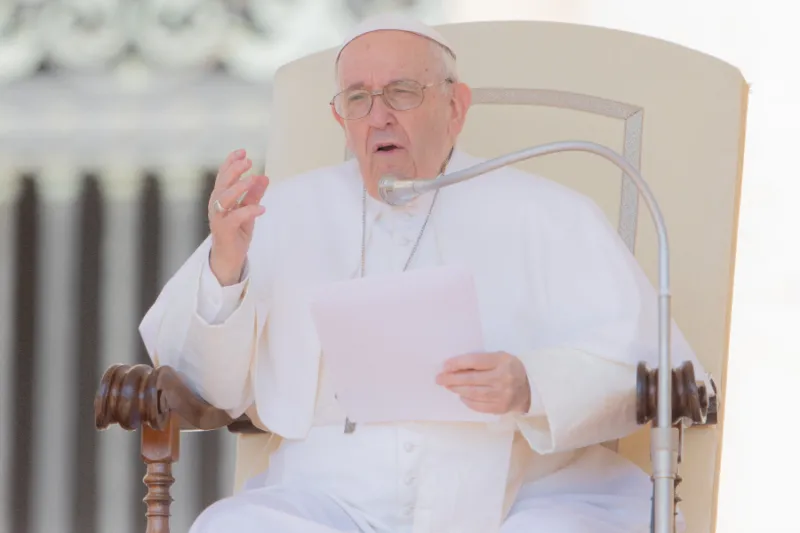
Pope Francis’ general audience in St. Peter’s Square, June 15, 2022. / Daniel Ibáñez/CNA.
Vatican City, Jun 15, 2022 / 06:50 am (CNA).
Pope Francis on Wednesday decreed that diocesan bishops must receive written permission from the Vatican before erecting a public association of the faithful that is later expected to become a religious institute.
The pope’s rescript, issued on June 15, states that the diocesan bishop must receive a “written license” from the Dicastery for Institutes of Consecrated Life and Societies of Apostolic Life before erecting, by decree, “a public association of the faithful with a view to becoming an institute of consecrated life or a society of apostolic life of diocesan right.”
The decision, approved on Feb. 7, goes into effect immediately.
The Code of Canon Law describes associations of the Christian faithful, which can be either public or private, as groups striving “in a common endeavor to foster a more perfect life, to promote public worship or Christian doctrine, or to exercise other works of the apostolate such as initiatives of evangelization, works of piety or charity, and those which animate the temporal order with a Christian spirit.”
It explains that “associations of the Christian faithful which are erected by competent ecclesiastical authority are called public associations.”
The new rule follows a change Pope Francis made to canon law in 2020, which required a bishop to have permission from the Holy See prior to establishing a new religious institute in his diocese.
The pope modified canon 579 of the Code of Canon Law, which concerns the erection of religious orders and congregations, referred to in Church law as institutes of consecrated life and societies of apostolic life.
The law was changed from requiring the diocesan bishop to consult with the Vatican before giving canonical recognition to a new institute to requiring him to have written permission.
This change further strengthened Vatican oversight over the process.
If you value the news and views Catholic World Report provides, please consider donating to support our efforts. Your contribution will help us continue to make CWR available to all readers worldwide for free, without a subscription. Thank you for your generosity!
Click here for more information on donating to CWR. Click here to sign up for our newsletter.
Pope Francis at the Jubilee of the Sick in St. Peter’s Square on Sunday, April 6, 2025, wearing nasal cannulas for supplemental oxygen as he continues recovering from bilateral pneumonia. / Credit: Daniel Ibañez/EWTN News
CNA Newsroom, Apr 6, 2025 / 07:32 am (CNA).
Still recovering from bilateral pneumonia that hospitalized him for nearly 40 days, Pope Francis made a surprise appearance in St. Peter’s Square on Sunday for the Jubilee of the Sick, sharing profound reflections on suffering, care, and the transformative power of illness.
Wearing nasal cannulas that provide supplemental oxygen, Pope Francis arrived in a wheelchair accompanied by a nurse.
Pope Francis blesses the faithful at the Jubilee of the Sick in St. Peter’s Square, Vatican City, on April 6, 2025, as his personal nurse, Massimo Strappetti, assists him in the wheelchair. Credit: Daniel Ibáñez/CNA
Hundreds of faithful gathered in St. Peter’s Square on April 6, receiving him enthusiastically around 11:45 a.m. local time.
The pontiff said that “the sickbed can become a ‘holy place’ of salvation and redemption, both for the sick and for those who care for them.”
“I have much in common with you at this time of my life, dear brothers and sisters who are sick: the experience of illness, of weakness, of having to depend on others in so many things, and of needing their support,” the pope told his audience.
“This is not always easy, but it is a school in which we learn each day to love and to let ourselves be loved, without being demanding or pushing back, without regrets and without despair, but rather with gratitude to God and to our brothers and sisters for the kindness we receive, looking toward the future with acceptance and trust.”
The 88-year-old pontiff invited the faithful to contemplate the Israelites’ situation in exile, as Isaiah described. “It seemed that all was lost,” Francis noted, but added that it was precisely in this moment of trial that “a new people was being born.” He connected this biblical experience to the woman in the day’s Gospel reading who had been condemned and ostracized for her sins.
Her accusers, ready to cast the first stone, were halted by the quiet authority of Jesus, the pope’s homily explained.
Faithful gather in St. Peter’s Square for the Jubilee of the Sick and Health Care Workers on April 6, 2025, including religious sisters, medical professionals, and pilgrims from around the world. Credit: Daniel Ibáñez/CNA
In comparing these stories, Pope Francis emphasized that God does not wait for our lives to be perfect before intervening.
“Illness is certainly one of the harshest and most difficult of life’s trials, when we experience in our own flesh our common human frailty. It can make us feel like the people in exile, or like the woman in the Gospel: deprived of hope for the future,” the pontiff’s homily said.
“Yet that is not the case. Even in these times, God does not leave us alone, and if we surrender our lives to him, precisely when our strength fails, we will be able to experience the consolation of his presence. By becoming man, he wanted to share our weakness in everything.”
Pope Francis thanked all health care workers for their service in a particularly moving passage: “Dear doctors, nurses, and health care workers, in caring for your patients, especially the most vulnerable among them, the Lord constantly affords you an opportunity to renew your lives through gratitude, mercy, and hope.”
The pontiff encouraged them to receive every patient as an opportunity to renew their sense of humanity. His words acknowledged the challenges facing medical workers, including inadequate working conditions and even instances of aggression against them.
Bringing his address to a close, the pontiff recalled the encyclical Spe Salvi of Pope Benedict XVI, who reminded the Church that “the true measure of humanity is determined in relation to suffering.” Francis warned, with the words of his predecessor, that “a society unable to accept its suffering members is a cruel and inhuman society.”
Archbishop Rino Fisichella incenses a statue of the Madonna and Child during the Jubilee of the Sick and Health Care Workers at St. Peter’s Square, April 6, 2025. Credit: Daniel Ibáñez/CNA
The Holy Father urged all present to resist the temptation to marginalize and forget the elderly, ill, or those weighed down by life’s hardships: “Dear friends, let us not exclude from our lives those who are frail, as at times, sadly, a certain mentality does today.”
‘I feel the finger of God’
In his brief Angelus remarks following the Mass, the pope shared his personal experience: “Dear friends, as during my hospitalization, even now in my convalescence I feel the ‘finger of God’ and experience his caring touch.”
The pope also called for prayers for all who suffer and for health care professionals, urging investment in necessary resources for care and research, so that health care systems may be inclusive and attend to the most fragile and poor.
Pope Francis concluded with a plea for peace in conflict zones, including Ukraine, Gaza, the Middle East, Sudan, South Sudan, the Democratic Republic of Congo, Myanmar, and Haiti.
The Holy See has not yet commented on whether Pope Francis will participate in Holy Week ceremonies, with the Vatican press office indicating that “it is premature to discuss this” and assuring that further details will be provided later.
The dome of St. Peter’s Basilica. / Credit: Daniel Ibáñez/CNA
CNA Newsroom, Apr 9, 2025 / 09:13 am (CNA).
The Vatican’s financial authority reported a significant drop in suspicious activity reports in 2024, attributing the decline to “progress… […]
5 Comments
How about the Vatican require associations of ‘Catholic’ synodal participants to obtain written permission prior to printing or speaking immoral modern inanity?
Francis’ 3-year-old letter to German synod participants (which Francis says took him a month to write) is a weak weapon compared to the grave, persistent, obstinate, publicly manifest and forceful and repetitious heretical errors put out by the German synod. Their errors oppose Catholic faith and morals. The pope should excise the errors and excommunicate the perpetrators.
But the new licensing rules probably aim against any Ecclesia Dei-like associations–lest those serious sinners all fail to follow the numerous nebulosities, sensuous spirits, or Delphic interpreters associated with VCII. How dare they rear their ugly heads against false teachings and corrupt persons in the church of pharisaical hypocrites governed by One Francis!
The Pope who wants to decentralize the papacy of tradition and moral law yet still wants to control seminaries and lay associations lest they challenge a ‘synodal way’ of his imagination.
It is a good move. To set up such institutions it makes sense for the diocese to get written license from a body set up for this purpose, the Dicastery for Institutes of Consecrated Life and Societies of Apostolic Life.
How about the Vatican require associations of ‘Catholic’ synodal participants to obtain written permission prior to printing or speaking immoral modern inanity?
Francis’ 3-year-old letter to German synod participants (which Francis says took him a month to write) is a weak weapon compared to the grave, persistent, obstinate, publicly manifest and forceful and repetitious heretical errors put out by the German synod. Their errors oppose Catholic faith and morals. The pope should excise the errors and excommunicate the perpetrators.
But the new licensing rules probably aim against any Ecclesia Dei-like associations–lest those serious sinners all fail to follow the numerous nebulosities, sensuous spirits, or Delphic interpreters associated with VCII. How dare they rear their ugly heads against false teachings and corrupt persons in the church of pharisaical hypocrites governed by One Francis!
The Pope who wants to decentralize the papacy of tradition and moral law yet still wants to control seminaries and lay associations lest they challenge a ‘synodal way’ of his imagination.
The key element is “control”. Centralized “control” over the Bishops’ authority as descendants of the Apostles. Mickey-Mouse “control” by bureaucracy.
Franciscan “collegiality”
It is a good move. To set up such institutions it makes sense for the diocese to get written license from a body set up for this purpose, the Dicastery for Institutes of Consecrated Life and Societies of Apostolic Life.
