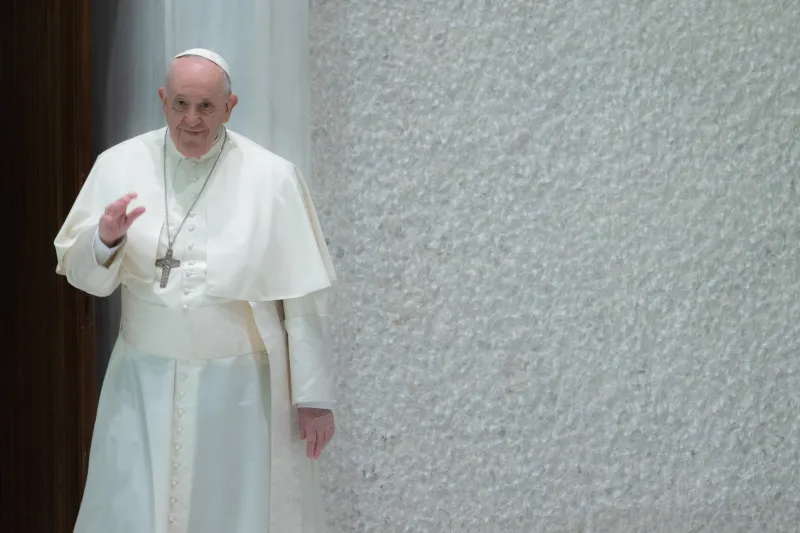
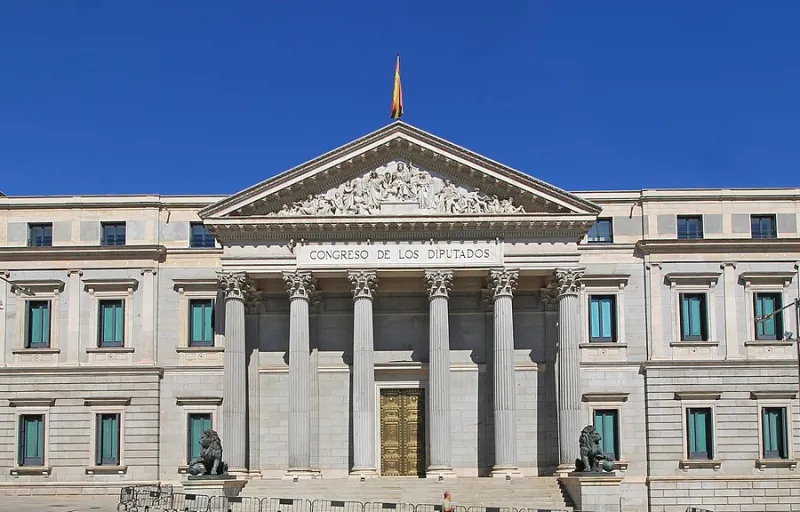
 The Palacio de las Cortes in Madrid, where Spain’s Congress of Deputies meets. / Luis García via Wikimedia (CC BY-SA 4.0)
Madrid, Spain, Feb 4, 2022 / 10:39 am (CNA).
Spain’s lower house, the Congress of Deputies, agreed Feb. 1 to debate the creation of a commission to investigate sexual abuse committed by members of the Catholic Church.
The request to create the commission was filed by Podemos, a left-wing party that is part of the governing coalition, as well as the Republican Left of Catalonia and EH Bildu, Catalan and Basque nationist parties that give confidence and supply to the government.
The People’s Party and Vox, which are in the opposition, voted against the commission and made a motion that all cases of the abuse of minors be investigated and not just those that have taken place in areas related to religious institutions.
However, this motion was vetoed by Podemos and the Spanish Socialist Workers’ Party, the largest group in the ruling coalition.
In the coming weeks, the Congress will vote on whether to create the investigative commission.
Bishop Luis Javier Argüello Garcia, Auxiliary Bishop of Valladolid and spokesman and general secretary of the Spanish Bishops’ Conference, said in a Feb. 2 interview with Ràdio Estel, the radio station of the Archdiocese of Barcelona, that if this investigative commission on sexual abuse in the Church is created, “political issues and the need for support (from other parties) will be more influential than the real interest of the victims of all abuses.”
“Experience tells us that these commissions are more of a platform for clashes between political parties than a search for the truth,” he said.
Bishop Argüello told Ràdio Estel that the parties promoting the investigation “are issuing a blanket judgement, saying that the Church isn’t a safe space,” and that “if there were real concern about all the abuse of minors, the commission would be different; it’s a problem for all of Spanish society that not only affects members of the Church.”
The Attorney General’s Office of Spain ordered Jan. 31 the head prosecutors of the country’s 17 regional autonomous governments to remit all open criminal proceedings for sexual abuse committed by members of the Church in Spain.
This procedure initiated by Spain’s Attorney General requires the head prosecutors to send, within 10 days, the complaints or charges in process that affect congregations, Catholic schools, dioceses, and any religious institution, not only Catholic, that have been initiated.
The Attorney General’s Office also stated that this requirement “doesn’t exhaust measures that the Government is studying to determine the facts and to prevent these incidents from being repeated.”
Sources in the Spanish Bishops’ Conference told Europa Press that “all the investigations carried out by the Judiciary “on the abuses committed against minors in the Church and in society are “well received, to the extent that they contribute to ending this social scourge.”
According to a report by the independent foundation Aid to Children and Adolescents at Risk , cases of sexual abuse committed by people related to the Church represent 0.2% of the total.
Cardinal Juan José Omella Omella of Barcelona, president of the Spanish Bishops’ Conference, said during a press conference following his ad limina visit last month, that “in face of the issue of abuse, we all feel the great pain over that fact, in the midst of the society, and the desire at all times for our closeness (to the victims). All of us bishops have established commissions in each diocese to receive the complaints, to accompany those people who feel wounded and prevent these things from happening in the future, we have to use all means. We are clear on this and we have discussed this with the (Congregation of the) Doctrine of the Faith and with the pope.”
Since the publication of Pope Francis’ motu proprio Vos estis Lux mundi in 2019, each diocese as well as religious institutions have offices to serve the victims in order to facilitate reporting and confirm the application of the action protocols.
The motu proprio norms also establish obligatory reporting for clerics and religious, require that every diocese has a mechanism for reporting abuse, and put the metropolitan archbishop in charge of investigations of accusations against suffragan bishops.
The request to create a commission to investigate cases of sexual abuse by members of the Church took place after the newspaper El País delivered a report in December to Pope Francis and the Spanish Bishops’ Conference with possible abuse cases committed by 251 priests or laity from religious institutions.
The bishops’ conference noted that “it would be desirable for the accusations contained in the aforementioned report to be more rigorous, since its content, of a very disparate nature, makes it difficult to draw conclusions that could be used for a possible investigation.”
[…]