


Washington D.C., Sep 22, 2021 / 14:01 pm (CNA).
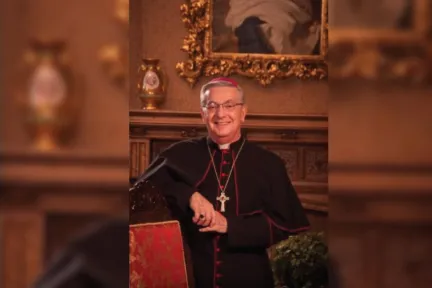
Bishop Anthony Pilla, who led the Diocese of Cleveland for 25 years and served as president of the United States Conference of Catholic Bishops, died Tuesday, Sept. 21. He was 88.
“It is with deep sadness that I share with the Catholic community of the Diocese of Cleveland the news of the passing this morning of Bishop Anthony M. Pilla,” said Bishop Edward Malesic of Cleveland on Tuesday. “Bishop Pilla died peacefully at his personal residence.”
Malesic described his predecessor as a “very warm, kind-hearted and deeply faithful shepherd” who was “generous with his time and sharing his knowledge and concern for the diocese with me.”
Pilla, said Malesic, was dedicated to the people he served in Cleveland, and served as an inspiration to him throughout his priesthood and episcopate. “As a leader in the community and a friend to so many, he will be greatly missed,” Malesic said.
Archbishop Jose Gomez of Los Angeles, president of the U.S. Conference of Catholic Bishops (USCCB), echoed Malesic’s sentiment in a Wednesday statement on Pilla’s death.
“[Pilla] led the bishops’ conference in the 1990s as president, and those who worked with him have expressed that his deep love for the Church was evident through his faithful commitment and desire for unity within the Church which he expressed through his pastoral leadership of the Conference,” said Gomez. He offered prayers for Pilla’s family and friends.
“May the Lord grant him eternal rest,” said Gomez.
A native of Cleveland, Pilla was born on Nov. 12, 1932, and discerned a vocation to the priesthood while in high school. He was ordained a priest of the Diocese of Cleveland at the age of 26 on May 23, 1959.
Almost exactly 20 years later, on June 30, 1979, Pilla was named as an auxiliary bishop of Cleveland by Pope John Paul II. He was consecrated as a bishop on Aug. 1, 1979, and, after just under a year, was named the apostolic administrator of the Diocese of Cleveland after Bishop James Hickey was appointed to lead the Archdiocese of Washington.
Pilla was officially named the bishop of Cleveland on November 13, 1980, becoming the first native of the city to lead the diocese. He was installed as the ninth bishop of Cleveland on Jan. 6, 1981.
In November 1995, Pilla was elected president of the USCCB. At the time, he was just the second bishop to be elected president; typically, the role went to an archbishop. He served his three-year term until 1998.
Throughout his time as bishop of Cleveland, Pilla was known for his desire to unite the Church, and for his deep love for the people of his hometown. He started a program called “Church in the City,” which aimed at partnering people who lived in the urban, suburban, and rural parts of the diocese to work together.
Pilla retired from the episcopacy in 2006, at the age of 73, reportedly for health reasons. He spent the entirety of his episcopacy, and his priesthood, in the diocese of his birth.
Funeral arrangements have not yet been announced.
If you value the news and views Catholic World Report provides, please consider donating to support our efforts. Your contribution will help us continue to make CWR available to all readers worldwide for free, without a subscription. Thank you for your generosity!
Click here for more information on donating to CWR. Click here to sign up for our newsletter.


Some random memories and impressions of Bishop Pilla from a lifelong Cleveland resident who was in sixth grade when he was installed for anyone interested:
He gave thunderous Good Friday liturgy homilies at St John’s Cathedral. They were largely “angry liberal” in content and style, but were not devoid of truth. He would rightly condemn the crass, consumerist, trashy, exploitative, throw-away culture of our time in very strong language. Mixed in would be the standard leftist political bromides. As a student and young adult, I recall the discomfort and guilt I felt listening to them. Somehow, he seemed unable or unwilling to connect the dots of the causes to the results he correctly deplored. Illegitimacy, divorce, contraception and the rampant general promiscuity were not issues he addressed very often or forcefully.
Very much a conventional liberal in most ways, he predictably repeated the USCCB cliches on issues like welfare, capital punishment, immigration and “racism.” He lamented the exodus of white Catholic families to the suburbs, and later the exurbs, while not recognizing the reasons, such as crime and drugs that made most neighborhoods in the city unsuitable for raising a family. He seemed quite comfortable associating with the mostly degenerate and mediocre Cleveland establishment and was basically part of it.
I distinctly recall an article in the the now defunct diocesan newspaper of an address he gave to “gay” Catholics. He praised them for questioning the Church on its teaching and encouraged them to continue doing so. I was told he spent the first Divine Mercy Sunday at an Earth Day event. Early in his tenure, the tabernacle at the Cathedral was moved from behind the altar to the side. Later, using a Jesuit pet, who was later taken out by an allegation of sexual abuse, he first implemented the practice of having the faithful stand throughout the Communion Rite. A number of parishes in the diocese during his time removed kneelers altogether.
He clearly favored progressives, but was capable of saying “no”. He told Future Church that it could not use Church property for events. He dropped Richard McBrien’s column from the diocesan paper. He once declined to grant permission for Catholics attending the Indians opening day game on Good Friday to eat hot dogs. Toward the end of his term, he appointed some more orthodox young priests to teaching positions at the seminary.
He usually conducted himself in a dignified manner. He seldom embarrassed himself like a Weakland, Mahoney or, today, Cupich.
On one Holy Thursday, he let an obvious homosexual priest give a lachrymose farewell address from the Cathedral pulpit. The poor guy apparently could not deal with the ordeal that was his cushy life. Pilla also did not distinguish himself in the sex abuse scandal in the early 2000s. In a deposition that was broadcast on local TV stations, he came across as a shabby liar. He left the thankless job closing urban parishes to his successor.
All in all, I’d say Pilla was a typical American bishop of the late twentieth century. By almost any measure, the Church was in Cleveland was in worse shape when he retired than when he started. He serenely presided over the decline of the Catholic Church in the Diocese of Cleveland.
As a member of the Diocese of Cleveland, I second most of what Tony W has written. Bishop Pilla was not exactly affable in the mold of Cardinal Dolan, but he did have dignity, and did not disgrace his office. I agree that he was way too progressive and leftist in his leadership, which I did not appreciate. A friend of mine, who was a seminarian during the time His Excellency taught at the seminary prior to his time as a bishop, has the greatest respect and affection for Bishop Pilla, and cites him as an excellent instructor and spiritual guide on a one-to-one basis. As Tony writes, I think he did slowly move toward a more orthodox stance in spiritual leadership toward the end of his episcopate, which is very much to his credit.
It is sad that the bulk of the animosity within the diocese ended up being aimed at his successor, the late Bishop Richard Lennon. Bishop Lennon was left to lead the Diocese in the wake of the dreadful sex scandals, which he had to do in Boston after Cardinal Law’s horrible mismanagement, and to do again in Cleveland as a result of Bishop Pilla’s laxity. And then – the parish mergers and closures. My own inner-city parish was merged with another that was about a mile away. We had a good merger, and I fully understand the reasons for it, but it wasn’t that way everywhere. Two years later, our sister parish was reopened, and there are barely 40 people who attend their only Sunday Mass (no vigil Mass). Poor Bishop Lennon actually had to have undercover cops protecting him when he was present at the final Masses of closed parishes, which is absolutely disgraceful – *no one* should place his life in danger to attend Mass in the Cleveland Diocese, nor anywhere else.
In his retirement, Bishop Pilla was supportive of the Diocese and assisted when he could at Confirmations, etc. I hope with all my heart he sees the face of Jesus and makes it to heaven. But I think a bigger halo was earned by Bishop Lennon, who suffered so much for the sake of the Church. Our present shepherd, our good Bishop Malesic, who is doing a splendid job and is wonderfully pastoral and loyal to the Faith, also is pleasing to God and is doing a magnificent job, IMHO.