The Vatican’s doctrinal office will hold a study day April 27 on the theme of the dissolution of marriage “in favorem fidei.”
The study day marks the 20th anniversary of the publication of the instruction Potestas Ecclesiae, which regulated the dissolution of a marriage between two non-Catholic persons, when at least one is not baptized, to allow for the contraction or validation of a Catholic sacramental marriage in the future.
The dissolution of a marriage “in favorem fidei” (in favor of the faith), can be approved on a case-by-case basis and only by the pope. In this way, it differs from what is called the “Pauline privilege,” when the Church recognizes the automatic dissolution of a natural marriage between two non-baptized persons.
The Congregation for the Doctrine of the Faith has organized the study day in partnership with the Pontifical Lateran University; the event is intended for Catholic university students, scholars, and those working in diocesan curias.
Attendance will be possible both in-person and online. The morning of April 27 will be dedicated to studying the theological-juridical aspect of Potestas Ecclesiae; in the afternoon participants will break into moderated small groups to look at practical cases related to the instruction.
The morning talks, in Italian, will be streamed online and can be watched without the need to register.
Potestas Ecclesiae says that “marriages between non-Catholics, of which at least one is not baptized, under certain conditions can be dissolved by the Bishop of Rome in favor of the faith and for the salvation of souls.”
“But the exercise of this power, bearing in mind both the pastoral needs of times and places, and all the circumstances of each individual case, is subject to the supreme judgment of the Supreme Pontiff himself,” the document’s introduction, signed by then-CDF prefect Cardinal Joseph Ratzinger, states.
The 2001 instruction explained that the dissolution of the bond “in favorem fidei” was first introduced after the promulgation of the 1917 Code of Canon Law.
Previously, the Pauline privilege had been adequate, it stated, since cases requiring the “pastoral remedy of the dissolution of the bond” were rare. In the 20th century, however, the need has increased.
Reasons include, the document states, the increase in mixed-faith marriages and marriages between a non-Catholic baptized person and a non-baptized person, as well as the increasing “fragility and inconstancy of family ties, so that divorce is spreading more and more and the number of marriages that fail is increasing day by day.”
“The Roman Pontiff, in the certainty of the power that the Church possesses to dissolve marriages between non-Catholics, of which at least one is not baptized, never hesitated to meet the new pastoral needs, resorting to the practice of exercising this power of Church, if, after an examination of all the circumstances that are found on a case-by-case basis, this would seem appropriate to him in favor of the faith and for the good of souls,” Potestas Ecclesiae says.
If you value the news and views Catholic World Report provides, please consider donating to support our efforts. Your contribution will help us continue to make CWR available to all readers worldwide for free, without a subscription. Thank you for your generosity!
Click here for more information on donating to CWR. Click here to sign up for our newsletter.
President Joe Biden delivers remarks at the White House, Sept. 9, 2021 / WhiteHouse.gov
Washington D.C., Feb 14, 2022 / 13:00 pm (CNA).
As the Supreme Court considers a case that directly challenges Roe v. Wade’s 1973 ruling that legalized abor… […]
Professor Nicholas Meriwether / Alliance Defending Freedom
Denver Newsroom, Apr 19, 2022 / 16:28 pm (CNA).
Shawnee State University and Prof. Nicholas Meriwether have agreed to a $400,000 settlement after the professor faced disciplinary action… […]
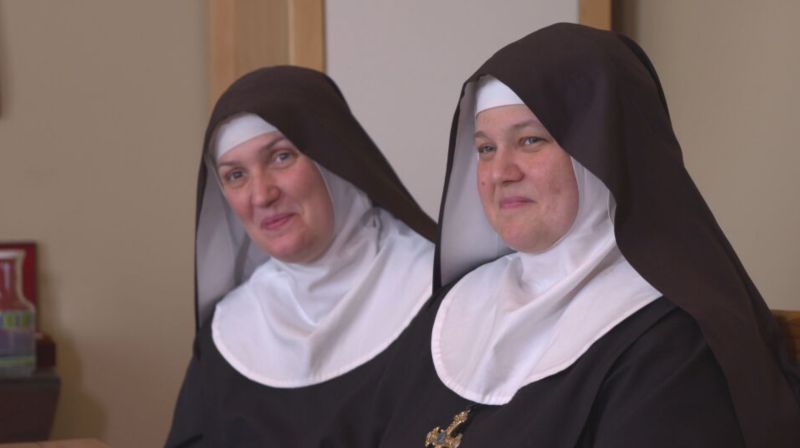
Sister Scholastica Radel (left) and Mother Abbess Cecilia Snell of the Benedictines of Mary, Queen of Apostles, discuss the recent exhumation of the order’s foundress, Sister Wilhelmina Lancaster, in an interview with EWTN News In Depth on May 30, 2023, at their abbey in Gower, Missouri. / EWTN News
Washington, D.C. Newsroom, Jun 4, 2023 / 08:00 am (CNA).
Her flashlight was dim, so when Mother Abbess Cecilia Snell first peered inside the cracked coffin lid and saw a human foot inside a black sock where one would expect to find only bone and dust, she didn’t say anything.
Instead, she took a step back, collected herself, and leaned in for another look, just to be sure. Then she screamed for joy.
“I will never forget that scream for as long as I live,” recalled Sister Scholastica Radel, the prioress, who was among the members of the Benedictines of Mary, Queen of Apostles, who were present to exhume the remains of their foundress, Sister Wilhelmina Lancaster.
“It was a very different scream than any other scream,” the abbess agreed. “Nothing like seeing a mouse or something. It was just pure joy. ‘I see her foot!’”
What the sisters discovered that day would cause a worldwide sensation: Roughly four years after her burial in a simple wooden coffin, Sister Wilhelmina’s unembalmed body appeared very much intact.
In an exclusive TV interview with EWTN News In Depth, the two sisters shared details of their remarkable discovery — revealing, among other things, that Sister Wilhelmina’s body doesn’t exhibit the muscular stiffness of rigor mortis — and reflected on the deeper significance of the drama still unfolding at their Abbey of Our Lady of Ephesus in rural Gower, Missouri.
They also clarified that Sister Wilhelmina’s coffin was exhumed on April 28, nearly three weeks earlier than CNA had understood. The sisters explained that it took about two weeks to remove dirt, mold, and mildew before they moved her body to the church. You can hear excerpts from the interview and other commentaries in the video at the end of this story.
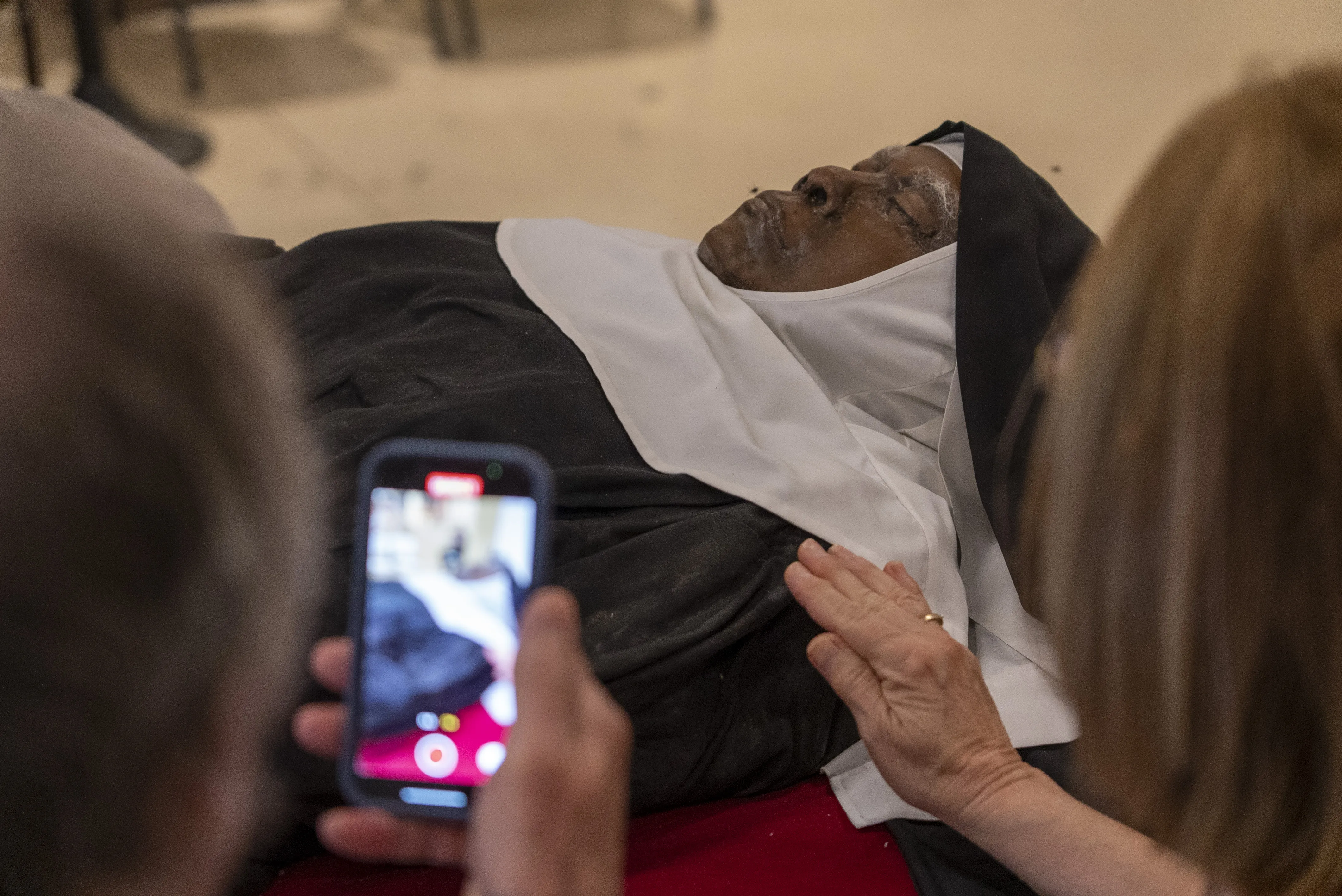
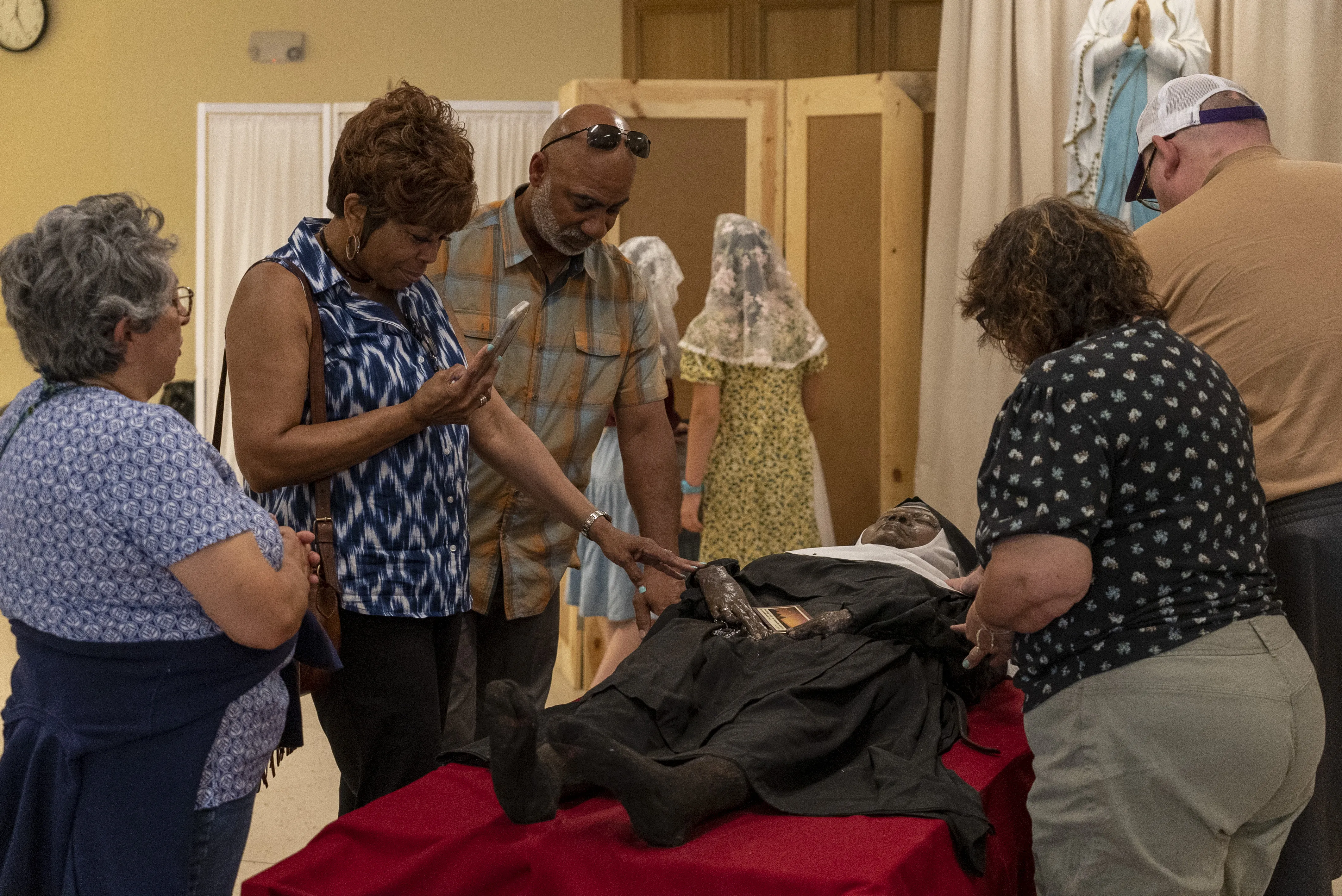
Pilgrims visit the body of Sister Wilhelmina Lancaster, the foundress of the Benedictines of Mary, Queen of Apostles, in Gower, Missouri. EWTN News
Of particular significance to the members of the contemplative order, known for their popular recordings of Gregorian chants and devotion to the Traditional Latin Mass, is that the traditional habit of their African American foundress also is surprisingly well-preserved.
“It’s in better condition than most of our habits,” Mother Cecilia told EWTN’s Catherine Hadro.
“This is not possible. Four years in a wet coffin, broken in with all the dirt, all the bacteria, all the mildew, all the mold — completely intact, every thread.”
For the sisters, the symbolism is profound. A St. Louis native, Sister Wilhelmina spent 50 years in another religious order but left after it dispensed with the requirement of wearing its conventional habit and altered other long-established practices. She founded the Benedictines of Mary in 1995 when she was 70 years old.
“It’s so appropriate, because that’s what Sister Wilhelmina fought for her whole religious life,” Mother Cecilia said of the habit.
“And now,” Sister Scholastica said, “that’s what’s standing out. That’s what she took on to show the world that she belonged to Christ, and that is what she still shows the world. Even in her state, even after death, four years after the death, she’s still showing the world that this is who she is. She’s a bride of Christ, and nothing else matters.”
‘I did a double take’
The Benedictine community exhumed Sister Wilhelmina, almost four years after her death, after deciding to move her remains to a new St. Joseph’s Shrine inside the abbey’s church, a common custom to honor the founders of religious orders, the sisters said.
Members of the community did the digging themselves, “a little bit each day,” Mother Cecilia said. The process began on April 26 and culminated with a half-dozen or so sisters using straps to haul the coffin out of the ground on April 28.
The abbess revealed that there was a feeling of anticipation among the sisters to see what was inside the coffin.
“There was a sense that maybe God would do something special because she was so special and so pure of heart,” Mother Cecilia said.
It was the abbess who looked through the cracked lid first, shining her flashlight into the dark coffin.
“So I looked and I kind of did a double take and I kind of stepped back. ‘Did I just see what I think I saw? Because I think I just saw a completely full foot with a black sock still on it,'” she recalled saying to herself.
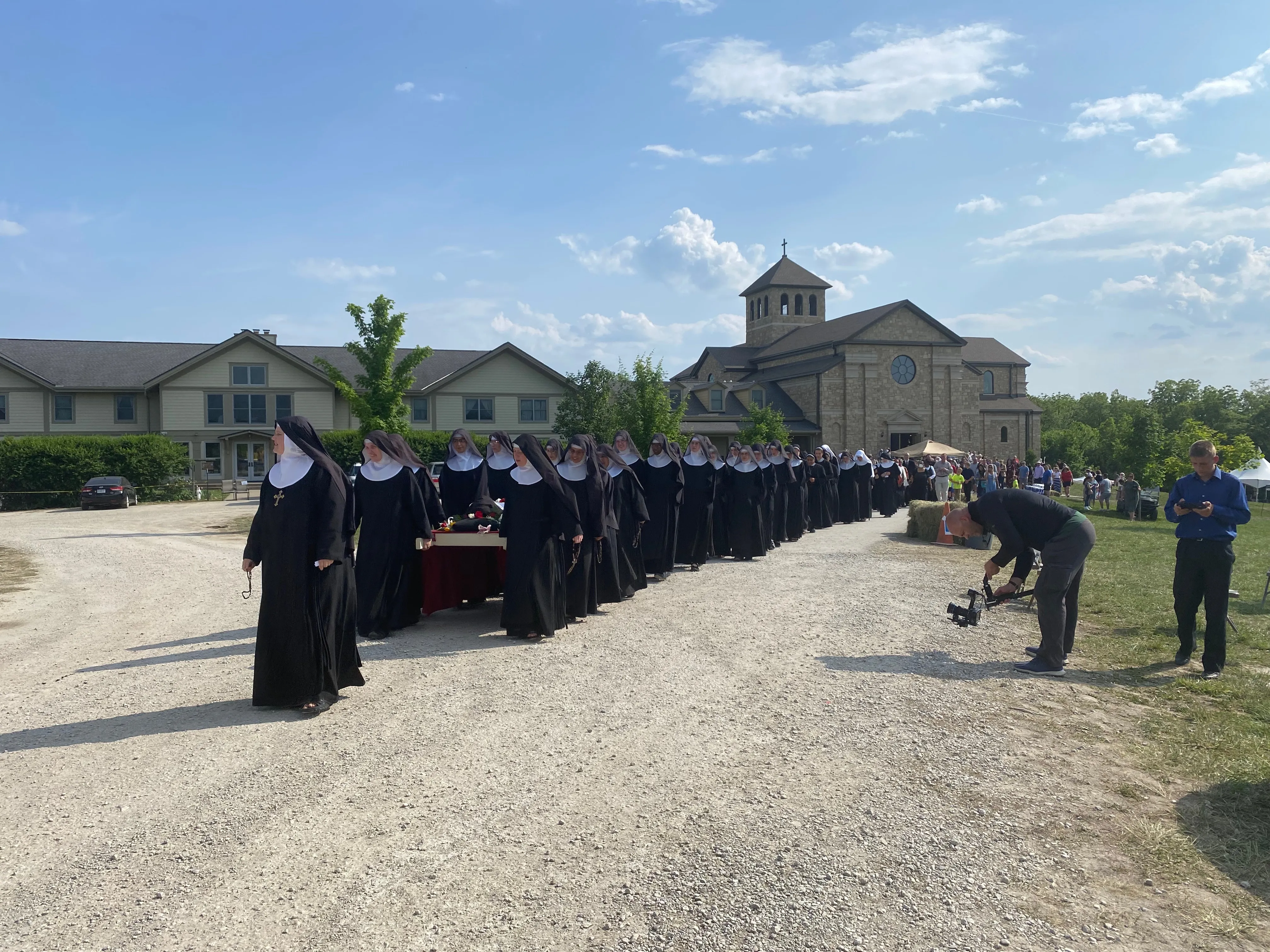
Members of the Benedictines of Mary, Queen of Apostles, lead a procession with the body of their foundress, Sister Wilhelmina Lancaster, at their abbey in Gower, Missouri, on May 29, 2023. Joe Bukuras/CNA
Sister Wilhelmina’s features were clearly recognizable; even her eyebrows and eyelashes were still there, the sisters discovered. Not only that, but her Hanes-brand socks, her brown scapular, Miraculous Medal, rosary beads, profession candle, and the ribbon around the candle — none of it had deteriorated.
The crown of flowers placed on her head for her burial had survived, too, dried in place but still visible. Yet the coffin’s fabric lining, the sisters noted, had disintegrated. So had a strap of new linen the sisters said they used to keep Sister Wilhelmina’s mouth closed.
“So I think everything that was left to us was a sign of her life,” Sister Scholastica reflected, “whereas everything pertaining to her death was gone.”
Another revelation from the interview: Contrary to what one would expect in the case of a four-year-old corpse, Sister Wilhelmina’s body is “really flexible,” according to Sister Scholastica.
“I mean, you can take her leg and lift it,” Mother Cecilia observed.
EWTN News In Depth also spoke with Shannen Dee Williams, an author and scholar who is an expert on the history of Black Catholicism. Sister Wilhelmina’s story, she said, is an important reminder of “the the great diversity and beauty of the Black Catholic experience across the spectrum.”
“It’s a really important story that reminds us of what is the great diversity of what is the Black Catholic experience.” – @BlkNunHistorian explains the significance of Sister Wilhelmina choosing a traditional habit for her community. pic.twitter.com/nJmyQ6UYjA
— EWTN News In Depth (@EWTNNewsInDepth) June 3, 2023
‘A unifying moment’
There has been no formal declaration by Church authorities that Sister Wilhelmina’s body is incorrupt, nor has an independent analysis been conducted of her remains, the condition of which has puzzled even some experienced morticians. Neither is there any official process yet underway to put the African American nun on a possible path to sainthood.
Pilgrims visit the body of Sister Wilhelmina Lancaster, foundress of the Benedictines of Mary, Queen of Apostles, in Gower, Missouri. EWTN News
In the interview, Mother Cecilia called what’s happening at the abbey “a unifying moment for everybody” in a time of discord.
“There’s so much division, and it’s crazy,” she said. “We’re children of God the Father, every single one of us. And so you see, Sister Wilhelmina is bringing everyone together . . . I mean, this is God’s love pouring forth through people of every race, color,” she said.
“They come and they’re blown away, and it makes them think,” the abbess said. “It makes them think about God, about, ‘OK, why are we here? Is there more than just my phone, and my job, and my next vacation?’”
As for what comes next, no one can say. “We love God so much, his sense of humor, the irony, this humble little black nun hidden away in a monastery is a catalyst for this. It’s like a spark to send fire to the world,” Mother Cecilia said.
“It’s just remarkable,” she said. “But this is the kind of thing that God does when we need a wake-up call.”





Leave a Reply