CNA Staff, Jan 20, 2021 / 04:20 pm (CNA).- A Catholic bishop in Burkina Faso is asking for prayers after the disappearance of another priest, whose vehicle was found abandoned earlier this week.
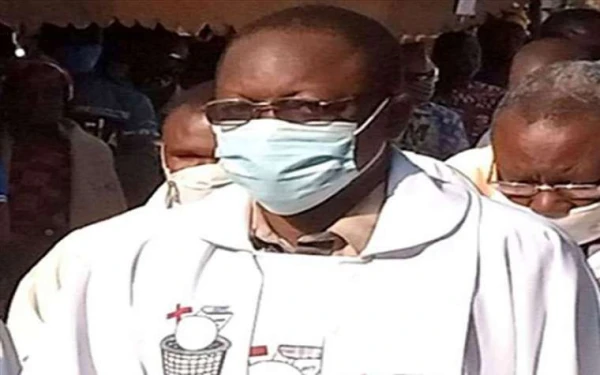
Father Rodrigue Sanon, a priest of Notre Dame de Soubaganyedougou, has not been seen since Tuesday.
According to ACI Africa, Bishop Lucas Kalfa Sanou of Banfora said the priest was supposed to meet him in Banfora, but never arrived.
“I invite all the faithful to a fervent prayer so that Father Rodrigue can be found safe and sound as soon as possible,” the bishop said.
The diocese has reached out to the authorities, “who are doing everything possible to search for him,” said Sanou.
According to AFP, the authorities issued an alert in the afternoon, and search parties were dispatched as soon as the priest was reported missing. As of Wednesday morning, “no trace of him” had been discovered.
Over the last five years, Burkina Faso has been a hub for religious violence and Islamist militias, especially in the northeastern territories. The militants include the Group for the Support of Islam and Muslims, Islamic State in the Greater Sahara, and Ansarul Islam.
According to a 2019 report from the U.S. State Department, 61% of Burkina Faso residents identify as Muslim and 23% identify as Christian.
The extremist attacks, which target both Christians and Muslims, have left over 1 million people displaced and almost 1,100 dead since 2015.
The bishops in Burkina Faso issued a statement in June, calling the situation “more worrying than ever.” They raised concerns about the increase in religious violence and called for more support from the authorities.
“The role of the Defense and Security Forces remains paramount,” said the bishops, adding that security forces in the country “must produce and guarantee a secure environment conducive to the conduct of the electoral process with the full participation of all citizens.”
In the June statement, the bishops statement said they are worried that the low levels of security are preventing priests from reaching their parishioners and asked the Blessed Mother to intercede for their efforts.
“For the Pastors in this part of Burkina Faso as elsewhere in the regions … it is a great suffering to no longer be able to reach the faithful in some places, or to see them fleeing from terrorist attacks without any guarantee of security,” they said.
“May Mary, Queen of Peace, accompany us on the path to true peace, a gift of God and the fruit of human efforts.”
If you value the news and views Catholic World Report provides, please consider donating to support our efforts. Your contribution will help us continue to make CWR available to all readers worldwide for free, without a subscription. Thank you for your generosity!
Click here for more information on donating to CWR. Click here to sign up for our newsletter.
Easter Sunday Mass on April 9, 2023, was held for the first time in 10 months at St. Francis Xavier Owo Catholic Parish of Ondo Diocese in Nigeria. / Credit: Ondo Diocese
ACI Africa, Apr 14, 2023 / 13:45 pm (CNA).
A parish church in Nigeria tha… […]
Nairobi, Kenya, Jul 15, 2018 / 04:01 pm (CNA/EWTN News).- Kenya’s high court is considering the state of health care in the country, as it hears a case brought on behalf of a young woman who died last month from complications which were related to a back-alley abortion she procured in 2014.
The girl, known by her initials JMM, was raped in 2014 at the age of 15. In December of that year, her guardian “received a call from a relative informing her that the former was vomiting and bleeding heavily at a local clinic where she had gone to seek treatment,” Akello Odenyo reported in The Standard, a Nairobi daily, May 28.
JMM had told clinic staff she had procured an unsafe abortion and that was sent to a variety of hospitals for post-abortive care.
In 2015, JMM’s mother, along with the Federation of Women Lawyers and the Centre for Reproductive Rights, filed a suit against the Ministry of Health claiming JMM was not provided with proper post-abortion care and calling on the government to provide access to safe abortions.
JMM developed kidney failure, and died June 10, 2018.
The 2010 Kenyan constitution made abortion legal in certain circumstances – in the cases of emergencies and when the woman’s health is in jeopardy.
Since then, Kenya’s health ministry “has withdrawn essential guidelines on conducting safe abortions and banned health workers from training on abortion,” according to Reuters.
The guidelines were removed in 2013 “after it emerged they were being used for unintended purposes,” according to the testimony of Dr. Joel Gondi, head of the Reproductive and Maternal Health Service Unit, The Star reported.
“The guidelines, amongst other things, provided clarity on who could perform abortions, safe-guarding against illegal practitioners,” reported Reuters. “The ban on training has meant fewer health professionals available to perform the procedure or after care.”
The suit filed on JMM’s behalf maintains that the poor care she received following her abortion was a result of the lack of safe abortion services. Petitioners seek the reinstatement of the abortion guidelines, and an end to the ban on training health workers on performing abortion.
The Ministry of Health reported in May that the country had spent 533 million Kenyan shillings ($5.29 million) treating complications from back-alley abortions.
Evelyne Opondo of the Centre for Reproductive Rights said that “While JMM was entitled to quality post abortion care irrespective of whether it was within the law or otherwise, she did not receive it from the point of first contact with the health system. Instead there were several delays and missed opportunities to mitigate the adverse effect of the unsafe abortion on her health and life.”
JMM’s mother said that her daughter’s death “was entirely preventable,” and maintained that “Kenya has to make abortion safe and accessible.”
The Kenyan high court heard three-day of testimony this week in the case. It has been adjourned until Sept. 18, and a verdict is expected before the end of the year.
Among the testimonies heard by the court was that of Dr. Wahome Ngari, who said that figures on the number of back-alley abortions procured, which are used to argue for the expansion of abortion rights, are wildly inflated.
Ngari said that a report by a reproductive health firm which had been cited in the court and which estimated 400,000 unsafe abortions in 2002 was inaccurage.
Such inflation “was used in Malawi to push the Government to repeal their abortion law,” he told the court.
Ngari said the focus on health care for pregnant women in Kenya should begin with blood loss.
“The reason pregnant mothers die in the country is haemorrhage, followed by infections, hyperactive disorders, prolonged or obstructed labour and lastly abortion. Anyone who wants to offer a solution should follow that order.”
The Sisters of St. Joseph of the Apparition cover the altar, just dedicated by the cardinal. The covering of the altar signifies that it is both the place of the Eucharistic sacrifice and the Lord’s table. / Credit: Photo courtesy of the Latin Patriarchate of Jerusalem
Jerusalem, Sep 12, 2024 / 07:00 am (CNA).
On Aug. 31, exactly 100 years after its dedication, the Church of Our Lady of the Ark of the Covenant was reopened for worship on the hill of Kiryat Yearim, nine miles from Jerusalem.
The church, which was closed for four years for restoration work, stands atop the hill overlooking the (Muslim) village of Abu Gosh. From the top, visitors can see Jerusalem.
A view from the hill of Kiryat Yearim, where the Church of Our Lady of the Ark of the Covenant stands. At the foot of the hill lies the Muslim village of Abu Gosh, with Jerusalem visible in the background, a little more than nine miles away. The place, mentioned in the Bible as “Kiriath-Jearim,” held an important role in the history of the Jewish people, as it was here that the Ark of the Covenant rested for about 20 years until King David brought it to Jerusalem. Credit: Marinella Bandini
The place, mentioned in the Bible as “Kiriath-Jearim,” has held an important role in the history of the Jewish people as it was here that the Ark of the Covenant rested after being recovered from the Philistines (see 1 Samuel 6).
The ark contained the two stone tablets on which the Ten Commandments — God’s covenant with the Jewish people — were inscribed and was the sign of God’s presence among his people.
According to the Bible, it was hosted in the house of Abinadab, where it remained for about 20 years (see 1 Samuel 7:1-2) until King David brought it to Jerusalem.
For this reason, even today, the site is visited by many groups of Jews.
A Byzantine basilica was built on the top hill around the fifth century. The current church, the foundation stone of which was laid in 1920, stands on the remains of that building. It was consecrated in 1924 by the then-Latin patriarch of Jerusalem, Luigi Barlassina, and dedicated to Our Lady of the Ark of the Covenant.
The Church of Our Lady of the Ark of the Covenant in Kiryat Yearim (exterior). The church is dedicated to the Virgin Mary, whom Christians also honor with the title of “Ark of the Covenant.” “The covenant of God with his people finds its fulfillment in Jesus Christ, who is no longer just the sign of God’s presence but God himself among us. Mary is the new Ark of the Covenant because she carried Christ himself in her womb,” said Cardinal Pierbattista Pizzaballa, the Latin patriarch of Jerusalem, in his homily. Credit: Marinella Bandini
Cardinal Pierbattista Pizzaballa, the current Latin patriarch of Jerusalem, recently came to the basilica to dedicate its new altar on the occasion of the reopening of the church.
“This reopening is a moment of trust in the future, a desire to start anew, and this is what we need most at this time, when everything around us speaks of death and endings,” he told CNA after the celebration on Aug. 31.
The opening of the doors of the Church of Our Lady of the Ark of the Covenant in Kiryat Yearim on Aug. 31, 2024, for the solemn celebration with the rite of dedication of the altar, presided over by Cardinal Pierbattista Pizzaballa, the Latin patriarch of Jerusalem. Credit: Photo courtesy of the Latin Patriarchate of Jerusalem
“Climbing this mountain, blessed by the presence of the Lord,” he added, “invites us to have a broad and farsighted perspective on events and not to close ourselves off in the dramatic present moment.”
Hosting the event were the Sisters of St. Joseph of the Apparition, a French congregation founded in 1832 by Mother Emilie De Vialar, which owns and operates the church and surrounding property.
The complete details of how the land came to be acquired by the sisters are lost to history, but it centers on one of the order’s sisters who died in 1927. Sister Josephine Rumèbe, who is buried in the church, was reportedly endowed with special mystical gifts and managed to acquire the land on behalf of the sisters. The story goes that she had 5,000 francs at her disposal and sought the help of a clergyman for the purchase. To prevent a competing buyer from acquiring it, the cleric secured the entire hill for 20,372 francs. Miraculously, when Sister Josephine counted the gold coins hidden in her room, the amount matched exactly what she needed.
Cardinal Pierbattista Pizzaballa, the Latin patriarch of Jerusalem, pours the chrism oil on the new altar of the Church of Our Lady of the Ark of the Covenant in Kiryat Yearim. On Aug. 31, 2024, he presided over the solemn Mass with the rite of dedication of the altar, marking the reopening of the church after four years of restoration and maintenance work. Credit: Marinella Bandini
The dedication of the new altar in the basilica took place after the recitation of the creed and chanting of the litanies. The cardinal placed relics in the altar, including that of Mother Emilie De Vialar, who was canonized a saint in 1951. This was followed by the anointing of the altar with chrism oil, the incensing of the altar, the covering of the altar, and the lighting of the altar.
The relics placed inside the new altar of the Church of Our Lady of the Ark of the Covenant in Kiryat Yearim, which was dedicated by Cardinal Pierbattista Pizzaballa, the Latin patriarch of Jerusalem, on Aug. 31, 2024. Among the relics are those of Mother Emilie De Vialar, founder of the Sisters of St. Joseph of the Apparition, the order who owns the church and surrounding property. Credit: Marinella Bandini
“The covenant of God with his people finds its fulfillment in Jesus Christ, who is no longer just the sign of God’s presence but God himself among us. Mary is the new Ark of the Covenant because she carried Christ himself in her womb,” said the cardinal in his homily, inviting the faithful, following the example of the Virgin Mary, to renew their trust in God as the Lord of history and active within history.
Upon entering the church — whose iconographic elements were created by artists from the Ave Center of the Focolare Movement — the eye is drawn to the golden flame emanating from the center of the apse.
Cardinal Pierbattista Pizzaballa, the Latin patriarch of Jerusalem, celebrates the Eucharistic liturgy on the altar he dedicated in the Church of Our Lady of the Ark of the Covenant in Kiryat Yearim on Aug. 31, 2024. Credit: Marinella Bandini
A special decoration that, on one hand, evokes the biblical significance of fire, symbolizing the presence of God, and on the other, is connected to the history of this place and particularly to Sister Josephine’s vision of a “mountain of fire,” holds significance here.
When she was still a young postulant in France, during Eucharistic adoration, Sister Josephine had a vision of flames forming a mountain with Jesus above them instead of the host. The vision then vanished, and only 50 years later, at the time of laying the foundation stone of the church, it was revealed to her that the “mountain of fire” was indeed Kiryat Yearim, which she used to call “the Holy Mountain.”
Sister Valentina Sala, the current provincial of the congregation for the Holy Land, immediately felt a strong connection to this place. She recounted to CNA: “The first time I came here for a few weeks, a sister took me to Kiryat Yearim. I knelt at Sister Josephine’s tomb and prayed to return if that was God’s will.”
Sister Valentina Sala, the current provincial of the congregation of the Sisters of St. Joseph of the Apparition for the Holy Land, prays at the tomb of Sister Josephine Rumèbe, founder of the convent and the church in Kiryat Yearim. “The first time I came here for a few weeks, a sister took me to Kiryat Yearim. I knelt at Sister Josephine’s tomb and prayed to return if that was God’s will,” she recounted to CNA. Credit: Marinella Bandini
On the centenary of the church’s dedication, Sister Valentina also emphasized the significance of this place for her congregation, whose charism is to serve the needs of people through works of charity.
“What is charity work? What people need today is not just health care or education; there is a hunger and thirst for God. We must be able to recognize this need, helping those who come here to listen to his voice. We need places where people can pause and rest with God,” she said.
When the construction of the church was nearly complete, Sister Josephine had a vision of the Virgin Mary, at the top of the church, facing Jerusalem with outstretched arms in a gesture of dispensing grace. A statue now stands above the church to recall that vision, facing away from those entering and directed toward Jerusalem.
“This place, which evokes the covenant, invites us to realign ourselves with God and to be under this blessing,” Sister Valentina concluded.
This is also the meaning of the words she addressed to those present — the vast majority of local faithful from Jerusalem as well as from Galilee — at the end of the Mass.
Hundreds of local faithful from Jerusalem and Galilee attend the solemn Mass with the rite of dedication of the altar, marking the reopening of the Church of Our Lady of the Ark of the Covenant in Kiryat Yearim, on Aug. 31, 2024. A hundred years ago, Sister Josephine Rumèbe of the Sisters of St. Joseph of the Apparition wrote about having seen a vision of “a crowd rushing toward the basilica. I saw priests, sisters of our order, and then men and women of the world who were even more pleasing to God than all the others, holy souls shining like stars.” Credit: Marinella Bandini
“Sister Josephine had already seen you in various visions: ‘I saw a crowd rushing toward the basilica. I saw priests, sisters of our order, and then men and women of the world who were even more pleasing to God than all the others, holy souls shining like stars.’”
She continued: “And what if we are that vision? What if we are that future? Of course, we are! From now on, you will be the ones to bring life to this hill, to this covenant between God and his people. Come, rush, stay, feel at home. There is not only a newly renovated church to see but a Presence to discover: Take the time to dwell with the Lord. What could be more beautiful… Many graces await to be dispensed from here!”





Leave a Reply